Trude Sojka (1909-2007) Artista visual y sobreviviente de la Shoá judío-checo-ecuatoriana/Czech Ecuadorian Jewish Artist and Holocaust Survivor

Trude Sojka

Gertrud Herta Sojková Baum nació en 1909 en Berlín de padres judíos checos. Su padre, Rudolf Sojka, era ingeniero y tenía tratos comerciales con el presidente ecuatoriano Eloy Alfaro relacionados con el sistema ferroviario ecuatoriano. Pronto la familia se mudó a Praga, Checoslovaquia. Se matriculó en la Academia de las Artes de Prusia en Berlín. Su talento como pintora la llevó a exponer en Berlín; Con el ascenso al poder de Hitler y la invasión de Checoslovaquia por el Tercer Reich, la familia judía de Sojka se vio amenazada. En 1938, Sojka se casó con Dezider Schwartz. En 1942, la pareja fue transportada al campo de concentración de Majdanek, luego al campo de trabajo de Sered y luego, en 1944, al campo de concentración de Auschwitz. Trude es trasladado al campo de concentración de Gross-Rosen, liberado por los rusos. Nunca volvería a encontrar a Dezider Schwartz. Pero encontró en la Cruz Roja un periódico de su hermano mayor, Waltre, que buscaba a su familia. Vivía en Ecuador desde 1938. Waltre había sido invitado a Ecuador para dar conferencias de química en la Universidad Central del Ecuador y, decidió quedarse allí. Trude decidió unirse a ellos. “Cuando llegué al puerto de Guayaquil , mi hermano me esperaba con los brazos abiertos.” “Solo que cuando salí del barco, fui corriendo directo a abrazar un racimo de plátanos”, solía bromear Sojka. Sojka estaba fascinado por la cultura, los pueblos indígenas y el paisaje. Ella descubre es el arte autóctono y aborigen , que comienza a estudiar cuanto antes: una fuente de inspiración para sus propias obras. Sojka comienza a trabajar para su hermano y su esposa, tanto en su fábrica como en su tienda de artesanías, llamada AKIOS, (Sojka escrito al revés), en el Centro Histórico de Quito. Cuando Sojka llegó a Guayaquil, conoció a un buen amigo de su hermano Hans Steinitz, también sobreviviente del Holocausto, quien logró huir del campo de concentración de Sachsenhausen. Se casaron. Luego, la artista se dedica casi por completo a su arte. Por estos tiempos conoce a grandes artistas ecuatorianos como Gilberto Almeida, Víctor Mideros, Manuel Rendón o, durante los 90, o Pilar Bustos. Incluso llega a enseñar escultura a Oswaldo Guayasamín. Sus primeras pinturas en Ecuador, creadas en 1950, representan sus experiencias en Auschwitz. También trabajó mucho en torno al significado de su apellido: Sojka, un pájaro que deambula por los bosques del este de Europa. Posteriormente, volvió a estudiar, pero esta vez profundamente, el arte precolombino, especialmente el arte indígena tradicional ecuatoriano y sus diferentes divinidades. Por eso, introdujo a muchas de sus figuras en su forma de pintar expresionista europea, que es única. Mientras tanto, sus pinturas se volvieron más alegres: la naturaleza, el universo, las oraciones, los recuerdos nostálgicos de su amada Checoslovaquia se convirtieron en sus temas principales. A finales del siglo XX pintó muchas más figuras tiernas. Las obras de Trude Sojka también se consideran muy especiales debido a su técnica. La artista utilizó cemento, un material muy duro y de secado rápido, para realizar sus pinturas, al igual que haría sus esculturas, dando una segunda dimensión a la superficie generalmente plana. Se le ocurrió la idea porque le encantaba trabajar con arcilla, pero el cemento era más barato y desafiante. Para fijar el cemento a la superficie de madera o cartón, utilizó un pegamento que su hermano Walter Sojka, un químico, inventó solo para ella. Además, fue pionera en Ecuador, y probablemente también en América Latina, en utilizar materiales reciclados dentro de sus obras de arte, como vidrios rotos, piezas de metal, estructuras de ruedas, tejas, tapas de cubos de basura. Con motivo del 90 cumpleaños de Sojka, la Casa de la Cultura Ecuatoriana ” Benjamín Carrión ” le rindió homenaje, nombrándola “Artista emérita” y se realizó una exposición retrospectiva de sus obras. En 2001, Sojka sufrió un derrame cerebral. Logró superarlo con un mínimo de pérdida de memoria. Continuó haciendo pinturas y esculturas pesadas con cemento y materiales reciclados hasta los noventa y cinco años. Cuando sus manos se volvieron demasiado frágiles, dejó de trabajar con cemento. Sin embargo, nunca dejó de pintar y dibujar. Se murió en 2007.

Adaptado de: https://stringfixer.com/es/Trude_Sojka

__________________________________________

Gertrud Herta Sojková Baum was born in 1909 in Berlin to Czech Jewish parents. His father, Rudolf Sojka, was an engineer and had business dealings with Ecuadorian President Eloy Alfaro related to the Ecuadorian rail system. Soon the family moved to Prague, Czechoslovakia. He enrolled at the Prussian Academy of Arts in Berlin. Her talent as a painter led her to exhibit in Berlin; With Hitler’s rise to power and the Third Reich’s invasion of Czechoslovakia, Sojka’s Jewish family was threatened. In 1938, Sojka married Dezider Schwartz. In 1942, the couple were transported to the Majdanek concentration camp, then to the Sered labor camp, and then, in 1944, to the Auschwitz concentration camp. Trude is transferred to the Gross-Rosen concentration camp, liberated by the Russians. She would never see Dezider Schwartz again. But he found in the Red Cross a newspaper of his older brother, Waltre, who was looking for his family. He had lived in Ecuador since 1938. Walter had been invited to Ecuador to give chemistry lectures at the Central University of Ecuador and decided to stay there. Trude decided to join them. “When I arrived at the port of Guayaquil, my brother was waiting for me with open arms.” “Only when I got off the boat, I ran straight to hug a bunch of bananas,” Sojka used to joke. Sojka was fascinated by culture, indigenous peoples and the landscape. She discovers indigenous and aboriginal art, which she begins to study as soon as possible: a source of inspiration for his own works. Sojka begins to work for his brother and his wife, both in their factory and in their handicraft store, called AKIOS, (Sojka written backwards), in the Historic Center of Quito When Sojka arrived in Guayaquil, she met a good friend of her brother Hans Steinitz, also a Holocaust survivor, who managed to escape from the Sachsenhausen concentration camp. They married. Later, the artist devotes herself almost entirely to her art. During these times he met great Ecuadorian artists such as Gilberto Almeida, Víctor Mideros, Manuel Rendón or, during the 90s, or Pilar Bustos. He even taught sculpture to Oswaldo Guayasamín. His first paintings in Ecuador, created in 1950, depict his experiences at Auschwitz. He also worked hard around the meaning of his last name: Sojka, a bird that roams the forests of eastern Europe. Later, he returned to study, but this time deeply, pre-Columbian art, especially Ecuadorian traditional indigenous art and its different divinities. For this reason, he introduced many of his figures in his European Expressionist way of painting, which is unique. Meanwhile, his paintings became more joyful: nature, the universe, prayers, nostalgic memories of his beloved Czechoslovakia became his main themes. At the end of the 20th century he painted many more cute figures. Trude Sojka’s works are also considered very special due to their technique. The artist used cement, a very hard and fast drying material, to make her paintings, as she would her sculptures, giving a second dimension to the generally flat surface. She came up with the idea because he loved working with clay, but cement was cheaper and more challenging. To fix the cement to the wooden or cardboard surface, she used a glue that her brother Walter Sojka, a chemist, invented just for her. In addition, it was a pioneer in Ecuador, and probably also in Latin America, in using recycled materials within its works of art, such as broken glass, metal pieces, wheel frames, roof tiles, and garbage can lids. On the occasion of Sojka’s 90th birthday, the Ecuadorian House of Culture “Benjamín Carrión” paid tribute to her, naming her “Emeritus Artist” and a retrospective exhibition of her works was held. In 2001, Sojka suffered a stroke. She managed to get through it with minimal memory loss. She continued to make heavy paintings and sculptures with cement and recycled materials until he was ninety-five years old. When his hands became too fragile, she stopped working with cement. However, he never stopped painting and drawing. He died in 2007.

Adapted from: https://stringfixer.com/es/Trude_Sojka

______________________________________________________________________

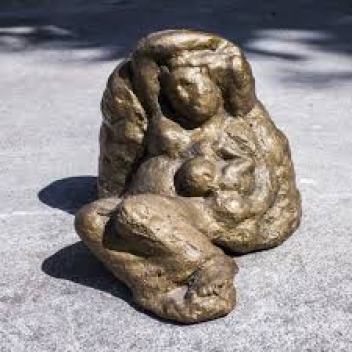
Obras de arte hechas de materiales reciclados y cemento/Artworks made of recycled materials and cement

_________________________________________________________

Escultura por Trude Sojka/Sculpture by Trude Sojke

______________________________________________

En español con fotos
In English

___________________________________

Un Libro sobre la obra de Trude Sojka/A Book about Trude Sojka’s Work

Español-English

_________________________________

Amazon

____________________________________________________

Liza Schneiderman — Artista visual judío-peruana/Peruvian Jewish Artist — “Obras judaicas y sensuales” /”Jewish and Sensual Works”

Lisa Schneiderman

_________________________________________

Liza Schneiderman nace y vive en Lima. Perú. Estudió en la escuela Leõn Pinelo, una escuela judía, y luego en la Escuela de Bellas Artes de Lima. Ha tenido muchas exhibiciones individuales y grupales en Perú, Ecuador, España y en Nueva York, EEUU.

_____________________________________

Liza Schneiderman was born and lives in Lima. Peru. She studied at the Leõn Pinelo school, a Jewish school, and then at the School of Fine Arts in Lima. She has had many individual and group exhibitions in Peru, Ecuador, Spain and in New York, USA.

___________________________________________________________________________________________________

Rubén Cukier– Artista surrealista innovador judío-argentino, radicado en Israel/Argentine Jewish Innovative Surrealist Artist, living in Israel

download-1

__________________________________________________

images
Rubén Cukier

_______________________________

rubencukierart.com

Rubén Cukier, nacido y criado en Buenos Aires en 1964, en una Argentina políticamente violenta. Ahora vive en Israel. Cukier elige colores y sombras que revelan un anhelo por una realidad menos superficial y menos engañosa. Las formas, dimensiones y colores dan forma a los sueños y pesadillas, e incluso aluden a una noción de esperanza. El humor se usa para reflejar miedos, hábitos y deseos que la mayoría de nosotros negamos y reprimimos profundamente dentro de yuxtaposiciones inesperadas que, al principio, son desconcertantes y provocan pensamientos, pero cuando se consideran más de cerca, producen reconocimiento. El reconocimiento de sueños, miedos o pensamientos que nosotros mismos pudimos haber experimentado en un momento u otro.

______________________________________________

Rubén Cukier, born and raised in Buenos Aires in 1964, in a politically violent Argentina. He now lives in Israel. Cukier chooses colors and shades that reveal a yearning for a less superficial, less deceptive reality. The forms, dimensions and colors give shape to dreams and nightmares, and even allude to a notion of hope. Humor is used to reflect fears, habits and desires that most of us deny and suppress deep within Unexpected juxtapositions that, at first, are baffling and thought provoking but when considered more closely, produce recognition. The recognition of dreams, fears or thoughts that we ourselves may have experienced at one time or another.

______________________________________________________

El diccionario define el surrealismo, como un estilo de arte y literatura, enfatizando el significado subconsciente o no racional de las imágenes a las que se llega mediante el automatismo o la explotación de los efectos del azar y las yuxtaposiciones inesperadas.

_________________________________________________________

The dictionary defines surrealism , as a style of art and literature, stressing the subconscious or non rational significance of imagery arrived at by automatism or the exploitation of chance effects and unexpected juxtapositions.

– Lydia Schrufer, BFA. Adaptada de:/Adapted from: rubencukierart.com

___________________________________________________________

images-3
Mesías/The Messiah

88px-Black_Box
The Black Box

download-4
El aeropuerto de ángeles

02c0c219fc129f998bbdeb9ebfc9692d
Escape into Life

download-2
Jerusalem

9fe32868695196b30809ab59d8bf9448
Sacred

download-1
La peluca de los alondras/The wig of larks

64994c815b54414de893c8c2a7e43925
Cabecita loca

download-3
Warming

1025749277079119
Pampa

download
Da Vinci Bio-construction

________________________________________________\

Zoma Baitler (1908-1994) — Artista impresionista y diplomático judío-uruguayo/Uruguayan Jewish Impressionist Painter and Diplomat


download-4
Jerusalem

Zoma Baitler 1991
Zoma Baitler

________________________________________________________________

Para un joven de 19 años, nacido cerca de Kovno, Lituania, Montevideo le debió impresionar como la tierra prometida después de una larga y agotadora travesía marítima. Zoma Baitler, el menor de seis hermanos, no llegó a conocer a su padre al morir él. Eso lo marcó en su infancia. En la sinagoga cercana aprendió el kadish, la oración por los difuntos, antes que la lectura. Atormentado por esa ausencia de un padre solo conocido por fotografías, decidió reaccionar y superar la intensa angustia que le impedía relacionarse con el mundo. La pintura y los estudios fueron abriendo el camino hacia la liberación de sus intensas emociones. Es probable su asistencia a la Escuela de Artes y Oficios y a la ORT, especie de escuela politécnica, de Kovno, optando por especializarse en tipografía, la frecuentación inevitable por la religión en la Escuela Talmúdica, además de asistir al taller del pintor académico Paul Kaufmann. Dominando varios idiomas (idish, hebreo, polaco, alemán, ruso, francés), Baitler estaba bien preparado. La década de los veinte en Uruguay se estiró más allá de sus límites cronológicos, hasta los años 40, la década dorada en la historia uruguaya. Zoma Baitler asistió deslumbrado a ese escenario de efervescencia cultural al cual muy pronto se incorporaría como protagonista. Dotado de cordialidad y simpatía, de la energía del exiliado, Su indeclinable vocación pictórica se manifestó con persistencia, por su apego a la naturaleza, prefirió el lirismo impresionista. No debió ser indiferente a los cuadros de Blanes Viale o Milo Beretta. Al regresar Joaquín Torres García en 1934, fue de los primeros en acercarse al maestro del constructivismo que lo aceptó como alumno. Trabajó con él siete años, sin adherir a sus principios teóricos y prácticos, ejecutando naturalezas muertas convencionales y, de vez en cuando, algún ensayo constructivista. “Llegué al impresionismo naturalmente. Sin esfuerzos, sin violencias. No es que lo eligiera yo. Es que lo llevaba con mi vocación”. La afirmación de Baitler hizo que fuera considerado, realmente, un pintor impresionista. Lo fue en parte. Manejó a su manera que, en principio coincidió con aspectos diversos del impresionismo y el posimpresionismo. Entusiasta de la naturaleza, pintó al aire libre. En la ciudad y el campo. Calles céntricas, caseríos suburbanos, estaciones de ferrocarril, campos cultivados y agrestes, todo lo que contribuye al género paisajístico.

Adaptado de La Red 21.

____________________________________________________________________________________________

For a 19-year-old boy, born near Kovno, Lithuania, Montevideo must have impressed him as the promised land after a long and exhausting sea voyage. Zoma Baitler, the youngest of six brothers, did not get to know his father when he died young. That marked him in his childhood. In the nearby synagogue he learned Kadish, the prayer for the dead, before reading. Tormented by the absence of a father known only for photographs, he decided to react and overcome the intense anguish that prevented him from relating to the world. Painting and studies were opening the way to the liberation of his intense emotions. He is likely to attend the School of Arts and Crafts and the ORT, a kind of polytechnic school in Kovno, opting to specialize in typography, the inevitable frequenting of religion in the Talmudic School, in addition to attending the workshop of the academic painter Paul Kaufmann . Mastering several languages ​​(idish, Hebrew, Polish, German, Russian, French), Baitler was well prepared. The twenties in Uruguay stretched beyond its chronological limits, until the 40s, the golden decade in Uruguayan history. Zoma Baitler dazzled attended that scenario of cultural effervescence which would soon be incorporated as a protagonist. Endowed with cordiality and sympathy, with the energy of the exiled, His indeclinable pictorial vocation manifested persistently, for his attachment to nature, he preferred Impressionist lyricism. He should not have been indifferent to the paintings of Blanes Viale or Milo Beretta. When Joaquín Torres García returned in 1934, he was among the first to approach the master of constructivism who accepted him as a student. He worked with him seven years, without adhering to his theoretical and practical principles, executing conventional still lifes and, from time to time, some constructivist essay. “I came to impressionism naturally. Without efforts, without violence. Not that I chose it. I was carrying it with my vocation. ” Baitler’s claim made him truly considered an impressionist painter. It was partly. He managed in his own way that, in principle, coincided with different aspects of impressionism and post-impressionism. Nature enthusiast, painted outdoors. In the city and the countryside. Downtown streets, suburban hamlets, railway stations, cultivated and rugged fields, everything that contributes to the landscape genre.

Adapted from La Red 21.

____________________________________________________________________________________________

El arte de Zoma Baitler/Zoma Baitler’s Art


207
Abujav Synagogue en Safed. Israel

images-12
My Garden in Punta del Este

images-13.jpg
Paisaje

baitler_zoma-puerto_del_buceo_OM4f5300_10699_20131206_1413_429.jpg
Puerto de Buseo, Uruguay

unnamed-1.jpg
Jerusalem

images-3.jpg
Synagoga Montefiore

download-1.jpg
Casa uruguaya

images-4
Cannes, France

images-8
Calle en Jerusalem

download-3.jpg
Haifa, Israel

Castells-Zoma-baitler-para-6-de-abril
Harbor, Montevideo

images

images-3.jpg
A Cubist Painting

________________________________________________________________________________________________

images-5.jpg
Zoma Baitler

_________________________