Miryam Moscona — Poeta y novelista judío-mexicana de fama internacional/Internationally famous Mexican Jewish Poet and Novelist — “Tela de cebolla”/”Onion Skin” –fragmento de una novela sobre los sefaradíes en México y Bulgaria/extract from a novel about Sephardic Jews in Mexico and Bulgaria

Miryam Moscona

_________________________________________

Myriam Moscona (1955) es poeta y periodista. Es autor de nueve libros, entre ellos Vísperas 1996), El que nada (México, 2006) y De par en par ( México, 2009). Su libro De frente y de perfil (DDF, México, 1996), presenta retratos literarios de 75 poetas mexicanos, con fotografías de Rogelio Cuéllar. Tela de sevoya (2012) y León de Lidia (2024) es una narración híbrida que entrelaza la memoria y la ficción; el telón de fondo del libro es el idioma familiar de Moscona, el ladino o el judeoespañol. Su secuencia de libro, Ivory Black (Negro marfil)”, traducido del español por Jen Hofer, recibió el Premio Harold Morton Landon 2012 de la Academia de Poetas Americanos. Moscona ha recibido numerosos premios, entre ellos el Premio de Poesía Aguascalientes y el Premio Nacional de Traducción de Poesía; Ella es beneficiaria del Sistema Nacional de Creadores de Arte, y recibió una beca de la Fundación Guggenheim. Selecciones de su trabajo también se han traducido al alemán, italiano, francés, hebreo, árabe, ruso, búlgaro, chino y sueco.

________________________________________________

Myriam Moscona (1955) is a poet and journalist. She is the author of nine books, including Vísperas (1996), El que nada (Mexico, 2006) and De par en par (Mexico, 2009). Her book De frente y de perfil ( Mexico, 1996), presents literary portraits of 75 Mexican poets, with photographs by Rogelio Cuéllar. Tela de sevoya (2012) and León de Lidia (2024) are hybrid narratives that intertwine memory and fiction; the book’s backdrop is Moscona’s familiar language, Ladino or Judeo-Spanish. Her book sequence, Ivory Black (Negro marfil),” translated from Spanish by Jen Hofer, received the 2012 Harold Morton Landon Award from the Academy of American Poets. Moscona has received numerous awards, including the Aguascalientes Poetry Prize and the National Poetry Translation Prize; she is a beneficiary of the National System of Art Creators, and received a Guggenheim Foundation Fellowship. Selections of her work have also been translated into German, Italian, French, Hebrew, Arabic, Russian, Bulgarian, Chinese, and Swedish.

______________________________________

DISTANCIA DE FOCO

¿Todos los abuelos de la tierra hablarán con esos giros tan extraños? Esther Benaroya creció envuelta en ese español entreverado con palabras de otros mundos. El judeo-español no fue la lengua de sus estudios pero sí la que escuchó de sus padres y abuelos. Más adelante vino a hablarla lejos, “adonde arrapan al güerko: Meksiko? Meksiko era para mozotros, en la karta, solo un payis ke de la banda izkyedra le enkolgava una lingua larga kon el nombre de la Basha Kalifornia”. Al poco tiempo de su llegada, Esther Benaroya, la abuela paterna, decide ir a Sears Roebuck, aquella tienda departamental, abierta ante sus ojos alterados por luz de neón. Necesita comprar pasadores para aplacarse los rizos. Sube las escaleras eléctricas con un temor que nadie parece distinguir. Se encamina al segundo piso y, muy segura de lo que busca, aborda a una dependienta: “senyorita, kero merkar unas firketas para los kaveyos”. “¿Unas qué?” “trokas, firketas”. La empleada no alcanza a comprender. Desde hace algunas semanas, se aprendió la palabra “chingada” y luego “chingadera” pero ella prefiere el diminutivo: “chingaderika”. Así pues, se corrige: “kero unas chingaderikas, bre”. La empleada se sonroja y va disparada en busca del gerente. Esther Benaroya sale con un empaque de cartón lleno de pasadores con punta engomada. La hace feliz desesperar a la gente. Ya se la dicho que la palabra “chingadera” es una majadería en ese país, pero ella no se inmuta. Es su forma de decir “agora avlo vuestro espanyol komo lo avlash vosotros en la Espanya i en Meksiko”. Unos se escandalizan, otros la ignoran o se carcajean ante sus chifladuras. Antes de llegar a México, sólo podía decir que era un país lejano donde se usaban chapeos de charro y se comía picante en forma exagerada. “Dize el marido miyo ke los mushos le kedan kemando dospues de estas komidas de foegos” Al desembarcar en estas tierras pensó por un momento que todos los mexicanos eran de sangre judía. Todos hablaban español, esa lengua de los sefardís de Turquía y de Bulgaria. “Ama aki lo avlan malo, malo… no saven dezir las kozas kon su muzika de orijín”.

MOLINO DE VIENTO

En mi otra vida, la que recuerdo sólo en fragmentos, la que irrumpe a media mañana con mensajes de otros mundos, en esa vida, digo, me he visto al lado de un hombre que me recibe de frente y sin ningún miramiento comienza a desnudarse. Me ofrece todo lo que se quita. “Te regalo esta ropa vieja” –me dice. “Úsala aunque esté gastada”. Cuando me pruebo los pantalones siento cómo se me escurren del cuerpo, no hay forma de ceñirlos a mi cintura. “Usa otra parte de ti para apretarlos”, me dice pausadamente. Capto sus indicaciones. Llevo una trenza larga. Con un instrumento que él pone en mis manos, la corto de tajo. La trenza me sirve para tejer un cinturón y atarme la ropa al cuerpo. Es un hombre de mediana estatura. Ojos grandes, brillosos. Conozco su cara, sus gestos. Lo veo mirarme y siento un impulso casi incontrolable de abrazarlo. Hay algo que me detiene. Me tomo la cabeza con las manos, cierro los ojos cuando irrumpe su voz al leerme estas líneas de un libro en caracteres cirílicos: Quiero darte un consejo. Nunca pronostiques una muerte trágica en lo que escribes porque la fuerza de las palabras es tal, que ella, con su poder de evocación, te conducirá a esa muerte vaticinada. Yo he llegado a esta edad porque siempre he eludido hacer predicciones sobre mí mismo. Algo me hace explotar en llanto. Cuando vuelvo en mí, lo busco. Ya no está. Sólo aparece cuando lo olvido. ¿Lo olvido?

DISTANCIA DE FOCO

Muerto en su cama, en México, a sus cuarenta y siete años. Me prometió un cochecito de cuerda que se desliza por la pared y nunca me lo dio. Me regaló una muñeca con chaleco rojo a cuadros y pelo crespo. No me gustan las muñecas aunque ésta sabe decir algunas frases con una voz aguda y fea, pero ¡sabe hablar! Expulsa las palabras desde un disco interno, allí pego la oreja, sobre sus pechos duros, de plástico. Sus palabras y las de mi padre muerto son igual de falsas. Un rostro con líneas borrosas, apenas las distingo. Mi padre es de Plovdiv, una ciudad en las montañas de Bulgaria. Sé poco de él. Sé que de niño lo llevaron a vivir a Estambul, en su casa se hablaba ladino, volvió a Plovdiv ya en su juventud. Cuando comenzó la Segunda Guerra, a los judíos de Bulgaria se les impidió circular libremente por las calles; podían hacerlo dos o tres horas al día y volver al toque de queda, siempre a una hora convenida. Debían usar esa estrella amarilla pegada a su ropa. No en las mangas, como en Europa Central, sino arriba del pecho en un lugar muy visible para diferenciarse de los otros. Sus casas y negocios también debían distinguirse con claridad. Un ideólogo antisemita de Bulgaria de nombre Alexsander Belev (a quien le llamaban “el rey judío”), amigo cercano del representante de la Gestapo en su país, había pasado una temporada en la Alemania nazi para estudiar las leyes antisemitas. Era un convencido del exterminio judío, vivía ansioso de colaborar con ese “noble propósito” y desde el Ministerio del Interior se encargó de preparar la nueva política judía del Estado Búlgaro que mantenía en esos momentos excelentes relaciones con los nazis. Empezó a fertilizar el terreno para preparar los convoyes con buenos resultados, aunque a última hora se frustró su plan: el tren fue detenido y la gente que iba a ser entregada en los campos de concentración fue puesta en libertad. De uno de esos vagones, vagones, incrédulo, agradecido, descendió en 1943 mi padre, con sus ojos grandes, envuelto en un abrigo gastado, casi al incio de la primavera.

DEL DIARIO DE VIAJE

Algunos pasajeros del avión se parecen a mi familia materna. Boca ancha y el corte de huesos de la cara. Mientras se escuchan los avisos de aterrizaje pienso en aquellas cosas que debieran hacerse a solas. Ahora, en este tiempo, a esta edad, llegar a Bulgaria por primera vez. Hacer el recuento, pensar en las decenas de generaciones que vivieron en este país y hablaron el judezmo. Las palabras son frágiles y la memoria que tengo de ellas está rodeada de calor. Llega el avión a Sofia, rasgada por una lluvia delgada, constante. Hay algo que hace fricción. Es la memoria: el eslabón abierto de una larga cadena. Esa abertura que me une y me separa es la que me ha traído aquí. Ande topes una senyal, alevanta la kara. Eso hago en la sinagoga de la ciudad levantada en 1909. Subo la mirada a la lámpara más grande en los Balcanes: tiene 460 luces que equivalen a 460 plegarias. La influencia árabe, la sillería, las columnas verdes, los contrastes de tono. “This is the life”, dice el cuidador. “Our style is colorful, is warmer”. En el fondo, arriba del tabernáculo, hay una inscripción en hebreo. “Conoce frente a quién estás parado”. (Haga lo que haga, sé que Dios me mira, incluso en el baño me observa como un cíclope y yo le pido perdón. Suelto frente al tabernáculo un tembloroso “guay de mi-no”. Así, como me enseñó la abuela). A la salida, enciendo dos velas sobre un pequeño estanque de aceite. Una por ella y otra por él, como en los viejos tiempos. Doy la vuelta en la esquina, veo el nombre de la calle Ekzarh Yosif. Casi el de mi abuelo. Sonrío. ¿Mencioné a las dos madres? Ahora espero a una mujer mayor, reducida a un metro cincuenta. “En la chikez fui una mujer de alturas”, me dice cerrándome un ojo después de saludarme en la lengua que me hace evocar un título del escritor israelí de origen rumano Aharon Appelfeld: La herencia desnuda. Eso se aproxima al calor del judeo-español en sus capas cubrientes. Y luego la mujer con su voz nasal, venida de Pasarjik, a cien kilómetros de Sofia. Allí pasó su infancia. Yo, en cambio, en mi herencia desnuda, más allá de la lengua, en los cuerpos que rodean mi chikez, papá y mamá, traigo, digo, la necesidad de inventarles biografías porque los perdí de vista, por eso vine, porque me dijeron que aquí podría descubrir la forma de atar los cabos sueltos.

______________________________________________

______________________________________

FOCAL DISTANCE

Do all grandparents on Earth speak with such strange twists of phrase? Esther Benaroya grew up surrounded by that Spanish interspersed with words from other worlds. Judeo-Spanish wasn’t the language of her studies, but it was the one she heard from her parents and grandparents. Later, she came to speak it far away, “where they catch the güerko: Meksiko? Meksiko was for us, in the karta, only a peasant who from the left-wing gang would utter a long language called Basha Kalifornia.” Shortly after her arrival, Esther Benaroya, her paternal grandmother, decides to go to Sears Roebuck, that department store, opened before her neon-lit eyes. She needs to buy hairpins to tame her curls. She takes the escalator with a fear that no one seems to recognize. She heads up to the second floor and, very sure of what she’s looking for, approaches a saleswoman: “Lady, I want some firketas for the kids.” “Some what?” “Trucks, firketas.” The clerk doesn’t understand. A few weeks ago, she learned the word “chingada” and then “chingadera,” but she prefers the diminutive: “chingaderika.” So she corrects herself: “I want some chingaderikas, bre.” The clerk blushes and rushes off to find the manager. Esther Benaroya comes out with a cardboard box full of glue-tipped bobby pins. It makes her happy to drive people crazy. I’ve already told you that the word “chingadera” is a swear word in that country, but she doesn’t flinch. It’s her way of saying, “Now I have your Spanish, just like you have it in Spain and in Mexico.” Some are shocked, others ignore her or laugh at her antics. Before arriving in Mexico, all she could say was that it was a faraway country where people wore charro hats and ate spicy food to excess. “My husband says his muscles are burning after eating these fires.” Upon landing in these lands, she thought for a moment that all Mexicans were of Jewish blood. They all spoke Spanish, the language of the Sephardim of Turkey and Bulgaria. “My dear, they speak badly here, badly… they can’t sing their songs with their traditional music.”

WINDMILL

In my other life, the one I remember only in fragments, the one that bursts in mid-morning with messages from other worlds, in that life, I say, I have found myself next to a man who greets me head-on and without any consideration begins to undress. He offers me everything he takes off. “I’m giving you these old clothes,” he tells me. “Wear them even if they’re worn out.” When I try on the pants, I feel them slipping from my body; there’s no way to cinch them around my waist. “Use another part of you to tighten them,” he tells me slowly. I take his instructions. I have a long braid. With an instrument he places in my hands, I cut it short. I use the braid to weave a belt and tie the clothes to my body. He is a man of medium height. Large, shiny eyes. I know his face, his gestures. I see him looking at me and I feel an almost uncontrollable urge to hug him. There’s something that stops me. I hold my head in my hands and close my eyes as his voice breaks in, reading me these lines from a book in Cyrillic script: I want to give you some advice. Never predict a tragic death in what you write, because the power of words is such that, with their evocative power, they will lead you to that predicted death. I’ve reached this age because I’ve always avoided making predictions about myself. Something makes me burst into tears. When I come to, I look for it. It’s gone. It only appears when I forget it. Do I forget it?

FOCAL DISTANCE

Dead in his bed, in Mexico, at forty-seven years old. He promised me a wind-up car that slides along the wall and never gave it to me. He gave me a doll with a red checked vest and curly hair. I don’t like dolls, although this one can say a few phrases in a high-pitched, ugly voice, but it can talk! It ejects words from an internal disk; I press my ear to it, against its hard, plastic breasts. Its words and those of my dead father are equally false. A face with blurred lines, I can barely distinguish them. My father is from Plovdiv, a city in the mountains of Bulgaria. I know little about him. I know that as a child he was taken to live in Istanbul; Ladino was spoken in his house; he returned to Plovdiv in his youth. When World War II began, Bulgarian Jews were prevented from moving freely in the streets; they could do so for two or three hours a day and return at curfew, always at an agreed-upon time. They had to wear that yellow star attached to their clothing. Not on the sleeves, as in Central Europe, but above the chest in a highly visible place to distinguish them from others. Their homes and businesses also had to be clearly distinguished. An anti-Semitic ideologue from Bulgaria named Alexsander Belev (who was nicknamed “the Jewish king”), a close friend of the Gestapo representative in his country, had spent time in Nazi Germany studying anti-Semitic laws. He was convinced of the need to exterminate the Jews, eager to collaborate with that “noble purpose,” and from the Ministry of the Interior, he was in charge of preparing the new Jewish policy of the Bulgarian state, which at the time maintained excellent relations with the Nazis. He began to lay the groundwork for the convoys with good results, although at the last minute his plan was thwarted: the train was stopped, and the people who were to be handed over to the concentration camps were released. From one of those wagons, wagons, incredulous, grateful, my father descended in 1943, with his big eyes, wrapped in a worn coat, almost at the beginning of spring.

FROM THE TRAVEL DIARY

Some of the plane’s passengers resemble my maternal family. Wide mouths and the cut bones of their faces. As the landing announcements are heard, I think about those things that should be done alone. Now, at this time, at this age, arriving in Bulgaria for the first time. Taking stock, thinking about the dozens of generations who lived in this country and spoke Judezmo. Words are fragile, and the memory I have of them is surrounded by heat. The plane arrives in Sofia, torn by a light, constant rain. There’s something that creates friction. It’s memory: the open link in a long chain. That opening that unites and separates me is what brought me here. And when you touch a sign, raise your kara. That’s what I do in the city’s synagogue, built in 1909. I raise my gaze to the largest lamp in the Balkans: it has 460 lights, equivalent to 460 prayers. The Arabic influence, the ashlar, the green columns, the contrasting tones. “This is life,” says the caretaker. “Our style is colorful, it’s warmer.” In the background, above the tabernacle, there’s an inscription in Hebrew: “Know before whom you stand.” (Whatever I do, I know God is watching me; even in the bathroom, He watches me like a Cyclops, and I ask for His forgiveness. I let out a shaky “Woah de mi-no” in front of the tabernacle. Just like Grandma taught me.) On the way out, I light two candles over a small pool of oil. One for her and one for him, just like in the old days. I turn the corner and see the name of Ekzarh Yosif Street. Almost my grandfather’s name. I smile. Did I mention the two mothers? Now I’m waiting for an elderly woman, reduced to about five feet five inches. “As a child, I was a woman of heights,” she tells me, winking after greeting me in a language that evokes a title by the Romanian-born Israeli writer Aharon Appelfeld: The Naked Inheritance. That approximates the warmth of Judeo-Spanish in its covering layers. And then the woman with her nasal voice, from Pasarjik, a hundred kilometers from Sofia. That’s where she spent her childhood. I, on the other hand, in my naked heritage, beyond language, in the bodies that surround my child, my father and mother, I bring, I say, the need to invent biographies for them because I’ve lost sight of them, that’s why I came, because they told me that here I could discover the way to tie up the loose ends.

___________________________

LIbros de Myriam Moscona/Books by Miryam Moscona

____________________________________________________

Judíos de Bulgaria antes de la WW2/Jews of Bulgaria before WW2

_____________________________________________

Noemi Jaffe — Romancista judeo brasileina/Brazilian Jewish Novelist– “Lili, um romance de luto”/”Lili – A Novel of Mourning”– um trecho do romance sobre uma mãe/an excerpt from the novel about a mother

Naomi Jaffe

_________________________________________

Noemi Jaffe é escritora, professora de literatura e de escrita e crítica literária. Doutorou- se em Literatura Brasileira pela USP. Publicou “O que os cegos estão sonhando” (Ed. 34-2012), “A verdadeira história do alfabeto” (Companhia das Letras – 2012), vencedor do Prêmio Brasília de Literatura em 2014, “Irisz: as orquídeas”(Companhia das Letras – 2015), “Não está mais aqui quem falou”(Companhia das Letras – 2017), “O que ela sussurra”, “Lili: Novela de um luto” (Companhia das Letras – 2021), “Escrita em movimento: sete princípios do fazer literário” (Companhia das Letras – 2023), entre outros. Desde 2016, mantém o Centro Cultural Literário Escrevedeira, em parceria com Luciana Gerbovic e João Bandeira

______________________________________.

Noemi Jaffe is a writer, professor of literature and writing and literary criticism. Doutorou- se em Literatura Brasileira pela USP. He published “O que os cegos estão sonhando” (Ed. 34-2012), “A Verdadeira História do Alfabeto” (Companhia das Letras – 2012), winner of the Prêmio Brasilia de Literatura in 2014, “Irisz: as orquídeas” (Companhia das Letras – 2015), “Não esta mais aqui quem falou” (Companhia das Letras – 2017), “O que ela sussurra”, “Lili: Novela de um luto” (Companhia das Letras – 2021), “Written in movement: seven principles of making literature” (Companhia das Letras – 2023), among others. Since 2016, we have maintained the Centro Cultural Literário Escrevedeira, in partnership with Luciana Gerbovic and João Bandeira.

_________________________________________

Elderly eighty plus year old woman in a hospital bed.

Quando ela estava morta, eu beijei seu rosto, suas mãos, seu colo. Apertava seu pulso, abraçava seu corpo, chamava: mãe, mãe. Levantava sua mão e a deixava cair. No dia anterior, quando ela ainda não estava morta, mas quase, eu aproximava meu ouvido do seu peito e ouvia a respiração. Era diferente. É diferente estar quase morta de estar morta mesmo. É diferente, e só sei disso agora que ela morreu. Se quando ela estava quase morta eu esperava que ela morresse, agora é como se eu a quisesse quase morta para sempre, só para ouvir sua respiração, a bochecha quente, os dedos da mão se mexendo mesmo que por reflexo, um ronco baixo no peito, o tremor nas pálpebras. Nunca tinha ficado perto de uma pessoa morta e descoberta. Apenas do meu pai, mas um lençol o cobria, sobre o qual tracei com o dedo o contorno do seu nariz, gesto que repeti com a minha mãe depois que a cobriram. Fui a única a permanecer com ela, ela morta. Fiz isso porque eu precisava, e por que precisava não sei dizer. Para estar mais com ela. O homem do chevra kadisha me censurou. Disse que quem estava lá não era mais ela. Com que rapidez se aceita que a morte subtrai a pessoa, que a morte esvazia o que chamam de alma da pessoa. Resisti: é o corpo da minha mãe. Era ela ou não era ela? Na hora, para mim, era. O corpo da minha mãe morta é minha mãe. Tive a ousadia de abrir os olhos dela, e por trás das pálpebras lá estava o olho inteiro, da mesma cor, o mesmo olhar, ainda que ninguém olhasse por trás dele. Não foi masoquismo, um prazer mórbido. Foi tão simples como uma despedida de amor ou a dificuldade da separação. Nas últimas semanas ela adormecia com frequência enquanto conversávamos e numa dessas vezes ela acordou sobressaltada, gemendo, e eu e a Leda perguntamos o que foi?, e ela respondeu: a dor da separação. Ela sabia que ia morrer e, apesar de sempre ter afirmado — e era verdade — não ter medo da morte, no final estava com medo, com muito medo. Ela pedia beijos sem fim, não queria largar o abraço e pedia mais e mais beijos. No penúltimo dia antes de morrer, aproximei minha bochecha da sua boca e pedi beijos, e ela, semi-inconsciente, fez um bico com os lábios, chegando a dar um estalo. Também apertou minha mão e fez que sim e que não com a cabeça. Por tanto tempo tive pressa pela morte dela, mas nos últimos dias eu só queria que demorasse para sempre. Uma pessoa pode ser só o calor da mão. Isso basta para que uma mãe seja mãe e para que eu seja filha. Ver o corpo morto e aceitar: mãe, você está morta. Existe uma aceitação incontornável a um corpo morto. Não vou prendê-lo, me agarrar a ele, impedir que seja embrulhado, ensacado, encaixotado e transportado por alguém que não conheço — e a quem agradeço de coração — para dentro de uma geladeira. Deve ser assim. É horrível e deve ser assim. Dever, aqui, quer dizer muitas coisas: é uma atribuição da maturidade realista, uma aceitação do ritual necessário de conformação à natureza (esse corpo vai se degradar) e à comunidade os mortos devem ser enterrados) e uma demonstração de sanidade (não sou louca, não devo me agarrar ao corpo). E existe ainda uma aceitação existencial, que oscila: aceito, não aceito: ela não existe mais. Minha mãe — o olhar, o sorriso, o beijo e o abraço — não existe mais. Quando penso nela, penso no olhar, no sorriso que ela abria quando reconhecia que eu tinha chegado, no abraço e nos beijos inumeráveis, sobre os quais ela dizia que “tudo era muito pouco”. Nos últimos meses, ela se transformou em puro carinho. Tudo nela emanava um amor infantil, que acariciava com o olhar. Era como ser olhada por um cervo filhote, ser abraçada por um leão, ser beijada por um amante que recebe amada. Sua mão grossa e quente apertava meu tronco e minhas mãos. Falávamos pouco. Ela adormecia, e muitas vezes dormi em seu ombro, ouvindo sua respiração lenta, me sentindo aconchegada. Ela era mãe. Ela se tornou mãe. Ela se reduziu a mãe. Ela era feliz porque tinha as três filhas, e nós três éramos o mundo todo, a vida toda para ela. Nada mais importava além de poder nos ver e beijar e abraçar.

Jaffe, Noemi . Lili . Companhia das Letras. Kindle Edition. 2021

_______________________________________________

______________________________

When she was dead, I kissed her face, her hands, her lap. I squeezed her wrist, hugged her body, called out: mother, mother. I lifted her hand and let it fall. The day before, when she wasn’t dead yet, but almost dead, I would put my ear close to her chest and listen to her breathing. It was different. Being almost dead is different from being really dead. It’s different, and I only know that now that she’s dead. If when she was almost dead I expected her to die, now it’s as if I wanted her almost dead forever, just to hear her breathing, her warm cheek, her fingers moving even if it was reflexive, a low rumble in her chest, the trembling of her eyelids. I had never been close to a dead person who was uncovered. Only my father, but a sheet covered him, on which I traced the outline of his nose with my finger, a gesture I repeated with my mother after they covered her. I was the only one to stay with her, when she was dead. I did it because I needed to, and why I needed to, I don’t know. To be with her more. The man in the chevra kadisha scolded me. He said that the person there was no longer her. How quickly one accepts that death takes away a person, that death empties what they call a person’s soul. I resisted: it was my mother’s body. Was it her or wasn’t it her? At the time, for me, it was. My dead mother’s body is my mother. I had the audacity to open her eyes, and behind her eyelids there was the whole eye, the same color, the same look, even though no one was looking behind it. It wasn’t masochism, a morbid pleasure. It was as simple as a farewell to a lover or the difficulty of separation. In the last few weeks she had often fallen asleep while we were talking, and one of those times she woke up startled, moaning, and Leda and I asked her what it was?, and she answered: the pain of separation. She knew she was going to die, and although she had always said — and it was true — that she wasn’t afraid of death, in the end she was afraid, very afraid. She asked for endless kisses, she didn’t want to let go of the hug and she asked for more and more kisses. On the second-to-last day before she died, I brought my cheek close to her mouth and asked for kisses, and she, semi-conscious, pouted her lips and even smacked them. She also squeezed my hand and nodded yes and no. For so long I was in a hurry for her death, but in the last few days I just wanted it to take forever. A person can be just the warmth of a hand. That’s enough for a mother to be a mother and for me to be a daughter. Seeing the dead body and accepting: mother, you’re dead. There is an inescapable acceptance of a dead body. I’m not going to hold it back, cling to it, stop it from being wrapped, bagged, boxed and transported by someone I don’t know — and to whom I thank from the bottom of my heart — into a refrigerator. It must be like that. It’s horrible and it must be like that. Duty, here, means many things: it is an attribution of realistic maturity, an acceptance of the necessary ritual of conforming to nature (this body will degrade) and to the community (the dead must be buried), and a demonstration of sanity (I am not crazy, I must not cling to the body). And there is also an existential acceptance, which oscillates: I accept, I do not accept: she no longer exists. My mother — her gaze, her smile, her kiss and her hug — no longer exists. When I think of her, I think of the gaze, the smile she gave when she recognized that I had arrived, of the hug and the countless kisses, about which she said that “everything was too little”. In the last few months, she transformed into pure affection. Everything about her emanated a childlike love, which she caressed with her gaze. It was like being looked at by a baby deer, being embraced by a lion, being kissed by a lover who receives his beloved. Her thick, warm hand squeezed my torso and my hands. We spoke little. She fell asleep, and I often slept on her shoulder, listening to her slow breathing, feeling warm. She was a mother. She became a mother. She reduced herself to being a mother. She was happy because she had three daughters, and the three of us were her whole world, her whole life. Nothing else mattered except being able to see each other and kiss and hug each other.

Jaffe, Noemi. Lili . Companhia das Letras. Kindle Edition. 2021.

El arte, la escultura, la fotografía y la arquitectura judío-mexicanos/Mexican Jewish Art, Sculpture, Photography and Architecture

Arnold Belkin (1930-1992) Artista judío-canadiense-mexicano muralista y artist/Jewish-Canadian-Mexican Jewish Muralist and Artist

________________________

Luis Filcer (1927-2018) Artista visual expresionista judío-mexicano/Mexican-Jewish Expressionist Artist — Un homenaje — An Homage

______________________________

____________________________________
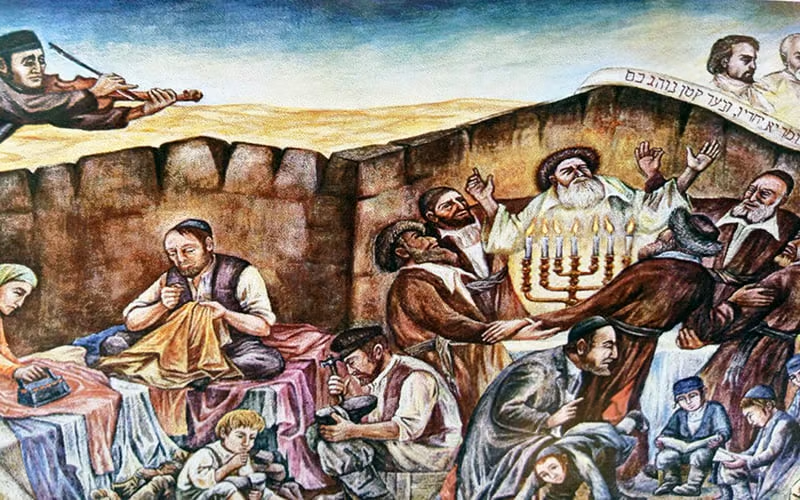
Eduardo Cohen (1939-1995) Artista judío-mexicano/Mexican Jewish Artist–Figuras de la Ciudad de Mexico, algo destorionadas/Characters from Mexico City, a bit distorted

_______________________________

Mariana Yampolsky (1925-2002) — Fotógrafa judío-norteamericana-mexicana/American-Mexican Jewish Photographer — “Vistas de la gente de México”/”Views of the People of Mexico”

Leonardo Nierman — Artista visual y escultor judío-mexicano/Mexican Jewish Artist and Sculptor — “Genesis” y otras obras/”Genesis” and other works

___________________________

José Sacal (1944-2018) Escultor judío-mexicano/Mexican Jewish Sculptor — “Un mexicano universal”/” A Universal Mexican” — Estatuas únicas en bronce/Unique Bronze Statues

_________________________

Noé Katz–Artista visual y escultor judío-mexicano, radicado en EEUU/ Mexican Jewish Artist and Sculptor, living in the United States-“Yom Kippur” y otras obras/”Yom Kippur” and other works

_________________________

Saúl Kaminer — Artista visual judío-mexicano multi-faceta, de renombre internacional/Mexican Jewish Multi-Faceted Artist, well-known internationally

_________________________________

Pedro Friedeberg — Artista visual judío-mexicano/Mexican Jewish Artist –El arte excéntrico, absurdo e irreverente/Eccentric, Absurd and Irreverent Art

______________________________

Fanny Haiat — Escultora y pintora judío-mexicana/Mexican Jewish Sculptor and Painter

_______________________________

Fanny Rabel (1922-2008) — Artista judío-mexicana/Mexican Jewish Artist–“Caras de México”/”Faces of Mexico

_______________________________

Abraham Zabludovsky (1924-2003)–Arquitecto y artista judio-mexicano/Mexican Jewish Architect and Artist — Líder del modernismo en la arquitectura de México/Leader of Modernism in the architecture in Mexico

______________________________________________

Jacqueline Goldberg–Poeta judía-venezolana/Venezuelan Jewish Poet–“El lugar de precariedades” y otros poemas”/”A Place of Precariousness” and other Poems

Jacqueline Goldberg

_______________________________________________

Jacqueline Goldberg. Es una escritora, periodista y editora venezolana. Nació en 1966, en Maracaibo. Es Licenciada en Letras, por la Universidad del Zulia (1990) y Doctora en Ciencias Sociales, por la Universidad Central de Venezuela (1998). Desde comienzos de los años noventa su trabajo discurre entre la literatura y el periodismo. En más de una veintena de libros abarca la narrativa, la poesía, la literatura infantil, el reportaje, el ensayo, la crítica de artes visuales, el periodismo gastronómico y el género testimonial. En su obra poética se encuentran los libros: Treinta soles desaparecidos (1986), De un mismo centro (1986), En todos los lugares bajo todos los signos (1987), Luba (1988), Máscaras de familia (1990), Trastienda (1992), Insolaciones en Miami Beach (1995), Carnadas (1998), Víspera (2000), La salud (2002), Una sal donde estoy de pie. Antología (2003), El orden de las ramas (2003), Verbos predadores. Poesía reunida (1986-2006) (2007), Amphycles, los bogavantes” (2011), Día del perdón (2011), Postales negras (2011), Limones en almíbar (2014), Nosotros, los salvados (2015), El libro de lo salvado (2020). Su trabajo poético aparece incluido y reseñado en antologías en Italia, Rumania, Corea del Sur, España, Puerto Rico, Chile, Perú, Argentina, Colombia, Estados Unidos, Cuba, México, Brasil y Venezuela.

De: Vomité un conejito

_______________________

Jacqueline Goldberg is a Venezuelan writer, journalist, and editor. She was born in 1966 in Maracaibo. She holds a Bachelor’s degree in Literature from the University of Zulia (1990) and a PhD in Social Sciences from the Central University of Venezuela (1998.). Since the early 1990s, her work has intersected literature and journalism. In more than twenty books, she covers fiction, poetry, children’s literature, reportage, essays, visual arts criticism, food journalism, and testimonials. Her poetic work includes the following books: Treinta soles desaparecidos (1986), De un mismo centro (1986), En todos los lugares bajo todos los signos (1987), Luba (1988), Máscaras de familia (1990), Trastienda (1992), Insolaciones en Miami Beach (1995), Carnadas (1998), Víspera (2000), La salud (2002), Una sal donde estoy de pie. Antología (2003), El orden de las ramas (2003), Verbos predadores. Poesía reunida (1986-2006) (2007), Amphycles, los bogavantes” (2011), Día del perdón (2011), Postales negras (2011), Limones en almíbar (2014), Nosotros, los salvados (2015), El libro de lo salvado (2020.) Her poetic work appears included and reviewed in anthologies in Italy, Romania, South Korea, Spain, Puerto Rico, Chile, Peru, Argentina, Colombia, United States, Cuba, Mexico, Brazil and Venezuela.

From: Vomité un conejito

___________________

_____________________________________

El lugar de las precariedades

Sobre el escritorio
reposa la fotografía de mi útero descolgado,
amasijo que tan poco dice
de la tenencia y de sus fibras.

He procurado permanecer cada tarde frente a la imagen,
convencerme de que ese bocado sacrificial
estuvo alguna vez atenazado en mi vientre.
Que su superficie lisa y brillante
se escurrió de mí en apenas un par de horas de quirófano.
Que en adelante será mansedumbre.

Aún siento mordimientos en el abdomen,
cansancio al retroceder.

Es difícil arremeter contra ciertos desenlaces:
las heridas no son diques,
no acunan,
no revierten.

Quizá reproduzca la imagen en una postal barnizada
y la obsequie a los amigos.
En su dorso escribiré:
«cuerpo uterino piriforme de 7 x 6 centímetros,
en el cual se diagnosticó fibromatosis,
adenomiosis y endometrio proliferativo,
extraído de Jacqueline Goldberg
el martes 21 de febrero del año 2006».

Que se vea.
Se admire.
Se abomine.

Me importa su cumplimiento de rastrojo.

Se trata de un retrato primordial,
procedencia sin fin.
Mis viejas fauces.

______________________________________

A Place of Precariousness

On the desk
sits a picture of my excised uterus,
a mess that says so little
about its fibers, the properties.

I’ve tried to spend time with the image every afternoon,
convincing myself that this sacrificial lump
was once attached to my belly.
Its smooth, glistening surface
slipped away in a few short hours of surgery.
Hereafter, there will be a gentleness.

I still feel twinges in my abdomen,
fatigue when I slow down.

It’s hard to lash out against certain outcomes:
wounds aren’t dikes,
they don’t cradle,
don’t regress.

Maybe I’ll reproduce the image on a glossy postcard
and give it away to my friends.
On the back I’ll write:
“pyriform uterine body of 7 x 6 centimeters,

in which fibromatosis was diagnosed
adenomyosis and proliferative endometrium,
extracted from Jacqueline Goldberg,
on Tuesday February 21 of the year 2006.”

Let it be seen.
Admired.
Detested.

The compliant stubble matters to me.

It’s an essential portrait,
a port of origin without end.
My old maw.

___________________

 Estado de exilio

Hay una retahíla de verbos emancipados, sin cielo.

Todo es mío. Lo pestilente y lo liviano.
Todo lo amasé, lo mordí, lo acuné.

Son mías las imprecisiones,
el barro que no amaina,
los hilos de sangre que cuajan el hogar.

Mío lo que despoja,
savia de una tarde avara,
huesos desmoronados en el útero.

Las minucias me las llevo al asco, al exilio de mí.

Las pérdidas no me arrancarán el mal,
no me harán dadivosa ni puntual.

Si me voy cargo con todo,
armo el miedo en otro puerto,
me ensucio para nuevas esperanzas.

 ____________________________

State of Exile

There is a string of emancipated verbs, without sky.

Everything is mine. The pestilent and lightweight things.
I kneaded it all, bit it all, cradled it.

Mine are the inaccuracies,
the mud doesn’t subside,
threads of blood coagulate the home.

Mine is whatever despoils,
sap of one greedy afternoon,
crumbling bones in the womb.

I carry minutiae to my disgust, to my exile.

The losses won’t pull the evil out of me,
they won’t make me generous or punctual.

If I go I will carry everything,

assemble fear in another port,
sully myself for new hope.

 ________________________________

El moribundo nos convoca

el moribundo nos convoca
para recapitular su vida

forzado como está
a respirarse a sí mismo hasta el fin
su confesión es de segunda mano
carece de voluntad
para ocultar ciertas lealtades

en la vastedad del adiós
la verdad es siempre un escándalo

__________________________________________

The Dying Man Summons Us

the dying man summons us,
to recapitulate his life

forced as he is
to breathe for himself until the end
his confession is a second hand one
lacks the will
to conceal certain loyalties

in the vastness of farewells
truth is always a scandal

Translated by Consuelo Méndez, with William Blair

___________________________

VÍSPERA (2000)

Si quedara un hombre

 un sólo hombre

 para después y la eternidad

corregido en su mínima condición

desechado si quedara para más nunca

postergado al tropiezo la triza infinita

 si existiera y nos viéramos

 y me explicara

el secreto que lo mantiene solo

alumbrado y solo pleno de encierros

 si existiera

 y pudiera irme lejos

 no desear arrimarme única

sola sin palabras

_______________________________

EVE (2000)

If there was a man

only one man

for later and eternity

corrected in his minimum condition

discarded if he remained for never again

postponed to stumble over the infinite fragment

if he existed and we saw each other

and he would explain to me

the secret that keeps him alone

lighted and alone full of confinements

if he existed

and I could go far away

not yearn get closer, unique

alone in words

_______________________________________

INSOLACIONES EN MIAMI BEACH (1995)

El balcón es un pedazo de Collins Avenue

vista reducida a extremos

que nadie atiende durante las horas del lunch 

miramos su amasijo en traje de baño disponemos toallas

sandwiches de tuna coca cola de dieta

 encallamos al disparo seco

de una avioneta sobre la bahía

__________________________

The balcony is a piece of Collins Avenue
a view
reduced to extremes
that no one notices
during lunch
we watch its jumble in bathing suits
arrange towels
tunafish sandwiches
diet cokes
become paralyzed at the dry shot

__________________________

«LUBA» (1988)

Tomo su herencia

de edades en quiebra

los oficios tristes del abandono sus muertos

I take on her inheritance

of crumbling ages

 the sad trades of neglect her dead ones

Diálogo de pasillos diurnos

raíz memoria que soy

Dialogues in Daytime Hallways

 root memory that I am

Duelen estas gana de luto

de amanecer

recogiendo plumas

en patios ajenos ganas

de ser ella

This Yearning of Mourning Hurts

of gathering feathers

 at dawn

in alien courtyards

desire to be her

Luba asiste a cuanto soy

detiene sus raíces

sufre de nuevo

Luba Delivers All I Am

stalls her roots

she suffers anew

__________________________________

 (Verbos Predadores/Predatory Verbs”, 2007)

Jardín Botánico

Muestro al hijo semillas hincadas en el musgo.

Señalo una palmera,

la flor que renacerá en sesenta años.

Él pregunta por las ramas del árbol invisible,

persigue dinosaurios,

remienda el carruaje de un fantasma.

Sigo los pretiles de mi angustia.

<<(Mira las aves de rapiña,

No esan lejos de la belleza», digo.

I<<Mira la quietud de los troncos,

manos condescendientes», digo.

Demasiados ángulos para un mismo blindaje.

Sentencio «he ahí un jabillo, una bromelia».

Nombro también destrozos, para no engañar.

El hijo no entiende, crepita en otro rubor.

Su mañana no es la mía. No es pálida. No es efímera.

Su mañana no cabe en mi reposo.

Lo conduzco para comparar nuestros océanos,

De tiempo viudo, idéntica admiración.

Jabillo: Name given in Venezuela to the tree Hura crepitans.

_______________________________________

“Botanical Garden”

I show my son the sunken seeds in the moss.
I point at a palm tree, at the flower that will be reborn in sixty years.

He asks about the branches of the invisible tree,
he chases dinosaurs, restores the carriage of a ghost.

I follow the barrier of my anxiety.

“Look at the vultures, not too far away from beauty” I say.

“Look at the tranquility of the trunks,

condescendent hands” I say.

Too many angles for a unique shielding.

I proclaim, “Behold a Jabillo, a Bromelia”,

I also name damage, not to cheat. 

The son understands, he crackles in another flush.
His morning is not mine. His isn’t pale. Nor ephemeral.
His morning doesn’t fit my rest.

I drive him to compare our oceans,
the being of a widowed time and an identical admiration.

Jabillo: Name given in Venezuela to the tree Hura crepitans.

_____________________________

___________________________________________