Centro de Espiritualidad y Cultura Judía.Promoviendo los valores de nuestra tradición desde una perspectiva plural, moderna y espiritual. Miembro del movimiento Masorati – Conservador.
Centro de Espiritualidade e Cultura Judaica, promovendo os valores da nossa tradição numa perspectiva plural, moderna e espiritual. Membro do movimento Masoratí – conservador.
Center of Jewish Spirituality and Culture, promoting the values of our tradition from a plural, modern and spiritual perspective. Member of the Masorati movement – Conservative.
Ser uma comunidade judaica de referência no judaísmo liberal, crítico e pensante para o Brasil. Uma kehilá kedoshá baseada em valores e conteúdo, e fundamentada no Ticun Olam e na assistência social. Relevante para seus membros e reconhecida como modelo de acolhimento, de inserção social, de integração comunitária e de educação abrangente.
Ser una comunidad judía de referencia en el judaísmo liberal, crítico y pensante para Brasil. Una kehilá kedoshá basada en valores y contenidos, y cimentada en Ticun Olam y asistencia social. Relevante para sus miembros y reconocida como modelo de acogida, inserción social, integración comunitaria y educación integral.
To be a Jewish community of reference in liberal, critical and thinking Judaism for Brazil. A kehilá kedoshá based on values and content, and founded on Tikun Olam and social assistance. Relevant to its members and recognized as a model of reception, social involvement, community integration and comprehensive education. – Website
La Comunidad Bet El de México es una congregación pluralista e incluyente, suscrita a los principios del Movimiento Conservador o Masortí Mundial, que brinda a sus socios una forma de vivir el judaísmo a tono con el mundo moderno, permitiendo a la familia rezar juntos y ofreciendo espacios a la participación activa de todos sus miembros.
A Comunidade Bet El do México é uma congregação pluralista e inclusiva, inscrita no princípios do Movimento Conservador ou Masorti Mundial, que oferece aos seus membros uma forma de viver o judaísmo em sintonia com o mundo moderno, permitindo que a família reze em conjunto e oferecendo espaços para a participação ativa de todos os seus membros.
.Bet El unit in Mexico is a pluralistic and inclusive congregation, pluralistic and inclusive region, subscribed to the principles of the Conservative Movement or World Masorti, which offers its members a way of living Judaism in tune with the modern world, allowing the family to pray together and offering spaces for the active participation of all its members. – Sitio web
Perla Bajder es licenciada en las artes visuales y es especialista en la administración cultural. Estudió en la Escuela Nacional de Bellas Artes y la Universidad de Barcelona. Exhibió su obra y dio clases en Córdoba, Mendoza, Río Negro (Argentina), Barcelona, Biesko Biala, Krackow and Torun (Polonia), Boston, Washington, D.C. (USA), Cappadocia (Turquía), Edinborough, Essex (Reino Unido), Florencia, Urbino (Itaia), Kazakhstan México D.F., La Havana, Quito, Santiago Transylvania (Romania), Y Vilnius (Lituania). Museos en muchos es esos lugares guardan sus obras. En 2018 fue invitada para dar seminario con producción en el instituto de Bellas Artes y una exhibición en la galería Meiki Meghara de Tetuán y presentar mi libro Un país de maravillas en la Universidad de Tetuán en el marco del XIII Encuentro Internacional de escritoras homenaje a Fatima Mernisi. Ese libro fue presentado en el mismo año en el Museo del Libro y de la Lengua por las escritoras Susana Cella Silvia Martinez de Delucchi y el académico Dr Emilio José Burucua.2019 invitada a exhibir “The Other, The Same” en el Museo Grebocin de la ciudad Medieval de Torun, Polonia,Estaba programada la muestra en la galería de la Universidad de Poznan.En 2020 fue seleccionada mi serie “Familia de Bacterias Eróticas Americanas para participar de la exhibición art week organizada por la Universidad de POZNAN y la Universidad de GRANADA. En 2021 envié pequeños trabajos sobre Diversity; y el Small Graphic Bienal para Interart Foundation, Aiud, Rumania. Participaré con ellos en el programa artista en residence August 2021.
_____________________________________
Perla Bajder earned a degree in visual arts and is a specialist in cultural administration. She studied at the National Schools of Fine Arts and at theUniversity of Barcelona. She exhibited her work and gave classes in Córdoba, Mendoza, Río Negro (Argentina), Barcelona, Biesko Biala, Krackow and Torun (Poland), Boston, Washington, D.C. (USA), Cappadocia (Turkey), Edinborough, Essex (United Kingdom), Florencia, Urbino (Italy), Kazakhstan México City., Havana, Quito, Santiago (Chile), Transylvania (Romania), Y Vilnius (Lithuania). Museums in many of these places show her Works .In2018 she was invited to give a seminar with production at the Institute of Fine Arts and an exhibition at the Meiki Meghara Gallery in Tetuan and present my book A country of wonders at the University of Tetuan in the framework of the XIII International Meeting of Writers homage to Fatima Mernisi. That book was presented in the same year at the Museum of the Book and Language by the writers Susana Cella Silvia Martinez de Delucchi and the academic Dr Emilio José Burucua. 2019 invited to exhibit “The Other, The Same” at the Grebocin Museum of the Medieval city of Torun, Poland, The exhibition was scheduled in the gallery of the University of Poznan. In 2020 my series “Family of American Erotic Bacteria was selected to participate in the art week exhibition organized by the University of POZNAN and the University of GRANADA.In 2021 I sent small papers on Diversity; and the Small Graphic Biennial for Interart Foundation, Aiud, Romania. I will participate with them in the artist program in residence August 2021.
La Torá dice: El hombre es un árbol del campo. Como el árbol arraigado a la tierra, son las emociones las que expresan nuestra profundidad . Asegurar al igual que los árboles nuestro arraigo en el sustento espiritual depende de nuestra conexión profunda con nuestra esencia. Al igual que el árbol, tenemos raíces, tronco y frutos. Las raices no son visibles y están profundamente enterradas, son las que dan vida al arbol.
Tenemos una parte invisible: la fe, es la que nos sostiene y le da sustento a nuestra vida. El tronco y las ramas son visibles, asi como los frutos que contienen la semillas a través de las cuales el árbol se propaga. El tronco es el intelecto y las emociones y los frutos el producto de nuesra existencia que se propaga después de nuestra desaparición física. Las ramas son ideas y raíces en acción. El que tiene mas sabiduría que acción es como un árbol frondoso que tiene pocas raíces, cualquier viento lo voltea. El que tiene acciones mas que sabiduría es capaz de resistir todos los vientos- Rabino Shemtov Shoftim
El tiempo suspendido, en que la incertidumbre y la ansiedad nos envuelven, los valores del espíritu son los que pueden darme respuesta. Mi cuerpo pierde material en la comunicación virtual y me alejo del corazón de las cosas simples . Se me están cerrando los sentidos . Me siento como un golem ciego a las huellas, como las piedritas que dejaban Hansel y Gretel con la esperanza de ser rescatados en el bosque.
Aunque parezca que miro de lejos el sentimiento de orfandad que sintieron Hansel y Gretel me recuerda el tiempo de las noches de verano, cuando la luna iluminaba los fragmentos de mi memoria confundidos al sonido del follaje que respiraban las hojas, los olores frescos , la manzana que caía para unirse al suelo, entonces escuchaba la voz de mi madre …no lejos cae lamanzana del árbol. Ahora en la necesidad de volver a conectarme con lo que he dejado allí fabrico paisajes de mar de tinta para poder estar. En esa necesidad de encontrar las huellas mi relación con el árbol se vueve emocional Contemplarlo, buscar cobija,inundarme de su esencia para descubrir seres y cosas y volver a las huellas.
Prof. Perla Bajder/ Lic. en Artes Visuales/ Universidad Nacional de las Artes/ Buenos Aires/Argentina
The Torah says: Man is a tree of the field. Like the tree rooted in the ground, it is our emotions that express our depth. Ensuring like trees our roots in spiritual sustenance depends on our deep connection with our essence. Like the tree, we have roots, trunk and fruits. The roots. They are not visible and are deeply buried, they are what give life to the tree.
We have an invisible part: faith, It is what sustains us and gives sustenance to our life. The trunk and branches are visible, as well as the fruits that contain the seeds through which the tree propagates. The trunk is the intellect and the emotions and the fruits the product of our existence that spreads after our physical disappearance. Branches are ideas and roots in action. He who has more wisdom than action is like a leafy tree that has few roots, any wind will turn it over. He who has actions more than wisdom is able to resist all winds- Rabbi Shemtov Shoftim
The suspended time, in which uncertainty and anxiety surround us, the values of the spirit are the ones who can give me answer. My body loses material in virtual communication and I get away from the heart of the simple things. My senses are closing. I feel like a golem blind to footprints, like the pebbles left by Hansel and Gretel hoping to be rescued in the forest.Although it seems that I look from afar the feeling of orphan that Hansel and Gretel felt reminds me of the time of summer nights, when the moon illuminated the fragments of my memory confused by the sound of the foliage that the leaves breathed, the fresh smells, the apple fell to join the ground, then listened the voice of mother … not far falls theapple from the tree. Now in need; to reconnect with what I have left there, I make landscapes of sea of ink to be able to be. In that need to find the traces, my relationship with the tree becomes emotional Contemplating it, seek shelter, flood myself with its essence to discover beings and things and go back to the tracks.
Prof. Perla Bajder / Graduate in Visual Arts / National University of the Arts / Buenos Aires / Argentina
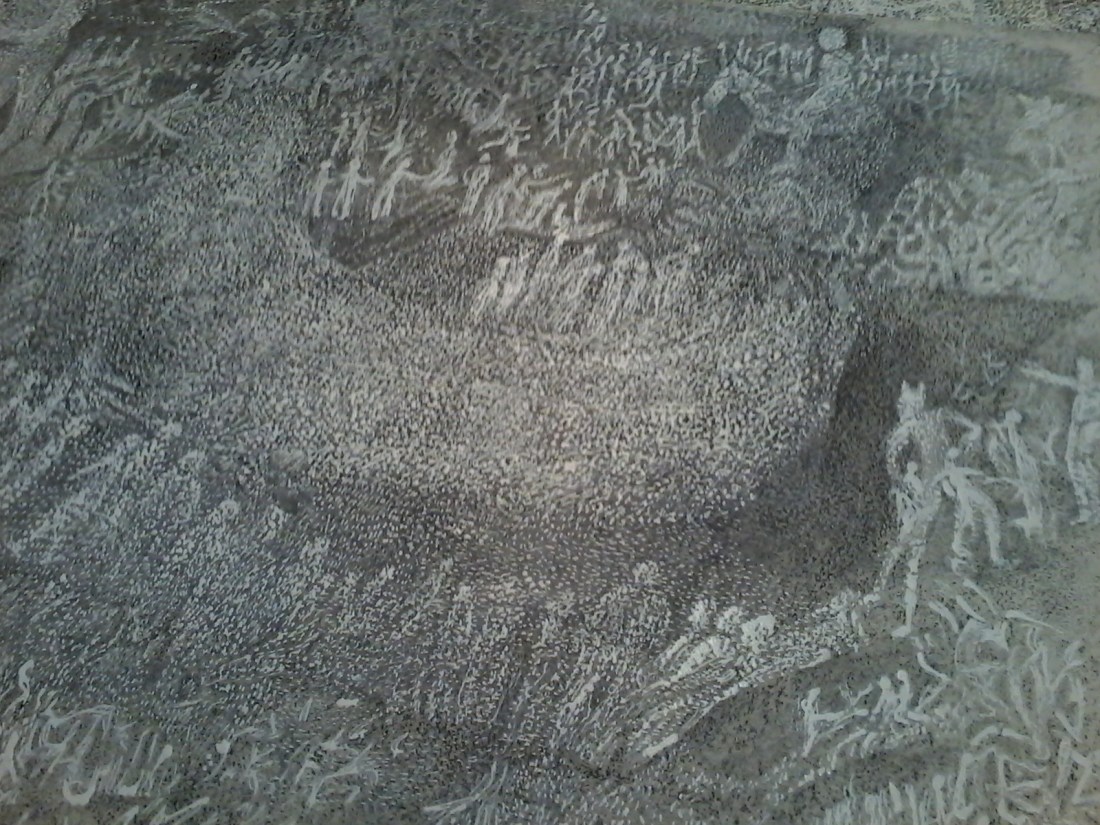
DIBUJOS DE TINTA SOBRE PAPEL/ PEN AND INK DRAWINGS
Y mañana serán árboles/And Tomorrow They Will Be Trees
La imagen de mis padres casándose y navegando en un pequeño bote hacia la Argentina/The picture of my parents getting married and travelling in a small boat toward Argentina
____________________________________
La rebelión de los árboles/The Rebellion of the Trees
Ben Molar nació en Buenos Aires en 1915. Fue autor, compositor, difusor, productor y promotor artístico. Se destacó por producir versiones en español de las canciones más famosas de la época, como “Las hojas muertas”, “Repican las campanas”, “Noche de paz, noche de amor”, etc. Algo similar con canciones de “Los Beatles ”, Paul Anka, Elvis Presley y muchos otros. Era común leer en las piezas musicales o en las etiquetas de los álbumes: “versión en español Ben Molar”. No fueron traducciones literales, sino interpretaciones idiomáticas que facilitaron su comprensión en Argentina y países de América Latina. Cabe mencionar la composición de boleros famosos como “Final”, “Sin importancia” y “Empecemos de nuevo”, escritos junto a Paul Misraki , famoso músico y autor turco francés, durante su exilio en Buenos Aires. Fue el responsable del éxito de figuras como Mercedes Sosa, Sandro, “Los Cinco Latinos”, Lito Nebbia. “Abuelos de la nada”. Creó “El Club del Clan” y fue el principal impulsor de Palito Ortega. Creó el sello musical “Fermata”, con el que produjo en 1966 el disco titulado “14 con el tango”. Supuso la creación de 14 piezas musicales y 14 pinturas que reunieron a las figuras más destacadas de cada categoría. El resultado de este esfuerzo incrementó la difusión del tango, en un período desfavorable. En 1995, “Fermata” produjo “Los 14 con Julio Caro”, un homenaje al Maestro, por famosos solistas de tango. Se casó con la actriz de cine Pola Newman, con quien tuvo dos hijos. Fue Presidente de Honor de la Asociación de Gardeliana Argentina, Miembro de la Academia Porteña del Lunfardo, Miembro de la CD del Instituto Cultural Argentino Israelí y Ciudadano Ilustre de Buenos Aires.
Ben Molar, was born in Buenos Aires in 1915. He was an author, composer, diffuser, producer and artistic promoter. He stood out for producing Spanish versions of the most famous songs of the time, such as “Las hojas muertas”, “Repican las campanas”, “Noche de paz, noche de amor”, etc. Something similar with songs from “ The Beatles”, Paul Anka, Elvis Presley and many others. It was common to read in the pieces of music or on the labels of the albums: “version in Spanish Ben Molar”. They were not literal translations, but idiomatic interpretations that facilitated their understanding in Argentina and Latin American countries.It is worth mentioning the composition of famous boleros such as “Final”, “Unimportant” and “Let’s Start Again”, written together with Paul Misraki, famous French Turkish musician and author, during his exile in Buenos Aires. He was responsible for the success of figures such as Mercedes Sosa, Sandro, “Los Cinco Latinos”, Lito Nebbia. “Grandparents of Nothing.” He created “El Club del Clan” and was the main promoter of Palito Ortega. He created the musical label “Fermata”, with which he produced in 1966 the album entitled “14 con el tango”. It meant the creation of 14 musical pieces and 14 paintings bringing together the most notable figures in each category. The result of this effort increased the diffusion of tango, in an unfavorable period. In 1995, “Fermata” produced “Los 14 con Julio De Caro”, a tribute to the Maestro, by famous tango soloists. He married film actress Pola Newman, with whom he had two children. He was Honorary President of the Argentine Gardeliana Association, Member of the Porteña del Lunfardo Academy, Member of the CD of the Argentine Cultural Institute Israeli and Illustrious Citizen of Buenos Aires.
Klezmer proviene de orígenes yiddish que significa literalmente “instrumentos de canción”. Se usa ampliamente para referirse a las tradiciones musicales populares de los judíos Ashkenazi de Europa del Este. Definir el repertorio y las raíces de Klezmer con exactitud es una tarea compleja. Entre sus fuerzas perdurables está la capacidad de integrarse y combinarse con un espectro de tradiciones musicales donde sea que se encuentre la diáspora judía: los Balcanes, Europa oriental e ibérica, el norte de África, el Medio Oriente y las Américas. La música Klezmer es tocada, disfrutada y bailada enérgicamente por las poblaciones judías de América Latina.
______________________________
Klezmer vem de origens iídiche, que significa literalmente “instrumentos de música”. É amplamente usado para se referir às tradições musicais populares dos judeus asquenazes da Europa Oriental. Definir o repertório e as raízes de Klezmer com exatidão é uma tarefa complexa. Entre suas forças duradouras está a capacidade de integrar e combinar com um espectro de tradições musicais onde quer que a diáspora judaica seja encontrada: os Bálcãs, a Europa Oriental e Ibérica, o Norte da África, o Oriente Médio e as Américas. A música Klezmer é tocada energeticamente, apreciada e dançada pelas populações judaicas da América Latina.
_________________________________
comes from Yiddish origins meaning literally “instruments of song.” It is broadly used to refer to the popular musical traditions of Eastern Europe’s Ashkenazy Jews. Defining Klezmer repertory and roots with exactness is a complex task. Among its enduring forces is a capacity to integrate and combine with a spectrum of musical traditions wherever Jewish diaspora is found: the Balkans, Eastern and Iberian Europe, North Africa, the Middle East, and the Americas. Klezmer music is energetically played, enjoyed and danced to by the Jewish populations of Latin America.
César Lerner y Marcelo Moguilevsky formaron un dúo prolífico que hizo una importante contribución y abrió nuevas tendencias en la música Klezmer en Argentina. Han contribuido a la recreación del estilo Klezmer desde 1996 sin pretensiones antropológicas. ———————————–
Cesar Lerner and Marcelo Moguilevsky formed a prolific duo making an important contribution Klezmer music in Argentina. They have contributed to the recreation of Klezmer style since 1996 without anthropological pretension.
APOIANDO KLEZMER: INSTITUTO DA MÚSICA JUDAICA – BRASIL
tem como missão promover, divulgar, ensinar, preservar e desenvolver a música do povo judeu, essa grande e maravilhosa herança, em benefício da presente e das futuras gerações.
__________________________
SUPPORTING KLEZMER: THE INSTITUTE OF JEWISH MUSIC -BRAZIL Its mission is to promote, disseminate, teach, preserve and develop the music of the Jewish people, this great and wonderful heritage, for the benefit of the present and future generations.
Santiago Klezmer Band, es una banda formada por músicos chilenos, dedicada a tocar parte del repertorio más representativo de la música klezmer y yiddish swing..
___________________________________
Santiago Klezmer Band, is a band formed by Chilean musicians, dedicated to playing part of the most representative repertoire of Klezmer and Yiddish swing music._
Benjamin Shwartz, violista, pianista y compositor decidió experimentar con sonidos antiguos y nuevos y sabores diferentes en 2003 integrando la música Klezmer desde un punto de vista mexicano. Klezmerson combina con gracia melodías y ritmos de la tradición judía de Europa e interactúa con influencias gitanas y mexicanas, crea una fusión peculiar que incluye improvisaciones de rock, funk y jazz.
_____________________________________
Benjamin Shwartz, violist, pianist and composer decided to experiment with old and new sounds and different flavors back in 2003 integrating Klezmer music from a Mexican standpoint. Klezmerson gracefully combines melodies and rhythms from Europe’s Jewish tradition and interacts with gypsy and Mexican influences, it creates a peculiar fusion including rock, funk and jazz improvisations
La Klezmeron Orkestra FINOLI surge por interés de aprender, difundir y disfrutar la música klezmer y otros folclores europeos, como la música de los balcanes, no necesariamente en el ámbito estrictamente judío, sino abrirnos a la sociedad uruguaya en su conjunto. El repertorio incluye composiciones propias del grupo, cada vez más, y melodías tradicionales con arreglos originales, donde fusionamos con la música uruguaya y otras expresiones. — Fernando Natan
_______________________________________
La Klezmeron Orkestra FINOLI came about in the interest of learning, disseminating and enjoying Klezmer music and other European folklores, such as the music of the Balkans, not necessarily in the strictly Jewish sphere, but open to Uruguayan society as a whole. The repertoire includes the group’s own compositions, more and more, and traditional melodies with original arrangements, where we merge with Uruguayan music and other expressions. — Fernando Natan