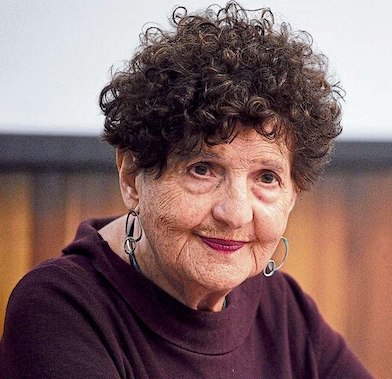
Ana María Shua — Novelista y Cuentista judío-argentina/Argentine Jewish Novelist and Short-story Writer– “El idioma/”The Language”– fragmento de “El libro de los recuerdos”/excerpt from “The Book of Memories”

Ana María Shua

_______________________

Ana María Shua nació en Buenos Aires. Siendo hija de padre padres judíos, padre libanés y madre polaca, que emigraron en los años 20 a Argentina. A los 15 años publicó su primer libro de poesía, El sol y yo que fue un éxito. Recibió dos premios, el Premio estímulo del Fondo Nacional de las Artes y la Faja de Honor de la Sociedad Argentina de Escritores. Estudió literatura en la Universidad de Buenos Aires donde obtuvo un Máster en Art. En 1976, hubo un golpe de estado en Argentina Shua se dirigió voluntariamente al exilio en París y trabajó como editora para la revista española “Cambio 16”. Regresó al cabo de un año a su tierra natal y publicó su primera novela Soy Paciente en Buenos Aires en 1980, considerada por los críticos metáfora interpretada por el régimen dictatorial. Algunas de sus obras fueron traducidas a múltiples lenguas y dos de sus novelas fueron llevadas al cine: Soy Paciente (1986) y Los amores de Laurita (1986). Desde entonces ha publicado más de ochenta libros de muchos géneros, incluyendo: novelas, cuentos, micro-ficciones, poesía, teatro, literatura infantil, literatura cómica, la antología, ensayos y guiones cinematográficos y artículos periodísticos. Ha recibido numerosos premios nacionales e internacionales, incluyendo una beca otorgada por la John Simon Guggenheim Memorial Foundation. Es particularmente famosa en el mundo de habla hispana como la “Reina de la Microficción”.

Adaptado de Fandom.com

___________________________________________________

Ana María Shua was born in Buenos Aires. Being the daughter of a Jewish father, a Lebanese father and a Polish mother, who emigrated to Argentina in the 1920s. At the age of 15, he published his first book of poetry, El sol y yo, which was a success. He received two awards, the Stimulus Award from the National Fund for the Arts and the Belt of Honor from the Argentine Society of Writers. She studied literature at the University of Buenos Aires where she obtained a Master’s in Art. In 1976, there was a coup in Argentina. Shua voluntarily went into exile in Paris and worked as an editor for the Spanish magazine “Cambio 16”. He returned to his homeland after a year and published his first novel Soy paciente in Buenos Aires in 1980, considered by critics to be a metaphor interpreted by the dictatorial regime. Some of his works were translated into multiple languages ​​and two of his novels were made into movies: Soy paciente(1986) and Los amores de Laurita (1986). Since then he has published more than eighty books of many genres, including: novels, short stories, micro-fictions, poetry, theater, children’s literature, comic literature, the anthology, essays and film scripts and newspaper articles. He has received numerous national and international awards, including a fellowship from the John Simon Guggenheim Memorial Foundation. She is particularly famous in the Spanish-speaking world as the “Queen of Microfiction”.

                                                                                                                Adapted from Fandom.com

_________________________________________________________________

images-1

                                                                 ________________________________

“El idioma”

Cuando el mayor de los hijos del abuelo Gedalia y la babuela, el que llegaría a ser, con el tiempo el tío Silvestre, empezó a ir a la escuela, todavía (como suele suceder con los hijos mayores en las familias de inmigrantes pobres) no dominaba el idioma del país.

           Esa desventaja con respecto a los compañeros le produjo grandes sufrimientos morales. Tardó pocos meses en poseer un vocabulario tan amplio como cualquiera d e los demás chicos, modificó con gran rapidez sus errores sintácticos y gramaticales en castellano, pero le llevó años enteros llegar a pronunciar la terrible erre de la lengua española, la fricativa alveolar sonora: la punta de su lengua resistía a vibrar con ese sonido de motor que escuchaba y envidiaba en niños mucho más pequeños que él, vibración que era capaz de imitar con el labio superior, pero no con el maldito punta de su lengua. (Pinche, que aprendió a hablar imitándolo a Silvestre, como lo imitaba en todo lo demás, nunca pudo llegar a pronunciar la doble erre, que a Silvestre sólo se le entregó mucho después, ya en plena adolescencia).

Decí regalo, le decían los otros chicos. Decí erre con erre guitarra, le decían. Decí que rápido ruedan las ruedas, las ruedas del ferrocarril. Y cuando escribía, Silvestre confundió territorio con terítorrio y la maestra se sorprendía de esa dificultad en un alumno tan bueno, tan brillante, tan reiteradamente abanderado.

           Entonces, un día, llegó Silvestre enojado y decidido a la Casa Vieja y declaró que en esa casa no se iba a hablar nunca más el Otro Idioma, el que sus padres habían traído con ellos del otro lado del mar. Ese idioma agonizante que tampoco en el país donde el abuelo Gedalia y la babuela habían vivido era la lengua de todos, la lengua de la mayoría, que ni siquiera era la lengua que los habían obligado a usar en la escuela pública, pero que sí había sido el idioma para ellos, el Idioma de sus padres y el de sus amigos y el de juegos infantiles y las canciones de cuna y las primeras palabras de amor los insultos y, par siempre, el Idioma de los números: el único Idioma en el que era posible hacer las cuentas . El Otro Idioma, el íntimo, el propio, el verdadero, el único, el Idioma de ningún país, el Idioma que tantos se burlaban, al que muchos llamaban jerga, el Idioma que nadie, salvo ellos y los que eran como ellos, respetaban y querían. El Idioma que estaba condenado a morir con su generación.

           Y sin embargo cuando llegó Silvestre, llegó ese día en la escuela y sin sacarse el delantal declaró que la señorita había dado el orden que en su casa tenían que hablar solamente castellano, nadie se sorprendió.

           Al abuelo Gedalia le gustó mucho la idea por dos razones: porque necesitaba, para su trabajo de kuentenik, es decir, vendedor, mejorar todo lo posible en su habilidad con la lengua del país en qué vivía, y también porque se le presentaba una oportunidad más de humillar a su mujer delante de sus hijos (esa actividad era una de sus diversiones preferidas).

           A la babuela, que nunca había hablado de corrido la lengua de la mayoría, ni siquiera en su país de origen, el castellano le parecía un idioma brutal, inexpresivo, y sobre todo inaccesible, y hasta ese momento se las había rebuscado con gestos con gestos y sonrisas u algunas palabras para hacer las compras. En la época en la cual el carnicero regalaba el hígado para el gato de la casa. La babuela señalaba el trozo de hígado sangrante y sonreía muy avergonzada y el carnicero

Se lo envolvía en un pedazo grande de papel de diario.

           Pero si así lo había dicho la señorita, así debía ser. La babuela le tenía miedo a la maestra, que era para ella casi un funcionario de control fronterizo, alguien destacado por las autoridades de inmigración para vigilar desde adentro a las familias inmigrantes y asegurarse de que se fundieran correctamente el crisol de razas.

           Y asî fue como el idioma de las canciones de cuna y las palabras de amor y los insultos de lo que con el tiempo llegaron a ser los abuelos, desapareció, al menos en la superficie, de la casa de la familia Rimetka, quedó para siempre encerrado en el dormitorio grande y los hermanos menores apenas lo entendían.

           Fuera del dormitorio, el abuelo Gedalia se complacía en no entenderse con su mujer en castellano de manera más completa y al mismo tiempo más sutil que la que usaban para no entenderse en la que era para ambos su Lengua natal. Es por eso que en el Libro de los Recuerdos son muy pocas o ninguna las palabras que no aparecen en castellano.

Ana María Shua. El libro de los recuerdos. Buenos Aires: Editorial Sudamericana, 1994, 21-23.

________________________________________________________________________________________

images-3

                                                                 _______________________________

“The Language”

When the eldest of Grandfather Gedalia and Granny’s children began attending school, he still hadn’t mastered the language of the country (as was customary with the eldest in families of poor immigrants.)

           This disadvantage, in terms of his relationship with other school mates, caused him great suffering. Yet it didn’t take him long to acquire an ample vocabulary equal to the other students, and he quickly learned how to mitigate his syntactical and grammatical errors in Spanish. Nevertheless, it took him several years to learn to roll that terrible Spanish double rr, that sonorous alveolar fricative in which the tip of his tongue refused to vibrate like the sound of a motor—you know—you know, vrrrrrrm—that he would hear children younger than him pronounce, making him envious, a sound that he could imitate with his upper lip but not with that damned tip of his tongue.

           Pucho, the second in line, who learned to speak by imitating Silvester (he imitated Silvester did), never did learn how to pronounce that double rr either, the same one that Silvester only managed to acquire much later in life, when he was already a teenager,

           “Say rrrregalo,” the other children would tell him. Or, they’d tell him to say “rr and rr, guitarra”” rápido ruedan las ruedas, laas recueros del ferrocarril.” And when he would write, Silvester always put teritorio for territorio, which surprised the teacher because Silvester was such a good student, so brilliant, a real standard bearer.

           Then on day, Silvester, who had become visibly upset, arrived at the Old House, having made up his mind that never again in that house was anyone was going to speak the Other Language, the one his parents had brought over from the old country; the language that was dying and wasn’t even the main language spoken in his parent’s native land, or taught in the public schools they had attended. It had been the language commonly used by their parents among their friends, for children’s games and lullabies, for their first words of love, for insulting, and always, counting; the only language in which they could do their adding and subtracting. It was that Other Language, the intimate language, the one they could call their own, the true language, the only language, the language, the one language

that knew no national boundaries, the one language that people joked about, the one so many people called jargon, the language that no one, except for them and others like them, loved and respected. The language was condemned to die with them.

           And yet no one was when Silvester came home from school that day and, even before taking off his school uniform, that the teacher had told them to speak only Spanish at home.

           Grandfather Gedalia liked the idea for two reasons: it enhanced his work as a peddler, that is to say, salesman, because it was a good opportunity to improve his Spanish. And also, because it gave him the opportunity to humiliate his wife in front of his children (which gave much pleasure.)

         For Granny, who didn’t even manage well in the majority of her country back home, Spanish seemed like a harsh, unexpressive language that was, above all, inaccessible. Up until that time, she had done her shopping mainly by gesturing and smiling. That was when the butcher at the meat market would give her liver for the cat. Granny would point at the bloody piece of meat and smile embarrassingly while the butcher wrapped it up in a large piece of newspaper.

         But if that’s what the teacher had ordered. That’s the way it had to be. Granny was a little afraid of the teacher who seemed to her more like a member of the border patrol under orders from the immigration authorities keeping an eye on immigrants and making sure they conform, integrate, and become part of the melting pot.

         And, hence, that’s how the grandparents became identified with the language of lullabies, love, and insults that in time began to disappear, at least on the surface of things, from the home of the Rimetka family. Once it became confined to the master bedroom, the two younger children, never did fully grasp the language.

         Beyond the bedroom. Grandfather Gedalia was quite happy not understanding his wife in Spanish, just as they didn’t understand each other in their native language. For that reason, you will only find Spanish in the Book of Memories.       

Ana María Shua. Albuquerque: The Book of Memories. The University of New Mexico Press, 1998. Trans. by Dick Gerdes. pp. 17-19

______________________________________________________

Unos libros de Ana María Shua/Some of Ana María Shua’s Books

Margo Glantz — Escritora judío-mexicana/ Mexican Jewish Writer — “Las genealogías”/ “The Genealogies” — Biografía famosa de su familia/Famous Biography of her family — dos capítulos claves del libro/two key chapters of the book

Margo Glantz

Marzo Glantz – Amazon 

Margo Glantz (Ciudad de México, 1930) Escritor, conferenciante y periodista. Después de graduarse de la UNAM, Glantz continuó su educación en París, donde recibió su doctorado en la Sorbona. En 1958 inició su carrera académica dando clases en la UNAM. Fundó y editó la revista Punto de Partida de la UNAM en 1966. En el campo de la difusión cultural ocupó diversos cargos: Directora del Instituto Cultural Mexicano-Israelí (1966-1970), del Centro de Lenguas de la UNAM. Extranjeras (1970-1971) y el puesto de Literatura en el Instituto Nacional de Bellas Artes (1983-1986), entre otros. De 1986 a 1988 fue agregada cultural de la Embajada de México en Londres. Desde 1995 es miembro activo de la Academia Mexicana de la Lengua. Es profesora emérita de la UNAM, columnista del diario mexicano La Jornada y novelista. Margo Glantz ha ganado numerosos premios y distinciones literarias durante su carrera como escritora, entre ellos el Premio Sor Juana de la Cruz por su novela El rastro (2004), el Premio Javier Villaurrutia por su novela Síndrome de naufragios (1984), el Premio Magda Donato de El árbol genealógico (1982) y el Premio Universidad Nacional (1991). Ganó el Premio Nacional de Artes y Ciencias en el campo de Lingüística y Literatura en 2004, el premio de la Feria Internacional del Libro de Guadalajara en 2010 y el Premio de Ficción Manuel Rojas (2015). Sus últimos libros son Coronada de moscas (2012), Yo también me acuerdo (2014), La cabellera andante (2015) y Por breve herida (2016).

Adaptado de Encyclopedia.com

___________________________________

Margo Glantz (Mexico City, 1930) Writer, lecturer and journalist. After graduating from UNAM, Glantz continued her education in Paris, where she received her doctorate from the Sorbonne. In 1958 she began her academic career, lecturing at UNAM. She founded and edited the UNAM magazine, Punto de Partida, in 1966. In the field of cultural dissemination, she held a number of positions: Director of the Instituto Cultural Mexicano-Israelí (1966-1970), of UNAM’s Centro de Lenguas Extranjeras (1970-1971) and the Literature post at the Instituto Nacional de Bellas Artes (1983-1986), among others. From 1986 to 1988 she was the cultural attaché at the Mexican Embassy in London. Since 1995 she has been an active member of the Academia Mexicana de la Lengua. She is an emeritus professor at UNAM, columnist for the Mexican newspaper La Jornada and a novelist. Margo Glantz has won many literary prizes and distinctions during her writing career, including the Sor Juana de la Cruz Prize for her novel El rastro (2004), the Javier Villaurrutia Prize for her novel Síndrome de naufragios (1984), the Magda Donato Prize for The Family Tree (1982) and the Universidad Nacional Prize (1991). She won the National Arts and Sciences Award in the field of Linguistics and Literature in 2004, the Guadalajara International Book Fair award in 2010, and the Manuel Rojas Fiction Prize (2015). Her latest books are Coronada de moscas (2012), Yo también me acuerdo (2014), La cabellera andante (2015) and Por breve herida (2016).

Adapted from Encyclopedia.com

______________________________________________________

___________________________________________

Las genealogías

(dos fragmentos)

XLVIII 

Los proverbios no son eternos. Mi padre los condimenta. A ésa muy conocido que reza: “Al ojo del amo engorda el caballo”, mi padre lo agrega, “pero enflaca al amo”, clave útil por entender por qué nuestro signo comercial fue tan variado. Ya he dicho que mis padres transitaron por los oficios y que, en resumidas cuentas, se detuvieron sobre todo aquello que tiene que ver con la manducación y con el calzado. Las reiteradas ocasiones en que la comida tuvo que ver en mi casa terminaron, al principio, en fracaso: un cafecito en las calle Guatemala, a pesar de que mi padre era un asiduo frecuentador de cafés y restaurantes, cafés donde se reunía la tertulia literaria en ese México ya desaparecido.

            El restaurante de Guatemala fue abandonado en un apagón, creo, porque mi padre prendió una lamparita de gasolina e incendió el local. Quizá exagero, pero entre las cosas quemadas está un monedero  de piel que mi mamá recibió de sus hermanos cuando cumplió quince años, monedero que llevaba grabados en oro algunos de sus nombres y que ahora se insertan en un viejo álbum de fotografías con tapas de marfil que conserva mi hermana menor Shulamis. Todo queda en familia, menos el primer café que luego se vuelve, hacia 1954, el Genova Coffee Shop (¿por qué inglés, no lo sé, o más bien, sí, era un barrio turístico o empezaba a serlo): allí se inicia mi padre en los problemas de la galería artística y empieza a exponer obras de pinturas en ese entonces poco conocidos; primero, como es natural, a los muralistas, luego empiezan a pasar, ya por el Carmel, los nuevos, Manuel Felguérez, Lilia Carillo, Brian Nissen, Leonel Góngora, Pedro y Rafael Coronel, López Loza, Arnaldo Coen, etcétera. El pan comenzó a vender muy pronto y su persistencia en mantenernos duró varios años: en los intersticios, algunas corbatas, mucho papel, peines de acero (quizá para despiojarnos en esos tránsitos por las escuelas públicas) y el paso indeterminado por distintos domicilios y, por consiguiente, el cambio constante de escuelas, la sensación de exilio permanente, los sobre saltos, quizá ya en los juegos de Chapultepec adonde nos llevaba a montar a burro o a caballo    . . .           

            El pan se mantenía caliente y también las muelas cuando se arrancaban de la boca. El Carmel se asocia con pasteles ya muy elaboradas, pasteles vieneses, o esos pasteles de manzana llamados strudl; mi madre solía hacerlos por domesticidad pura y sencilla y de pronto se transformaron en posibilidades de ganancia. Luego los cuernitos de nuez y al lado, Felguérez adornando con cuerdas marineras la incipiente galería donde se exhibirían algunas de sus primeras obras. Juan García Ponce solía aparecer y también Jaime García Terrés, el novio eterno de con Celia Chávez; Juan de la Cabada contaba cuentos en el restaurante y comía allí cuando no tenía dinero para ir a otra parte, Arreola organizaba sus talleres, cenaban y hacían poesía Gabriel Carbajal, Armando Zárate, Luis Mario Schneider. Mi padre iba de mesa en mesa respondiendo a las peticiones de esos gringos que venían a comer en México guisos estilo kosher—nunca ortodoxamente preparados—siempre reminiscencias de los pescados rellenos o del maná convertido en sopa que comíamos durante las fiestas religiosas celebradas en casas de mis tías pelirrojas que llegaron a México desde Constantinopla, trayendo en los cuellos esos largos collares de ámbar rojo que fueron las canicas de mi infancia. También había borsht (no sé si así se escribe) y golubzes, col rellena con carne.      

_____________________________

L

Marc Chagall es nonagenario y como en sus pinturas, sigue volando por los techos. Algunas veces realizó uno de estos viajes con mis padres, pues el destino se prepara desde la más tierna infancia, y como ya lo he dicho varias veces, el pueblo de mi padre se llama Novo Vitebsk y se construyó con las sobras del pueblo donde nació Chagall, Vibebsk, pueblo de casas de madera con tzerbas (iglesias rusas) y con sinagogas de shtétl, pueblitos de judíos sin dinero y con barbas.

            –Hay quienes consideran la vejez como naufragio—dice mi padre–, casi como estas aves que cruzan por los pantanos sin marcharse.

            Y lo dice por Chagall, a quien conoció en México al principio de la década de los cuarenta, por intermedio de Diego Rivera, quien lo presenta así ante al maestro, en carta de agosto 13 de 1942 (la traduzco porque estaba en francés):

            He aquí que sin todavía tener el placer de verlo le dirijo otra carta. Mi amigo , el escritor Yacob Glantz, redactor (poeta y crítico de arte) de la Gaceta Israelita de México, quiere entrevistarlo para su periódico.  Por eso, me veo obligado molestarle de nuevo con mi correspondencia. Agradezco de antemano la atención que prestará usted a mi amigo Glantz.

            ¿Está usted bien aquí? Esperando tener el placer saludarlo, quedo de usted. Diego Rivera.

            Y la repetición se instaura en la novedad. Y mi padre se instala en Bellas Artes y observa las idas y venidas del pintor. Rehace los trayectos antes hechos con Orozco, con Rivera, y con Fernando Leal. Ahora lo visita diariamente en el escenario de Bellas Artes. “donde trepaba escaleras para dibujar coreografía del ballet Aleka  de Dugalieff, basado en el poema de Alejandro Pushkin, Tzigany (Gitanos)”.

            También estaba Bella, “su inspiradora”. La que le sirvió de modelo por muchas de sus famosas pinturas: La novia vestida de blanco, La boda, El entierro, etcétera.

            –La consultaba siempre.

            Chagall era muy cordial—cuenta mamá—muy simpático. Y su primera mujer, Bela, con la que había vivido casi todo el tiempo, era amable, muy preparada. Se habían conocido donde muy chicos, y cuando él se fue a estudiar fuera de Virtebsk, ella se quedó en Rusia haciendo altos estudios.

            Los Chagall permanecen en la Ciudad de México un breve tiempo, casi de incógnito, allá por los años 40, y van a visitar a mis padres, toman el té y blintzes con ellos. Bella lee sus poemas y sus cuentos, entre ellos uno que se llama pleonásticamente “Velas encendidas”, por los candeleros que se encienden los viernes por la noche.

            –Hay que buscar el libro.

            Y por un azar feliz y extraño lo encuentra, también otro, en yidish, que se llama “El primer encuentro”, y otro más, traducido al sueco: “Con amor”.

            En Saint Paul de Vence también lo visita, en 1964.

            –Llamé desde París y me dijo: “Toma un coche y ven a verme”. Le contesté: ¿Cómo puedo ir , si estoy en París?”. “Entonces toma un tren”, me dijo.

            Al llegar a la estación lo esperaba un chofer, un ruso blanco, aristócrata.

            –La casa tenía un hermoso parque y caballos. Tenía muchas cuadras que nunca quiso vender.

            Y para confirmar la ley de las reiteraciones, mi padre entra de nuevo al tabernáculo.

Y observó al pintor dentro de su estudio.

            –A nadie dejaba entrar en donde pintaba y yo sí entré. No entendía entonces la importancia de que me pintara.

            Mi madre intercala:

            –Siempre se entiende tarde.

            Jacobo escribió en yidish un texto sobre Chagall y sus personajes, y al enseñárselo, le preguntó:

            ¿Por qué lo lee con tanto interés? ¿A poco no está cansado de leer lo que otros escriben sobre usted??”

             ¿Qué saben los demás de mí?—me contestó. Usted, sí, lo que usted dice, vale la pena”.

_______________________________________________

The Genealogies

(two excerpts)

XLVIII

The proverbs are not eternal. My father seasons them. To this very well-known one that claims: “The master’s eye makes the horse fat,” my father adds, “but makes the master skinny,” a useful key for understanding why our commercial trail was so varied. I have already said that my parents moved around in various trades, and to sum it up, they most often stopped on that which had to do with grub and shoes. The reiterated occasions with food had to be seen in my house, ended, at first, in disaster: a small café on Guatemala Street, in spite of the fact my father was an assiduous frequenter of cafés and restaurants, cafés where the literary gatherings met in that Mexico now disappeared.

The restaurant on Guatemala was abandoned during a blackout, I believe, because my father took a small gasoline lamp and burnt down the place. Perhaps, I exaggerate, but among the scorched articles was a change purse that my mama had received from her brothers and sisters on her fifteenth birthday that had some of their names engraved in gold and that now is inserted in an old photograph album with marble covers that my youngest sister Sholomis keeps aside. Everything stays in the family, except the first café, that later became, in 1954, the Genova Coffee Shop. (Why English? I don’t know, or more likely, yes, it was a tourist area or was beginning to be one): there my father was initiated in the problems of an art gallery and began to show paintings by, at that time, little-known artists; first, as was to be expected, the muralists, then began to pass by, still by the Carmel, the new ones: Manuel Felguérez, Lilia Carillo, Brian Nissen, Leonel Góngora, Pedro y Rafael Coronel, López Loza, Arnaldo Coen, etcetera. The bread began to sell very quickly, and its persistence in supporting us, lasted for several years. In the intervals, some neckties, a lot of paper, iron combs (perhaps to delouse us during those transits through the public schools) and the indeterminate movement through districts, and, as a result, the constant change of schools. The sensation of permanent exile, the summersaults, perhaps, already experienced in the Chepultepec playgrounds where we were carried by burros or horses. . .

The bread stayed hot and also your molars when you pulled them from your mouth. The Carmel neighborhood was associated with very elaborate pastries, Viennese pastries, or those apple pastries called strudel; my mother continued to make them for domesticity, pure and simple; they were suddenly were transformed in a means of earning money. Then, the little horns of walnuts, and all around Felguérez adorning with maritime ropes the incipient gallery where some of his early works would be exhibited. Juan García Ponce often came by and also Jaime García Terrés, the eternal boyfriend of Celia Chávez; Juan de la Cabada told stories in the restaurant and ate there when he didn’t have the money to go elsewhere, Arreola organized his workshops, Gabriel Carbajal, Armando Zárate, Luis Mario Schneider had supper and wrote poetry. My father went from table to table, responding to the requests of the gringos who came to eat in Mexico, kosher-style plates—never prepared in the orthodox manner—always reminiscent of the stuffed fish or the manna from heaven converted into soup that we ate during the religious festivals celebrated in the houses of my red-haired aunts who arrived to Mexico from Constantinople, carrying on their necks those large collars of red amber that were the marbles of my childhood. There was also borsht (I don’t know if it is spelled like that) and golubses, cabbagestuffed with meat.

___________________________________________

_________________________________________

L

Marc Chagall is a nonagenarian  and as in his paintings, continues flying over the rooftops. Sometimes, he made one of those trips with my parents, since destiny prepared for it from the earliest infancy, and as I had said before several times, my father’s town is called Nove Vitebsk and it was built one what was left of the town where Chagall was born, a town of wooden houses with tzerbas (Russian churches) and with shtetl synagogues of Jews without money and with beards.

            There are those who consider old age as a ship wreak—my father says–, almost like these birds that cross the swamps without leaving them.

            And he said it about Chagall, whom he met in Mexico at the beginning of the forties, by the intervention of Diego Rivera, who presented him so to the maestro, in a letter on August 13, 1942 (I translate it as it was in French,)

As I have not yet had the pleasure of seeing you, I send you another letter. My friend, the writer, Yacob Glantz, editor (poet and art critic) for the Israelite Gazette of Mexico, would like to interview you for his paper. For that reason, I see myself obliged to bother you again with my correspondence. I thank you in advance for the attention that you lend to my friend Glantz.

            Are you well here? Hoping to have the pleasure of greeting you, Yours, Diego Rivera.

And the repetition is found in the new. And my father set himself up in the Palace of Fine Arts and observed the comings and goings of the painter. He redid the trajectories already taken with Orozco, with Rivera, and with Fernando Leal. He visited him daily in the Fine Arts stage “where he climbed stairs to design the choreography for the ballet Aleka by Diaghilev based on a poem by Alexander Pushkin, Tzigany (Gypsies.)”

            Bella was there too, “his inspiration.” The one who served as the model for many of his famous paintings, The Bride Dressed in White, The Wedding, The Burial, et cetera.

            The Chagalls stayed in Mexico City for a short time, almost incognito, there during the forties, and they went to visit my parents, had tea and blintzes with them. Bella read his poems and his stories, among them one called pleonasticly “Lit Candles” for the candle sticks lit on Friday night

            “We must look for the book.”

            And by a happy and strange chance, he found it, and another one, in Yiddish, that is named The First Meeting, and yet another translated into Swedish: With Love.

             He also visited him in Saint Paul de Vence in 1964.

“I called from Paris, and he told me: “Take a car and come to see me.” I answered him, “How can I come, I am in Paris?” “Then take a train,” he told me.

            On arriving at the station, a driver was waiting, a White Russian, an aristocrat.

            “The house had a pretty garden and horses. He had many paintings that he never wanted to sell.”

            And to confirm the law of repetitions, my father once again entered the tabernacle. And he observed the maestro in his study.

            “He didn’t allow anyone to enter where he painted, and I did enter. I didn’t understand then the importance of what he was painting for me.”

            My mother interjected:

            “You always understand too late.”

            Jacob wrote in Yiddish a text about Chagall and his characters, and on showing it to him, he asked him?

            “Why are you reading it with so much interest? Aren’t you a bit tired of reading what others write about you?”

            “What do the others know about me?” he answered me. You, yes, what you say, is worth the trouble.”

_____________________________________________________________

Algunos de los muchos libros de Margo Glantz

Some of the many books by Margo Glantz

Amazon: Margo Glantz