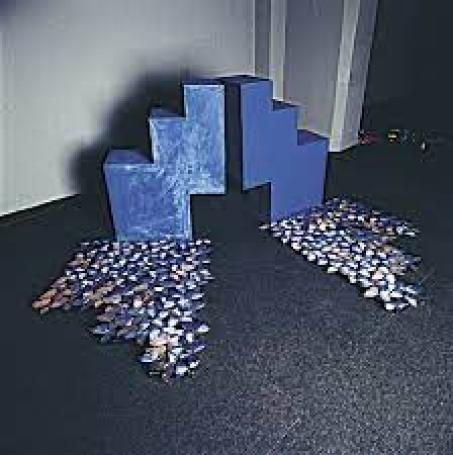
Su obra ha sido un intento por encontrar su lugar en el mundo. Si bien Esther Vainstein nació en Lima en 1947, sus orígenes están en Polonia y Rumania, de donde vinieron sus padres antes de estallar la Segunda Guerra Mundial. Eso los salvó del exterminio nazi. Sin embargo, la mayoría de su familia judía en Europa pereció en loscampos de concentración. Actualmente, ella tiene una hermana y dos hijas que viven desde hace buen tiempo en Estados Unidos. Por eso, dice: “Soy la primera y la última generación de mi familia en el Perú”.Esto la llevó a buscar sus raíces a través de sus proyectos artísticos, y decidió adoptar el desierto costeño como su patria. “Yo no conozco Polonia ni Rumania y tampoco tengo ganas de ir porque no quiero visitar los campos de concentración. Esto es como una búsqueda de raíces en un país que no es el mío, como tampoco lo son Polonia ni Rumania. Yo estudié cine y trabajé nueve años en la BBC de Londres haciendo documentales sobre el Perú, viajé mucho y descubrí el desierto que para mí resulta fantástico. Es un tema recurrente en mi obra desde hace 40 años”, dice.Y el desierto costeño está conectado con lo precolombino, con culturas como Chancay, Paracas y Nazca, temas que Esther Vainstein ha desarrollado en pinturas e instalaciones como la realizada en 2007, en el ICPNA, titulada Ofrendas de Barro y Viento / Cadencia y variaciones, una exposición antológica de su obra, donde construyó una huaca enorme en la sala miraflorina. “Ese año ocurrió el terremoto en Pisco —cuenta— y se derrumbó una casa hecha de adobes en Chorrillos. Uno de los obreros que estaba trabajando conmigo me avisó del hecho y esa noche mandamos un camión a recoger esos adobes y con ellos construí la instalación de la huaca. La hice con arena negra como símbolo de la muerte causada por el terremoto. . . Fue toda una experiencia”.Lo que a ella le interesa contar es eso que se esconde y revela en la aparente inercia del desierto. “El desierto está vivo —dice— las arenas se mueven constantemente, tapan y destapan las cosas. En Paracas, en Nazca, en Palpa, por ejemplo, los vientos cambian mucho, y existen cosas que recién se han ido descubriendo, como las líneas Paracas, porque antes estaban ocultas”. Se queda en silencio y segundos después, agrega: “Hace más de 40 años, vivo frente al mar y creo que este es equivalente al desierto. Las mareas cambian, nunca nada es igual, todos los días el mar es distinto, lo mismo sucede con el desierto, por eso cada persona tiene una visión distinta de él”.
El Comercio, Lima
.__________________________________________
His work has been an attempt to find his place in the world. Although Esther Vainstein was born in Lima in 1947, her origins are in Poland and Romania, where her parents came from before the outbreak of World War II. That saved them from Nazi extermination. However, most of his Jewish family in Europe perished in the concentration camps. Currently, she has a sister and two daughters who have long lived in the United States. For this reason, she says: “I am the first and the last generation of my family in Peru.” This led her to seek her roots through her artistic projects, and she decided to adopt the coastal desert as her homeland. “I don’t know Poland or Romania and I don’t feel like going because I don’t want to visit the concentration camps. This is like a search for roots in a country that is not mine, and neither are Poland or Romania. I studied film and worked for the BBC in London for nine years making documentaries about Peru, I traveled a lot and discovered the desert, which for me is fantastic. It has been a recurring theme in my work for 40 years ”, he says. And the coastal desert is connected with the pre-Columbian, with cultures such as Chancay, Paracas and Nazca, themes that Esther Vainstein has developed in paintings and installations such as the one carried out in 2007, at the ICPNA, entitled Offerings of Clay and Wind / Cadence and Variations, an anthological exhibition of her work, where she built a Huge huaca in the Miraflorina room. “That year the earthquake occurred in Pisco,” he says, “and a house made of adobes collapsed in Chorrillos. One of the workers who was working with me told me of the fact and that night we sent a truck to collect those adobes and with them I built the installation of the huaca. I made it with black sand as a symbol of death caused by the earthquake. . . It was quite an experience. ”What she is interested in telling is what is hidden and revealed in the apparent inertia of the desert. “The desert is alive,” he says, “the sands are constantly moving, covering and uncovering things. In Paracas, in Nazca, in Palpa, for example, the winds change a lot, and there are things that have only recently been discovered, such as the Paracas lines, because before they were hidden ”. He remains silent and seconds later, he adds: “For more than 40 years, I have lived in front of the sea and I think it is equivalent to the desert. The tides change, nothing is ever the same, every day the sea is different, the same happens with the desert, that is why each person has a different vision of it ”.
Luisa Futoransky nació en Buenos Aires. En 1967 se recibe de abogada en la misma Universidad. Obtiene una beca de la Universidad de Iowa mediante la que realiza la residencia del Programa Internacional de Escritura, EE. UU.En Roma, Italia, estudia poesía contemporánea en la Universidad de Roma y en la Academia Chighiana, Siena. Tras residir en China, donde trabaja para Radio Pekín, y Japón, donde es periodista del servicio en español de la NHK y profesora de música en la Universidad de música de Mushasino (Tokio), en 1981 se radicó en Francia, trabajando en el Centro Georges Pompidou, y como redactora de la agencia de noticias France Presse.Ha colaborado en diversos medios literarios periodísticos: Ars, L’Ane, Página/30, Página/12, Clarín, El Correo de la Unesco, World Fiction, Hispamérica, Basel Zeitung. Asimismo, ha hecho trabajos para Radio France, el Ministerio de Cultura Francés y Radio Euskadi de España.Futoransky, que habla español, francés, inglés, hebreo e italiano, reúne en su obra un conjunto increíblemente rico de referencias culturales inspiradas en sus experiencias de vida en América Latina, Europa y el Lejano Oriente, que mezcla con imágenes distintivas de su hogar (Argentina). En 1997 fue miembro del International Writing Program de Iowa City, Iowa. Es invitada regularmente a dar conferencias en prestigiosas universidades de Francia, España, Argentina y Estados Unidos. Asimismo, con regularidad es autora invitada a festivales literarios internacionales. La obra de Futoransky se cita a menudo en los estudios sobre la escritura femenina contemporánea, así como en los que tratan temas como el exilio, la identidad transnacional, la lengua, la poesía latinoamericana contemporánea o los escritores argentinos en París.
Luisa Futoransky was born in Buenos Aires. In 1967 she received her law degree from the same University. He obtains a scholarship from the University of Iowa through which he does the International Writing Program residency, USA in Rome, Italy, studies contemporary poetry at the University of Rome and at the Chighiana Academy, Siena. After residing in China, where she works for Radio Peking, and Japan, where she is a journalist for the NHK Spanish service and a music professor at the Mushasino University of Music (Tokyo), in 1981 she settled in France, working at the Center Georges Pompidou, and as editor of the France Presse news agency, has collaborated in various literary and journalistic media: Ars, L’Ane, Página / 30, Página / 12, Clarín, El Correo de la Unesco, World Fiction, Hispamérica, Basel Zeitung. He has also done work for Radio France, the French Ministry of Culture and Radio Euskadi de España.Futoransky, who speaks Spanish, French, English, Hebrew and Italian, brings together in his work an incredibly rich set of cultural references inspired by his experiences of life in Latin America, Europe and the Far East, which he mixes with distinctive images of her home (Argentina). In 1997 she was a member of the International Writing Program of Iowa City, Iowa. She is regularly invited to give lectures at prestigious universities in France, Spain, Argentina and the United States. She is also a regular guest author at international literary festivals. Futoransky’s work is often cited in studies of contemporary female writing, as well as in those dealing with topics such as exile, transnational identity, language, contemporary Latin American poetry, or Argentine writers in Paris.
En el comienzo hay ruido a viento, está soleado y yo estoy adentro. No empleo el tiempo caminando por el sendero de tierra para el barrio de Jaitién, no por el de la derecha hacia la Cooperativa Popular. Se me cruzan varios lugares en los que puedo pensar para no estar donde estoy ahora, sugeridos por una foto y una tarjeta postal que coloqué bajo el vidrio del escritorio, son: un ramo de cerezas en flor de uno de los árboles de la casa donde viví cuatro años en Sakuradai, Tokio, y la Puerta de los Leones de Jerusalem.
Me soné los dedos, los de la mano izquierda, cada crujido equivale a una mentira: tengo más mentiras en la mano derecha que en la izquierda. Estoy de acuerdo: la izquierda es del corazón.
Oigo que por el pasillo que da a mi cuarto los tonjis, camaradas en chino, se están gritoneando, a lo mejor son simplemente como me suenan a mí los cuatro tonos de su idioma y en vez de putearse están hablando de sus temas preferidos: el tiempo o el precio, calidad y escasez de las verduras. Las ramas de los árboles ya están peladas.
Cancelo la nostalgia de un plumazo y no voy a hablar de cuando volví a ver la Cruz del Sur, pero en Bali. Entonces, ¿qué? Estoy mareada porque no sé lo que vale la pena decir y lo que tengo que seguir diciendo. Excusas, tentaciones que no me voy a conceder: irme un <<ratito>> a la cama para hacerme la paja, visitar a mi vecina para preguntarle cómo siguen los múltiples fracturas del marido después del accidente—último escandalete protagonizados por sudamericanos del Hotel de la Amistad, donde ocurrió que luego de hartas tramoyas para conseguirlo por vía diplomático, el único latino con auto propio de los que trabajamos contratados por China en Pekín, sale a estrenarlo con el amigo y el mismo día se hacen polvo en curda a las tres de la mañana tratando de levantar minas en el parque Beihai—o hablar con Ana para matar el tiempo, suponiendo que el tiempo se deje. Entonces accedo a tras trampas de las urgencias: mear y lavar los pañuelos—estoy tan resfriada–, por encima de la náusea que no quedan restos de moco y hacerlos secar en las azulejos del baño para que se planchen solos. También ahí, está claro, me doy una lectura, una guía, una señal.
No puedo comenzar esto diciendo: <<Nací 1632 en la ciudad de York>> como Robinson, porque nací en Buenos Aires el 5 de enero de 1939. Mis padres decían que en el nacimiento del cuello tengo dos venitas que formaban claramente una V, la V de Victoria, decían.
Casi ningún recuerdo de la guerra, aunque esforzándome puedo distinguir con vaguedad en la pieza que nos servía de comedor y dormitorio, de techo muy alto con ladrillos entre las vigas, pintados de cal blanca, una conversación entre papá y los tíos—apuesto que quieran ganar a los aliados–. Y otra más susurrada: –dicen que en Entre Ríos están preparando campos de concentración–. Y una tercera en la que mamá trata de aplacarlo y él da un puñetazo sordo en la mesa y se pone colorado de rabia, como cuando se enoja conmigo: — cuando ustedes decían que Londres no iba a aguantar el único que tenía razón como siempre era yo–, notar el como siempre. Pero, mucho más que eso, recuerdo celebrando parecido con Shirley Temple; por él una mujer una vez hasta me quiso regalar plata en el subte: –la nena es una belleza, Dios la guarde; toma linda, para que te compres algo que te guste–. Y papá, por supuesto impidiéndome recibirla con la mirada: –faltaba más, señora, pero decí gracias lo mismo–. Y ella: –pero señor….
Y el episodio me dejaba una sensación de culpa, de vergüenza, de miedo, porque estaba enojado y yo no sabía qué había hecho de malo; otra mujer con papá y yo en la plaza de Santos Lugares, papá nunca me deja esta vez me manda — ¡qué raro!—a jugar sola; por fin después me llaman y la mujer se ríe siempre me regalaba monedas uruguayas grandotas de cinco centésimos, muy pesadas. –Pichita, decí muchas gracias–, y digo pero de mentira si igual no son para mí, si el que junta monedas es papá. Desde ese día perdí el gusto por mi juego preferido, subirme a la cama grande y que papá y yo desparramáramos juntos su colección de monedas porque estaban <<esas>> de las que no podía hablar ni la señora tampoco. Recuerdo a mi abuela que me ordenaba contestar a todos que me dijeran que yo era linda, sana y gordita: –¿yo como tu pan?—y hacer simultáneamente sin que me vieran el signo de la figa así me alcanzaría el mal del ojo. Recuerdo el gallinero, los nísperos y el membrillo cerca de un lugar que no me dejan y llamaban pozo ciego, recuerdo a mi abuelo siempre con tos y cosiendo corbatas, la mano más linda de todas de llevar mi mano por la calle, la boca más verdad de todas de contarme cuentos de gitanos, recuerdo el polvillo que levantaba en la entretela cuando cosía y tosía porque yo siempre quería estar parada al lado de la máquina con él, a mi abuelo un día muerto y papá que me lleva para que lo vea en la pieza de al lado y aunque estaba muy raro y amarillo y medio blanco y medio verde tuve que darle un beso, pero yo no quería. Recuerdo la bomba de agua tan fría a la mañana tan lejos en el fondo de la casa, mejor morir como el abuelo y los canarios del abuelo y el perro del abuelo que tener que lavarse para ir al colegio; –de la Capital porque aunque sea un sacrificio para mi marido llevar y traer a la nena todos los días a la escuela, la enseñanza es mucho mejor que de la provincia–.
El colegio Delfín Gallo, Escuela número 1, Consejo escolar 17, de Villa Devoto. Por más que ahora me esfuerce, nunca sabré ya quién era ellfíngallo, ni cuál será el fin del gallo y como esa, muchísimas cosas más.
En el exilio no se velan las armas sino el cartero.
siempre, siempre, desde hace veinte años, la esperanza en el cartero o en el teléfono con el mensaje milagroso que cambiara el curso de la vida, o más modestamente una pequeña glorificación, al menos uno de los premios menores de la lotería
debido a mi precariedad todos mis cuartos han tenido y tienen todavía cosas en la pared clavadas con chinches, nada de marcos ni clavitos, nada de permanente ni de permanecer, al menos por ahora, la inseguridad de no tener derecho (real) de estar en el lugar donde estás, de paso marginal o casi fuera de la ley, un eterno rechazo (eso no se hace, nena, ¡qué vergüenza!) a firmar contratos y angustia a renovar el pasaporte, cambio, refocilarme en la lista de miedos de día, que los de noche todavía no se tocan, siempre existen varias manera para salir del callejón sin salida, volver sobre los pasos por ejemplo, aunque generalmente el camino de vuelta es más largo y pesado, o saltar la tapia—
posibilidad aún no contemplada. pausa. debajo del vidrio de mi escritorio—pesado resabio, como todos los todos los muebles del hotel, de la primavera del romance chino-soviético–, también tengo una foto del Buda de Kamakura; le miro larga, intensamente, cómo forma con las manos el mudra perfecto para integrarse con el cosmos, por si alguna vez aprendo. estoy sacando del cajón lo que tengo (¿todo?, existe acaso todo?), en este momento es lo mejor, lo único, una cosa que querría tener delante, mecerla contra el pecho, a tres metros del ojo, incrustada en mi pared: la chupa enlozada, con esfuerzo podría decir con mayúsculas azules y dibujo y texto en parte borrados para siempre que se encontraba en el muro de entrada del patio de mi escuela primaria: las mayúsculas grandes rezaban absolutos: SEA COMPASIVO CON LOS ANIMALES (Domingo Faustino Sarmiento).
la palabra compasión que volvió a aparecérseme hace un par de años, allá por los trainings de Life dynamics en Tokio, en los libros de budismo que leo ahora y que me sorprendió—pero, ¿de qué está hablando? – cuando al final de algunas de aquellas catárticas maratones emocionales, Paula, una muchacha integrante del grupo, le pidió a Satoko, la calígrafa japonesa, que le llevara la mano para escribirse esa palabra en los enigmáticos y sombríos caracteres chinos y poder tenerla así continuamente delante a mí se me confunde con la que a mi turno, yo le pedí: alegría y creación, o sea con-pasión, una sola patita de una consonante y es una puerta que no cruzo, al menos todavía, detengámonos en el dintel.
Recién estoy empezando a aceptar que en Baires no se acuerden de mí. Un segmento de recta largo que tracé relativamente a sabiendas y del cual soy responsable. Me liga un ajado pasaporte azul marino, el idioma que estoy viviendo como puedo, el paquete de fantasmas que me visitan cada vez por suerte de menos frecuencia, los cuatro o cinco amigos que cada tanto reencontramos por el mundo y pará de contar. Se acabaron los firuletes y el vendedor de barquillos con el eje de su ruleta pura trampa en el recuerdo. Nadie conserva los negativos del bebé desnudo en Santos Lugares ni las piedrecitas que se metía en mis primeros zapatos cuando caminaba orgullosa de la ma-no-de-pa-pá por el pedregullo de la plazoleta de la estación de ferrocarril. Allí quedaron también los huesos de las bobes y zeides que a veces pretendo que me visitan para protegerme cuando medito a modo nuestro en el zaipe número 4414 del pekinés Yoi-Bing-Wang, Hotel de la Amistad.
In the beginning there is noise of the wind, it is sunny and I am inside. I don’t use the time walking on the dirt path toward the Jaitien neighborhood, not to the right toward the Popular Cooperative. Several places pass me by of which I can think in order not to be where I am now, suggested by a photograph and a post card that I placed under the glass of the next, they are: a branch or cherries in flower of one to the house trees where I lived tor four years in Sakuradai, Tokyo and the Lion’s Gate in Jerusalem.
I cracked my fingers, the lefthanded ones, each crack equals a lie: I have more lies in the right hand than in the left. I agree: the left side is the heart.
Though the hallway that faces my room I hear the tonjis, comrades in Chinese, they are yelling, or perhaps it is simply how the four tones of their language sound to be, and instead of screwing around, they are speaking about their favorite topics: the weather or the price, quality and shortages of vegetables. The tree branches are already bare.
I cancel nostalgia with a stroke of my pen and I’m not going to speak about when I saw the Southern Cross again, though in Bali. Then, what? I am dazed because I don’t know what is worth saying and what I have to say continue saying. Excuses, temptations to which I am not going to concede: go to bed for “a little while” to masturbate, visit my neighbor to ask her how her husband’s multiple fractures are coming along after the accident—a small scandal starring South Americans from the Hotel of Friendship, where it happened that after full-fledged schemes to obtain it by diplomatic means, the only Latino with his own car from among those who worked under contract to China in Peking, goes out with a friend to show it off, and the same day they got wasted and totaled it at three o’clock in the morning, while chasing girls in Bahei Park. Or to speak with Ana to kill time, supposing that there was time left to kill. Then, I accede to those urgent requirements: to pee and to wash handkerchiefs—I have such a bad cold—above and beyond the nausea, that there are no bits of snot left and to let them dry on the bathroom tiles so that they iron themselves. Also, there, I give myself a lecture, a guide, a signal.
I can’t begin by saying: “I was born in the city of York” like Robinson, because I was born in Buenos Aires in the fifth o January of 1939. My parents use to say that since birth I have two little veins that clearly form a V, a V for Victoria, they said.
Almost no memory of the war, though forcing myself I can distinguish vaguely in the room that served us as bedroom and living room, with a very high roof with bricks between the rafters, painted with white lime, a conversation among papa and my uncles—I guess the wanted Allies to win–. And another more whispered: “They say that they are preparing concentration camps in Entre Ríos.” And a third in which my mother tried to calm him down, and he slammed the table with dull blow of his fist on the table and turned red with rage, like when he was mad at me: “When you folks said that London will not endure, I was the only one who was right, as I always was, with the emphasis as always. But much more that, I remember my celebrated resemblance to Shirley Temple. For that, once a woman wanted to give me money on the subway: “The little girl is a beauty, let God watch over her, take pretty one, so that you can buy something that you like.” And papa, of course keeping me with his glance from receiving it; “It’s not necessary, Madam, but tell the thank you anyway.” And she: “But, sir… And the episode left with a sensation of guilt, of shame, of fear, because he was angry, and I didn’t know what I had done wrong; another woman with papa in the Santos Lugares Plaza, papa who never left me, ordered me–how strange!—to play alone; finally, later they called me, and the woman laughed and gave me huge Uruguayan coins of five centesimos, very heavy ones. “PInchita, say thank you very much”, and I said it, but I was lying, for as it was, they weren’t for me, since the one who collects coins from all over the world is papa. From that day, I lost my appetite for my favorite game, to climb onto the big bed, and papa and I spilled together his collection because there were “those” which he couldn’t speak not even to mother. I remember my grandmother who ordered me to answer all those who told me I was pretty, healthy and chubby: “Do I eat your bread?” and simultaneously without their seeing it give them the finger, so as to avoid the evil eye. I remember the chicken coop, the medlars and the quince tree near a place where they didn’t let me go near and they called the blind well, I remember my grandfather who always had a cough and always sewing neckties, the nicest hand of all to take my hand on the street, the most true of all for telling me gypsy stories, I remember the dust that rose on the inner lining when he sewed and coughed because I always wanted to stand beside the machine with him, of my grandfather, dead one day, and papa who brought me so I could see him in the side room, and although he was very strange and yellow and half white and half green, I had to give him a kiss, but I didn’t want to. I remember the pump of cold water in the morning so far from the back of the house, better to die like my grandfather and my grandfather’s canaries than to have to wash yourself before going to school: “in the Capital because even if it was a sacrifice for my husband to take the girl to school and bring her home every day, the teaching is far better than in the province.”
The Delfín Gallo School, School number 1, School Council 17 of Villa Devoto. For as hard as I now try, I will never yet know who was ellfíngallo, or what will be the ‘fin (end) of the gallo (rooster)’ and like that, many other things.
In exile, you don’t watch over your weapons and armor, but rather the postman.
always, always, for twenty years, the hope in the postman or in the telephone with a miraculous message that will change the course of life, or more modestly, a small gratification, at least one of the smaller prizes of the lottery.
owing to my precariousness, my rooms have had and still have thing on the wall stuck in with little pins, nothing like frames or little nails, nothing permanent nor staying, at least for now, the insecurity of not having the right (for real) to be in the place where you are, marginally passing through or almost beyond the law, an eternal rejection (you don’t do that, little girl, how shameful!) to sign contracts and the anguish of renewing your passport, change, to take pleasure in the list of fears by day, that those by night don’t yet touch you, there always exist various ways to leave the dead end street, reverse your steps, for example, although generally the return trip is larger and harder, or jump over the wall—
a possibility not yet contemplated, pause, below the glass of my writing desk—awfully bad taste, like all the furniture of the hotel, from the spring of the Chino-Soviet romance–, also I have a photo of the Buddha of Kamakural; I look at him for a long time, intensely, how he forms the perfect mudra with his hands to integrate himself with the cosmos, as if I will learn sometime. I am taking what I have out of my big box (all? does all perhaps exist?), in this moment, it is the best; the only one, a thing that I would like to have in front of me, to rock it against my chest, at three meters from my eye, incrusted into my wall: the enameled piece of leather, with difficulty it could say with it had blue capital letters and drawing and text, in part erased, for all times that was found in the entrance wall of the patio of my elementary school: the capital letters prayed in absolute terms: BE COMPASSIONATE WITH ANIMALS (Domingo Faustino Sarmiento.)
the word compassion that appeared to me again a couple of years ago, there in the trainingsofLife dynamics in Tokyo, in the books of Buddhism that I read now and that surprised me—but, what are they talking about—when at the end of some cathartic emotional marathons, Paula, a girl member of the group, aske Satoko, the Japanese calligrapher, that he raise his hand to write that work in the enigmatic and somber Chinese characters and have it always in front of her, and I am confused when at my turn, I ask him for: joy and creation, o rather con-passion, a single little foot of a consonant and it is a door that I don’t cross, at least for now. let’s stop at the threshold.
Recently, I am beginning to accept that in Baires they don’t remember me. A segment of a long straight line that I trace relatively fully aware and of which I am responsible. I am tied by a worn sea blue passport, the language that I am living as I can, a package of phantasms that visit me luckily over time less frequency, the four of five friends that every once in a while we meet again in the world and–stop to retell. The knick-knacks have stopped and the seller of ice cream cones with the shaft of his roulette wheel only a trap in the memory, nobody keeps the negatives of the naked baby in Santos Lugares nor the little stones that were put in my first shoes when I proudly walked with pa-pa’s ha-nd through the little square of the railway station. There also remain the bones of the las bobes and zeides who at times I pretend visit me to protect me when I meditate in our way in the zaipe number 4424 of the Bejing Yoi-Bing-Wang, Hotel of Friendship.
Myra Landau nació el 5 de diciembre de 1926 en Bucarest, Rumania. Después de un extenso viaje por Europa y Estados Unidos, se mudó a Brasil. Landau ha vivido durante un tiempo considerable en otros países ricos en cultura y diversidad social. Estas diversas culturas le han dado a su trabajo una mirada cosmopolita. Por ejemplo, el período que pasó en Brasil donde, en colaboración con el maestro Osvaldo Goeldi, realizó numerosas obras utilizando diversas técnicas gráficas. En México, Myra Landau ayudó a introducir una nueva técnica de grabado en metal, utilizando ácidos, pero impresa desde la superficie, llamada ‘Metal Relief’. Las obras de ‘Metal Relief’ le valieron una mención en la importante revista “El Nuevo arte de los metal”. Myra Landau tuvo su primera exposición individual en México en 1963. No se detuvo en las “artes del grabado”, sino que continuó su investigación en profundidad y finalmente tuvo éxito a través de la expresión del pastel sobre lino crudo. En 1974 comenzó a trabajar como profesora en la Universidad Veracruzana en la facultad de Bellas Artes. En 1975 se convirtió en investigadora a tiempo completo para el Instituto de Estética y Creación Artística de la Universidad Myra Landau. El currículum contiene más de sesenta exposiciones individuales y aproximadamente ciento cincuenta exposiciones colectivas en diferentes países; (México, Francia, Italia, Brasil, Estados Unidos, Perú, Uruguay, España, Costa Rica, Nicaragua, etc.) En 1994 reside en Roma, Italia, para luego trasladarse a Jerusalén, Israel, donde residió durante 6 años. Myra Landau vivió con su familia en Holanda, hasta su muerte en 2018.
________________________________________________
Myra Landau was born December 5, 1926 in Bucharest, Romania. After extensive travel throughout Europe and the United Sates she moved to Brazil. Landau has lived for a considerable time in other countries rich with culture and social diversity. These diverse cultures have given her work a cosmopolitan outlook. For example, the period she spent in Brazil where, in collaboration with Master Osvaldo Goeldi, she created numerous works using various graphic techniques. In Mexico, Myra Landau helped introduce a new technique of engraving on metal, utilizing acids, but printed from the surface, called ‘Metal Relief.’ The ‘Metal Relief’ works earned her mention in the important magazine “El Nuevo arte de los metal”, Myra Landau had her first individual exhibition in Mexico in 1963. She did not stop with “engraving arts” but continued her in-depth research finally succeeding through the expression of pastel on raw linen. In 1974 she began working as teacher in the Veracruzana University in the faculty of Fine Arts. In 1975 she became a full-time researcher for the Institute of Aesthetics and Artistic Creation at the University Myra Landau’s resume contains more than sixty individual exhibitions and approximately one hundred and fifty collective exhibitions in different countries;(Mexico, France, Italy, Brazil, United State, Peru, Uruguay, Spain, Costa Rica, Nicaragua, etc.).I n 1994, she has been resident in Rome, Italy, later moving to Jerusalem, Israel where she lived for 6 years. Myra Landau lived with her family in Holland, until her death in 2018.
Myra Landau nasceu em 5 de dezembro de 1926 em Bucareste, Romênia. Después de un extenso viaje por Europa y Estados Unidos, se mudó a Brasil. Landau viveu durante um tempo considerável em outros países ricos em cultura e diversidade social. Estas diversas culturas le han dado a su trabajo una mirada cosmopolita. Por ejemplo, o período que passou no Brasil, em colaboração com o maestro Osvaldo Goeldi, realizou numerosas obras utilizando diversas técnicas gráficas. No México, Myra Landau ayudó a introducir una nueva técnica de grabado en metal, utilizando ácidos, pero impresa from la superficie, llamada ‘Metal Relief’. Las obras de ‘Metal Relief’ o valieron uma menção na importante revista “El Nuevo arte de los metal”. Myra Landau tuvo sua primeira exposição individual no México em 1963. No se detuvo nas “artes del grabado”, não se deu continuidade à investigação em profundidade e finalmente alcançou o sucesso a través da expressão pastel sobre lino crudo. Em 1974, começou a trabalhar como profesora na Universidad Veracruzana na faculdade de Bellas Artes. Em 1975, foi convocada para a investigação de um tempo completo para o Instituto de Estética e Criação Artística da Universidad Myra Landau. El currículum contém más de sesenta exposiciones indivíduos y aproximadamente ciento cincuenta exposiciones colectivas em países diferentes; (México, França, Itália, Brasil, Estados Unidos, Peru, Uruguai, Espanha, Costa Rica, Nicarágua, etc.) Em 1994 residir em Roma, Itália, para luego trasladarse a Jerusalén, Israel, donde residió durante 6 años. Myra Landau vivió com sua família em Holanda, hasta su muerte em 2018.
________________________________________
El arte de Myra Landau/ The art of Myra Landau/ A arte de Myra Landau
Liza Schneiderman nace y vive en Lima. Perú. Estudió en la escuela Leõn Pinelo, una escuela judía, y luego en la Escuela de Bellas Artes de Lima. Ha tenido muchas exhibiciones individuales y grupales en Perú, Ecuador, España y en Nueva York, EEUU.
_____________________________________
Liza Schneiderman was born and lives in Lima. Peru. She studied at the Leõn Pinelo school, a Jewish school, and then at the School of Fine Arts in Lima. She has had many individual and group exhibitions in Peru, Ecuador, Spain and in New York, USA.
Rosita Kalina nació en San José de Costa Rica. Recibió su licenciatura en literatura inglesa de la Universidad de Costa Rica. Enseñó el inglés al nivel secundario y ayudó en la fundación de la Escuela Secundaria de Santa Ana de San José. De 1965-1970, vivió en los Estados Unidos, trabajando por el Johnson County Health Department en Iowa City Iowa. Regresó a la Universidad de Costa Rica donde enseñó el inglés. Kalina publicó mucha ficción corta en los suplementos literarios de La Nación, un periódico de San José, para el cual también escribió la crítica social. A menudo, contribuyó a Herencia judía, una revista judía de Bogotá, Colombia. En 1988, fue otorgada el Premio Nacional de Poesía por su obra Los signos y los tiempos. En su poesía, exploró temática judía religiosa y existencial en obras como Detrás de las palabras (1983), Cruce de niebla (1987), and Mi paz guerrero (1998).
________________________________________________
Rosita Kalina was born in San José, Costa Rica. She graduated from the University of Costa Rica with a degree in English literature. She taught English at the high school level and helped to found the Santa Ana High School in San José. From 1965 to 1970, she lived in the United States, working for the Johnson County Health Department in Iowa City, Iowa. She returned to the University of Costa Rica, where she taught English. Kalina published much short fiction in the literary supplements of La Nación, a newspaper in San José, for which she also wrote social criticism. She often contributed to Herencia judía, a Jewish journal in Bogotá, Colombia. In 1988, she was awarded the Premio Nacional de Poesía (National Poetry Prize) for her Los signos y los tiempos. In her poetry, she explored Jewish religious and existential themes in works such as Detrás de las palabras (1983), Cruce de niebla (1987), and Mi paz guerrero (1998).
______________________________
Nota: En la tradición judía, el golem es más conocido como una criatura artificial creada por magia, a menudo para servir a su creador. Jewish tradition
__________________
El “Golem”
El día de su muerte fuimos todos a verlo porque recordábamos su enorme barba platinada y su sombrero negro, figura angulosa el hombre bueno como Don Quijote luchando contra los molinos de viento.
El Rebe Israel siempre nos recibía sin vernos. Tenía un halo sobre su cabeza y un látigo entre las manos. Nos preparaba para la Bar Mitzvah, mataba a gallinas, pollos y gallos que le llevábamos dos veces por semana y cuando tomaba alcohol de noventa y cinco grados aromatizado con gotitas de extracto de menta, en su vaso de vidrio, eso sí y de un solo golpe, a veces hasta bailaba el “shérele”. El Rebe Israel vivía a cincuenta metros del almacén El Acorazado España, en una casa destartalada, con un patio para las gallinas que brincaban en medio de estertores y de los pozos de sangre que brotaban de sus cuellos. El patio que agonizaba los animales era acanalado y angosto. Detrás, una pila de cemento que siempre correaba el agua que caía sobre el patio, para lavar la sangre.
No todo era rojo en la casa del Rebe. Pero no podríamos que todo era blanco. Cuando nos sentábamos en los pupitres del jéder, unos días los jóvenes y otras, las muchachas, los papeles volaban por los aires, las plumas de fuente danzaban sobre nuestras cabezas y el agua caía del cielo sin que supiéramos cómo. Todo era milagroso en la casa de Rebe Israel, hasta las coscorrones que nos daba en la cabeza cuando olvidábamos ponernos, y los tirones a las largas patillas de los jóvenes más religiosos cuando no se movían con ahínco mientras rezaban, o cuando se equivocaban al pronunciar alguna palabra, sobre todo el nombre de Dios al revés, lo que provocaba la cólera del Rebe quien se valía de ángeles que nos castigaban con una vara de madera como de medio metro de longitud.
En la casa del Rebe no se hablaba ningún idioma. El nos hablaba en “yidish”, y medio le entendíamos en español. El nos traducía las bendiciones del hebreo al “yidish”, y nosotros asentíamos y repetíamos, como si todo lo entendiéramos por completo. En hebreo, repetíamos como loros el paisaje de la Torah que nos tocaría leer, y en “yidish”, como loros, aprendíamos el discurso posterior a nuestra confirmación al cumplir los trece años.
A veces nos vengábamos de la magia del Rebe y le aplicábamos la nuestra. Rebe Israel usaba dos Talit, uno para el uso diario, y otro para los rezos especiales. Tales Kutn, lo llamaba. Se lo pasaba por encima de la cabeza, lo hacía descansar en sus hombros que no se quitaba encima ni durante el verano. Cuando el Rebe se sentaba, le amarrábamos los cuatro flecos largos al asiento, y había que ver el alboroto. Las gallinas cacareaban, las que brincaban agónicas se quedaban quietas para escuchar mejor, el aire se orinaba de risa y los ángeles descargaban sus furias con la varita mágica, cada vez más puntiaguda, o con unas palmadas repentinamente llenas de fuerza para los coscorrones de rutina.
Un día se nos ocurrió una venganza más elaborada. Gallina que nuestras mamás nos encajaban en una bolsa de mangueta para llevársela al Rebe, gallina que milagrosamente pasaba por una navaja Gillette que fingíamos no ver entre nuestros dedos temblorosos. Nos dejábamos la peseta para ir al Teatro Moderno el domingo y nunca nos pasó por la cabeza que la pobre gallina, así sacrificada, dejaba de ser pura, porque le habíamos echado el pescuezo hacia atrás sin quitarle las plumillas, o porque no rezamos la brajá antes de pasarla por la navajilla.
Como fábulas eran las series del Moderno: Rin, Tin, tin, el Fantasma, El Águila Solitaria y Drácula contra los lagartos des río. Cuando se aparecía Fu Man Chu -el mago- en persona, teníamos que ahorrar más dinero. Entonces le llevábamos menos gallinas al Rebe. Nuestras madres estaban felices: alababan nuestra buena disposición de cargarlas al bulto. No sabían que nuestra magia hacía desaparecer las gallinas de la casa del Rebe y ¿las trasladaba de inmediato a la mesa de los viernes por la noche, bien adobadas, tiernas y frescas, después de pasar sólo una noche en la nevera con marqueta de hielo.- de nuestra casa.
Como íbamos diciendo, la cosa se enredó mucho en la casa del Rebe. Éramos doce muchachos, todos dados a la magia y entre la taumaturgia del Rebe y la nuestra, la preparación para nuestra Bar Mitzvah se retrasaba. Por su puesto, necesitábamos seis meses de estudio. Ya llevábamos tres y nada nos entraba en la cabeza. Los lápices seguían haciendo piruetas por los aires, los cuadernos perdían sus hojas y cada vez se colaba más agua por las paredes, porque el Rebe hacía brotar agua de la pared al toque de la varita mágica. Siempre volvíamos bañados como sapos nocturnos y preguntaba la madre.
–¿Qué pasó? ¡Ustedes son unos vagabundos!
–¡Qué no, mamá! Es que el Rebe se le inundó la pila y le ayudamos a detener la catarata.
Ya íbamos por la mitad del aprendizaje y cada vez entendíamos menos. De repente, se nos aparece una persona nueva en la casa del Rebe. Lo miramos con desconfianza. Era un niño pequeño, callado, con una mancha en la frente. Aún cuando le hiciéramos una pregunta, el niño se hacía el desentendido. O era muy callado o algo bobo, así que nos despreocupamos de él y tratamos de poner más atención a la jerigonza del Rebe Israel.
Desde apareció ese niño, nos comenzamos a poner las filacterias en el izquierdo y en la frente. Comenzamos a entender un poco más el hebreo y hasta lo que debíamos decir en “yidish”. Incluso le preguntamos a mamá si tenía bien colocada la mezuzá al lado derecho de la puerta porque descubrimos que la tenía puesta al revés, así que la bajamos, la abrimos para ver qué decía por dentro, la volvimos a cerrar para volverla al sitio debido y comenzamos a darle besos para salir o entrar al hogar.
Mientras tanto, el extraño niño iba creciendo y creciendo cada día con más fuerza. Nos dábamos cuenta porque él se estiraba rápidamente y nosotros no. En seis meses no crecimos ni un centímetro y en cambio él se estiraba con la fuerza de una enredadera de frijoles. ¡Caramba! Inventamos una historia. Al niño lo bautizamos “golem”, porque aunque entendía lo que decíamos, nunca hablaba pero ni una sílaba. Seguro lo había creado el Rebe con la tierra del patiecillo y el agua de la pila, para ayudarnos con los cuadernos, los tinteros y los lápices. Discreto. El “golem” se movía entre nosotros, nos ponía la pluma entre las manos, mantenía las hojas de los cuadernos en orden y hasta ayudaba a las gallinas a morir rápidamente.
Mientras el “golem” crecía, Rebe Israel se iba acortando. Cada día se disminuía dos o tres centímetros, hasta que llegó a medir lo mismo que nosotros.
Pero el “golem” crecía desmesuradamente. La mancha rojiza de la frente no le desaparecía, pero ya no nos causaba curiosidad. Lo habíamos perdido la desconfianza y su figura no nos daba miedo. Todo era magia en la casa de Rebe Israel.
Por fin llegó el día esperado de nuestra Bar Mitzvah. Sentados en la primera fila con nuestros correligionarios de la Sinagoga, situada frente a la Canada Dry, esperamos turno para ser llamados a leer al Torah. Rebe Israel, a nuestras espaldas, nos propinaba pellizcos y empujones cariños. Leímos con devoción el pasaje cuando el profeta Elías sube al cielo en un carro de fuego y hablamos a la congregación en un buen “yidish”, tan bueno como el Rebe hablaba y enseñaba.
Cuando días después fuimos a visitarlo, para llevarle un regalito de agradecimiento, el Rebe había recuperado su estatura, pero no vimos al “golem”. Quisimos preguntarle: “Rebe, ¿dónde está el “golem”?, pero pensamos que tal vez se había muerto de repente porque había un gran puñado de tierra cerca de la pila.
Hemos sabido, posteriormente, que a otros grupos de jóvenes les pasó lo mismo que a nosotros. También vieron al “golem”. Lástima que ya hemos olvidado el “yidish”, el hebreo, y que Rebe Israel haya muerto. Lo tenían tapado con blancas sábanas y doce candela encendidas hacían guardia en torno al cuerpo acostado sobre el piso, junto a los pupitres del jéder. Dicen que, cuando murió, le salió una mancha roja en la frente, parecida a la letra “alef”.
Pero nosotros, eso, ya no lo creímos.
__________________________________________
__________________________________________
Note: In Jewish tradition, the golem is most widely known as an artificial creature created by magic, often to serve its creator.
____________________
The “Golem”
On the day of his death, we all went to see him because we all remembered his enormous platinum beard and his black hat, the angular figure of a good-hearted man, like Don Quixote, battling the windmills.
Rebbe Israel always received us without really seeing us. He had a halo over his head and a strap in his hands. He prepared us for our Bar Mitzvah, killed the hens, chickens, and roosters that we brought him twice a week, and when he drank alcohol that was ninety-five proof, perfumed with a few drops of mint extracts, from a glass tumble, just like that and all of a sudden, he’d even dance the sherele sometimes, Rebbe Israel lived a block away from the Battle Ship Spain grocery store in a tumble-down shack with a court yard for hens who thrashed around in the middle of their death throes, pools of blood spurting from their jugulars. The courtyard where animals were dying was grooved and narrow. Toward the back stood a cement basin, always trickling water from a spout to was away the blood.
Not everything was red at the rebbe’s house. Neither could we say that everything was white. When we sat in the school desks of the cheder, some days the boys and others the girls, papers would fly through the air, fountain pens would dance over our heads, and water would fall from the sky without our knowing how. Everything was miraculous in Rebbe Israel’s house, even the big lumps on our heads that he gave us when we forgot to put on our yarmulkes, and the tugs at the long peyes of the most religious boys when they did not move earnestly enough while they prayed, or when they made a mistake in pronouncing some word, especially the name of God in reverse, which provoked the fury of the rebbe, who relied on angels to punish us with a wooden with a wooden rod about half a meter long.
In the rebbe’s house no common language was spoken. He spoke to us in Yiddish and we half understood him in Spanish. He translated the blessings form Hebrew into Yiddish for us, and we acquiesced and repeated, repeated and acquiesced, as if we understood completely. In Hebrew, we repeated like parrots the passage from the Torah that we’d have to rea, and in Yiddish, like parrots, we’d learn the speech that would follow our confirmation when we became thirteen years old.
Sometimes we took revenge on the rabbe’s magic and applied our own to him. The rebbe used two talitim, one for everyday use, and another for special prayers. The everyday one was smaller. Talit katan, he called it. He passed it over his head, making it rest on his shoulders, and he didn’t take it off, even during the summer. When the rebbe sat down, we tied the four long fringes to the seat, and you should have seen the commotion. The hens cackled, the ones who were jumping around in their death throes became quiet in order to hear better, the air wet itself laughing, and the angels discharged their fury with the magic wand, which was sharper and sharper, or with suddenly strengthen hand-slaps, instead of the usual blows.
One day a more elaborate revenge occurred to us: a hen that our mamas squeezed into a sack for us to take to the rebbe, a hen that miraculously passed over a Gilette razor that we pretended not to see between our trembling fingers. We kept the peseta for ourselves in order to go to the Teatro Moderno on Sunday, and it never entered our heads that the poor hen, sacrificed that way, ceased to be kosher, because we had thrown its head backwards without removing the small feathers, or because we had not recited the brocha before passing her over the blade.
The series of films at the Moderno were like fables: Rin Tin Tin, the Phantom, the Lone Eagle, and Dracula against the River Lizards. When Fu Man Chu—the magician—appeared in person, we had to save more money. Then we took fewer hens to the rebbe. Our mothers were happy, they praised our eagerness to carry the bundle for them. They didn’t know that our magic was making the hens from the rebbe’s house disappear, immediately transferring them to the Friday night table, well-seasoned, after spending a single night in the refrigerator with a block of ice in our house.
As we were saying, things became very complicated at the rebbe’s house. We were twelve boys, all given to magic, and between the rebbe’s miracle-working and our own, our Bar-Mitzvah preparations were delayed. Of course, we needed six months of study. We had already spent three, and nothing had entered our heads. The pencils continued making pirouettes in the pages, and every time more water slipped in through the walls, because the rebbe made water spring from the wall at the touch of his magic wand. We all returned home soaked like nocturnal frogs, and our mothers asked, “What happened? You bunch of bums!”
“No, Mama! It’s just that the rebbe’s basin overflowed and we helped him hold back the waterfall.”
We were already halfway through our apprenticeship, and we understood less and less each time. Suddenly, a new person appears in the rebbe’s house. We look at him with distrust. A rival who knows a lot and has already left us in the dust, He was a small boy, quiet, with a mark on his forehead. Even when we asked him a question, the boy pretended not to understand. He was either very quiet or very foolish, so we did not worry about him and tried to pay more attention to Rebbe Israel’s gibberish.
What a curious thing! From the time the boy appeared, we began to place phylacteries on our left arms and on our foreheads. We began to understand the Hebrew a little bit more, and even what we would have to say in Yiddish. We even asked Mama if she had placed the mezuzah correctly on the right-hand side of the door, because we discovered that she had put on backward, so we took it down, opened it to see what it said inside, closed it again to return it to its proper site, and began to kiss when we entered or left the home.
Meanwhile, the strange boy kept growing and growing each day by leaps and bounds. We realized this because he was stretching out rapidly and we were not. In six months, we did not grow even a centimeter, and he, on the other hand, was getting taller with the power of a beanstalk. Caramba! We invented a story: we baptized the boy “Golem.” Because although he understood what we were saying, he never spoke, not even a word. Surely, the rebbe had created him with the earth from the little courtyard and the water from the basin, in order to help us with our notebooks, inkwells and pencils. Unobtrusively, the “golem” moved among us, placed our pens in our hands, kept the pages in our notebooks in order, and even helped the hens to die quickly.
While the “golem” was growing, Rebbe Israel was becoming shorter. Each day, he shrank by two or three centimeters, until he managed to measure the same as we did.
But the “golem” grew disproportionately and already managed to touch the ceiling. The reddish stain on his forehead did not disappear, but it no longer caused us any curiosity. We had lost our distrust of him, and his figure did not frighten us. Everything was magic in Rebbe Israel’s house.
Finally, the long-awaited day of our Bar Mitzvah arrived. Seated with our coreligionists in the first row of the synagogue facing the Canada Dry plant, we waited our turn to be called to read the Torah. Rebbe Israel, at our back, administered affectionate pinches and shoves. We read with devotion the passage where the prophet Elijah rises to heaven in a chariot of fire, and we addressed the congregation in good Yiddish, as good as that which Rebbe Israel spoke and taught.
When days later we went to visit him to bring him a little token of appreciation, the rebbe had recovered his stature, but we did not see the “golem.” We wanted to ask him. “Rebbe, where is the ‘golem’”? but we thought that perhaps he had died suddenly because there was a great mound of dirt near the basin.
We learned later that the same thing that happened to us had happened to other groups of young boys. They also say the “golem.” It’s a shame that we had already the Yiddish and the Hebrew, and that Rebbe Israel has died. They covered him with white sheets, and twelve burning candles kept watch over the body, which was laid out on the floor, alongside the desks of the chéder. They say that when he died, a red mark appeared on his forehead, like the letter aleph.
But we did not believe it.
Translated by Roberta Gordenstein.
_________________________________________________
De/From: Marjorie Agosín, ed. The House of Memories: Stories by Jewish Women Writers of Latin America, New York: The Feminist Press, 92-95.
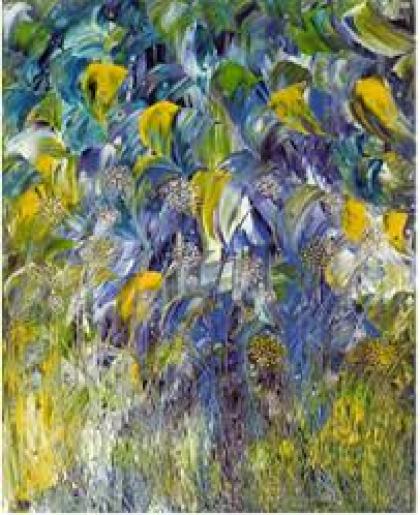
Entre los pintores latinoamericanos más exitosos, la forma de Sandra Beraha se compara con impresionistas anteriores, pero su uso de medios creativos, que incluyen tinta, pastel, acrílicos, lana, harina, madera, vidrio y especias la distingue. Sandra, quien comenzó su carrera como artista a los cuatro años, es una poeta publicada y líder en el campo de las artes visuales. Un punto culminante de su carrera, “Maravilloso Ecuador” (Ecuador maravilloso), una colección de más de 700 pinturas, muestra la belleza natural de su hogar durante tiempos de incertidumbre política. Los críticos han señalado: “Desde su regreso a Quito inició uno de los viajes más difíciles, el de elegir entre una de las múltiples fases de su personalidad creativa…” Sus colecciones más recientes combinan su pasión por la pintura con la fotografía digital. Las obras de Sandra se han presentado en América del Norte y del Sur.
Among the most successful Latin American painters, Sandra Beraha’s form draws comparison to earlier impressionists, but her use of creative media, including ink, pastel, acrylics, wool, flour, wood, glass and spices sets her apart . Sandra, who began her career as an artist at age four, is a published poet and leader in the field of visual arts. A highlight of her career, “Marvilloso Ecuador” (Marvelous Ecuador) a collection of over 700 paintings, showcases the natural beauty of her home during politically uncertain times. Critics have noted, “Since her return to Quito she started one of the most difficult journeys –that of choosing among one of the multiple phases of her creative personality…” Her most recent collections combine her passion for painting with digital photography. Sandra’s works has been featured in both North and South America.
El arte de Sandra Beraja/ The Art of Sandra Beraja
_______________________________________________
Autorretrato
La poesía de Sandra Beraja/ The Poetry of Sandra Beraja
EL OLVIDO

Olvidé leer,
Olvido de olvidar,
Aquel olvido, así como nunca estar
Olvidaré.

FORGETTING

I forgot to read,
I forgot to forget.
That forgetting, thus like never being.
I will forget.

EL PASADO

¿Qué decir ya del pasado?
Lo que es.
Parte del tiempo que parte, parte.

THE PAST

Why still speak of the past?
What is.
A part of time that departs, departs.

LA DISCULPA

La disculpa es la culpa de ser,
Se mantiene en culpa por la disculpa.

THE EXCUSE

The excuse is the fault of being
One affirms guilt by the excuse.

________________________________________________

THE BATTLE

I have fought battles to reach your heart,
With mine naked to the storms.

Defeated I am by your thoughts.
So strong they are,
They buried my heart under the stones
That I placed in your yard.

There is where I lay,
Under the leaves that feel,
Under the snow that came.

Si tu amor fuera para siempre,
Viviría eternamente
En el aliento que respiras.

Es allí donde yo siento
Respirando tu aliento.

Es el amor
Donde te encuentro,
Como si sudara a borbotones
Las insensatez de la exageración,


Una producción al por mayor de ilusiones y desilusión
Correteando el cansancio
Me arrastro hacia la luz de mis errores.

Dispuesta a vivir a pesar de mí misma,
Dispuesta a descansar en los brazos del riesgo de ser/ imperfecta,
Me preparo a dormir en mi propia soledad.

Una vez más desnuda
Ante la falta de razón
Sudando a borbotones
Las ganas de compresión.

Nada tengo ya que decir
Y quisiera saber si lo que he dicho de algo ha servido.

¿Será que llegaré a silencio,
O que el silencio ha llegado a mí?
What am I thinking about.

Recuerdo más que pienso,
Porque no sé si recordar
Es pensar.

Los extremos desbordados
                       deformados
                            exagerados

huyen los sensatos

___________________________________

THE BATTLE

I have fought battles to reach your heart,
With mine naked to the storms.

Defeated I am by your thoughts.
So strong they are,
They buried my heart under the stones
That I placed in your yard.

There is where I lay,
Under the leaves that feel,
Under the snow that came.

If your love was forever
I would live eternally
In the breath your breath,

It is there where I feel
Breathing your breath.
The craziness of exaggeration.

It is love
Where I meet you,
As if I was sweating at the boiling point.

A wholesale production of illusions and disillusion
Chasing weariness
I drag myself toward the light of my errors.

Ready to live in spite of myself,
Ready to rest in the arms of the risk of being imperfect.
I prepare to live in my own solitude.

Once more naked
Before the lack of reason
Sweating at a boil
The desire for understanding.

And I would like to know if what I have said has had/an effect.
Will it be that I arrive at silence
Or that the silence has arrived to me.

I recognized them, didn’t I without knowing who they are
I don’t have anything left to say,
What am I thinking about.

I remember more than I think,
Because I don’t know it remembering
Is thinking.

I always return home.
I always take off my clothes

I have wanted to live with you more
I have wanted to love you.

He querido.

I rarely go anywhere
And much further.

I would like to know what I feel.
Perhaps that may be because I feel nothing that I don’t/ know that I feel.

I wish to believe what I tell myself
And I tell myself things not to believe in.
The story continues without knowing what I feel.

I have spent so much time with me and with my stories,
That now what do I tell myself?

The extremes exceeded
                            deformed
                                 exaggerated

flee the sensible.

_________________________________________________________
Nacida en Caracas, Alicia Freilich Warshavsky, es hija de inmigrantes de origen judío polaco. Asistió a la Universidad Central de Venezuela, donde recibió un B.A. en literatura en 1960. Freilich comenzó su carrera de periodista en 1969, trabajando desde entonces en una columna sobre literatura y política informativa, con un enfoque en temas de niños y familiares, entre otros temas. Gravitó hacia historias que presentaban luchas de la vida real de la gente común, con artículos de perfil que han obtenido premios nacionales de escritura y honores internacionales. Freilich también ha publicado artículos independientes en la prensa venezolana. Además, su interés en los medios se proyectó en la atmósfera televisiva, cuando fue anfitriona de un programa de asuntos culturales en Televisora Nacional. Escribió un guión para un drama televisivo basado en la novela La Rebelión, del autor y presidente venezolano Rómulo Gallegos. Como educadora activa durante más de cuatro décadas, Freilich ha sido capaz de proporcionar instrucción en varios niveles en su disciplina desde la escuela primaria hasta la universidad, tanto en educación pública como privada. Su obra más conocida es Cláper (1987), una novela que muestra un sentido más profundo de pertenencia e identidad familiar durante un viaje espiritual y físico de un inmigrante judío a Estados Unidos a principios del siglo XX, que comienza en Polonia e incluye paradas en París. , Cuba y Estados Unidos antes de aterrizar en Venezuela. A través de los años, esta novela fue traducida al inglés y publicada por la University of New Mexico Press (EEUU). Freilich estuvo casado con Jaime Segal, un neurólogo, en 1962, hasta su divorcio en 1998. Tienen dos hijos, Ernesto y Ariel.
____________________________
Trabajos seleccionados
Libros
• Cuarta Dimensión • En clave sexymental: Aldemaro Romero a medio siglo creativo • Entrevistados en carne y hueso • Ilan Chester es verdad • La Venedemocracia • Legítima defensa • Triálogo, Notas de crítica urgente
Novelas
• Cláper (Traducido al inglés) • Colombina Descubierta • Vieja Verde (Traducido al inglés).
Born in Caracas, Alicia Freilich Warshavsky, is the daughter of immigrants of Polish-Jewish origin. She attended Universidad Central de Venezuela, where she received a B.A. in literature in 1960. Freilich began her journalism career in 1969, working since then on a column about literature and reporting politics, with a focus on children and family issues, among other subjects. She gravitated toward stories that featured real-life struggles of ordinary people, with profile articles that have garnered national feature-writing awards and international honors. Freilich also has published freelance articles in the Venezuelan press. In addition, her interest in the media projected into the television atmosphere, when she hosted a cultural affairs program at Televisora Nacional. She wrote a script for a television drama based on the novel La Rebelión, by the Venezuelan author and president Rómulo Gallegos. As an active educator for more than four decades, Freilich has been capable of providing instruction at various levels in her discipline from elementary school to university, both in private and public education. Her best-known work is Cláper (1987), a novel which shows a deeper sense of belonging and family identity during a spiritual and physical journey of a Jewish immigrant to America in the early twentieth century, which starts in Poland and includes stops in Paris, Cuba and the United States before landing in Venezuela. Through the years, this novel was translated into English and published by the University of New Mexico Press (EEUU). Freilich was married to Jaime Segal, a neurologist, in 1962, until their divorce in 1998. They have two sons, Ernesto and Ariel.
__________________________________
Selected works
Books
• Cuarta Dimensión • En clave sexymental: Aldemaro Romero a medio siglo creativo • Entrevistados en carne y hueso • Ilan Chester es verdad • La Venedemocracia • Legítima defensa • Triálogo, Notas de crítica urgente
Novels
Cláper (Translated into English – Colombina Descubierta – Vieja Verde (Translated into English
Llega la Semana Santa. El miércoles todavía abren los comercios. Desde que salgo de mi pensión, noto que las mujeres y hombres de todas las edades y en gran cantidad, van vestidos en túnicas moradas de tela gruesa. Algunos avanzan de rodillas como si en verdad fueran tullidos.
Decido seguir esa extraña manifestación silenciosa y así llego hasta la Basílica de Santa Teresa que está repleta de fieles apretujados, a su alrededor también.
Por la tarde luego de cerrar, paso de nuevo y entonces de lejos veo saliendo un Jésus de madera, cas arrastrándose bajo el peso de una gran cruz. Lo llaman Nazareno de San Pablo y va lentamente al centro de la multitud que lo pasea por las cercanías de la iglesia. A su paso ves que todos se persignan rogãndole ayuda por los males de salud.
Aquella inmensa cruz se vuelve mi martirio. Nadie me ha señalado en las calles como un criminal, pero de nuevo creo de advertir el odio, allá en Léndov, cuando la procesión de los cristianos en alguna Semana Mayor, culminó en piedras, palos y sangre . . . Como un asesino que acecha/ puñal en la mano/ a su víctima/ en altas horas de la noche/ así acecho tus pasos/ dios mío./ Mira tu piedad/ nunca me ha sonreído todavía a mí/ el nieto de Iscariote. . .? Es otra vez un poeta que me explica con sus versos que leí tantas veces y ahora sólo ahora, son poema mío. Gracias, Itzik Manger. . .
Casi corriendo, voy a bañarme y vestirme pues esa misma tarde celebramos nuestra primera cena de pascua. Es lógico. ¿No fue la comida pascual como ésta llamada la Última Cena?
Nos reunimos en la quinta moderna de los esposos /Tolder, muy religiosos. Han traído de Estados Unidos el vino de consagrar y pan de aflicción, esas galletas de harina sin levadura recuerdo del maná que comieron nuestros antepasados en sus cuarenta años de peregrinaje por el desierto para alcanzar la tierra santa de Abraham, de Isaac y de Jacob.
Como si fuera una sola voz todo el grupo canta — Esclavos fuimos del Faraón en Egipto, de donde dios sacó con potente mano y brazo protector. . .
Y una sola voz de verdad, la del hijito de los Berger, hace las cuatro preguntas de qué esta noche es diferente de los otros del año.
Nos servimos hierbas amargas porque fue amargo nuestra forzado cautiverio egipcio y comemos huevo cocido y remojado en agua salada para reproducir la vida plena sumergida en lágrimas de servidumbre, aunque tú sabes, mi teoría particular sobre esta costumbre de los huevos duros en agua de sal, es que a nuestros hermanos se les mojaron mucho los suyos al cruzar el Mar Rojo. . . Y dios sabe que no le falto el respeto con esta esta opinión sincera porque no es necesario creer que él nos puso la cosa tan fácil, abriendo el mar en dos para huyéramos. No tiene gracia. ¿Dónde queda entonces el espíritu de lucha? Yo pienso que Moisés era muy astuto y cruzó la parte más angosta en tiempo de sequía, como hice yo en el Oder sin ser tan grande como Moisés. Aprovechó la baja marea y es seguro de ella que allá más de los nuestros se ahogaron. ¿Y dónde está el milagro entonces? preguntarás tú. –En que calculó bien bien y se salvaron los necesarios para que sigamos existiendo como pueblo. . .
También probamos una crema de manzana triturada con nueces y vino para recordar la arcilla con que, año tras año pegamos los enormes ladrillos pues fuimos la mano de obra más barata para construir esas pirámides que admiras plácidamente hoy existiendo luego de tantos siglos ¿no?
Y el fin de aquella misma semana, soy testigo de un escena grotesca. En varias esquinas por donde transito queman un muñeco nombrado Judas. Es lo que llaman aquí un monigote, vestido con ropas viejas pero como nosotros, en flux de dril blanco y corbata. Antes de prenderle fuego lo cuelgan para significar su horca. Me resigno a no comprender el escarnio duele igual. Están cobrando la milenaria culpa a un correligionario mío de trapo y paja convertida en ceniza con gran contenido del poblacho,
Debo entonces agradecerme ¿verdad dio mío? Al menos esta vez, hoy, aquí, no soy la víctima de carne y hueso. . .
Holy Week is here. On Wednesday, the still open. From the moment I leave my boarding house I notice men and women of all ages and in large numbers wearing dark purple tunics made of heavy cloth. Some are kneeling as if they were really crippled.
I decide to follow that strange silent parade and arrive at the Basílica of Sta. Teresa packed with parishioners. That afternoon, after closing, I go again and at that time. I see from afar a wooden Jesus, dragging himself under the weight of an enormous crucifix. The refer to him as the Nazarene of St. Paul, He proceeds very slowly at the center of the crowd that accompanies him all around the church neighborhood. As he goes by, people cross themselves and beg his help for their many sorrows.
That immense crucifix becomes my martyrdom. No one has pointed me out as a criminal, but, once again I can feel the hatred I felt back in Lendov, when the Christian procession for the Holy Week would always end in stoning, beatings and bloodshed. . . .
Como un asesino
puñal en mano
a su víctima
en altas horas de la noche
así acecho tus pases, dios mío.
Mira, tu piedad
Nunca me has sonreído todavía
el nieto de Iscariot. . . .
———————-
Like an assassin who lurks
knife in hand
waiting for the victim
in the early hours of the morning
I search your steps my god
Your mercy has not yet smiled on me
I am the grandson of Judas Iscariot. . . .
Once again, the answer comes from the poet Itsik Manger whose verses I read so often, yet only know have become truly mine. Thank you, Itsik!
I run to bathe and dress because that same night we celebrate out first night Passover Seder. Nu! After all, wasn’t the other on. the so-called Last Supper, a pashal meal too?
We gather in the modern house of the very religious Tolders. From the Univter States, they get kosher wine and the bread of affliction, matzoh to remind us of the manna our ancestors ate during the forty-year journey through the desert on the way to the Holy Land of Abraham, Isaac and Jacob.
As if in unison, the whole group chants,
“We were the Pharaoh’s slaves in Egypt from
where He took us with a firm hand and an
outstretched arm.”
Then, one true voice, the Berger’s youngest son, asks the four questions that answer:
“Why is this night different from any other night?”
We partake of bitter herbs because we were forced captivity by the Egyptians was bitter; we eat hard boiled eggs-dipped in saltwater in order to produce life submerged in the tears of slavery. You know that something though? To me, eggs dipped in salt water comes from the fact that I always thought that our brothers got them wet when they crossed the Red Sea. God knows I have no disrespect for with this theory, but they way i see it, he wouldn’t have made things that easy for us by just separating the waters so that we could flee. To me that makes no sense at all. What would that do to our fighting spirit? No, I think Moses was a pretty smart fellow, and he crossed the narrowest point during the dry season, just like I did , when I crossed the Oder and I’m not even half as Moses was. No. He, like me, took advantage of the low tide. The others probably died. So, nu? Where is the miracle you ask? Ah, in that Moses calculated right! He save enough of us so that we could continue to exist as a people. Believe me, that’s a miracle!
We also had some chopped apples mixed with wine and nuts to remind ourselves of the mortar with which, year after year, we cemented together the giant bricks to hold the pyramids you admire so much today and have lasted for centuries. Weren’t we, after all, the cheapest labor around!
At the end of that same week, i witness a grotesque scene. On several street corners they burn a rag doll named Judas. It’s a puppet, dressed like us, in white linen suits and ties. Before setting him on fire, they hang him. I pretend not to understand but the mocking hurts just the same. I know that once again a fellow Jew is paying for a thousand year-year-old sin, only this one is made of cloth and straw. to the mob’s great delight, it turns into ashes.
I thank you, gottenyu, that this time, today, here, now, I am not the flesh and blood victim. . . .