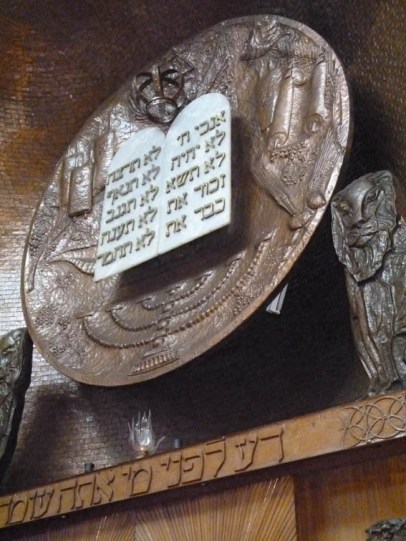
En Buenos Aires, hay una plétora de sinagogas que sirven a la comunidad de 160,000 mil judíos. La gran mayoría de los que pertenecen a las sinagogas son ortodoxos: Askenazí, de origen europeo y un número Sefardí, de origen de los descendientes de los que tuvieron que dejar España después de 1492. Además, hay sinagogas de Masorti Olami (Conservadora) que tienen rabinos y cantores entrenados en el Seminario Judío-latinoamericano “Marshall Meyer Z”L”. Hay dos templos reformistas. Y hay numerosos centros de Jabad Lubavitch, ultra-ortodoxo. También, hay asociaciones de judío laïcos o culturales
In Buenos Aires, there is a plethora of synagogues that serve the community of 160,000 Jews. The vast majority of those who belong to synagogues are Orthodox: Ashkenazi of European origin, and Sephardic, of origin from the descendants of those who had to leave Spain after 1492. In addition, there are synagogues of Masorti Olami (Conservative) whose rabbis and singers were trained in the Jewish-Latin American Seminary “Marshall Meyer Z” L “. There are two reform temples. And there are numerous centers of Chabad Lubavitch, ultra-orthodox. There are also associations of non-believing or cultural Jews.
De todas las sinagogas de Argentina, la gran mayoría están en Buenos Aires, la capital, que refleja en parte, el hecho de que hasta 80% de los judíos del país viven dentro o cerca de Buenos Aires. La Seminario Rabínico “Marshall Meyer Z”L” queda allí tanto como las sedes culturales la Asociación Mutual Israelita Argentina y La Hebraica y también el Congreso Judío-Latinoamericano. Y hay redes de escuelas judías y programas deportivas.
La situación en el interior del país es bien diferente. En las otras ciudades grandes, Córdoba, Rosario y Tucumán, el número de judíos no pueden soportar más de dos o tres sinagogas. En otros lugares, los socios luchan para mantenerse en comunidades o kehilot mucho más chicas. Estas sinagogas existen desde el calor de la provincias del Chaco y Resistencia hasta el frío de Tierra del Fuego en el sur. Son ortodoxos or masorati olam (Conservadores). Recientemente, Jabad Lubavitch, la organización ultra-ortodoxa, ha extendido sus servicios religiosos y sociales a lugares que antes tenía poca vida judía.
En las provincias de Entre Ríos y Santa Fe quedan sinagogas chicas fundadas a fines del siglo XIX en las colonias agrícolas en la pampa. Ahora unas pocas de estas sinagogas son activas; las otras han vuelto a ser museos de la época de “los gauchos judíos”, los primeros pioneros judíos en la Argentina.
Of all the synagogues in Argentina, the vast majority are in Buenos Aires, the capital, which reflects in part the fact that up to 80% of the country’s Jews live in or near Buenos Aires. “Marshall Meyer Z”L” Rabbinical Seminary is there as well as the cultural headquarters of the Argentine Israelite Mutual Association and La Hebraica and also the Jewish-Latin American Congress. And there are networks of Jewish schools and sports programs.
The situation in the interior of the country is quite different. In the other large cities, Córdoba, Rosario and Tucumán, the number of Jews cannot support more than two or three synagogues. In other places, members struggle to stay in much smaller communities or kehilá. These synagogues exist from the heat of the provinces of Chaco and Resistencia to the cold of Tierra del Fuego in the south. They are orthodox or masorati olam (Conservatives). Recently, Chabad Lubavitch, the ultra-Orthodox organization, has extended its religious and social services to places that previously had little Jewish life.
In the provinces of Entre Ríos and Santa Fe there are still small synagogues founded at the end of the 19th century in the agricultural colonies on the pampas. Now a few of these synagogues are active; the others have returned to being museums from the time of “the Jewish gauchos”, the first Jewish pioneers in Argentina.