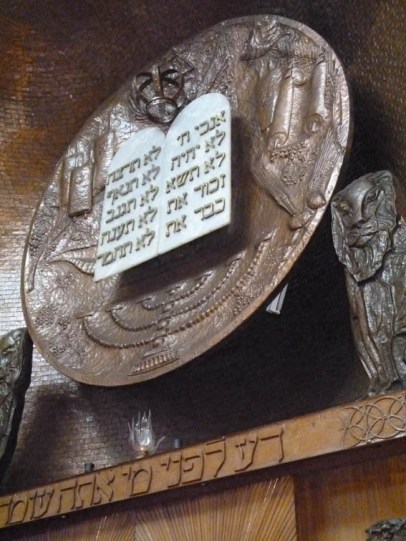
De todas las sinagogas de Argentina, la gran mayoría están en Buenos Aires, la capital, que refleja en parte, el hecho de que hasta 80% de los judíos del país viven dentro o cerca de Buenos Aires. La Seminario Rabínico “Marshall Meyer Z”L” queda allí tanto como las sedes culturales la Asociación Mutual Israelita Argentina y La Hebraica y también el Congreso Judío-Latinoamericano. Y hay redes de escuelas judías y programas deportivas.
La situación en el interior del país es bien diferente. En las otras ciudades grandes, Córdoba, Rosario y Tucumán, el número de judíos no pueden soportar más de dos o tres sinagogas. En otros lugares, los socios luchan para mantenerse en comunidades o kehilot mucho más chicas. Estas sinagogas existen desde el calor de la provincias del Chaco y Resistencia hasta el frío de Tierra del Fuego en el sur. Son ortodoxos or masorati olam (Conservadores). Recientemente, Jabad Lubavitch, la organización ultra-ortodoxa, ha extendido sus servicios religiosos y sociales a lugares que antes tenía poca vida judía.
En las provincias de Entre Ríos y Santa Fe quedan sinagogas chicas fundadas a fines del siglo XIX en las colonias agrícolas en la pampa. Ahora unas pocas de estas sinagogas son activas; las otras han vuelto a ser museos de la época de “los gauchos judíos”, los primeros pioneros judíos en la Argentina.
Of all the synagogues in Argentina, the vast majority are in Buenos Aires, the capital, which reflects in part the fact that up to 80% of the country’s Jews live in or near Buenos Aires. “Marshall Meyer Z”L” Rabbinical Seminary is there as well as the cultural headquarters of the Argentine Israelite Mutual Association and La Hebraica and also the Jewish-Latin American Congress. And there are networks of Jewish schools and sports programs.
The situation in the interior of the country is quite different. In the other large cities, Córdoba, Rosario and Tucumán, the number of Jews cannot support more than two or three synagogues. In other places, members struggle to stay in much smaller communities or kehilá. These synagogues exist from the heat of the provinces of Chaco and Resistencia to the cold of Tierra del Fuego in the south. They are orthodox or masorati olam (Conservatives). Recently, Chabad Lubavitch, the ultra-Orthodox organization, has extended its religious and social services to places that previously had little Jewish life.
In the provinces of Entre Ríos and Santa Fe there are still small synagogues founded at the end of the 19th century in the agricultural colonies on the pampas. Now a few of these synagogues are active; the others have returned to being museums from the time of “the Jewish gauchos”, the first Jewish pioneers in Argentina.
Edgardo Cozarinsky nació en Buenos Aires en 1939. Estudió literatura en la Universidad de Buenos Aires. Tenía veinte años cuando conoció a Silvina Ocampo, Adolfo Bioy Casares y, a través de ellos, a Borges, escritores que frecuentó durante sus años de vida en Buenos Aires. En 1973 ganó un premio literario, compartido con José Bianco, con un ensayo sobre el chisme como procedimiento narrativo en Proust y James. En 1974 publicó Borges y el cine. Ese mismo año dejó Buenos Aires y se fue a París. Allí se dedicó principalmente al cine, el título más representativo de esta tendencia es La Guerre d’un seul homme (1981), confrontación entre los diario de Ernst Jünger durante la ocupación alemana en Francia y los noticieros franceses de propaganda del mismo período. Durante el resto de los años 70 y 80 su obra literaria estuvo postergada. Sin embargo, el único libro que publicó en esos años – Vudú urbano (1985) – se convirtió en un éxito. En 1999 Cozarinsky pasó un mes en un hospital de París allí escribió los dos primeros cuentos de su libro premiado, La novia de Odessa. A partir de ese momento también empezó a pasar casi todo el tiempo en Buenos Aires con breves estadías en Europa.
Edgardo Cozarinsky was born in Buenos Aires in 1939. He studied literature at the University of Buenos Aires. He was twenty years old when he met Silvina Ocampo, Adolfo Bioy Casares and, through them, Borges, writers whom he frequented during his years of life in Buenos Aires. In 1973 he won a literary award, shared with José Bianco, with an essay on gossip as a narrative procedure in Proust and James. In 1974 he published Borges y el cine. That same year he left Buenos Aires and went to Paris. There he devoted himself mainly to cinema, the most representative title of this trend is La Guerre d’un seul homme (1981), a confrontation between Ernst Jünger’s diary during the German occupation of France and the French propaganda news from the same period. During the rest of the 70s and 80s his literary work was postponed. However, the only book he published in those years – Urban Voodoo (1985) – became a success. In 1999 Cozarinsky spent a month in a Paris hospital where he wrote the first two stories for his award-winning book, The Bride from Odessa. From that moment he also began to spend almost all his time in Buenos Aires with brief stays in Europe.
El atardecer del día siguiente los encontró sentados en un banco, bajo las acacias del parque Tchevchenco. El rumor de la ciudad les llegaba apaciguando y a lo lejos podían entrever el mar y los barcos, promesa indefinida que cada uno de ellos entendía a su manera.
Ella le confesó que era huérfana, que estudiando las revistas francesas de donde Madame Yvonne copiaba sus modelos había aprendido que la vida es la misma en París, en Viena o en Odessa, que sin dinero sólo se puede ser sirvienta, y que el mundo se divide entre los que tienen y los que no tienen. Él le explicó que eso es cierto en Europa pero del otro lado del océano hay una tierra de pura posibilidad, un país joven donde un judío como él puede poseer un pedazo de tierra. Atropelladamente, le habló del barón Hirsch, de la colonización, de Santa Fe, de Entre Ríos. Ella oyó, por primera vez, cosas cuya existencia había ignorado, que un judío podía querer cultivar la tierra, que podía temer a los cristianos como ella temía a los judíos del taller, que podía hablarle a ella de otra cosa que del regalo que le haría si consintiera en acompañarlo una noche a cierto hotelucho de la plaza Privakzalnaia.
¿Fue durante ese segundo encuentro cuando él le reveló el modo de la tristeza, en apariencia inexplicable, que lo dominaba en vísperas de cruzar el Atlántico hacia una nueva vida? Ese motivo tenía nombre: Rifka Bronfman.
Sus familias los habían presentado cuando cumplieron catorce años, ya los habían prometido antes de se conocieran y los habían casado cinco días antes de él dejara Kiev. Se habían visto a solas no más de diez veces antes de la boda, y siempre con padres o hermanos en el cuarto de al lado o en la ventana que supervisaba el magro jardín entre la casa y la calle.
Hacia un año que Daniel había empezado a jugar con la idea de emigrar. La delegación de la Argentina para la Colonización Judía, de paso por Kiev, había organizado reuniones vespertinas en la Asociación Mutual Israelita, donde un conferencista elocuente, con la ayuda de una linterna mágica y una docena de placas de vidrio, les había mostrado los campos fértiles, interminables que los esperaban en la Argentina. En un mapa había señalado la ubicación de esas tierras y su distancia de las metrópolis: Buenos Aires y Rosario, que otras placas les habían descubierto. También había agitado en la mano un delgado volumen encuadernado en color celeste y blanco sobre cuya tapa—había explicado—estaba impreso (en español, por lo tanto en caracteres latinos) “Constitución de la República Argentina”; de ese volumen les había leído, traduciendo inmediatamente al idish, los artículos que prometían igualdad y libertad de cultos para todos quienes quisieran trabajar esa “tierra de paz”.
Estas palabras Daniel las había repetido a Rifka, esas imágenes se las había descrito detalladamente. Su prometida no compartía tanto entusiasmo. Aceptó seguirlo, acatando el precepto según el cual el lugar de la mujer está al lado del marido, pero ese mundo nuevo no la hacía soñar. Cuando él llenó los papeles necesarios, no expresó ningún reparo particular, pero cuando volvieron aprobados y sellados por el consulado argentino, y leyó en ellos su nombre, su fecha de nacimiento, el color de su pelo y el de sus ojos, prorrumpió en sollozos vehementes, renovados cada vez que el cansancio prometía extinguirlos. Las familias creyeron que se trataba de un estado de agitación provocado por las vísperas del casamiento; un primo, que había hecho vagos estudios de medicina, declaró que se trataba de una afección a la moda, llamada neurastenia. Vagamente halagada por ese diagnóstico, Rifka enfrentó dignamente la ceremonia en la sinagoga, bajo la peluca ritual que cubría su cráneo recién afeitado.
Esa noche, Daniel debió vencer su inexperiencia y ella su miedo. Descubrieron, en medio de la sangre, él el placer, ella el dolor. A la mañana siguiente, él despertó solo en medio de las sábanas manchadas; de lejos le llegaban gritos, llanto, reproches, quejas. Encontró a Rifka en brazos de su suegra, cuyo consuelo rehusaba. Mientras la señora repetía incesantemente “Se le va a pasar, se le va a pasar”, tratando de cubrir la voz de la joven esposa, ésta lograba oír no menos incesantemente y cada vez más fuerte: “No voy, no voy, no voy”. Cuando Rifka recobró cierta serenidad, pudo unir algunas palabras, formar frases.
–Tengo miedo, mucho miedo. Aquí conozco a todos, aquí está mi familia, tu familia, mis amigas; está la sinagoga, el mercado, todo lo que conozco. ¿Con qué nos vamos a encontrar allá? ¿Víboras? ¿Indios? ¿Plantas carnívoras?
Daniel intentaba explicarle que ahora ella tenía un marido para protegerla, pero Rifka parecía impermeable a todo argumento. Cuando logró secar sus lágrimas, aceptó, junto con un vaso de té con limón, la sugestión, nada optimista, casi desesperada, de su madre; viajar un año más tarde, tal vez sólo seis meses, cuando él hubiese escrito confirmándole que ella estaría a salvo de tantos peligros con que las novelas de Emilio Salgari la habían amenazado.
Daniel no la tocó en las noches siguientes, que precedieron su viaje. Rifka, tal vez aliviada, no se lo reprochó.
La muchacha lo había escuchado el silencio. Del parque han caminado lentamente en dirección al escenario de su primer encuentro. El cielo rosado del crepúsculo ha cedido gradualmente a un azul cada vez más profundo. Ya es de noche cuando él termina su relato, abrupto, desordenado, que los párrafos anteriores intentan resumir.
Pasan ante cafés y pastelerías con nombres franceses e italianos, donde no pueden permitirse entrar, y tras la cortina de encajes de una ventana, ella reconoce las flores de trapo, el pájaro embalsamado y remendado y cintas de sed de un sombrero que vio armar, pieza por pieza, y ahora corona un cabeza invisible. Llegan a la estatua del duque francés cuyo nombre no les dice nada; pálidamente, intermitentemente, la ilumina el resplandor del hotel de Londres. A lo lejos, los barcos anclados en el puerto también conceden algún reflejo al tierra negra, susurrante.
Cuando ella no es para comentar el relato que ha escuchado con atención.
–¿Cuándo te embarcas?
–Mañana. El barco parte a las seis de la tarde pero los pasajeros de tercera clase deben estar a bordo antes de mediodía.
Ella lo mira, esperando palabras que no llegan. Tras un instante, insiste.
–¿Vas a viajar solo?
Él la mira, entendiendo y sin atreverse a creer en lo que entiende.
–Solo. . . Que remedio tengo. . .
Ella lo tomas por los brazos con fuerza, plantada ante él.
Daniel siente que esas manos pequeñas pueden apretar y tal vez golpear, que no están hechas para sostener solamente una aguja.
–¡Me llevas contigo! ¡Yo soy casi rubia, tengo ojos claros si no celestes, mido poco menos de un metro sesenta y cinco y tengo dieciocho años! ¿Acaso hay una fotografía en el salvoconducto?
–Pero. . .—él atina a balbucir—no estamos casados. . .
La carcajada de ella resuena en la plaza desierta, parece rodar por la escalinata y despertar un echo en el puerto.
–¿Cómo podríamos estar casados si yo soy ortodoxa y tú judío. Necesitaríamos meses para que un rabino aceptase mi conversión. . . Además, ¿no dices que en este país nuevo no importa nada de todo lo que aquí nos esclaviza? Let’s go!” ¡Vamos!
Ante la mirada estupefacta de Daniel, ella empieza a girar sobre sí misma, con brazos extendidos, como un derviche de Anatolia. Sin dejar de reír, repite como una invocación los nombres que ha oído mencionar hace un momento por primera vez.
–¡Buenos Aires! ¡Rosario! ¡Entre Ríos! ¡Santa Fe! ¡Argentina! Se ríe cada vez más fuerte y no deja de girar.
–Yo soy Rifka Bronfman!
_________________________________________
The Fiancée from Odessa
– excerpts from the story
Sunset, the next day, found them seated in a bench under the acacias of Tchevchenco Park. The noise of the city came muted to them and at a distance they could make out the sea and the ships, an indefinite that each of the understood in their own way.
Was it during that second meeting that when he revealed to her the manner of his sadness, inexplicable in its appearance, that dominated him on the eve of crossing the Atlantic to a new life? That reason had a name: Rifka Bronfman.
Their families had introduced them when they turned fourteen, they had already been engaged before they knew each other and they had had them marry five days before he was to leave Kiev. They had seen each other alone no more than ten times before the wedding, and always with parents or brothers in the room next door or in the window that oversaw the meager garden between the house and the street.
It had been a year since Daniel had begun to play with the idea of emigrating. The delegation of from Argentina for Jewish Colonization, passing through Kiev, had organized evening meetings at the Jewish Mutual Association, where an eloquent speaker, with the help of a magic lantern and a dozen of glass slides, had shown them the interminable fertile fields that await them in Argentina. On a map, he had pointed out the location of those lands and their distance from the metropolises: Buenos Aires Y Rosario, that other slides had discovered for them. He had also shaken in his hand a thin volume, bound in light blue and white whose cover–he explained—was printed (n Spanish, and so in Latin letters) “Constitution of the Argentine Republic.” From that volume, he had read to them, immediately translating into Yiddish, the articles that promised equality and freedom of religion for all who wish to work that “land of peace.”
Daniel had repeated these words to Rifka, those images that had been described to them in detail. His fiancé didn’t share such enthusiasm. She accepted that that she had to follow him, obeying the precept according to which the place of the wife is at the side of her husband, but this new world didn’t make her dream. When he filled out the necessary papers, she didn’t express any particular objection, but when they returned approved and stamped by the Argentine consul, and she read in them her name, her date of birth, the color of her hair and of her eyes, she broke out in vehement sighing, renewed every time that tiredness promised to extinguish them. The families believed that it was a state of nervous agitation, provoked by the eve of the wedding; a cousin, he had done some vague studies in medicine, declared that is was an affliction that was in fashion, called neurasthenia. Vaguely flattered by that diagnosis, Rifka faced the ceremony in a dignified way, under that ritual wig that covered her recently shaved cranium.
That night Daniel had to conquer his inexperience and she her fear. They discovered, in the midst of the blood, he, pleasure and she, pain. The next morning, he awoke alone in the middle of the stained sheets; from a distanced came yelling, crying, reproaches, complaints. He found Rifka in the arms of his mother-in-law, whose solace she refused. While the lady repeated incessantly “It will pass, it will pass,” trying to cover the voice of the young bride; just as incessantly, she didn’t hear, and each time more strongly: “I’m not going, I’m not going, I’m not going.” When Rifka recovered a certain serenity, she could put together a few words, form phrases.
“I am afraid, very much afraid. Here, I know everyone, my family is here, my friends, the market, everything I know. What is going to find us there? Snakes? Indians? Carnivorous plants?””
Daniel tried to explain to her that now she had a husband who would protect her, but Rifka seemed impervious to any argument. When she was able to dry her tears, she accepted, together with a glass of tea with lemon, her mother’s suggestion, in no way optimistic, almost desperate: to travel a year later, perhaps only six month, when he had written, confirming to her that she would be safe from so many dangers with which the novels of Emilio Salgari had threatened her.
The following nights, Daniel didn’t touch her during the following nights that preceded his voyage. Rifka, perhaps relieved did not reproach him.
_______________________________________________
The girl had listened to him in silence. From the park, they have walked slowly in the direction of the scene of their first meeting. The rosy sky of sunset had gradually ceded to a blue more and more deep. It is already night when he finishes his story, abrupt, disorganized, that the previous paragraphs had tried to summarize,
They passed in front of cafés and pastry shops with French and Italian names, into which they didn’t let themselves enter, and through a lace curtain, she recognizes the flowery cloth, the bird stuffed and mended and ribbons of silk that she saw made, piece by piece, and now crowned an invisible head. They arrived at the statue of the French duke whose name didn’t mean anything to them; pallidly, intermittently, it was illuminated by the splendor of the London Hotel. At a distance, the ships anchored in the port also conceded some reflection to the black earth, murmuring.
She doesn’t comment on the story that she has listened to with rapt attention.
“When do you embark?”
“Tomorrow. The ship leaves at six in the afternoon, but the third- class passengers have to be on board before noon.
She looks at him, but the words don’t come. After an instant, she insists.
“Are you going to travel alone?
He looks at her, understanding, and without daring to believe what his understands.
“Take me with you! I’m almost blond, I have light eyes if not light blue, I’m a little less than on meter sixty-five and I’m eighteen years old. By any chance is there a photograph in the letter of safe passage?”
“But. . .”, he is able to stammer. “We are not married. . .”
The loud laugh that she resounds in the deserted plaza, seems to roll down the stairway and awaken an echo in the port.
“How could we be married if I’m Orthodox and you are Jewish. We would need months for a rabbi to accept my conversion. . . Moreover, didn’t you say that in this new country, everything that enslaves us here doesn’t matter at all. Let’s go!
Before Daniel’s stupefied face, she began to spin around herself, with her arms extended, like a dervish from Anatolia. Without stopping laughing, she repeats like an incantation the names that she had heard mentioned for the first time a moment ago. –Buenos Aires! Rosario! Entre Ríos! Santa Fe! Argentina! She laughs more and more strongly and she doesn’t stop spinning..
Algunos libros de Edgardo Cozarinsky/Some of Edgardo Cozarinsky’s Books
EDGARDO COZARINSKY
BIBLIOGRAFÍA/BIBLIOGRAPHY
Crónica y relato/Non-fiction and stories: Vudú urbano, 1985 La novia de Odessa, 2001. El pase del testigo, 2001. Museo del chisme, 2005. Tres fronteras 2006. Palacios plebeyos, 2006. Milongas, 2007. Burundanga, 2009. Blues, 2010. Nuevo museo del chisme, 2013.
Novela/Novel:
Maniobras nocturnas, 2007. Lejos de dónde, 2009. La tercera mañana, 2010 Dinero para fantasmas, 2012
PREMIOS/PRIZES Premio “La Nación” de Ensayo, compartido con José Bianco. 1973 Premio Konex de platino y Diploma al Mérito, categoría “Cuento: Quinquenio 1999 – 2003”. 2004 Premio Cóndor a la trayectoria, de la Asociación Argentina de Críticos de Cine. 2004 Prix de l’Avenir, Rencontres Internationales du Cinéma à Paris, por “Ronda nocturna”. 2005 Primer premio de narrativa bienio 2001-2003 por “La novia de Odessa” de Ministerio de Cultura, Gobierno de la ciudad autónoma de Buenos Aires. 2008 Premio Cóndor a la Innovación Artística por “Apuntes para una biografía imaginaria” 2011 Premio a la mejor novela 2008-2010 de la Academia Argentina de Letras por “Lejos de dónde”. 2011
Moisés Ville surgió a partir de la iniciativa conjunta de alrededor de ciento treinta familias oriundas de la región ucraniana de Podolia que, a mediados de 1889, emigraron de la Rusia zarista para establecerse como agricultores en la Argentina. Durante ese período inicial de la colonización, la Alliance Israélite Universelle (una importante institución filantrópica parisina) solicitó al médico higienista judeo-alemán Wilhelm Loewenthal –quien había trabajado para el Estado argentino recorriendo distintas provincias– que visitara a los nóveles colonos y, en caso de ser necesario, los auxiliara. Su intervención resultó determinante para lograr el establecimiento definitivo del grupo, pero también para impulsar el ambicioso proyecto de colonización masiva que llevaría a la práctica inmediatamente el Barón Maurice de Hirsch, creador de la Jewish Colonization Association, la asociación filantrópica que organizó y financió el arribo de miles de judíos provenientes del este europeo a distintas colonias argentinas. Dicha compañía instaló a nuevos y sucesivos grupos de inmigrantes, incluyendo a unas ochenta familias alemanas que, en la segunda mitad de los años treinta, llegaron huyendo del nazismo.
Moisés Ville arose from the joint initiative of around one hundred thirty families native of the Ukrainian region of Podolia that, in the middle of 1889, emigrated of tsarist Russia to settle down like agriculturists in Argentina. During that initial period of colonization, the Alliance Israélite Universelle (a major Parisian philanthropic institution) asked the Judeo-German hygienist doctor Wilhelm Loewenthal -who had worked for the Argentine State through different provinces- to visit the new colonists and, in case if necessary, it will help them. His intervention was decisive to achieve the definitive establishment of the group, but also to promote the ambitious project of massive colonization that would immediately put into practice Baron Maurice de Hirsch, creator of the Jewish Colonization Association, the philanthropic association that organized and financed the arrival of thousands of Jews from Eastern Europe to different Argentine colonies. This company installed new and successive groups of immigrants, including about eighty German families who, in the second half of the thirties, came fleeing from Nazism.