Yishai Jusidman es un pintor contemporáneo y crítico de arte ocasional. Nació en la Ciudad de México, reside en Los Ángeles y pronto emigrará al moshav Tal Shachar. Su obra se ha exhibido en prestigiosas exposiciones internacionales en todo el mundo. Una serie reciente, “Azul de Prusia”, aborda los desafíos estéticos de la conmemoración del Holocausto a través del arte y se exhibe en el Museo Memorial de Auschwitz-Birkenau hasta octubre de 2026. Sus escritos se han publicado en Artforum, Art Issues, Los Angeles Times, Cleveland Review of Books y más.
____________________________
Yishai Jusidman is a contemporary painter and occasional art critic, born in Mexico City, based in Los Angeles and soon migrating to moshav Tal Shachar. His artwork has been shown worldwide in prestigious international exhibitions. A recent series, “Prussian Blue”, deals with the aesthetic challenges of Holocaust remembrance through art, and it is on view at the Auschwitz-Birkenau Memorial Museum through October 2026. His writing has been published in Artforum, Art Issues, Los Angeles Times, Cleveland Review of Books, and more.
En mi serie Azul de Prusia, abordo el Holocausto en la pintura buscando generar la impresión pictórica de un silencio tan solemne y directo como elocuente, ofreciendo así una alternativa a las restricciones fatalistas que han frenado la producción de obras que abordan este tema.
Pintura azul de Prusia: El producto Zyklon B, utilizado como agente letal entre 1940 y 1945, solía producir manchas azules en las paredes de las cámaras de gas debido a una reacción química con el ladrillo y el mortero. Dichas manchas aún son muy visibles en las estructuras de Majdanek. El compuesto de cianuro y hierro de estas manchas es químicamente idéntico al pigmento del pintor, conocido como Azul de Prusia. — Yisgai Jusidman
_________________________________
In my Prussian Blue series, I address the Holocaust in painting by seeking to generate the pictorial impression of a silence as solemn and forthright as it is eloquent, thus furnishing an alternative to the fatalistic strictures that have stifled the production of works dealing with this subject.
Prussian blue paint: The Zyklon B product that was used as a killing agent from 1940 through 1945 often produced blue stains on the walls of the gas chambers by way of a chemical reaction with the brick and mortar. Such stains are still very much apparent in the structures at Majdanek. The cyanide-iron compound of these stains is chemically identical to the painter’s pigment known as Prussian Blue.
Mutatis Mutandi
He manipulado elementos basados en objetos y tecnología para llamar la atención sobre el efecto pictórico, colocando lo táctil contra lo óptico, lo literal contra lo metafórico, los fenómenos contra el discurso. – Yisgai Jusidman
______________________________________
I have manipulated object-based and technology-based elements so as to call attention to the painterly effect, by placing the tactile against the optical, the literal against the metaphorical, phenomena against discourse. — Yisgai Jusidman
Eduardo Mosches es mexicano de origen argentino. Nació en Buenos aires en 1944. Vivió en Israel de 1963 a 1970. Tomó un avión en 1970 hacia Berlín, donde estudió Ciencias Sociales en la Universidad Libre en, Alemania y se dirigió hacia Argentina en 1974. Después en 1976, se fue rumbo a México, donde entabló varios retos, entre otros el de estudiar Cinematografía en la UNAM. Reside en México desde ese año. Fue coordinador editorial en la Universidad Autónoma de la Ciudad de México(2002-2012). Fundador y director de la revista literaria Blanco Móvil, desde 1985. Ha publicado los poemarios Los lentes y Marx, Los tiempos mezquinos, Cuando las pieles riman, Viaje a través de los etcéteras, Como el mar que nos habita, Molinos de Fuego, Susurros de la memoria,Avatares de la memoria (antología poética 1979-2006) , El ojo histórico (2014), Los enemigos del silencio ( 2014) y el libro de prosa Caminos sin ruta. Ha colaborado en periódicos y revistas en México, Argentina, Alemania, Brasil, España, Estados Unidos, Israel, Italia, Chile, entre otros. Ha recibido varios premios nacionales como poeta y editor de revistas literarias. Ha sido traducido al alemán, italiano, portugués, hebreo e inglés.
______________________________________
Eduardo Mosches is a Mexican of Argentine origin. He was born in Buenos Aires in 1944. He lived in Israel from 1963 to 1970. In 1970, he went to Berlin, where he studied Social Sciences at the Free University of Berlin, Germany, and then returned to Argentina in 1974. In 1976, he went to Mexico, where he undertook several challenges, including studying Cinematography at the National Autonomous University of Mexico (UNAM). He has resided in Mexico since that year. He was the editorial coordinator at the Autonomous University of Mexico City (2002-2012). Founder and editor of the literary magazine Blanco Móvil since 1985. He has published the poetry collectionsLos lentes y Marx, Los tiempos mezquinos, Cuando las pieles riman, Viaje a través de los etcéteras, Como el mar que nos habita, Molinos de Fuego, Susurros de la memoria, Avatares de la memoria (poetic anthology 1979-2006), El ojo histórico (2014), Los enemigos del silencio (2014), and the prose work Caminos sin ruta. He has contributed to newspapers and magazines in Mexico, Argentina, Germany, Brazil, Spain, the United States, Israel, Italy, Chile, and other countries. He has received several national awards as a poet and editor of literary magazines. His work has been translated into German, Italian, Portuguese, Hebrew, and English.
Las gotas de lluvia golpeaban en un ritmo pausado de somnolencia, las veladuras de grises ingresaban a través del cristal, enfriaban las tazas de un café por beberse a sorbos lentos mientras la mano tatuada por venas infladas, ríos congelados por la pesada edad, desnudas de líquido, descansan un momento tomadas entre sí, como trapecios en el descanso. El río de las venas se oculta mientras los árboles crecen al ritmo que los pantalones se achican. Nubes de conversaciones se inclinan como ramas cargadas de frutos carnosos, envueltos en la piel de recuerdos. Los caballos se lanzan veloces a galopar en el patio empedrado, giran como en un carrusel con que se arma el pentagrama de los sucesos infantiles, donde la figura del abuelo, alta y ceremoniosa, juez de la vida y las hazañas, se va dibujando en trazos finos deslavados, para ir llegando a toparse con la mítica imagen de espalda tan amplia como una meseta, la que sostiene la caída ominosa de terrosas bolsas de granos. La voz lenta, animosa, nos dice de cómo salva la vida del hermano, en su niñez de rodillas raspadas y uñas mordidas, el cual años más tarde, muere en un salto desde un techo sin violín alguno. Narrando está mi padre, mientras el café en la taza va adquiriendo una tonalidad muy negruzca, azulada, como la noche que avanza sobre el crepúsculo de un día de invierno, en alguna ciudad puerto.
__________________________
Clouds and Veins
The raindrops pattered with a languid, sleepy rhythm, veils of gray seeped through the glass, chilling the cups of coffee sipped slowly while the hand, tattooed with swollen veins, rivers frozen by the weight of age, bare of liquid, rested for a moment, clasped together, like trapezes at rest. The river of veins hides as the trees grow at the same pace as the trousers shrink. Clouds of conversation bend like branches laden with fleshy fruit, wrapped in the skin of memories.
The horses burst into a gallop across the cobbled courtyard, circling like a carousel, forming the musical staff of childhood memories. There, the figure of the grandfather, tall and ceremonious, judge of life and deeds, is sketched in fine, faded strokes, eventually colliding with the mythical image, his back as broad as a plateau, supporting the ominous fall of earthen sacks of grain. His slow, spirited voice tell he saved his brother’s life in his childhood, knees scraped and his nails bitten, a brother who, years later, died jumping from a roof, without a violin in sight.
My father is narrating, while the coffee in the cup takes on a very dark, bluish hue, like the night advancing over the twilight of a winter’s day in some port city.
________________________________
Susurros de la memoria (fragmento)
VII
Momento de gateo refugio del pavor el eco de los gritos o la oscuridad las horas y el angustiado temor del hambre calor cobijador de ciertas patas caninas Aroma de recuerdo bosque de abedules perfumadas tardes acompañadas de pardos eucaliptos mientras el frío se omitía crecían en el vaho nubes de vapores otoñales la lluvia se deslizaba en su sonido parco sueño logrado por el vientre protector que compartió su refugio con ese niño que era yo
Ven perro, perro, sin un ladrido, desolación
El recuerdo es acción del cuento oral algunas horas barridas en la angustia de los otros mientras soñaba con suma placidez tranquilidad del reposo sobre el perro almohada de pelos cálidos oscuridad y tibieza Es posible que cierto lejano familiar mordiese muslos que bajaban de los trenes en Treblinka o Auschwitz rasgase pantalones junto con los músculos en algún lugar cercado por el miedo: Altamirano Trelew o Kosovo
Todo esto fue antes que creciera la sombra de un bigote y enfrentase otros dientes amenazantes en alguna manifestación en contra o a favor.
___________________________________
Whispers of Memory (fragment)
VII
Moment of crawling
refuge from terror
the echo of screams or the darkness
the hours and the anguished fear of hunger
the comforting warmth of certain canine paws
Scent of memory, birch forest
perfumed afternoons accompanied by brown eucalyptus trees
while the cold was omitted
clouds of autumnal vapors grew in the mist
the rain slid in its sparse sound
sleep achieved by the protective womb
that shared its refuge
with that child who was me
Come, dog, dog, without a bark, desolation
Memory is the action of oral storytelling
some hours swept away in the anguish of others
while I dreamed with utmost placidity
the tranquility of repose
on the dog, a pillow of warm fur
darkness and warmth
It is possible that a certain distant relative
bite thighs that came down from the trains
in Treblinka or Auschwitz
ripping trousers along with the muscles
somewhere surrounded by fear:
Altamirano, Trelew, or Kosovo
All this was before
the shadow of a mustache grew
and faced other threatening teeth
in some demonstration for or against.
___________________________________
Los tiempos mezquinos (fragmento)
V
Los olivos murmuran sobre las zanjas que fueron casas o en los trozos de loza que alguna vez cobijaron redondos panes árabes que sonreían blanco a los dientes. Un trago lento y leve de agua fresca lavado el paladar de ese café pastoso un corto ademán de entretejerse dedos en el mismo momento en que la explosión hacía hondo el instante del silencio.
Las bocas de todos los asesinados fragmentan a la historia en un gemido largo.
_____________________________________
The Mean Times (excerpt)
V
The olive trees murmur
over the ditches that were once houses
or on the pieces of pottery
that once
sheltered round
Arabian loaves that smiled white
at the teeth.
A slow, light sip
of fresh water washes the palate
of that thick coffee, a brief gesture
of interlacing fingers
at the very moment
when the explosion
deepened
the instant of silence.
The mouths of all the murdered
fragment history
in a long moan.
_________________________________
Dejando atrás
La ciudad se cubre los ojos respira agitada entre el temor y la angustia.
Las nubes se llenan de pájaros oscuros revolotean sobre los cadáveres que van a existir.
La letanía de los mensajes penetra por las uñas, se deslizan a través de las venas, surcan el cuerpo afiebrando al miedo.
Huir de los otros cuerpos, no acariciarse, los ojos esquivos, mirar ese otro cuerpo los otros cuerpos, las manos y sus pies con las náuseas del posible sufrimiento.
Las lajas de los cementerios cubren con pesadez el espíritu de los vecinos. Las bocas respiran a través del tejido no hablar no comer no besarse.
Los caballos atraviesan el horizonte a trote cansino, pisan pesadamente en las osamentas de los deseos, el cerrojo de las prohibiciones abre su boca ávida, hundir los dientes revolotean los vampiros las alas se llenan de tabúes, mientras las sotanas marchan y marchan al sonido de los tambores del pasado.
La ciudad y su gente se revuelve arrullada por las hojas de los árboles afiebrados, una nube abre su ojo y la lluvia humedece los hombros las cabelleras los huesos los tejidos, toda flota sobre ese río de las nubes.
El sol entibia los cuerpos, el mío y el de ella y jugamos al no me importa mientras las pieles se sonríen, se rebelan pintando nuevas pecas gozosas, componen la música de los susurros y quejidos dejan atrás las letanías de las prohibiciones.
_____________________________
Leaving Behind
The city covers its eyes,
breathes raggedly between fear and anguish.
The clouds fill with dark birds,
fluttering above the corpses that are yet to come.
The litany of messages seeps through the fingernails,
slides through the veins,
rides the body, feverish with fear.
Fleeing from other bodies,
not touching each other,
eyes averted,
looking at that other body, those other bodies,
hands and feet,
with the nausea of possible suffering.
The flagstones of the cemeteries
heavily cover
the spirits of the neighbors.
Mouths breathe through the fabric,
not speaking, not eating, not kissing.
Horses cross the horizon at a weary trot,
their feet crunch heavily on the bones of desires,
the bolt of prohibitions opens its eager mouth,
vampires flutter, sinking their teeth,
their wings fill with taboos,
while the cassocks march on and on
to the beat of the drums of the past.
The city and its people stir,
lulled by the leaves of feverish trees,
a cloud opens its eye and the rain dampens
shoulders, hair, bones, fabrics,
everything floats on that river of clouds.
The sun warms our bodies,
mine and hers,
and we play at not caring,
while our skin smiles,
rebels, painting new, joyful freckles,
composing the music of whispers and moans,
leaving behind the litanies of prohibitions
___________________________________________
Dolor y tiempo
El dedo pulgar de esa mano izquierda refrenda el dolor de una cantidad ampliada de días
La pinza de esos dedos ha aprisionado no pocas veces frutos coloridos y jugosos alguna carta que ha llegado del pasado en esa larga travesía de los mares amorosos para crear la cueva cálida de mano con mano y atravesar la corriente fría de las despedidas Una vuelta en el cerrojo de la propia puerta
El atardecer se carga en el vaho aceitoso de los automóviles circulando en las calles de esta ciudad que anuda en su misterio diario a muchos otros pulgares
Pedro Meyer nació en Madrid (1935) hijo de padres judíos exiliados republicanos de España. Obtuvo la nacionalidad mexicana a los 7 años. Lleva cuarenta años en el mundo del arte fotográfico y es uno de los grandes representantes de la fotografía mexicana contemporánea. Como declaró en una entrevista nunca deja de aprender, porque se debe estar aprendiendo todos los días, “las circunstancias nos obligan a ello, ya que los cambios tecnológicos afectan a todo”, dijo. Ha sido pionero en el lenguaje digital, autor de varios libros, curador y director de ZoneZero, famoso sitio virtual que recoge portafolio de más de mil fotógrafos alrededor del mundo. Meyer ha expuesto su trabajo en más de doscientas muestras en diversos países y su obra hace parte de importantes colecciones privadas y de los más prestigiosos museos.Ha presentado su obra en más de 200 exposiciones que han recorrido países como China, Inglaterra, Francia, Estados Unidos, Cuba e Italia. Entre sus principales contribuciones se encuentran la fundación del Consejo Mexicano de Fotografía y la organización de los tres primeros Coloquios Latinoamericanos de Fotografía. También es director de la Fundación Pedro Meyer, con la que busca “contribuir a la reflexión, interpretación e investigación en lo que se refiere a la imagen fotográfica dentro del marco de las nuevas tecnologías”. En 2014 erige el Foto Museo 4 Caminos que tiene como principal objetivo la educación en el ámbito fotográfico.
_______________________________________
Pedro Meyer was born in Madrid in 1935, the son of exiled Jewish Republicans from Spain. He obtained Mexican citizenship at the age of seven. He has been involved in the world of photographic art for forty years and is one of the leading figures in contemporary Mexican photography. As he himself stated in an interview, one should never stop learning, because continuous learning is essential every day, “circumstances demand it, since technological changes affect us all,” he said. He has been a pioneer in digital photography, the author of several books, a curator, and the director of ZoneZero, a renowned online platform that features a portfolio of more than a thousand photographers from around the world. Meyer has exhibited his work in over 200 exhibitions in various countries, and his work is part of important private collections and the most prestigious museums. He has presented his work in more than 200 exhibitions that have traveled to countries such as China, England, France, the United States, Cuba, and Italy. Among his main contributions are the founding of the Mexican Council of Photography and the organization of the first three Latin American Photography Colloquiums. He is also the director of the Pedro Meyer Foundation, whose objective is to contribute to reflection, interpretation, and research on the photographic image within the framework of new technologies. In 2014, he founded the Foto Museo 4 Caminos, whose main objective is education in the field of photography.
__________________________________
Pedro Meyer insists that all photographs – manipulated or not – are equally true and untrue. Meyer argues that digital manipulation continues the tradition of so-called “straight photography” in which unwanted details are cropped out, or the photographer directs the scene from behind the camera, asking his subject to step out of the shadows into better light. In addition, Meyer contends that unseen elements like memory or emotion present themselves with a physical reality equal to visible objects. In his photographs, these elements often appear with a clarify that connects his work to the tradition of Magical Realism. — Lehigh University Arts
_________________________________
Pedro Meyer insists that all photographs – manipulated or not – are equally true and untrue. Meyer argues that digital manipulation continues the tradition of so-called “straight photography” in which unwanted details are cropped out, or the photographer directs the scene from behind the camera, asking his subject to step out of the shadows into better light. In addition, Meyer contends that unseen elements like memory or emotion present themselves with a physical reality equal to visible objects. In his photographs, these elements often appear with a clarify that connects his work to the tradition of Magical Realism. — Lehigh University Arts
____________________________________
Fotografía digital y no realista de Pedro Meyer/
Digital and non-realist photography by Pedro Meyer
Tosia Malamud nació en 1923 en Vinnytsya, Ucrania, fue la menor de los dos hijos de Isaac Malamud y Liza Backal, quienes emigraron a México cuando ella tenía 4 años de edad. En el nuevo hogar, su padre estableció la primera imprenta en idish, donde se publicó el legendario libro: “Di Drai Vegn” (Los Tres Caminos) de los recordados poetas Itzjak Berliner, Yacov Glantz y Moishe Glikovsky.. En 1952 tuvo la oportunidad de tener su propio estudio formal que compartió con otro artista, así logró separar su vida familiar con la artística. El año de 1954 fue para Tosia muy importante, debido a que tuvo varias exposiciones, tanto en el Salón de Plástica Mexicana del INBA como en el Centro Deportivo Israelita. Ya se pueden advertir tendencias personales y de estilo que la distinguen de otros escultores de México. Lo que más destaca es la acción, el movimiento; es decir Tosia no toma la expresión escultórica como arte inerte, estática, sino que sus preferencias y su talento la llevan a animar un aliento vivo y sugerente al menor tema. Tosia participó en más de 40 exposiciones individuales y otras tantas colectivas, tanto en México, Estados Unidos, Europa e Israel. Su magistral obra, la mayor parte de ella elaboradas en bronce y piedra, de las cuales 38 de ellas están expuestas en instituciones y lugares públicos en la República Mexicana y 14 en el extranjero.
_______________________________________
Tosia Malamud was born in 1923 in Vinnytsya, Ukraine, the younger of two children of Isaac Malamud and Liza Backal, who emigrated to Mexico when she was four years old. In their new home, her father established the first Yiddish printing press, where the legendary book “Di Drai Vegn” (The Three Paths) by the renowned poets Itzjak Berliner, Yacov Glantz, and Moishe Glikovsky was published. In 1952, she had the opportunity to have her own formal studio, which she shared with another artist, thus allowing her to separate her family life from her artistic life. The year 1954 was very important for Tosia, as she had several exhibitions, both at the Salón de la Plástica Mexicana of the INBA (National Institute of Fine Arts) and at the Israeli Sports Center. Personal and stylistic tendencies that distinguish her from other Mexican sculptors were already evident. What stands out most is the sense of action and movement; that is, Tosia did not conceive of sculptural expression as an inert, static art form, but rather her preferences and talent led her to imbue even the simplest subject with a vibrant and evocative spirit. Tosia participated in more than 40 solo exhibitions and numerous group exhibitions in Mexico, the United States, Europe, and Israel. Her masterful works, most of them created in bronze and stone, include 38 pieces displayed in institutions and public spaces throughout Mexico and 14 abroad.
Sara Levi Calderón no es su verdadero nombre, pues ella viene de una familia ashkenazí muy reconocida en México. Es su nombre de pluma con el cual publicó hace 30 años, su libro, una relato que incluye poesía erótica y describe un amor prohibido entre dos mujeres, siendo una de ellas parte de la Comunidad judía de México. Debido a este amor, “Sara” es desterrada de su casa por sus propios hijos; desheredada por sus padres; y expulsada de su comunidad por sus amigos y parientes. La aparición del libro y la condición de lesbiana de una “hija de familia” fue un shock para la comunidad judía de la época. “La homofobia era terrible. No supe cómo defenderme, no supe cómo explicárselo a mis hijos. Estaba aterrada por el escándalo, me sentí señalada- y dejé el país. // Se casó a los 18 años con un hombre, quien fue excelente marido y buen padre . La mujer, que tiene otras expectativas, vive insatisfecha y termina divorciándose. Un buen día, se enamora por primera vez en la vida “algo de lo cual no me creía capaz”. El objeto de su amor es una mujer que todo el mundo a su alrededor ama… hasta que se descubre el lazo que las une. “La Comunidad no me perdona que haya yo herido a mis padres y a mis hijos “ y lo lamenta. Sin embargo, tenía que elegir entre perder el amor y morir; o aceptarlo y seguir con vida”. “Desde hace 35 años que vivo con esta persona, la amo con todo mi ser”, concluye la novelista. vuelve a tomar la pluma con la obra “Vida y peripecies de una buena hija de familia”. Adaptado de Enlace Judío
_________________________
Sara Levi Calderón is not her real name, as she comes from a well-known Ashkenazi family in Mexico. It is the pen name she used to publish her book 30 years ago, a story that includes erotic poetry and describes a forbidden love between two women, one of whom is part of the Jewish community in Mexico. Because of this love, “Sara” is banished from her home by her own children, disinherited by her parents, and expelled from her community by her friends and relatives. The publication of the book and the lesbian identity of a “daughter of a family” shocked the Jewish community at the time. “The homophobia was terrible. I didn’t know how to defend myself, I didn’t know how to explain it to my children. I was terrified of the scandal, I felt singled out—and I left the country. // She married at 18 to a man who was an excellent husband and a good father. The woman, who had different expectations, lived unsatisfied and ended up divorcing. One day, she fell in love for the first time in her life, “something I didn’t think I was capable of.” The object of her love was a woman whom everyone around her loved… until the bond between them was discovered. “The community doesn’t forgive me for having hurt my parents and my children,” and she regrets it. However, she had to choose between losing love and dying; or accepting it and continuing to live.” “I have lived with this person for 35 years, I love her with all my being,” the novelist concludes. She returns to writing with the work “Life and Adventures of a Good Daughter of a Family.” Adapted from Enlace Judío
_____________________________________________
___________________________________
Dos mujeres/Two mujeres
Una menta?
Genovesa me ofreció una menta. Sin recato la tomé con mi boca. Sentí el contacto desconocido de sus dedos en mi lengua: un rayo luminoso se abrió camino por mi cerebro. Ella me miró atónita sin quitar la mano. Hice un avance hacia su boca entreabierta por la sorpresa. Temblé, temblamos, con el corazón enloquecido metí mi lengua en su boca, circundé sus dientes: sabía a flor nueva. Nuestras miradas se desprendieron como dos pájaros en fuga. Nos perdimos en el espejo frente a la cama. Alrededor de nosotras miles de ojos rellenos de azul y mar, gusanos y despojos. En medio dos mujeres, una hincada frente a la otra; alrededor de ellas un panteón de ojos. Caíamos en un silencio inhóspito. Gulp, vi mis profundos interiores. Negras entrañas enrojecían, pequeñas estrías se marcaron en mis ojos. Genovesa seguía clavada en el espejo. Su vista se había poblado de nardos.
Todo duró un instante que a mí me pareció una eternidad. Ella salió lentamente del entramado de refracciones.
Parecía una doliente milenaria. Me reconocí en ella como aquella joven mujer que había sido hacía no mucho tiempo. Tomé su mano que reposaba sobre el edredón beige. Las dos veníamos de dos experiencias tan diferentes, pero en algo nos parecíamos.
—No es fácil hacer añicos a los fantasmas genitores —le dije—. Lo nuestro significa romper con los símbolos más antiguos: símbolos aprendidos desde antes de nacer. —Bajó la cabeza y acomodó el edredón sobre sus piernas.
—Sí —dijo suavemente—, tiene que ver con algo muy antiguo. —Al verme retraída me pasó la mano por la mejilla. Me preguntó si a mí también me preocupaba.
—Sí —le dije. Mi afirmación pareció tranquilizarla. Poco a poco nuestras formaciones graníticas se fueron disolviendo y el deseo volvió a ser transparente.
Pronto supe que la entrega de su cuerpo era lenta. Había que acariciarla con la mirada, eliminar la tristeza que encubría su voluptuosidad. Tal quehacer se asemejaba a la delicada factura de una acuarela japonesa. Lamí su cuello, su boca…
Afuera, una lluvia fina golpeaba las ventanas. La música de Alain Barrière nos acompañaba en la entrada de un territorio nuevo.
«Dos mujeres», pensé con todo mi deseo a flor de cada poro. Mi boca se detuvo en su cuello. Bajé por su vientre, retuve sus caderas. Ella acercó sus senos a mis senos, a mi cara, a mi boca; lamió con su lengua mi cuello. Volvimos a las bocas reconociendo nuestras lenguas. Las palpitaciones de mis sienes se transportaban a mi sexo. Los caballos, oh Dios, galopan a la velocidad del viento, de sus hocicos brotan llamaradas al rojo vivo. Nuestros cuerpos danzan.
—Qué fuerte siento contigo —susurró.
—Deseo hacerte mía: volverme tuya —musité a su oído.
Mi lengua perturbada recorre sus senos, sus pezones inflamados, su vientre liso, se interna en su vulva: está hecha de musgo fresco. Destellos plateados caen sobre un mar plumbago. Me siento fuerte, ilimitada.
—Le temo al vértigo —dijo.
La tierra se vuelve líquida. Nos detenemos la una de la otra. Reconoce su sabor a través de mi boca… Los leños regurgitan secamente mientras nuestras voces se dicen coplas. Una voz urbana clama: te amo. Esa voz es mía y de nadie más.
Para quien quiera un poco de vida…
Cuando desperté la vi acostada a mi lado. Era muy bella. Me gustaba que solo tuviera veinticinco años y que estuviera allí, en mi cama, tranquilamente dormida. Movió la boca como si fuera a decir algo, pero solo era un movimiento del sueño. Deseé que nunca terminara el puente de Muertos. «Es ella a quien he estado esperando toda mi vida», pensé. Pero que fuera una mujer no era cualquier cosa. Recordé a Morena que nunca quería hablar conmigo de su querida prima, pero que finalmente me la presentó y luego le dejó una nota diciéndole que me llamara cuando ella partiera. Qué diferentes eran la una de la otra. Con Morena yo tenía el papel de protectora. Genovesa, a pesar de sus catorce años menos que yo, podía mostrarme caminos que yo anhelaba recorrer.
Abrió los ojos. Noté que algo la afligía. Ya habían pasado tres días y no quería que terminaran las vacaciones. ¿Qué va a pasar después? No había que preocuparse antes de tiempo…
—Me gustas —le dije.
Me pasó la mano por la nuca y el hombro. Qué delicia de manos. Se las miró detenidamente como si no fueran suyas.
—Parecen de pintora.
— ¿Y cómo son las manos de pintora?
—No lo sé, pero las tuyas son muy sensibles.
Me pidió que le mostrara las mías. Me dijo que no sabía de qué podían ser, pero que definitivamente no eran de socióloga. Me preguntó qué me gustaría ser.
—Escritora.
— ¿De veras? Qué guardado te lo tenías.
—Te lo juro, toda mi vida lo he deseado. Me he metido a estudiar teatro, creación dramática, sociología, etcétera. Todo, para un día poder escribir. Pero ya se me pasó el tiempo.
—Decídete: deja de hacer otras cosas y ponte a escribir —me urgió.
—Voy a escribir una historia de amor.
— ¿Sí? ¿Alguna muy importante en tu vida?
La besé y le dije que la nuestra era la historia de amor más importante de mi vida. Me preguntó que cómo podía saberlo si apenas la conocía. Así es el amor, pega como un destello de luz y sabes que esa persona es la esperada. Es la ventaja de tener más años.
—A mí me falta vivir, conocer —dijo. No sabía qué quería en su vida. Le preocupaba terriblemente que su gran historia de amor fuera con una mujer—. No es lo más común —sonrió. Además, yo era madre de dos hijos e hija de padres muy conocidos.
— ¿Debo negarme a vivir lo que tanto he anhelado? Seguro terminaré siendo una vieja amargada. Mis hijos pronto se van a casar, ¿y yo qué? ¿Voy a casarme con alguien a quien no quiero? Qué injusto para mí.
—Para mí también sería injusto no vivir lo que estoy viviendo —dijo.
Pasó su mano sobre mis senos. Era la primera vez que se atrevía. Su boca se abrió levemente y pude ver su lengua húmeda. Saqué mi lengua pidiendo la suya. El gesto la enloqueció y me agarró de la cintura, me hizo subir sobre ella. Nos besamos hasta agotar la respiración.
El brinco del siniestro
Los espejos devolvían nuestras imágenes desnudas. Un rayo de sol, como lengua de gato, entraba por la rendija de la ventana. Genovesa parecía animal joven que ha desechado la tensión mediante juegos amorosos. Abrió un ojo, luego el otro. Se sobresaltó al verme mirándola. Para que recordara quién era yo la besé suavemente. Se agarró de mí como una gata mimosa. Nos dimos el primer beso de la mañana. Abrazadas giramos de un lado al otro de la cama. Pronto, nos encontramos sobre el tapete africano. Frente a la chimenea nos detuvimos a ver los leños carbonizados de la noche anterior. Nos hicimos el amor sin ninguna otra finalidad que dejarnos sentir. Rotos los límites sugerí que saliéramos a la terraza. Aceptó diciendo que el jardín era bello.
Saqué de la covacha un par de colchones amarillo chillante y los puse sobre el piso de ladrillo. Ella volvió a entretenerse con las flores.
—Están más abiertas, están más felices —dijo. Jugamos con las palabras: más abiertas, más felices. Las pusimos, las antepusimos, las propusimos: las tornamos y las alternamos.
—Las posibilidades son muchas —dijo plácidamente recostada sobre el colchón. Cerró los ojos. El sol daba directo en su cara.
Se sentó a verme. Pasó un dedo sobre mi boca, la delineó. Con la punta de mi lengua toqué su dedo. ¡Ay! Mi boca se hizo una cueva, su dedo necesitaba conocer sus escondites: entrar y descubrir y salir y volver… La volteé boca abajo. Lamí su espalda, acaricié su cintura pronunciada, sus nalgas.
—Tus manos parecen palomas —dijo.
Un viento recio hizo que los sauces llorones se cimbraran. Volteó desesperada a buscar mi boca. Nos besamos. Acarició la curvatura de mi espalda, sentí duros sus pezones bajo mi boca que hacía una débil presión sobre ellos. Sus caderas subían y bajaban, abrí con mi rodilla sus piernas, acoplamos ritmos, pasó su mano por mis senos, su mano volvió a mi cintura, me hizo girar para montarse sobre mí, su mata de pelo cubría mi cara, a través de ese enjambre dorado veía las nubes aborregadas viajar veloces. Puse mis dedos en su clítoris, con mi muslo ayudé a mi mano. Ella acariciaba mi brazo y susurraba: más, más, más: el susurro acabó en gemido: en un grito, en una risa. Se abrió un placer indescriptible.
El sol se escondió bajo una nube. Ansiosa, ella buscó mi vagina. El sol no tardó en salir para que no sintiéramos frío. Una luz iridiscente me traspasó. Ella entraba y salía de mí rítmicamente. El mundo de todos los principios… En medio de toda esta euforia escuché un ruido extraño. Vi miles de conchas marinas romperse. Corrí a asomarme a la calle. Alejandro se estaba brincando la reja. Desesperada corrí a avisarle a Genovesa… No entendía nada. La tomé de la mano y tal como estaba la escondí en la covacha. Me puse la bata que había dejado sobre la cama. Alejandro ya estaba tocando furioso la puerta de mi recámara que por suerte tenía echado el cerrojo. Ay, el corazón. Le abrí con la resolución de…
Como amo por su casa entró mirándome de soslayo. « ¿Cómo se atreve?», pensé. Abrió la puerta del baño y se asomó al vestidor. Volvió a la recámara. Giró la llave del ropero antiguo, percibió los siete jarrones de rosas. Me volteó a ver. Deseé tener las agallas para sacarlo a patadas. En medio de ese odio trastabilló y sin querer oprimió el mecanismo de carrusel. Se escuchó un alarde de cornetas y trombones. Gritó como rata atrapada.
—¿Qué es esto? ¿Una casa de locos?
Me atraganté de terror al verlo salir a la terraza.
—¿Conque sí, eh? —dijo mirando el colchón amarillo—: aquí hay gato encerrado — agregó.
Un destello surgió de sus lentes negros. Determinado se dirigió a la covacha. Tomó la perilla de la puerta. No quise decirle: «Adentro hay alimañas». Uf, soltó la perilla.
—Ahorita mismo te me vassss —silbé aplomada.
Entré a mi recámara por un par de piedras milenarias y llevándolas a lo alto de mi cabeza lo amenacé con romperle la crisma. Maldiciendo se dio la media vuelta. Bajé tras él para abrirle el candado. Le pedí las llaves de mi casa y di tal portazo que lo supuse clavado en la banqueta. Subí corriendo a sacar a Genovesa de la covacha. Estaba encorvada y lívida.
— ¿Ya se fue? —preguntó seca.
Algo se había roto en ella. No entendió qué tipo de mujer era yo. Cómo era posible que ese hombre tuviera las llaves de mi casa y no hubiera tomado ninguna medida. Traté de explicarle que él, ese hombre, se había brincado la reja, que lo del candado y la cadena eran la medida. No le interesaban mis explicaciones. Preguntó cuándo regresaban los demás miembros de mi familia.
—Posiblemente hoy en la noche —le dije.
—Pues es tiempo de que me vaya.
El mundo se me vino abajo. Me pidió que la acompañara al vestidor. Sentada en la alfombra vi cómo guardaba su ropa en el maletín café. Parecía una niña enfurruñada.
—Debe haber algo que te convenza de quedarte: no puedes irte así. No sería justo para la historia —le dije.
— ¿Para la historia?
Le aseguré que su huida era un pretexto para no enfrentar lo que había sucedido entre nosotras. Dejó la maleta y vino a sentarse a mi lado. Me miró y supe que iba por buen camino…
— ¿Tú crees que de eso se trata? Metí mi mano por su camisa blanca. Me detuvo la mano…
Genovesa offered me a mint. Without hesitation, I took it in my mouth. I felt the unfamiliar touch of her fingers on my tongue: a luminous ray shot through my brain. She stared at me, astonished, without removing her hand. I moved closer to her mouth, slightly open in surprise. I trembled, we both trembled, my heart racing, I thrust my tongue into her mouth, circling her teeth: she tasted of a new flower. Our gazes separated like two birds in flight. We lost ourselves in the mirror opposite the bed. Around us, thousands of eyes filled with blue and sea, worms and remains. In the middle, two women, one kneeling before the other; around them, a pantheon of eyes. We fell into an inhospitable silence. Gulp, I saw my deepest recesses. Black entrails reddened, small striae appeared in my eyes. Genovesa remained fixed on the mirror. Her gaze had filled with tuberoses. It all lasted an instant that felt like an eternity to me. She slowly emerged from the labyrinth of refractions.
She looked like an ancient mourner. I recognized myself in her as that young woman I had been not so long ago. I took her hand, which rested on the beige comforter. We both came from such different experiences, yet we were alike in some way.
“It’s not easy to shatter the ghosts of our ancestors,” I told her. “What we’re doing means breaking with the most ancient symbols: symbols learned even before birth.” She lowered her head and adjusted the comforter on her legs.
“Yes,” she said softly, “it has to do with something very old.” Seeing me withdrawn, she ran her hand along my cheek. She asked if I was worried about it too.
“Yes,” I said. My affirmation seemed to reassure her. Little by little, our granite-like formations dissolved, and desire became transparent once more.
I soon knew that the surrender of her body was slow. I had to caress her with my gaze, dispel the sadness that concealed her voluptuousness. Such a task resembled the delicate execution of a Japanese watercolor. I licked her neck, her mouth…
Outside, a fine rain tapped against the windows. The music of Alain Barrière accompanied us as we entered a new territory.
“Two women,” I thought, all my desire surfacing from every pore. My mouth lingered on her neck. I moved down her belly, held her hips. She brought her breasts to mine, to my face, to my mouth; she licked my neck with her tongue. We returned to our mouths, recognizing each other’s tongues. The throbbing in my temples traveled to my sex. The horses, oh God, gallop at the speed of the wind, red-hot flames erupting from their muzzles. Our bodies dance.
“How strong I feel with you,” she whispered.
“I want to make you mine: to become yours,” I murmured in her ear.
My troubled tongue explores her breasts, her swollen nipples, her smooth belly, delves into her vulva: it is made of fresh moss. Silver flashes fall upon a plumbago sea. I feel strong, boundless.
“I’m afraid of vertigo,” she said.
The earth turns liquid. We stop, each of us. She recognizes her taste through my mouth… The logs regurgitate dryly as our voices sing verses to each other. An urban voice cries out: I love you. That voice is mine and no one else’s.
For those who crave a little life…
When I woke up, I saw her lying beside me. She was very beautiful. I liked that she was only twenty-five and that she was there, in my bed, peacefully asleep. Her mouth moved as if she were going to say something, but it was just a movement of sleep. I wished the Day of the Dead would never end. “She’s the one I’ve been waiting for all my life,” I thought. But the fact that she was a woman wasn’t just any old thing. I remembered Morena, who never wanted to talk to me about her beloved cousin, but who finally introduced us and then left her a note telling her to call me when she left. How different they were from each other. With Morena, I played the role of protector. Genovesa, despite being fourteen years younger than me, could show me paths I longed to explore.
She opened her eyes. I noticed that something was troubling her. Three days had already passed, and she didn’t want the vacation to end. What would happen next? There was no need to worry prematurely…
“I like you,” I told her.
She ran her hand over the back of my neck and shoulder. What delightful hands. She examined them closely, as if they weren’t her own.
“They look like a painter’s.”
“And what are a painter’s hands like?”
“I don’t know, but yours are very sensitive.”
She asked me to show her mine. She said she didn’t know what they could be from, but they definitely weren’t a sociologist. She asked me what I’d like to be.
“A writer.”
“Really? You’ve kept that a secret.”
“I swear, I’ve wanted it my whole life. I’ve studied theater, playwriting, sociology, and so on. Everything, so that one day I could write. But my time has passed.”
“Make up your mind: stop doing other things and start writing,” she urged.
“I’m going to write a love story.”
“Really?” “Someone very important in your life?”
I kissed her and told her that ours was the most important love story of my life. She asked me how I could know that when I barely knew her. That’s how love is; it hits like a flash of light, and you know that person is the one you’ve been waiting for. That’s the advantage of being older.
“I still have to live, to get to know,” she said. She didn’t know what she wanted in her life. She was terribly worried that her great love story was with a woman. “It’s not the most common thing,” she smiled. Besides, I was a mother of two and the daughter of very well-known parents.
“Should I deny myself the life I’ve longed for so much? I’m sure I’ll end up a bitter old woman. My children will soon be married, and what about me? Am I going to marry someone I don’t love? How unfair to me.”
“It would be unfair to me too not to live what I’m living,” she said.
She ran her hand over my breasts. It was the first time she had dared. Her mouth opened slightly, and I could see her moist tongue. I stuck out my tongue, begging for hers. The gesture drove her wild, and she grabbed my waist, pulling me on top of her. We kissed until we were breathless.
The leap of the sinister
The mirrors reflected our naked images. A ray of sunlight, like a cat’s tongue, entered through the crack in the window. Genovesa looked like a young animal that had released its tension through amorous games. She opened one eye, then the other. She startled when she saw me looking at her. To remind her who I was, I kissed her gently. She clung to me like a cuddly cat. We shared our first kiss of the morning. Embraced, we turned from one side of the bed to the other. Soon, we found ourselves on the African rug. In front of the fireplace, we paused to look at the charred logs from the night before. We made love with no other purpose than to let ourselves feel. Having broken all boundaries, I suggested we go out onto the terrace. She agreed, saying the garden was beautiful.
I took a couple of bright yellow mattresses from the shed and laid them on the brick floor. She went back to playing with the flowers.
“They’re more open, they’re happier,” she said. We played with words: more open, happier. We placed them, we put them before, we proposed them: we turned them and alternated them.
“The possibilities are many,” she said peacefully, reclining on the mattress. She closed her eyes. The sun shone directly on her face.
She sat down to watch me. She ran a finger over my mouth, traced its outline. With the tip of my tongue, I touched her finger. Oh! My mouth became a cave, her finger needed to know its hiding places: to enter and discover and leave and return… I turned her face down. I licked her back, caressed her pronounced waist, her buttocks.
“Your hands are like doves,” she said.
A strong wind made the weeping willows sway. She turned desperately to find my mouth. We kissed. She caressed the curve of my back, I felt her nipples harden beneath my mouth, which applied gentle pressure to them. Her hips rose and fell, I parted her legs with my knee, we synchronized our rhythms, she ran her hand over my breasts, then back to my waist, turning me around.
The sun hid behind a cloud. Eagerly, she sought my vagina. The sun soon reappeared so we wouldn’t feel the cold. An iridescent light pierced me. She entered and withdrew from me rhythmically. The world of all beginnings… In the midst of all this euphoria, I heard a strange noise. I saw thousands of seashells shatter. I ran to look out into the street. Alejandro was jumping over the fence. Desperate, I ran to warn Genovesa… I didn’t understand anything. I took her hand and, just as she was, hid her in the shed. I put on the robe I had left on the bed. Alejandro was already furiously banging on my bedroom door, which luckily was locked. Oh, my heart. I opened it with the resolve of…
As if he owned the place, he entered, glancing at me sideways. “How dare he?” I thought. He opened the bathroom door and peeked into the dressing room. He went back to the bedroom. He turned the key to the antique wardrobe, noticed the seven vases of roses. He turned to look at me. I wished I had the guts to kick him out in the midst of that hatred, he stumbled and accidentally pressed the carousel mechanism. A cacophony of trumpets and trombones was heard. He screamed like a trapped rat.
“What is this? A madhouse?”
I choked with terror when I saw him go out onto the terrace.
“So, huh?” he said, looking at the yellow mattress. “There’s something fishy going on here,” he added.
A glint appeared in his dark glasses. Determined, he went to the storage room. He grabbed the doorknob. I didn’t want to tell him, “There are vermin in there.” Ugh, he let go of the knob.
“You’re getting out of here right now,” I whistled steadily. I went into my room to grab a couple of ancient stones and, holding them high on my head, threatened to crack his skull. Cursing, he turned away. I went downstairs after him to unlock the door. I demanded the keys to my house and slammed the door so hard I thought he was pinned to the sidewalk. I ran upstairs to get Genovesa out of the shed. She was hunched over and pale.
“Is he gone already?” she asked curtly. Something had broken inside her. She didn’t understand what kind of woman I was. How was it possible that this man had the keys to my house and hadn’t taken any precautions? I tried to explain that he, this man, had jumped the fence, that the padlock and chain were the only measure. She wasn’t interested in my explanations. She asked when the rest of my family would be back.
“Possibly tonight,” I told her.
“Well, it’s time for me to go.” My world collapsed. She asked me to accompany her to the dressing room. Sitting on the rug, I watched her pack her clothes into her brown suitcase. She looked like a sulking child.
“There must be something that convinces you to stay: you can’t just leave like this. It wouldn’t be fair to history,” I told her.
“To history?” I assured her that her running away was just an excuse to avoid facing what had happened between us. She put down her suitcase and came to sit beside me. She looked at me, and I knew I was on the right track…
“Do you think that’s what it’s about?” I reached inside her white shirt. She stopped my hand…
Arquitecto y pintor, José Grinberg se graduó de arquitecto en la Universidad Nacional Autónoma de México (UNAM). Fundador y director de Grinberg & Topelson Arquitectos en la Ciudad de México en 1978, ha desarrollado una diversidad de proyectos residenciales, educativos, de salud, culturales, de vivienda social y de desarrollo urbano. Ha construido más de cien residencias y diseñado complejos urbanos de vivienda social con más de 20,000 unidades. Fue profesor de Diseño Arquitectónico y Urbano durante 26 años en la Universidad Anáhuac. Miembro del Consejo de Mérito del Colegio de Arquitectos de México. Miembro de la Academia Mexicana de Arquitectos y de la Academia Nacional de Arquitectos de México. En la obra de José Grinberg, las soluciones arquitectónicas y urbanísticas se fundamentan en el análisis del contexto, el programa, las implicaciones sociales y las tecnologías constructivas, en estrecha relación con su tiempo y lugar.
Architect and Painter, José Grinberg received his architectural degree form the National University UNAM. Founder and principal of Grinberg & Topelson Architects in Mexico City 1978, he has developed a diversity of projects, residencial, educational, health, cultural, social housing and urban development. He has built more than one hundred residencies, and designed urban complexes of social housing holding more than 20,000 units. Professor of Architectural & Urban Design during 26 years at the Universidad Anahuac. Member of the Merit Board at the Colegio de Arquitectos de Mexico. Fellow of the Mexican Academy of Architects and the National Academy of Architects of Mexico. In the works of Jose Grinberg, the architectural and urban solutions are rooted in the analysis of the context, program, social implications and building technologies, in close relation to their time and place.
_____________________________________
Sara Topelson de Grinberg se graduó como arquitecta en la Universidad Nacional Autónoma de México (UNAM). Nombrada Mujer del Año en México en 1996, Topelson fue presidenta de la Unión Internacional de Arquitectos (UIA) de 1996 a 1999. Durante su trayectoria como socia del estudio de arquitectura Grinberg & Topelson, ha desarrollado proyectos en los ámbitos de vivienda, industria, educación, cultura y vivienda social. Además de su labor en la práctica privada, Sara ha sido profesora en la Universidad Anáhuac, donde impartió clases de historia de la arquitectura durante 25 años. De 2001 a 2003, fue directora de Arquitectura del Instituto Nacional de Bellas Artes de México, donde impulsó la conservación de la arquitectura del siglo XX mediante registros, publicaciones y exposiciones en el Museo Nacional de Arquitectura. Coordina el Centro de Documentación e Investigación sobre Vivienda (CIDOC) de México, fundado en 2000, donde ha promovido proyectos de investigación, entre ellos «La vivienda en el Estado de México», en colaboración con el Centro Conjunto de Estudios de Vivienda de la Universidad de Harvard. Fue Directora General de Desarrollo Urbano del Distrito Miguel Hidalgo en la Ciudad de México desde octubre de 2006 hasta enero de 2007. Se desempeñó como Subsecretaria de Desarrollo Urbano y Regional del Gobierno Federal en México.
___________________________________________
Sara Topelson de Grinberg received her architectural degree from the National University of Mexico (UNAM). Named Mexico’s Woman of the Year 1996, Topelson was President of the International Union of Architects (UIA) 1996 – 1999. During her career as a partner in the architectural firm Grinberg & Topelson, she has developed projects in the fields of housing, industry, education, culture and low-income housing. In addition to her work in private practice, Sara has been a professor at the Universidad Anahuac, teaching history of architecture for 25 years. From 2001 to 2003, she was Director of Architecture of the National Institute of Fine Arts of Mexico; promoting conservation of XX Century architecture through registers, publications and exhibitions ar the National Museum of Architecture. She coordinates the Housing Documentation and Research Center (CIDOC), México, founded in 2000 where she has promoted research projects, among them “The State of Mexico’s Housing” in collaboration with the Joint Center for Housing Studies of Harvard University. She was General Director of Urban Development for the Miguel Hidalgo District in Mexico City from October 2006 to January 2007. She has served as Undersecretary for Urban and Regional Development for the Federal Government in Mexico.
________________________________________
Museo Pre-historico — Corea del Sur/The Prehistoric Museum — South Korea
Edificio Anahuac/Anahuac Building
Biblioteca Pública de Jalisco
Comisión nacional de vivienda/National Housing Commission
Margo Glantz (Ciudad de México, 1930) Escritor, conferenciante y periodista. Después de graduarse de la UNAM, Glantz continuó su educación en París, donde recibió su doctorado en la Sorbona. En 1958 inició su carrera académica dando clases en la UNAM. Fundó y editó la revista Punto de Partida de la UNAM en 1966. En el campo de la difusión cultural ocupó diversos cargos: Directora del Instituto Cultural Mexicano-Israelí (1966-1970), del Centro de Lenguas de la UNAM. Extranjeras (1970-1971) y el puesto de Literatura en el Instituto Nacional de Bellas Artes (1983-1986), entre otros. De 1986 a 1988 fue agregada cultural de la Embajada de México en Londres. Desde 1995 es miembro activo de la Academia Mexicana de la Lengua. Es profesora emérita de la UNAM, columnista del diario mexicano La Jornada y novelista. Margo Glantz ha ganado numerosos premios y distinciones literarias durante su carrera como escritora, entre ellos el Premio Sor Juana de la Cruz por su novela El rastro (2004), el Premio Javier Villaurrutia por su novela Síndrome de naufragios (1984), el Premio Magda Donato de El árbol genealógico (1982) y el Premio Universidad Nacional (1991). Ganó el Premio Nacional de Artes y Ciencias en el campo de Lingüística y Literatura en 2004, el premio de la Feria Internacional del Libro de Guadalajara en 2010 y el Premio de Ficción Manuel Rojas (2015). Sus últimos libros son Coronada de moscas (2012), Yo también me acuerdo (2014), La cabellera andante (2015) y Por breve herida (2016).
Adaptado de Encyclopedia.com
___________________________________
Margo Glantz (Mexico City, 1930) Writer, lecturer and journalist. After graduating from UNAM, Glantz continued her education in Paris, where she received her doctorate from the Sorbonne. In 1958 she began her academic career, lecturing at UNAM. She founded and edited the UNAM magazine, Punto de Partida, in 1966. In the field of cultural dissemination, she held a number of positions: Director of the Instituto Cultural Mexicano-Israelí (1966-1970), of UNAM’s Centro de Lenguas Extranjeras (1970-1971) and the Literature post at the Instituto Nacional de Bellas Artes (1983-1986), among others. From 1986 to 1988 she was the cultural attaché at the Mexican Embassy in London. Since 1995 she has been an active member of the Academia Mexicana de la Lengua. She is an emeritus professor at UNAM, columnist for the Mexican newspaper La Jornada and a novelist. Margo Glantz has won many literary prizes and distinctions during her writing career, including the Sor Juana de la Cruz Prize for her novel El rastro (2004), the Javier Villaurrutia Prize for her novel Síndrome de naufragios (1984), the Magda Donato Prize for The Family Tree (1982) and the Universidad Nacional Prize (1991). She won the National Arts and Sciences Award in the field of Linguistics and Literature in 2004, the Guadalajara International Book Fair award in 2010, and the Manuel Rojas Fiction Prize (2015). Her latest books are Coronada de moscas (2012), Yo también me acuerdo (2014), La cabellera andante (2015) and Por breve herida (2016).
Adapted from Encyclopedia.com
___________________________________
Algunos dicen que la serpiente de Edén era Satán disfrazado; o sea el Arcángel Samael.
Otros dicen que cuando los ángeles (todos) se habían puesto obedientemente a los pies de Adán, Samael le dijo a Dios: “Señor del Universo, Tú nos creaste con el esplendor de Tu gloria. ¿Debemos adorar a un ser formado con polvo?” Dios replicó: “Sin embargo, esta criatura, aunque fue formada con polvo, te supera en sabiduría e inteligencia”. Samael le dijo: “¡Ponnos a prueba!” Dios dijo: “He creado a los animales y a los reptiles. Desciende y ponlos en fila, y si puedes, dale los nombres que yo les habría dado, Adán rendirá homenaje a tu sabiduría. Pero si no puedes hacerlo y él sí, tendrás que rendirle homenaje”.
En Edén, Adán rindió homenaje a Samael, a quien tomó equivocadamente por Dios. Pero Dios le hizo levantarse y preguntó a Samael: “¿Serás tú el primero que dé nombres a esos animales o será Adán?” Samael contestó: “Seré yo pues soy el mayor y el más sabio”. Inmediatamente Dios puso bueyes ante él y le preguntó: “¿Cómo se llaman?” Cuando Samael guardó silencio Dios alejó a los bueyes. Luego le presentó un camello y después un asno, pero Samael no pudo dar nombre a ninguno de ellos.
Luego Dios puso comprensión en el corazón de Adán y le habló de manera que la primera letra de cada pregunta indicara el nombre del animal. Así tomó unos bueyes y dijo: “Bueno, abre tus labios, Adán, y dime su nombre”. Adán contestó: “Bueyes”. A continuación, le presentó un venado y le dijo: “Ven, dime el nombre de éste”. Adán contesto: “Venado”, Por fin Dios le mostró un asno: “¿Aspiras a nombrar a éste?” Adán contestó: “Es un asno”.
Cuando Samael vio que Dios había instruido a Adán gritó indignado. “¿Gritas…?”, le preguntó Dios. “¿Cómo no he de gritar —replicó Samael— si Tú me creaste con Tu gloria y luego has dado inteligencia a una criatura hecha con polvo?”
Dios dijo: “¡Oh malvado Samael! ¿Te asombra la sabiduría de Adán? ¡Sin embargo, él ahora preveerá el nacimiento de sus descendientes y dará a cada uno su nombre hasta el Día del Juicio!” Dicho esto arrojó a Samael del cielo y a sus ángeles ayudantes. Samael se asió a las alas de Miguel y lo habría arrastrado a él también hasta el abismo si Dios no hubiera intervenido.
Samael quiere decir quizá “veneno de Dios”, aunque probablemente su nombre sea una deformación de Shemal, divinidad siria. Adán inventó el vino y no tuvo tiempo de ponerle nombre porque se embriagó de tal forma que perdió el aliento. Las peleas y rencillas del Paraíso se diferencian de las de la Tierra en que las letras se inscriben con Mayúsculas y en que Dios tiene más poder para castigar a los hombres. Con todo, en los episodios de Abel y Caín y en las maldiciones de Noé, es fácil advertir que la cólera divina y la cólera terrestre vuelven a diferir solamente por las Capitulares.
____________________________________________
AdánAdán, Eva, El serpiente, SamaelSamael, el ángel caído/the fallen angel
Some say that the serpent in Eden was Satan disguised, or rather the Archangel Samael with his angels and helpers.
Others say that when the angels (all of them) had obediently set themselves at Adam’s feet, Samael said to God: Master of the Universe> “You created for us with the splendor of your glory. Should we adore a being formed of dust?” God replied” Nevertheless, , this creature, although made of dust, is superior to you in wisdom and intelligence.” Samael said to Him, “Test us:” God said to him, “I have created the animals and the reptiles. Come down and put his in a line, if you can, give them the names that I would have given them</ Adam will give homage to your wisdom. But if you can’t do it and he can, you will have to give homage to him.”
Then God put understanding into Adam’s heart and spoke to him in a way the first letter of each would indicate the name of an animal. And so, he took some antelope, and he said: “Good open your lips and tell me their name.” Adam answered, “Antelope.” Then he showed him a bear and said to him. “Look, tell me the name of this one,” Adam answered “Bear”. Finally, God showed him and ass: “Are you ready to name this one?” Adam replied, This iis an ass.”
Adam made homage to Samael, for whom he mistakenly took for God. But God made him arise and he He asked Samael; “Will you be the first to give the animals names or will 1t be Adam?” Samael answered, “It will be me since I am the oldest and the wisest.” Immediately, God put oxen before hem and asked him, “What are they called?” When Samael remained silent, God took away the oxen. Then he showed him a camel and later an ass; but Samael could not put a name on any of them.
When Samuel saw that God had ta Adam, he shouted indignantly. “You shout?” God asked him. Why shouldn’t I shout,” replied Samuel, “if You made me with your Glory and then you have given intelligence to a creature made of dust,”
God said, “Oh, cursed Samael! Does Adam’s wisdom amaze you? Even so, he now he will foresee the birth of you descendants, and he will give each a name, he will give a name to each of them until the Day of Judgment.” Having said that, he threw Samael from the heavens. Samual grabbed onto the wings of the Archangel Michael, and he would have pulled him too down to the abysm, if God had not intervened.
Samael means, perhaps, “God’s poison,” although his name was a deformation of Shamal, a Syrian divinity. Adam invented wine, and he didn’t have time to give him a name as he got drunk to such an extent that he lost consciousness. The quarrels and arguments in Paradise are different from those of the Earth in that letters in that the letters are written in Upper Case and where God has more power to punish humans. In everything, in the episodes of Cain and Abel and in the curses of Noah, it is easy to note that the divine anger and terrestrial anger became together again only for the the Priests to figure out.
Verónica Volkow nació en la Ciudad de México en 1955. Es poeta, ensayista, traductora y doctora en Letras. Actualmente es profesora e investigadora en la Universidad Nacional Autónoma de México (UNAM). Tiene una maestría en Literatura Comparada por la Universidad de Columbia, una maestría en Historia del Arte por la UNAM y un doctorado en Literatura Comparada por la UNAM. Recibió el Premio Nacional de Poesía Carlos Pellicer en 2004 por su poemario Oro del viento y el Premio Nacional de Ensayo José Revueltas en 2005 por su novela El Retrato de Jorge Cuesta.Ha publicado varios poemarios, así como el volumen en prosa Sudafrica: Diario de un Viaje, un relato sobre la vida cotidiana en Sudáfrica durante el apartheid. Ha traducido la obra de Elizabeth Bishop, León Trotsky, Victor Serge, Henry Michaux y Michael Hamburger.
____________________________
Verónica Volkow was born in Mexico City in 1955. She is a poet, essayist, translator, and a Doctor of Letters. She is currently a Professor and researcher at the National Autonomous University of Mexico (UNAM). She holds a master’s degree in Comparative Literature from Columbia University, a master’s degree in Art History from UNAM, and a doctorate in Comparative Literature from UNAM. She received the Carlos Pellicer National Poetry Prize in 2004 for her poetry book Oro del viento, and the José Revueltas National Essay award in 2005 for her novel El Retrato de Jorge Cuesta. She has published several collections of poetry, as well as the prose volume Sudafrica: Diario de un Viaje, a report on daily life in South Africa under apartheid. She has translated the work of Elizabeth Bishop, Leon Trotsky, Victor Serge, Henry Michaux, and Michael Hamburger.
Poemas personales/Personal Poems
LIBERTAD
Me gusta la libertad, viajar rodeado por el horizonte, en el gran círculo sin muros, caminar casi volando,
y del corazón surgir que en sí mismo es ahora un vuelo mudo e invisible, un impulso solitario, no sé si fuera de lo real o realmente dentro, o dónde no importará porque no soy un muro y abandoné mi peso en cada orilla.
Somos un pájaro por dentro, un vuelo, y yo —no estoy en la tierra ni en el hierro— soy un sueño, un ala múltiple, un fuego interior.
Y me gusta la soledad y el mar y el horizonte y ese dejarse ser como un acecho de pájaros o una flor o una estrella dispersa y me gusta el amor que se asemeja a la libertad, sí, que es la creación de cosas y con suave e inexplicable razón me ilumina.
______________________________
FREEDOM I like freedom, to journey encompassed by the horizon, in the great circle without walls to walk almost flying,
and from the heart spring up that in itself is now a mute and invisible flight, a solitary impulse, I don’t know if outside the real or actually inside, Or where it won’t matter because I’m not a wall and I abandoned my weight on every shore.
We are a bird inside, a flight, and I -am not on the earth or iron -I am a dream, a multiple wing, an internal fire.
And I like solitude and the sea and the horizon and that letting one be like a stalking of birds or flower or star scattering and I like love that resembles freedom, yes, which is the creation of things and with gentle, inexplicable reason it illuminates me.
_________________________________
PETICIÓN

Dame la humildad del ala y de lo leve,

de lo que pasa suave

y suelta el ancla,

la despedida ingrávida,

y el abandono al vuelo,

la cicatriz que avanza

como ala en su desierto.


Dame la humildad del alma

sin cuerpo y ya sin cosas.

Ser la poesía y su luz,

tan sólo la poesía

y la región más de aire,

inaccesible al desastre.


Dame la luz sin límites

acechando adentro

y la noche que soy y el barro,

con la estrella distante

que la sed no sacia.


Dame la humildad que suelte las cadenas,

la verdad que desnuda

el polvo, el hueso que me fraguan.

Sólo en lo que soy caigo,

me derrumbo.


Déjame andar sin equipaje,

leve,

abierta al horizonte.
__________________________________

 PETITION

Give me the humility

of the wings and of lightness,

of what passes gently

and drops its anchor,

the weightless farewell,

and abandonment to flight,

the scar that advances

like a wing in its desert.


Give me the humility of the soul

without body and now without weight.

To be poetry and its light,

only poetry

and the most airy region,

inaccessible to disaster.


Give me the limitless light

lurking within

and the night where I am and the mud,

with the distant star

that thirst cannot quench.


Give me the humility that unchains,

the truth that lays bare

the dust, the bone that tembers me.

Only in what I am do I fall,

I collapse.

Let me walk without baggage,

light,

open to the horizon.

____________________________________

RÍO

El río es sólo un brillo entre las rocas
que cae, cae
y canta un estallido incesante
como vidrio que nunca deja
por dentro de quebrarse.
Los árboles danzan en el viento,

danzan con perfección,

se mueven en un mezcla
de agitación y engranaje.
El viento, se alza el viento,
rumor que desglosa lo múltiple.
El lago cambia de rostros como un espejo,
en la tarde después de ser sol
se vuelve algo metálico.
Ahora el lago es azul
y paulatinamente transparente
como aire cercano hacia los bordes.
Entre la niebla el agua es una piedra,
la niebla cubre el bosque como un velo profundo
pero por todas partes está abierta.

_______________________________________________

 RIVER

The river is only a glimmer among the rocks
that falls, falls
and sings an incessant burst
like glass that never stops
breaking inside.
The trees dance in the wind,

they dance with perfection,

they move in a mixture
of agitation and gears.
The wind, the wind rises,
a murmur that breaks down the multiple.
The lake changes faces like a mirror,
in the afternoon, after being sunny,
it becomes something metallic.
Now the lake is blue
and gradually transparent
like air close to the edges.
Amid the mist, the water is a stone,
the mist covers the forest like a deep veil,
but everywhere it is open.

                                  Translations by Stephen A. Sadow
_________________________________________
Arcana del Tarot/Arcana of the Tarot
Arcanum 1 El mago
¿Quién escuchó la voz del viento, la palabra que dice, su grito interminable en la montaña, y descifró el lenguaje de los ruidos, el galopar de letras del follaje, y las «eles» del agua? ¿ Quién atrapó con un nombre el fondo de la noche, la rasgadura del rayo? Poderes precisos de lo etéreo, y un saber que rescata en manos de aire. Lo eterno es hueco, es forma, es alma —esa imposible sed de la memoria. Sin cuerpo y sin las cosas, sólo viento tejido por los sueños, almas al aire que el silencio olvida, estatuas de la ausencia insomnes, despertar de la nada hacia la nada. Hay sombras en los sueños que no son de las cosas, sino cuerpos quizá de las palabras, ánimas de los nombres, resurrección de la llamada. Para poder morir son las palabras: salvación profunda de lo ido, tiempo enamorado que habla. ___________________________________ Arcanum 1 The Magician Who listened to the voice of the wind, the word that speaks, its unceasing shout in the mountain, and deciphered the language of noises, the galloping of the letters of foliage, the liquid ‘l’s’ of water? Who captured with a name the night’s depth and the tearing flash of lightning? Precise power of the ethereal, nd a knowledge that rescues in aerial hands. The eternal is a gap, a form, a soul —that impossible thirst of memory. Bodiless and without substance, nothing but wind and dreams, words, wind woven by dreams, souls in the air which silence forgets, Insomniac statues of absence, waking from nothingness to nothingness. In dreams there are shadows which are not of things but maybe the body of words, the soul of names, the resurrection of calls. Words are to help us die: profound salvation of what’s gone, time speaking in love.
_________________________ Arcano 2
La sacerdotisa
No se mira la noche, se sueña y los sueños como la luna son reflejos, flotan aquí y están en otra parte.
Ancla la transparencia en el espacio, mas vuela el velo fuera del tiempo como ensueño; el velo deshaciéndose devela y disuelve a la noche en un suspenso. Luz ya casi más niebla y que es un sueño náufrago de misterio.
Vela que zarpa hacia lo tenue y luz que se adelgaza quizás hasta perderse, disipación sutil que el aire excava: desaparecido interior que es un afuera. Hundido desconcierto en lo intangible.
La eternidad está durmiendo bajo el tiempo, y los astros en su lejanía inmersos permanecen idénticos.
________________________________
Arcanum 2 The High Priestess
Night is not observed., it is dreamt and dreams like the moon are reflections— they float here and are elsewhere.
Transparence anchors in space but the veil flies outside time as if day-dreaming; unravelling, the veil reveals and dissolves night into suspense. Light is almost mist now and a dream a castaway into mystery. and light that grows faint maybe to the point of disappearing, subtle dissipation digging the air: a vanished interior which is an exterior. Sunk startling into the intangible.
Eternity is sleeping under time, and stars, immersed in their distance, remain identical.
_______________________________
Arcanum 4 El emperadorEntallaron la piedra hasta que recordara: ejércitos como ecos que estampan las colinas, lanzas y saetas ciertas con la muerte erizadas y volutas veloces que deslizan el río; las plantas y las bestias, tributos derramados, y hundidos en un número, idénticos esclavos. Extrajeron el mundo de la roca, le pusieron cuatro esquinas al tiempo y guardaron en muros lo interior del espacio. Crear un hueco, un patio, la nada de lo abstracto, la moneda en la mano, la rueda que al vaciarse avanza, el dibujo del que un ser deserta; o tomar entre manos exactas lo perdido, cantera y cántaro la estatua, agua imposible y piedra. Formas con el poder de su vacío, su ceñido abismo, su llamado, como vasos traídos del reino de los muertos. La espada creó la forma del imperio; el cincel, los muertos, las estatuas que habitamos. Somos el despertar de su escritura, su mundo interno, su añoranza humeante. La materia es un hueco en que soñamos.
_________________________________
Arcanum 4 The Emperor
They carved the stone until it remembered: armies like echoes printing the hills, lances and arrows pointed with death and swift spirals that slide down the river. Plants and beasts, lavished tributes, and identical slaves sunk in a number. They extracted the world from rock, they boxed time in and within walls they guarded the interior of space. To create a hole, a courtyard, the nothingness of the abstract, the coin in one’s hand, the wheel that emptying moves on, the drawing from which a being deserts; or to take what is lost between exact hands, the statue a quarry and a jug, impossible water and stone. Forms with the power of their own emptiness, their tight abyss, their call, like glasses brought from the kingdom of the dead. The sword shaped the empire; the chisel, the dead, the statues we inhabit. We are the waking of their writing, their inner world, their smoldering longing Matter is a hole in which we dream.
___________________________________
Arcano 5 El hierofante
La cúpula amarrada por un centro, las bóvedas ceñidas son estrellas, y una mano invisible une un dibujo. Geometría entrañada hay en las cosas y constelación subterránea. Aquí piedras respiran la música del templo, metales y maderas cantan un mundo que se inhala, voz que es esencias y fuego de sentido despierto en cada piedra. La memoria en vuelo va por dentro, el viento sopla interno y es recuerdo, silbo de entraña que lo escucha, un tiempo casi puro y desterrado en sueños y un decir cosas transparentes que son alma y son nada. Inmensidades guarda en su interior el templo, en los muros las conchas con sus manos agarran los sonidos; orbes de noche y sol: follajes. Agujero del cielo en el claustro: la fuente. orbes de noche y sol: follajes. Agujero del cielo en el claustro: la fuente. _______________________________ Arcanum 5 The Hierophant
The cupola tied to a centre, the embraced vaults are stars, and an invisible hand links a drawing. There is an inner geometry in things and a subterranean constellation. Here stones breathe the music of the temple, brass and wood sing a world inhaled, a voice of essences and a fire of sense awake in every stone. Memory in flight is deep down, the wind blows internally and is recollection, a whistle from the innards that listens to it, a time almost pure and exiled in dreams and a saying of transparent things that are soul and are nothing. The temple guards immensities inside, in its walls shells with their hands grab sounds— spheres of night and sun: foliage. A heavenly gap in its cloister: the fountain.
Poems translated by Luis Ingelmo y Michael Smith
_____________________________________
Poemarios de Ver Volkow/Poetry Books by Verónica Volkow
Fanny Rabel nació en 1922 en Polonia, en el seno de una familia judía que huyó a la Ciudad de México en 1937, cuando comenzó la Segunda Guerra Mundial. A los 17 años, comenzó su carrera artística, estudiando en la Escuela Nocturna para Trabajadores No. 1. Después de eso, fue contratada por David Alfaro Siqueiros para decorar los murales del Sindicato Mexicano de Electricistas y por Diego Rivera para trabajar en los murales del Palacio Nacional. Su primera exposición individual pública se realizó en 1941 en la Liga Popular Israelita en la Ciudad de México. Sus temas, composiciones y técnicas eran característicos de los conceptos del realismo social que la mayoría de los artistas de la época intentaban retratar. Realizó varios murales importantes con estos temas. En 1993, el Instituto Nacional de Bellas Artes reconoció sus 50 años de dedicación a las artes en el Palacio de Bellas Artes. Fanny Rabel, murió en 2008 a los 86 años en la Ciudad de México. Su cuerpo fue enterrado en el Panteón Israelita. Adaptado de la Galería Artspawn.
____________________________________________
Fanny Rabel was born in 1922 in Poland to a Jewish family that fled to Mexico City in 1937 when WWII began. At 17, she began her artistic career, studying at the Escuela Nocturna para Trabajadores No. 1. After that she was hired by David Alfaro Siqueiros to decorate the murals of the Mexican Syndicate of Electricians and by Diego Rivera to work on the murals at the Palacio Nacional. Her first public solo exhibit was held in 1941 at the Liga Popular Israelita in Mexico City. Her themes, compositions and the techniques were all characteristic of the concepts of social realism which most artists of the time tried to portray. She did several important murals with these themes. In 1993, the Instituto Nacional de Bellas Artes recognized her 50 years of dedication to the arts at the Palacio de Bellas Artes. Fanny Rabel, died on in 2008 at age 86 in Mexico City. Her body was buried at the Panteon Israelita. Adapted from Artspawn Gallery.
Mariana Yampolsky nació en Chicago de padres judíos. Como fotógrafa tomó fotografías de muchas personas y lugares mexicanos. A la edad de diecinueve años en 1944, se mudó sola a México y no hablaba nada de español. “Desde el principio le gustó mucho México y su gente. Diez años después tuvo que tomar una decisión difícil”. Mariana se nacionalizó mexicana en 1954. Oscar, su padre, le enseñó a seguir sus sueños donde quiera que fuera. “Él le dio un fuerte sentimiento de confianza en sí misma que conservó toda su vida”. (Entrevista con Arjen Van der Sluis, 2/12/05) Mariana era artista, pero utilizó su arte como herramienta para hacer de México un lugar mejor para los pobres. Ella usó su arte para mostrar la belleza de México. Tomó fotografías de México y de los mexicanos durante cincuenta años. Creó dieciséis libros de su fotografía. Aunque Mariana Yampolsky era famosa, se preocupaba por las personas que fotografiaba. Ella siempre preguntaba antes de tomar fotografías por respeto a su privacidad. “Cuando fotografía en el campo, Mariana Yampolsky se acerca a la gente de un pueblo como si llevara una bandera blanca en las manos”. dice Vander de Sluis. Era maestra y ayudó a muchos huérfanos a encontrar familias. Fue famosa en México y su arte se mostró en otros países: Italia, Inglaterra, Francia, Yugoslavia, Holanda, Ecuador, Islandia, Alemania, Cuba, Australia y España.
Mariana Yampolsky was born in Chicago of Jewish parents. As a photographer she took pictures of many Mexican people and places. At the age of nineteen in 1944, she moved to Mexico by herself and did not speak any Spanish. “Right from the beginning, she liked Mexico and its people very much. Ten years later she had to make a difficult decision.” Mariana became a Mexican citizen in 1954. Oscar, her father, taught her to follow her dreams wherever she went. “He gave her a strong feeling of self-confidence that she kept all her life.” (Interview with Arjen Van der Sluis, 12/2/05) Mariana was an artist, but she used her art as a tool to make Mexico better for the poor people. She used her art was to show Mexico’s beauty. She took pictures of Mexico and Mexican people for fifty years. She created sixteen books of her photography. Though Mariana Yampolsky was famous, she cared for the people she photographed. She always asked before taking pictures out of respect for their privacy. “When she photographs in the field, Mariana Yampolsky approaches the people in a village as if she’s carrying a white flag in her hands.” says Vander de Sluis. She was a teacher, and she helped many orphans find families. She was famous in Mexico, and her art was shown in other countries: Italy, England, France, Yugoslavia, Holland, Ecuador, Iceland, Germany, Cuba, Australia, and Spain.
Myriam Moscona (1955) es poeta y periodista. Es autor de nueve libros, entre ellos Vísperas 1996), El que nada (México, 2006) y De par en par ( México, 2009). Su libro De frente y de perfil (DDF, México, 1996), presenta retratos literarios de 75 poetas mexicanos, con fotografías de Rogelio Cuéllar. Tela de sevoya (2012) y León de Lidia (2024) es una narración híbrida que entrelaza la memoria y la ficción; el telón de fondo del libro es el idioma familiar de Moscona, el ladino o el judeoespañol. Su secuencia de libro, Ivory Black (Negro marfil)”, traducido del español por Jen Hofer, recibió el Premio Harold Morton Landon 2012 de la Academia de Poetas Americanos. Moscona ha recibido numerosos premios, entre ellos el Premio de Poesía Aguascalientes y el Premio Nacional de Traducción de Poesía; Ella es beneficiaria del Sistema Nacional de Creadores de Arte, y recibió una beca de la Fundación Guggenheim. Selecciones de su trabajo también se han traducido al alemán, italiano, francés, hebreo, árabe, ruso, búlgaro, chino y sueco.
________________________________________________
Myriam Moscona (1955) is a poet and journalist. She is the author of nine books, including Vísperas (1996), El que nada (Mexico, 2006) and De par en par (Mexico, 2009). Her book De frente y de perfil ( Mexico, 1996), presents literary portraits of 75 Mexican poets, with photographs by Rogelio Cuéllar. Tela de sevoya (2012) and León de Lidia (2024) are hybrid narratives that intertwine memory and fiction; the book’s backdrop is Moscona’s familiar language, Ladino or Judeo-Spanish. Her book sequence, Ivory Black (Negro marfil),” translated from Spanish by Jen Hofer, received the 2012 Harold Morton Landon Award from the Academy of American Poets. Moscona has received numerous awards, including the Aguascalientes Poetry Prize and the National Poetry Translation Prize; she is a beneficiary of the National System of Art Creators, and received a Guggenheim Foundation Fellowship. Selections of her work have also been translated into German, Italian, French, Hebrew, Arabic, Russian, Bulgarian, Chinese, and Swedish.
*****************************
When conceiving Negro marfil, Moscona focused on the use of visual materials (inks, pastels, graphite, and acrylics), which led her to explore visual poetry. In this realm, she is the creator of a variety of art objects and artist books, some of which are part of the Special Collections and Archives at the University of California, Irvine.
********************************
Al concebir Negro marfil, Moscona se centró en el uso de materiales visuales (tintas, pasteles, grafito y acrílicos), lo que la llevó a explorar la poesía visual. En este ámbito, es creadora de una variedad de objetos de arte y libros de artista, algunos de los cuales forman parte de las Colecciones Especiales y Archivos de la Universidad de California, Irvine.
Periodista, historiadora, antropóloga, crítica de arte y escritora creativa, Anita Brenner fue una de las intérpretes más comprensivas y perspicaces de México. Nacida en una familia de inmigrantes judíos en México unos años antes de la Revolución Mexicana, maduró hasta convertirse en una liberal independiente que defendió a México, a los trabajadores y a todos aquellos que eran tratados injustamente, cualquiera que fuera su origen o nacionalidad. Sus extensos escritos, especialmente Your Mexican Holiday y The Wind that Swept Mexico, introdujeron a los lectores estadounidenses en la riqueza de la cultura y la historia mexicanas:.
_________________________________
Journalist, historian, anthropologist, art critic and creative writer, Anita Brenner was one of Mexico’s most sympathetic and discerning interpreters. Born to a Jewish immigrant family in Mexico a few years before the Mexican Revolution, she matured into an independent liberal who defended Mexico, workers and all those who were treated unfairly, whatever their origin or nationality. Her extensive writing, especially Your Mexican Holiday and The Wind that Swept Mexico introduced American readers to the wealth of Mexican culture and history.
Estos fragmentos vienen de: Susannah Joel Glusker. Anita Brenner: A Mind of her Own. Austin, TX: University of Texas Press, 1996. pp. 32-39, 150-4.
Los fragmentos incluidos aquí vienen de: Susannah Joel Glusker. Anita Brenner: A Mind of her Own. Austin, TX: University of Texas Press, 1996. pp. 32-39, 150-4.
_____________________________________
Aún bastante joven, Anita Brenner se convierte en una escritora:
EN EL VERANO DE 1923 Anita regresó a San Antonio y convenció a su padre para que la dejara ir a la escuela en la Ciudad de México. Isidore Brenner consultó al rabino Ephraim Frisch, quien le aseguró que estaría a salvo.
El Dr. J. L. Weinberger, quien dirigió la oficina de B’nai B’rith en México, se mantuvo en contacto y no informó ningún problema. La lucha armada de los dirigentes revolucionarios había terminado. Álvaro Obregón era presidente. otros (Carranza, Villa y Zapata) estaban muertos. La Universidad de México. estaba en sesión.
Anita llegó a la Ciudad de México en septiembre de 1923. Tenía dieciocho años. Pasaría los siguientes cuatro años asistiendo a la escuela, trabajando para mantenerse y comenzando una carrera. Su primer trabajo fue enseñar inglés en la Escuela Normal de San Ángel, una escuela misionera presbiteriana. Sus 2 años incluían alojamiento y comida. En ese momento se establecieron muchos patrones para el futuro. Su vida social cambió dramáticamente. Pasó de sentirse fuera de lugar a sentirse orgullosa de ser parte de un grupo excepcional de personas, algunas de las cuales luego serían consideradas los artistas e intelectuales más importantes de México.
Todo se juntó rápidamente. La carta de presentación del rabino Frisch a Weinberger le dio a Anita su entrada al mundo de los escritores, artistas e intelectuales como Paca o (Panchita), miembro del grupo de intelectuales. Visitar a Panchita fue muy divertido, en contraste con la vida solemne en la escuela misionera. Frances vivía en un apartamento con vistas a un patio compartido y sus vecinos eran amigos y colegas, incluidos Carleton Beals, Bertram y Ella Wolfe.
Frances llevó a Anita a tomar el té a la YMHA (Asociación Hebrea de Hombres Jóvenes). Carleton la llevó a bailar al Salón México y todos fueron a Sanborns (la Casa de los Azulejos), “el único lugar donde se podía tomar un café decente” y donde la gente iba a las citas. Anita rebosaba emoción en una larga carta dirigida a su amigo Jerry Aron en Austin.
Está bastante de moda, sobre todo a la hora del té. Pero en el desayuno es diferente. Usted descansa mientras come, y gente interesante que conoce (o debería conocer) se acerca y habla (oh, libros, política, teatro y chismes) mientras fuma y toma café. Está Goopta, un revolucionario hindú que enseña sánscrito en la universidad y también en las escuelas públicas, que es famoso, intrigante y encantador. Están los Wolfe, comunistas, lectores ávidos, satisfactorios y encantadores, sobre todo la dama. Hay muchos otros: todos los que tienen algún tipo de derecho al intelectualismo (?) están más o menos ligados a él. Artistas, escultores, escritores, socialistas, músicos, poetas intelectuales, pero no la imitación que tenemos nosotros, Jerry. No son nada sorprendentes. Que el amor es libre es una cuestión tan aceptada que a nadie se le ocurre molestarse en afirmarlo. Todos hablan el mismo idioma, es decir, todos se entienden, lo aprueben o no. Por supuesto que lo disfruto. Sin esnobismo, prejuicios de ningún tipo, raciales, monetarios, aparentes. En cuanto a la raza, no podría haberla. Hay demasiados tonos de piel y /1.ag representados. En cuanto a lo monetario, bueno, prácticamente todos tienen sus “nombramientos”, que significa una hora o dos de trabajo en las escuelas públicas, lo que significa mucha política y una posibilidad azarosa de recibir un pago. Todo el mundo siempre está pidiendo prestado a los demás, lo cual es bastante reconfortante como en casa, ¿sabes? Pero es tan real, tan fácil, tan libre y nada agitado, que tengo ganas de tener alas vivas, poner mi máquina de escribir bajo el brazo e ir al cielo o a algún lugar más tranquilo para realizar una obra maestra.
Anita se vio arrastrada a un mundo de personas e ideas. Renunció a su trabajo en la escuela de la misión para protestar por el despido de una maestra estadounidense por salir con un mexicano; Más tarde ficcionalizó el evento en un cuento. El trabajo que encontró a continuación, con Weinberger en B’nai B’rith, incluía recibir barcos que traían inmigrantes judíos a Veracruz; llevar registros del número, ocupaciones y necesidades de las personas que llegaron; redacción de informes; y ayudar a asentar a los inmigrantes en una nueva cultura.
Anita comenzó a escribir para su publicación. Los primeros artículos establecieron su patrón de vida: escribir positivamente sobre México. Su primer artículo, “El judío en México” en The Nation en 1924, fue una respuesta a las críticas estadounidenses a México como un lugar inadecuado para que se establecieran los judíos. Maurice Hexter, jefe del Comité Judío Estadounidense, consideraba que México no estaba seguro, incluso si el conflicto armado de la Revolución de 1910 hubiera terminado. Consideraba que México era demasiado diferente culturalmente de la cultura europea. Los judíos necesitaban abandonar Europa y Estados Unidos había cerrado sus puertas a una nueva inmigración. Anita sintió que México era apropiado. Escribió una serie de artículos para el Jewish Morning Journal, envió numerosos despachos a la Agencia Telegráfica Judía y ficción al Menorah Journal. En todos ellos presentó a México con entusiasmo, describiendo el estilo de vida de los judíos europeos y los acontecimientos sociales y culturales de la comunidad, así como las actividades económicas, contrarrestando eficazmente la mala prensa que había en los Estados Unidos. Anita se identificó como judía. No practicó su religión dentro de una tradición ortodoxa, ni se unió a ningún movimiento sionista, pero estaba comprometida, como periodista independiente, a ayudar a los judíos a escapar de los pogromos en Europa y defender a México.
La contradicción de que una joven contribuyera a la construcción de una nueva sociedad mientras su familia enfrentaba la posibilidad de perder su tierra no parecía preocupar a Anita. Muchos artistas y (como Diego Rivera, José Clemente, Orozco, Daniel Alfaro Siqueiros, Atonieta Rivas Mercado y las familias Marín y Asúnsulo) se encontraban en una situación similar. Ellos también pertenecían a la clase media y alta educada. Anita conocía los problemas de los ricos, pero eso no atenuó su entusiasmo por crear una nueva sociedad.
Diego Rivera
_____________________
Anoche vino Diego (Rivera) a mecanografiar un artículo: “El arte de la revolución” y de allí derivó una larga y emocionante discusión, en el curso de la cual me convertí activamente en un revolucionario, puesto que (ya que) estás a favor o en contra y la pasividad es negación… El valor de la conversación para mí es una razón para trabajar…
___________________________________________
En 1933, el problema era el antisemitismo en México… especialmente después de que la Ley Johnson restringiera la inmigración a los Estados Unidos en 1924. Algunos inmigrantes llegaron con la idea de cruzar la frontera hacia los Estados Unidos. El peligro era ser atrapado y deportado a Europa. Muchos judíos inmigrantes trabajaron como vendedores ambulantes en la Ciudad de México y otras ciudades importantes. También viajaron a pequeñas comunidades rurales en busca de clientes con planes de pago a plazos. A medida que aumentaron los ingresos, alquilaron puestos en los mercados públicos. El siguiente paso fue alquilar una tienda y luego establecer sus propias pequeñas plantas de fabricación. A los propietarios de grandes almacenes les molestaba la competencia, especialmente la pérdida de clientes, que preferían tratar con amables vendedores ambulantes en casa que enfrentarse a taciturnos empleados de la ciudad. Se sintieron más cómodos haciendo preguntas, realizando pagos y esperando futuras visitas. Los comerciantes europeos establecidos eligieron el momento para financiar una campaña xenófoba contra judíos y orientales. Apoyaron al congresista Ángel Ladrón de Guevara, quien organizó manifestaciones y lanzó una campaña de prensa. Logró expulsar a judíos y orientales del centro comercial Lagunilla de la Ciudad de México y estaba trabajando para expulsarlos de México.
Anita se puso a trabajar. Telegrafió a La Nación para documentar la necesidad de una entrevista con el presidente Abelardo Rodríguez y Ángel Ladrón de Guevara. La Nación respondió con telegramas presionando para obtener información. Anita publicó los hechos sobre la campaña antisemita y la declaración del presidente Rodríguez en las portadas de la prensa local. La Nación publicó entrevistas así como un comunicado del presidente para frenar efectivamente la campaña. Los judíos no serían expulsados de México. Su nacionalidad no sería revocada; estaban a salvo.
Anita había iniciado su carrera como periodista en los años veinte escribiendo sobre México. Su papel de defensa de la comunidad judía de México fue un puente entre su pasado y su futuro, escribiendo en defensa de las personas en problemas. Su identificación con el pueblo judío está estrechamente relacionada con sus luchas como radical independiente: ella era una judía independiente y una radical independiente.
The selections included here come from: Susannah Joel Glusker. Anita Brenner: A Mind of her Own. Austin, TX: University of Texas Press, 1996. pp. 32-39, 150-4.
IN THE SUMMER OF 1923 Anita returned to San Antonio and persuaded her father to let her go to school in Mexico City. Isidore Brenner consulted Rabbi Ephraim Frisch, who reassured him that she would be safe.
Dr. J. L. Weinberger, who headed the B’nai B’rith office in Mexico kept in touch and did not report any problems. The armed struggle n the revolutionary leaders was over. Alvaro Obregon was president. others-Carranza, Villa, and Zapata-were dead. The University of Mexico. was in session.
Anita arrived in Mexico City in September 1923. She was eighteen years She would spend the following four years going to school, working to support herself, and launching a career. Her first job was teaching English at the Escuela Normal de San Angel, a Presbyterian mission school. Her 2es included room and board. Many patterns for the future were set at time. Her social life shifted dramatically. She moved from feeling out of place to feeling proud to be part of an exceptional group of people, some of whom would later be considered Mexico’s most important artists and intellectuals.
It all came together quickly. Rabbi Frisch’s letter of introduction to Weinberger gave Anita her entree to the world of writers, artists, and intellectuals as Paca, or (Panchita), a member of the group of intellectuals. Visiting with Panchita was great fun, in contrast to thsolemn life at the mission school. Frances lived in an apartment overlooking a shared courtyard, and her neighbors were friends and colleagues, including Carleton Beals and Bertram and Ella Wolfe.
Frances took Anita to the YMHA (Young Men’s Hebrew Association) for tea. Carleton took her dancing to the Salon Mexico, and they all went to Sanborns (the House of Tiles), “the only place where one could get decent coffee” and where people went to rendezvous. Anita bubbled with excitement in a long letter to her friend Jerry Aron in Austin.
It is quite fashionable, particularly tea-time. But at breakfast it is different. You lounge through your meal, and interesting people whom you know-or ought to know, drop along and talk-oh, books and politics and the theatre and gossip-over the cigarettes and the coffee. There is Goopta, a Hindu revolutionist, who teaches Sanskrit in the University and also teaches in the public schools, who is famous and intriguing and delightful. There are the Wolfes, com munists, avid readers, satisfying and quite charming, particularly the lady. There are lots of others-everybody who has any sort of claim to intellectual-ism (?) is sort of loosely bound into it. Artists, sculptors, writers, socialists, musicians, poets-intelligentzia, but not the imitation of it that we have, Jerry. They are not a bit startling. That love is free is a matter so accepted that no one ever thinks to bother to state so. They all speak the same language, that is, all understand each other, whether they approve or not. Of course I bask in it No snobbishness, prejudice of any sort racial, monetary, apparent. As to racial, there couldn’t be. There are too many shades of skin and /1.ag represented. As to monetary-well, practically all of them have their “nombramientos” [contracts] which means an hour or two of work at the government schools, which means much politics and a haphazard chance of being paid. Everybody is always borrowing from everybody else which is quite comfortingly like home, you know. But it is so real, so easy, so unconstrained and not at all hectic, that I feel like living wings, putting my typewriter under my arm and going to heaven or to some quieter place to achieve a masterpiece.
Anita was swept up into a world of people and ideas. She resigned from her job at the mission school to protest the firing of an American teacher for dating a Mexican; she later fictionalized the event in a short story. The job she found next, with Weinberger at B’nai B’rith, included meeting boats bringing Jewish immigrants to Veracruz; keeping records on the number, occupations, and needs of people who arrived; writing reports; and helping to settle the immigrants into a new culture.
Anita began to write for publication. The earliest articles established her lifelong pattern: writing positively about Mexico. Her first article, “The Jew in Mexico” in The Nation in 1924, was a response to U.S. criticism of Mexico as an inappropriate place for Jews to settle. Maurice Hexter, head of the American Jewish Committee, felt that Mexico was not safe, even if the armed conflict of the 1910 Revolution was over. He considered Mexico too culturally dissimilar from European culture. Jews needed to leave Europe, and the United States had closed its doors to new immigration. Anita felt that Mexico was appropriate. She wrote a series of articles for the Jewish Morning Journal, sent numerous dispatches to the Jewish Telegraphic Agency, and sent fiction to the Menorah Journal. In them all, she presented Mexico enthusiastically, describing the life style of European Jews and the community’s social and cultural events as well as economic activities, effectively countering the bad press had in the states. Anita identified as a Jew. She did not practice her religion within an orthodox tradition, nor did she join a Zionist movement, but she was committed , as an independent journalist, to helping Jews excape pogroms in Europe and defending Mexico.
***********************
The contradiction of a young woman contributing to building a new society while her family faced the possibility of losing their land did not seem to concern Anita. Many artists and (such as Diego Rivera, José Clemente, Orozco, Daniel Alfaro Siqueiros, Atonieta Rivas Mercado, and the Marin and Asunsulo families) were in a similar situation. They too belonged to the educated upper- and middle-class. Anita knew of the problems of the wealthy., but that did not temper her enthusiasm for creating a new society.
_____________________
Diego Rivera
_____________________
Last night Diego (Rivera) came over to get an article typed– “Art of the Revolution” and derived therefrom a long and thrilling discussion, in the course of which I I became actively a revolutionist, puesto que (since) you are either for or against and passivity is negation… The value of the conversation for me a reason to work…
************************
In 1933, the issue was anti-Semitism in Mexico... especially after the Johnson Act restricted immigration to the United States in 1924. Some immigrants came with the idea of getting across the border into the United States. The danger was getting caught and being deported back to Europe. Many immigrant Jews worked as peddlers in Mexico City and other major cities. They also traveled to small rural communities in search of installment-plan clients.As revenues increased, they rented stalls in public markets. The next step was to rent a shop and then to establish their own small manufacturing plants.’ Large department-store owners resented the competition, especially the loss of clients, who preferred dealing with friendly peddlers at home to facing taciturn city clerks. They felt more comfortable asking questions, making payments, and looking forward to future visits. Established European merchants chose the moment to fund a xenophobic campaign against Jews and Orientals. They supported Congressman Angel Ladron de Guevara who organized demonstrations and launched a press campaign. He succeeded in getting Jews and Orientals expelled from the Lagunilla market center of Mexico City and was working on expelling them from Mexico.
Anita went to work. She cabled The Nation to document the need for an interview with President Abelardo Rodriguez and Angel Ladron de Guevara. The Nation responded with telegrams pressuring for information. Anita got the facts about the anti-Semitic campaign and President Rodriquez’s statement on the front pages of the local press. The Nation published interviews as well as a statement from the president to effectively stop the campaign. Jews would not be expelled from Mexico. Their nationality would not be revoked; they were safe.
Anita had initiated her career as a journalist in the twenties writing about Mexico. Her role defending the Jewish community of Mexico was a bridge from her past to her future, writing in defense of people in trouble. Her identification with the Jewish people is closely related to her struggles in independent radical-she was an independent Jew and an independent radical.
Eduardo Cohen nació en la Ciudad de México, en 1939. Se formó en la Academia de San Carlos, en el México City College (hoy Universidad de las Américas) y los talleres de dibujo y pintura de los maestros Arnold Belkin, Silva Santamaría, Antonio Rodríguez Luna y Muñoz Medina… Su obra estuvo cargada de pasión, sensualidad, humor, mirada crítica y una reiterada perspectiva irónica que intentaba despojar a los objetos y a los seres de esa pomposa solemnidad tras la que a menudo se esconden otras “realidades” distintas que Cohen se empeñó en descubrir al tiempo que construir. De ahí su inclinación hacia el dibujo expresionista como vía que opta por mostrar la realidad, no tal cual aparece a nuestros sentidos sino como la percibe una mirada intensamente subjetiva que cambia, trastoca y altera nuestras acostumbradas convenciones para expresar una emoción profundamente personal. La búsqueda constante de Cohen dio pie a una insólita versatilidad. Sus referencias eran explícitas: consciente de su admiración a Francis Bacon, Grosz, Góngora, Schielle y Orozco, por citar algunos ejemplos, exploraba esos caminos compartidos con el resultado de que tales referencias eran rebasadas finalmente al imponerse en su obra su sello absolutamente personal.Hacia fines de los años ochenta el dibujo minucioso deja paso a un ímpetu informalista de trazos violentos y simplificados a partir de los cuales su virtuosismo se manifiesta en una nueva y más libre vertiente… El pastel va a ser usado por Cohen cada vez con más frecuencia y ello da pie a que el color ingrese en su mundo plástico como un elemento a la vez enriquecedor y desafiante… En esos mismos años es cuando Cohen recibe la misión de pintar un mural para una sinagoga y realizar poco después dos series de vitrales para bibliotecas de escuelas judías. Estos encargos, además de estimularlo a una ardua labor de investigación en referencia a los temas elegidos –el ritual festivo judío, los profetas bíblicos y la creación del mundo según una libérrima interpretación del texto bíblico– lo vuelcan hacia el descubrimiento de la sensualidad del trabajo en dimensiones espaciales mayores. A su muerte, acaecida el 15 de junio de 1995, guardaba en su estudio cerca de tres mil obras.
________________________________________
Eduardo Cohen was born in Mexico City, in 1939. He trained at the Academia de San Carlos, at the México City College (today the University of the Americas) and the drawing and painting workshops of the masters Arnold Belkin, Silva Santamaría, Antonio Rodríguez Luna and Muñoz Medina… His work was full of passion, sensuality, humor, a critical gaze and a repeated ironic perspective that attempted to strip objects and beings of that pompous solemnity behind which other different “realities” are often hidden that Cohen insisted on discovering. time to build. Hence his inclination towards expressionist drawing as a way that chooses to show reality, not as it appears to our senses but as it is perceived by an intensely subjective gaze that changes, disrupts and alters our usual conventions to express a deeply personal emotion. Cohen’s constant search gave rise to unusual versatility. His references were explicit: aware of his admiration for Francis Bacon, Grosz, Góngora, Schielle and Orozco, to name a few examples, he explored those shared paths with the result that such references were finally surpassed as his absolutely personal stamp was imposed on his work. Towards the end of the eighties, the meticulous drawing gave way to an informalist impetus of violent and simplified strokes from which his virtuosity manifested itself in a new and freer aspect… Pastel was going to be used by Cohen each time with more frequently and this gives rise to color entering his plastic world as an element that is both enriching and challenging… In those same years is when Cohen receives the mission of painting a mural for a synagogue and shortly after creating two series of stained glass for Jewish school libraries. These assignments, in addition to stimulating him to carry out arduous research work in reference to the chosen topics – the Jewish festive ritual, the biblical prophets and the creation of the world according to a very free interpretation of the biblical text – turned him towards the discovery of the sensuality of work. in larger spatial dimensions. At his death, on June 15, 1995, he kept nearly three thousand works in his studio.
Pedro Friedeberg, aunque se nació en Italia, es un artista y diseñador mexicano conocido por su obra surrealista llena de líneas, colores y símbolos antiguos y religiosos. Su pieza más conocida es la “Hand-Chair”, una escultura/silla diseñada para que las personas se sienten en la palma de la mano, usando los dedos como respaldo y reposabrazos. Friedeberg comenzó a estudiar arquitectura pero no completó sus estudios ya que comenzó a dibujar diseños contra las formas convencionales de la década de 1950. Su trabajo llamó la atención del artista Mathias Goeritz, quien lo animó a continuar como artista. Friedeberg se convirtió en parte de un grupo de artistas surrealistas en México que incluía a Leonora Carrington y Alice Rahon, quienes produjeron obras de arte altamente provocativas, rechazando las formas de arte social y político que eran dominantes en ese momento. Desde sus primeras exposiciones individuales a fines de la década de 1950, Friedeberg se ha convertido en uno de los artistas más reconocidos de México, con sus obras de arte surrealistas que se encuentran en las colecciones de prestigiosas galerías y museos de todo el mundo. Frecuentemente conocido como el último gran excéntrico, Friedeberg crea obras absurdas e irreverentes que desafían las convenciones y superan los límites de lo imposible. Friedeberg ha tenido una reputación de por vida de ser excéntrico y afirma que “el arte está muerto porque no se produce nada nuevo”.
Adaptado from Todd Merrill Studio
_____________________________
Pedro Friedeberg, although born in Italy, is a Mexican artist and designer known for his surrealist work filled with lines colors and ancient and religious symbols. His best known piece is the “Hand-Chair” a sculpture/chair designed for people to sit on the palm, using the fingers as back and arm rests. Friedeberg began studying as an architect but did not complete his studies as he began to draw designs against the conventional forms of the 1950s. His work caught the attention of artist Mathias Goeritz, who encouraged him to continue as an artist. Friedeberg became part of a group of surrealist artists in Mexico which included Leonora Carrington and Alice Rahon, who produced highly provocative art works, rejecting the social and political art forms that were dominant at the time. Since his first solo exhibitions in the late 1950s, Friedeberg has become one of Mexico’s most recognized artists, with his surreal artworks found in the collections of prestigious galleries and museums around the world. Often referred to as the last great eccentric, Friedeberg creates absurd and irreverent works that challenge convention and push the limits of the impossible. Friedeberg has had a lifelong reputation for being eccentric, and states that “art is dead because nothing new is being produced.”
Saúl Kaminer nace en la Ciudad de México en 1952. Entre 1970-75 estudia en la Escuela Nacional de Arquitectura de la UNAM. Obtiene su titulo de Arquitecto con una tesis sobre la fundación de las ciudades prehispánicas Teotihuacán, Tula y Tenochtitlán. En 1976 se instala en Paris, donde permanece durante 22 años guardando un fuerte contacto con México. Realiza estudios de doctorado en el Instituto de Urbanismo de Paris. Actualmente comparte su tiempo entre Francia y México.Ubicado en Paris, en 1982 se hizo miembro fundador del grupo MAGIA-IMAGEN integrado por ocho artistas latinoamericanos, el cual fue disuelto en 1992, este grupo tuvo una intensa relación con el pintor Roberto Matta. Desde 1973 ha realizado 70 exposiciones individuales desde 1978 al 2020, ha participado en más de 170 exposiciones colectivas en galerías y museos de México y Paises como Francia, E. U., Nicaragua, Italia, España, Inglaterra, Argentina, Chile, Alemania, República Dominicana, Suiza, Perú, Puerto Rico y Cuba.
_____________________________________
Saúl Kaminer was born in Mexico City in 1952. Between 1970-75 he studied at the National School of Architecture at UNAM. He obtained his title of Architect with a thesis on the foundation of the pre-Hispanic cities Teotihuacán, Tula and Tenochtitlán. In 1976 he settled in Paris, where he stayed for 22 years keeping a strong contact with Mexico. He is doing doctoral studies at the Institute of Urbanism in Paris. He currently shares his time between France and Mexico. Located in Paris, in 1982 he became a founding member of the MAGIA-IMAGEN group made up of eight Latin American artists, which was dissolved in 1992. This group had an intense relationship with the painter Roberto Matta. Since 1973 he has had 70 individual exhibitions; From 1978 to 2020, he has participated in more than 170 collective exhibitions in galleries and museums in Mexico and countries such as France, the United States, Nicaragua, Italy, Spain, England, Argentina, Chile, Germany, the Dominican Republic, Switzerland, Peru, Puerto Rico and Cuba.
___________________________________________
Variaciones en el arte de Saúl Kaminer/Variations in the Art of Saúl Kaminer
Ein Sof 1963 imprint on styrene on stone and wood baseSize:62.5 x 26 x 23 cm. (24.6 x 10.2 x 9.1 in.)
Lugar del desierto
Amor lejano, Signed and dated París 94, Lithograph 37/ 150, 63 x 47 cm / 24.8 x 18.5 inches.
Las voces del cielo (The Voices in the Sky), 2018. Oil on canvas. 47 1⁄4 in. (120 cm) diameter.
The Mountain and the Seed, 2015. Glass, Wood and steel. 22 x 15 x 2 in. (56 x 38 x 5 cm.).
The Photographer
Portrait de l’Oiseau-Qui-N’Existe-Pas, 2005. Mixed media on paper laid down on canvas, 38 x 28 cm.
Le Souffle de la Terre, Oil on canvas, diameter 120 cm. 2015
La Peluquera (The Hairdresser), Oil on Canvas 65 × 45 1/2 in | 165.1 × 115.6 cm 2019
Ancêtre, Oil on canvas, 15 2/5 × 11 2/5 in | 39 × 29 cm, 2019
Tour, Metal and ceramic 10 × 9 1/10 × 7 9/10 in | 25.5 × 23 × 20 cm, 2020
Coeur du Nord, Oil on canvas, 17 7/10 × 13 4/5 in | 45 × 35 cm, 2021
Géo-écriture, Oil on wood16 1/10 × 10 3/5 in | 41 × 27 cm, 2019
“Oestrus”, óleo sobre tela, 195 x 260 cm, 2016
La boda. Engraving 30 x 27 cm 2004
Verticalité, commencement et semence, Arches cardboard 640 gr on paper, 13 1/5 × 9 3/10 in | 33.5 × 23.5 cm, 2021
Liliana Blum (Durango, Durango, México,1974) ha publicado las novelas El extraño caso de Lenny Goleman (Planeta Joven, 2022), Cara de liebre (Seix Barral, 2020), El monstruo pentápodo (Bordes, 2019; Tusquets, 2017), Pandora (Tusquets, 2015; MaxiTusquets 2020), Residuos de espanto (Ficticia Editorial, 2011) y los libros de cuentos Tristeza de los cítricos (Páginas de Espuma, 2019), Todas hemos perdido algo (Tusquets, 2020), No me pases de largo (Literal Publishing, 2013), Yo sé cuando expira la leche (IMAC Durango, 2011), The Curse of Eve and Other Stories (Host Publications, 2008), Vidas de catálogo (Fondo Editorial Tierra Adentro, 2007), ¿En qué se nos fue la mañana? (ITCA, 2007) y (Ediciones de Barlovento, 2002). Sus escritos son parte de las antologías El crimen como una de las bellas artes (2002), Atrapadas en la madre (Alfaguara, 2006), El espejo de Beatriz (Ficticia, 2009), Óyeme con los ojos: de Sor Juana al siglo XXI (UANL, 2010), Three Messages and a Warning: Contemporary Mexican Short Stories of the Fantastic (Small Beer Press, 2012), La renovada muerte : antología de noir mexicano (Grijalbo, 2019), entre otras. Su nueva colección de relatos, Un descuido cósmico, saldrá este 2023 bajo el sello de Tusquets. Liliana Blum estudió Literatura Comparada en The University of Kansas y tiene una maestría en educación con especialidad en humanidades por el ITESM.
Liliana Blum (Durango, Durango, Mexico, 1974) has published the novels: El extraño caso de Lenny Goleman (Planeta Joven, 2022), Cara de liebre (Seix Barral, 2020), El monstruo pentápodo (Bordes, 2019; Tusquets, 2017), Pandora (Tusquets, 2015; MaxiTusquets 2020), Residuos de espanto (Ficticia Editorial, 2011) and the books of short-stories: Tristeza de los cítricos (Páginas de Espuma, 2019), Todas hemos perdido algo (Tusquets, 2020), No me pases de largo (Literal Publishing, 2013), Yo sé cuando expira la leche (IMAC Durango, 2011), The Curse of Eve and Other Stories (Host Publications, 2008), Vidas de catálogo (Fondo Editorial Tierra Adentro, 2007), ¿En qué se nos fue la mañana? (ITCA, 2007) and (Ediciones de Barlovento, 2002). Her writing can be found in the anthologies: El crimen como una de las bellas artes (2002), Atrapadas en la madre (Alfaguara, 2006), El espejo de Beatriz (Ficticia, 2009), Óyeme con los ojos: de Sor Juana al siglo XXI (UANL, 2010), Three Messages and a Warning: Contemporary Mexican Short Stories of the Fantastic (Small Beer Press, 2012), La renovada muerte : antología de noir mexicano (Grijalbo, 2019), among others. Her new short-story collection: Un descuido cósmico, will be out later in 2023 (Tusquets). Liliana Blum studied Comparative Literature at The University of Kansas and has a master’s degree in education with a specialty in humanities from ITESM.
De://From: Liliana V. Blum. Vidas de catálogo. México, D. F.: Tierra Adentro, 2007, 71-76.
“Tocaré el piano vestida de novia”
A Paloma Bauer
Un año más, que sumado a los otro veintinueve, daba treinta. Pero yo me siento justamente igual que ayer y el día antes de ayer. Andrei se fue a pasar el verano con su futura esposa, mi último papanicolao mostró algunas células anormales y tengo que sacar una cita con el ginecólogo. Salí de la universidad antes de la cinco de la tarde. Pasé al pequeño mercado orgánico y compré algunas cosas. Me he propuesto cambiar de hábitos, ser más saludable. Desde mañana comenzar a nadar antes de la clase de sociología. Dejaré de fumar y habrá más frutos y verduras en mi dieta. Los árboles a lo largo de la calle están cambiando sus hojas de verde a amarillo a rojo, y algunas ya cubren el suelo. Unas cigarras fuera de temporada se escuchan allí y allá.
Me detengo porque los hombros me duelen por tantos libros que llevo. Desde que Andrei se fue, leo de tres o cuatro libros por semana y consumo paquetes enteros de galletas con chispas de chocolate sumergidas en café con leche. Suspiro y me obligo a seguir. He llegado a los treinta, estoy viva y camino por una hermosa calle de un pequeño pueblo universitario. Conservo aún la beca para mi maestría y muy pronto terminaré la tesis. De repente la bolsa se rompe y un par de latas de sopa de tomate ruedan por la acera. Otro eslabón de tristeza que se une con todo lo demás.
Sé que sí me agacho para recoger las dos latas voy a llorar y no podré detenerme. Miro a los dos lados: no hay nadie más en la calle, salvo un gato anaranjado afilándose las garras en un tronco. Cuatro dólares bien valen mis lágrimas, o al revés, así que mejor la sopa de tomate. En la banqueta veo dibujos hechos con gises de color. Flores, catarinas, unos cuadros con números para brincar. Hace muchos años me hacía feliz dibujar, jugar con el resorte, la cuerda, las muñecas. Ahora estudio porque supuestamente es lo que quiero y soy independiente, pero me pongo a llorar a mitad de la cuadra. Los cuarenta o cincuenta metros que faltan para mi departamento me parecen una distancia infinita. ¿Cómo voy a llegar yo sola con mis células anormales y mi posible cáncer cervical?
El cielo comienza a cerrarse, y sé que con latas de sopa de tomate o sin ellas debo llegar pronto a donde sea que voy. Vuelvo a cargar la bolsa y camino rápidamente, hasta que la tensión de los músculos de mis piernas me obliga a parar. Para entonces la lluvia ha comenzado; abrazo lo que resta de la bolsa y alcanzo el camino de piedras que lleva a lo que es mi departamento, en el segundo piso de una casa antigua que no se distinguiría de cualquier otra de la calle si no fuera por la casera, que vive en el primer nivel, ha llenado de gnomos y ranas todo el jardín. Corro entre los figurines con cuidado de no tocarlos, porque está estipulado en el contrato de alquiler que, si llegamos a romper alguno de los gnomos, ella puede pedirnos dejar el piso en cualquier momento. Cuando termine la maestría y consiga un buen trabajo, lo primero que haré es cambiarme de casa.
Debería de tomar el rastrillo de Andrei, todas sus cosas, y tirarlas en la basura. O cortarme las venas. Eventualmente él llegaría y me encontraría convertida en una forma de pasta sobre la alfombra e la salita de tele, putrefacta, y entonces vería que yo era una mujer, shiska o no, una mujer que se pudre si deja de vivir. Tomo el rastrillo y lo acerco mis ojos. Tiene algunas barbas de Andrei entre las hojas. No quiero llorar de nuevo así que los pongo en su lugar y salgo del baño. Tomo tres de las cervezas de Andrei, me siento frente al televisor y comienzo a beber.
Adentro todo está oscuro y se percibe un ligero olor a humedad. Me gusta la casa así. Con poca luz. Andrei bromea siempre con que en el fondo yo debo tener algo de judía, porque dice que soy una tacaña con la energía eléctrica. Entonces puedes quedarte conmigo, contesto yo a sabiendas que él mirará el piso, me tomará de los hombros y dirá: sabes que te amo, pero no puedo casarme con una shiksa. No nos casemos entonces, digo yo, como siguiendo mi parte en el guion. Lo que hago para mortificarlo, para hacerle saber que yo sufro. Me debo a mis padres, y les prometí casarme con una judía y darle nietos, no dejar que muera el apellido, me explica pacientemente una y otra vez lo mismo. Tal vez tiene la esperanza de que en una de tantas repeticiones yo termine por entender y lo deje ir. ¿Pero porque sigue durmiendo aquí en mi casa? Entonces no me digas que me amas, Andrei, porque está claro que no me amas. Luego me encierro en el cuarto con un portazo, o salgo a caminar. En la noche, cuando regreso, lo encuentro sumido en cierta depresión, frente a la tele, viendo las noticias con una cerveza en la mano, las luces apagadas en mi honor. Se levanta para recibirme, no dice nada y comienza a besarme; hacemos el amor allí mismo, en el futón, con un anchorman de CNN dando las últimas noticias de sobre los conflictos en el Medio Oriente. Al terminar, Andrei hace comentarios de cuando en vez sobre lo que ve en la tele, y yo acaricio los rizos, hasta que nos quedamos dormidos.
Pongo lo que queda de la bolsa y el mandado sobre la mesa de la cocina. Saco el paquete de jamón de pavo kosher y la pinta de leche descremada para acomodarlas en el refri. Entro el baño, orino y prendo la luz para verme de cerca en el espejo. Me parece que tengo más arrugas que la última vez. No me reconozco. Antes yo era otra, digo en voz alta, y pienso en Andrei con la novia judía que finalmente le pareció aceptable. ¿Estarán sentados en la sala, con los padres de allá interrogándolo para ver si es un buen prospectivo, o tal vez van juntos a la sinagoga, tomados de mano?
Los últimos meses han sido insoportables para mí. O bien soy indestructible, o no tengo dignidad. Supongo que lo segundo. Vivimos en el mismo lugar, él me prepara el desayuno, yo lavo los trastes, Y de repente, alguien, una judía contesta su anuncio en el sitio de Jewish Singles y se pone de acuerdo con ella para conocerse. Entonces me dice: me voy a Seattle o cualquier parte, para conocer a Sarah o a quien sea. Se me salen las lágrimas y él me repite que no puede casarse conmigo, aunque me ame. Luego viene mi escena con gritos, tal vez una taza de café rota, y al final hacemos el amor hasta casi morirnos. A la mañana siguiente, mientras yo duermo, él prepara su maleta, me besa y lo escucho entre sueños decirme que volverá en un par de días. Yo me vuelvo de espaldas. Cuando escucho la puerta cerrarse, aprieto mi cara contra la almohada de él y aspiro su aroma. Sigo miserable hasta medio día, y si no hubiera trabajo que hacer, me quedaría en la cama hasta que Andrei volviera a aparecer. Porque siempre, al fin de cuentas, termina por volver y explica que Rachel o Abby no es interesante, que físicamente no le atrae o que no comparten el mismo nivel de religiosidad. Cualquier cosa. Es mi turno de ser indignada y el de Andrei para mimarme y buscar mi perdón, hasta que la normalidad se vuelve a establecer en la casa, al menos por algún tiempo. Más tarde yo diré: tal vez yo también deba subir mi perfil a un sitio de solteros católicos. Andrei fingirá no escucharme mientras me besa y me quita la ropa. No quiero quedarme de solterona, sobre todo si tú te vas a casar un día de estos. Cuando terminemos, todavía ebria con los efectos del orgasmo, seguiré: Me vas a volverme loca, Andrei. Él sólo guardará silencio, con la cara entre mis pechos. Siempre me deja hablar sin interrumpirme: un cachorro que sabe que hizo mal al destrozar la pantufla. Y cuando esté loca, voy a tocar el piano vestida de novia. Él me besará otra vez: No te vas a volver loca, tú vas a encontrar a alguien que te quiera mucho.
Termino la última cerveza y cambio el canal. Veo un especial de Seinfeld y pienso cómo río con Andrei. ¿Voy a encontrar a alguien quién sentirme así? Porque cuando no está buscando esposa judía, es casi perfecto. Una vez, un poco ebrio, me dijo que, si se casaba pronto, a lo mejor podíamos seguir viéndonos. Eso no está bien, si te casas le va a ser fiel a tu mujer, le dije. Ser parte de un triángulo no entraba en mi plan de vida. Aunque tal vez ahora mismo haría lo que Andrei me dijera. Pero ¿cómo ser “la otra mujer’, si yo no tengo ningún aire de misterio, no uso negligés ni ligueros ni maquillaje? Pero en el fondo sé que ni siquiera tengo esa opción. Andrei estará el resto del verano con su novia, fijará una fecha para la boda y recibiré una postal del lugar a donde vayan de luna de miel. Luego se instalará en otra ciudad y nos escribiremos por correo electrónico, cada vez menos, hasta que finalmente termine por alejarse por completo de mi vida.
Camino un poco vacilante al cuarto. Tengo que dejar de pensar en él. Lo mejor será tomar, como dicen los libros de autoayuda, un día a la vez. Me prometo no beber más hasta que encuentre una pareja estable, o si no voy a terminar como una patética depresiva alcohólica, y luego nadie, y con razón, va a quererme. Lo primero que haré por la mañana es llamar al ginecólogo y hacer la cita. Me desvisto en la oscuridad y dejo la ropa en el suelo. Mañana, también, comenzaré a limpiar. Ningún traste sucio pasará más de un día en el fregadero. Voy a poner un florero en medio de la mesa y voy a sacudir los libros.
Me acuesto. Mis dedos tocan el cabello rizado de Andrei. Su cuerpo se mueve un poco, hasta que termina por despertar. Entré con mi llave, dice, abrazándome. Shhh, no quiero que me platiques de tu viaje. Vuelve a dormirse a los pocos minutos y escucho su respiración. Me quedo despierta con sus brazos rodeándome. Mientras no tenga vestido de novia, creo que no me volveré loca.
On year more, that added to the other twenty-nine, comes to thirty. But I feel exactly the same as I did yesterday and the day before yesterday. Andrei went to spend the summer with his future wife, my Pap test showed some abnormal cells, and I have to make an appointment with the gynecologist. I left the university before five in the afternoon. I passed the small market where I bought I a few things. I have made a plan to change my habits, to be healthier. From tomorrow on, to swim before sociology class. I will stop smoking, and there will be more fruits and vegetables in my diet. The trees along the street are changing their leaves from green to yellow to red, and some already cover the ground. Some cicadas out of season are heard here and there.
I stop as my shoulders hurt me because I carry so many books. Since Andrei left, I read three or four books a week, and I consume entire boxes of chocolate chip cookies dipped into coffee with milk. I take a breath and force myself to go on. I have made it to thirty, I am alive, and I walk on a beautiful street in a small university town. I still have the scholarship for my masters and very soon, I will complete my thesis. Suddenly, the bag breaks and two cans of tomato soup roll down the sidewalk. Another kind of sadness that joins all the rest.
I know that if I bend down to pick up the two cans, I’m going to cry, and I won’t be able to stop myself. I look both ways; there is nobody else on the street, except an orange cat sharpening its nails on a tree trunk. My tears are worth four dollars, or seen the other way around, it’s better that I pick up the tomato soup. On the pavement, I see pictures made with colored chalk. Flowers, ladybugs, some pictures with numbers to jump around. Many years ago, it made me happy to draw, to play with the elastic, the rope, the dolls. Now I study because supposedly that’s what I want and I am independent, but I begin to cry in the middle of the block. The forty or fifty meters left to my apartment seem to me to be an infinite distance. How will I arrive alone with my abnormal cells and a possible cervical cancer?
The sky begins to darken, and I know that with the cans of tomato soup or without them, I’d better quickly get wherever I’m going. I carry the bag again and walk rapidly, until the tension in the muscles in my legs makes me stop. By then the rain has begun, I hug what is left of the bag, and I reach the stone walk that leads to what is my apartment, on the second floor of an old house that would be indistinguishable from any other on the street, if it wasn’t for the fact that the landlady, who lives on the first floor, has filled the entire garden with gnomes and frogs. I run among the figurines, carefully not to touch them, because it is stipulated in the lease that, if we break one of the gnomes, she can ask us to leave the place at any time. When I complete the Masters and I get a good job, the first thing I will do is change my abode.
Inside, everything was dark, and a vague humid smell was perceivable. I like the house like that. With little light. Andrei always jokes that down deep I ought to have some Jewishness, because he says that I am a cheapskate with electricity. Then you can stay with me, I answer deliberately that he will look at the floor, take me by the shoulders and will say: you know that I love you, but I can’t marry a shiska. Then we won’t get married, I say, as is continuing my part in the script. I do that to mortify him, to make him know that I suffer. I owe it to my parents, and I promised to marry a Jew and give them grandchildren, not let our name die out, he patiently explains to me the same way, again and again. Perhaps he has the hope that from one of so many repetitions, I will finally understand and let him go. But why does he keep sleeping here in my home? Then don’t tell me that you love me, Andrei, because it’s clear that you don’t love me. Then with a door slam, I shut myself into my room, or I leave to take a walk. That night, when I return, I find him sunken into in a kind of depression, in front of the TV, watching the news with a beer in his hand, the lights turned off in my honor. He gets up to meet me, doesn’t say anything and begins to kiss me, we make love there right there, on the futon, with a CNN anchorman telling the latest news about the conflicts in the Middle East. When we’re done, Andrei sometimes makes comments about what he sees on TV, and I caress his curls, until we fall asleep.
I put what is left of the bag and the bill on the kitchen table. I take out the packet of Kosher turkey ham and the pint of skim milk to put them in the fridge. I enter the bathroom, I urinate, and I turn on the light in order to see myself up close to the mirror. It seems that I have more wrinkles than the last time. I don’t recognize myself. Before, I was different, I say out loud, and I think about Andrei with the Jewish girlfriend who finally seems acceptable. Will they be in the living room, with her parents, interrogating him to see if he is a good prospect, or perhaps they attend synagogue together, holding hands?
I ought to take Andrei’s razor, all his things, and throw them in the garbage. Or cut my wrists. Eventually, he would arrive and would find me converted into a form of pasta on the rug in the little TV room, purified, and then he would see that I was a woman, shiska or not, a woman who rots if she is allowed to live. I take the razor, and I bring it close to my eyes. It has a few of Andrei’s beard hairs among the blades. I don’t want to cry again, so I put it back in its place, and I leave the bathroom. I take out three of Andrei’s beers, I sit in front of the television and a begin to drink.
The last few months have been unbearable for me. Or I’m quite indestructible, or I have no dignity. I guess the second. We live in the same place, He makes breakfast for me, I wash the dishes. And suddenly, someone, a Jewish woman answers his ad in the Jewish Singles site, and he arranges for them to meet each other. Then he says to me: I’m going to Seattle or somewhere, to meet Sarah or whoever. I begin to cry, and he repeats to me that he can’t marry me, even though he loves me. Then comes the scene with shouting, perhaps a broken coffee cup, and finally we make love until we die. The next morning, while I sleep, he packs his suitcase, kisses me and half-asleep, I hear him tell me that he will be back in a couple of days. I turn onto my back. When I hear the door close, I press my face against his pillow, and I breath in his smell. I continue to be miserable until about noon, and if I didn’t have work to do, I would stay in bed until Andrei appears again. Because always, at the end of the day, he returns again, and explains that Rachel or Abby isn’t interesting, that she doesn’t attract him physically or they don’t share the same level of religiosity. Whatever. it is my turn to be indignant and Andrei’s to pamper me and ask my forgiveness, until normality is established at home again, at least for a time. Later on, I will say: perhaps I too ought to put my profile in a site for unmarried Catholics. Andrei will pretend not to hear me while he kisses me and takes off my clothes. I don’t want to stay unmarried, especially if one day you’re to marry one of them. When we finish, still drunk from the effects of the orgasm, I will continue: you are not going to make my crazy, Andrei. He will simply remain silent, with his face between my breasts. He always lets me speak without interrupting me, a puppy that knows that he was bad destroying the slipper. And when I’m crazy, I’m going to play the piano, dressed as a bride. He will kiss me again. You won’t go crazy; you will find someone who will love you a lot.
I finish the last beer, and I change the channel. I watch a Seinfeld special, and I think of how much I laugh with Andrei. Will I find someone who will feel for me so? Why, when he is not looking for a Jewish woman, it’s almost perfect. Once, a bit drunk, he said that if he gets married soon, at least we could continue seeing each other. That’s no good. if you marry, you will be faithful to your wife, I told him. But now perhaps right now I would do what Andrei said. Being part of a triangle is not in my life plan. But how can I be “the other woman”, if I don’t have any air of mystery, I don’t use negligees or garter belts or makeup? But down deep, I know that I don’t even have that option. Andrei will be with his girlfriend for the rest of the summer, they will set a date for the wedding, and I will receive a postcard from the place where they go for their honeymoon. Then he will settle in another city, and we will write each other by email, less and less, until finally he ends up completely out of my life.
I walk a bit shaky to the bedroom. I have to stop thinking about him. The best thing would be to take, like the self-help books say, one day at a time. I promise myself not to drink any more until I find a steady boyfriend, or, if I’m not going to end up like a pathetic depressive alcoholic, and then nobody, and with reason, will love me. The first thing I will do in the morning is call the gynecologist and make an appointment. I get undressed in the darkness, and I leave the clothes on the floor. Tomorrow, also, I will begin to clean up. No dirty dish will stay in the refrigerator for more than a day. I’m going to put a vase in the middle of the table, and I’m going to dust the books.
I go to bed. My fingers touch Andrei’s curly hair. His body moves a bit, until he wakes up. I got in with my key, he said, hugging me, Shhh, I don’t want you to talk to me about your trip. He fell asleep again in a few minutes and I hear his breathing. I remain awake with his arms surrounding me. While I don’t have a wedding dress, I won’t go crazy.
Ethel Krauze es comunicadora, docente, poeta, ensayista y tallerista, con un doctorado en Literatura por la Universidad Nacional Autónoma de México. Conductora de televisión en Canal 11, o en programas como “Descarga Cultura UNAM”, ha dedicado su vida profesional a la difusión de la lectura y la escritura. Algunos de sus libros como Cómo acercase a la poesía (2018), son fundamentales en la enseñanza, así como su taller “Mujer: escribir cambia tu vida” que ha superado fronteras geográficas para difundir la escritura de mujeres. Su temática en narrativa y poesía cubre desde historia de México, la violencia de género, la violencia desatada por la “guerra contra el narcotráfico”, el erotismo, la sensualidad, el amor filial, la soledad, la frivolidad y el vacío proveniente del consumismo y el materialismo. Entre sus muchas obras son: Infinita ( 1992),El secreto de la infidelidad (1998),El instante supremo (2002), El diluvio de un beso (2004),Dulce cuchillo (2010), La otra Ilíada (2016), El país de las mandrágoras (2016), Lo que su cuerpo me provoca (2016) y Poemas para Adelina ( 2020).
Ethel Krauze is a communicator, teacher, poet, essayist and workshop facilitator, with a doctorate in Literature from the National Autonomous University of Mexico. Television host on Channel 11, or on programs such as “Descarga Cultura UNAM”, she has dedicated her professional life to the dissemination of reading and writing. Some of her books, such as How to approach poetry (2018), are fundamental in teaching, as well as her workshop “Woman: writing changes your life” that has crossed geographical borders to spread women’s writing. His themes in narrative and poetry cover from the history of Mexico, gender violence, the violence unleashed by the “war on drugs”, eroticism, sensuality, filial love, loneliness, frivolity and emptiness from consumerism. and materialism. Among his many works are: Infinita ( 1992),El secreto de la infidelidad (1998),El instante supremo (2002), El diluvio de un beso (2004),Dulce cuchillo (2010), La otra Ilíada (2016), El país de las mandrágoras (2016), Lo que su cuerpo me provoca (2016) y Poemas para Adelina ( 2020).
En la nevada Ucrania del zar Nicolai, Ralínkova era un punto en los mapas chicos rodeado de trigales. Los Kolteniuk tuvieron cinco hijos. Piotr siguió el oficio de su padre, que eran dos: rezar y vender telas. Aunque el segundo le dio de comer más mal que bien hasta su apacible muerte en la colonia Condesa de la ciudad de México, el primero lo dotaba de un olor de cera bendecida, a vino del profeta Elías en copa labrada, a cuerno que abre los oídos de Dios de día del perdón, a palio para las bodas del rey David. De estirpe cohen, principesca para judíos, podía hacer las veces del rabino, y en cualquier ceremonia imponía solemnidad y suspiros al cielo.
Lo veo enorme y rubio en la silla del desayunador, envuelto en el talit azul y blanco, murmurando sobre el Libro.
–Sshhh… –decía la abuela–. No hablas hija, zeide enoja.
Y no sabía por qué ese misterioso silencio, cuando los oía en el baño, ella enjabonándolo macizamente el cuerpo regañándole mientras él gemía con dulzura.
Piotr viajaba de pueblo en pueblo ofreciendo sus telas. Un día llegó a Shmérinka.
Se hizo amigo de los Talésnik, dueños de ferretería donde Ana la hija soñaba en las matemáticas. Sus padres le habían dispuesto al hijo del rabino Bogomolny por marido. Pero Ana amaba en secreto.
–Ay hija, si yo contarra… anduvíamos en carreta hasta bosque, scapábamos…Era tan gvapo… pero era casado hija, ni modo.
Los padres presionaron tanto, que por liberarse de aquel al que abominaba, se casó con Piotr.
–Muy decente, sí, pero pior que rabino de tan kosher!
¡Quién iba a decirle que cincuenta años después habrá de darle el sí al abominable Bogolmony, que convertido en millonario la llevó a pasear el mundo a los setenta años!
Piotr y Ana tuvieron dos hijos: Lázar y Mitya. Lázar se robaba el para dárselo a los pobres. El padre lo azotaba, Veinte años después Lázar sería el mejor guard entre los Pumas de la UNAM. Rompía quijadas a diestra y a siniestra, y se gana el temible apodo Ochichornia. Pero entonces, los golpes lo acicateaban para seguir robando una papa, una cebolla, un poroto.
Un día se perdió en los trigales, y ocultó entre las varas vio cómo llovían cabezas: la del herrero, la del sastre, la del vecino…cabezas de verdad, cortadas con la hoz de Pet Lúra, el cosaco que dirigía los pogroms en los poblados de Ucrania. Lázar se desmayó. Lo encontraron de milagro tres días después, y entró con fervor en las juventudes comunistas.
La revolución fue sangre y hambre, fríos de muerte sin carbón y madrugadas en la cola de racionamiento. Para conservar agua la gran casa, los Talésnik metieron en ella a todos los hijos, nueras, yernos y nietos que se apretaron hasta la asfixia. Salas, pasillo y comedores se improvisaron en recámaras, separadas por cortinas. Sólo un soldado se les coló vivir allí. Fueron gentiles con él, y él dio la firma que falta en los documentos que los sacarían de Rusia para siempre. Piotr se despidió de su mujer y sus hijos: iba a “hacer la América”, es decir, a hacer la fortuna en la tierra de la abundancia y oportunidades”, y luego mandaría por ellos para instalarse definitivamente en los Estados Unidos. Pero la frontera estadunidense se había cerrado a los inmigrantes. Así que Piotr llegó en un barco de tercera a Veracruz, y luego en tren con guajalotes y huacales a la ciudad de México. La fortuna no llegaba. Y sí la persecución a los que se habían quedado del otro lado del mar.
No hubo más remedio. Ana empacó su samovar con cubiertas de plata escondidas entre la ropa, y un hijo a cada mano, se lanzó. Llegaron a Vínnitza, donde el río Bug, Y ese acaso fue el primer lazo entre Lázar y Réizel, porque del otro del Bug, en el poblado de Vískof, en Polonia, Réizel oía a sus padres hablar en secreto; una palabra que no conocía se le quedó grabado: América. Pero ese encuentro no se daría sino años después, en un camión Roma-Mérida, hacia Chapultepec.
De Vínnitsa se fueron a Odesa. Ana coechaba con la plata a los aduaneros, se escondía en los baños de los andenes, de frontera a frontera. Sólo le quedó el samovar, y los hijos, cuando su hermano David la recibió en París. Era médico eminente, había salido tiempo antes de Rusia. La llevó al Moulin Rouge y le compró un sombrero. La mandó en primera clase a rumbo a Veracruz. Pero le pidió que le dejara a Lázar, porque él y su mujer no podían tener hijos. Ana lo consideró largamente.
–Pero hija, ¿ya vez? no pudía quitar hijo a tu zeide ¡y primer hijo! No, veis míer, hubiera matado a mí y tu hija, no hubieras nacido… O quién sabe, a lo mejor foiras hoy francesita.
Lázar vivía un gran acontecimiento: pelear con las pieles rojas le parecía lo más divertido del mundo, según había leído en Fenimore Cooper. En el barco, se hizo amigo del capitán, que le enseño maniobras navieras. Mitya lo seguía entusiasmada. Ana meditaba en su camarote: “indios con plumas en cabeza, Dios, Dios”. Y de pronto: ¡Nash parajod potonít!, ¡el barco empezó a naufragar! Entre gritos y marejadas Ana vio cómo a sus niños se los llevaba el bote salvavidas, y ella, aferrada a su samovar—todo el equipaje fue a dar a la caldera para tratar para tratar de sostener el barco–, maldecía a los tripulantes que querían quitárselo.
–Pesa mucho, deje eso señora, ¡no sea necia, parece loca! ¡Con una chingada, se va a hundir esta porquería!
–“Si va samovar, voy yo, si no aquí quedo”. … Ay hija, llegó verde de óxido de mar. Pero vino.
Cuando veinte años después se lo robaron en la colonia Álamos, lloró todo no había llorado por dejar su tierra para siempre.
Su madre Bela, fue enterrada viva en la fosa común de los nazis. Sus hermanos Rosa y Yosik desaparecieron en campos de concentración. Mark se hizo comunista del partido en Jarkov, se cambió su nombre y no quiso recibir cuarenta años después a una embajada—amistades de Piotr y Ana—que fue a buscar rastros de la familia a la Unión Soviética. Sólo murió Faña de vieja y en paz, a los 93 años, cuando iba a abandonar su querido México para hacerse ciudadana estadunidense en pos de su anciana hija en Boston. La víspera del viaje, con pasaporte y permisos especiales, en una suave tarde de septiembre, suavemente cerró los ojos y logró lo que quería: quedarse en este suelo.
Dos años después de haberse despedido de Rusia, Piotr y Ana se abrazaron en Veracruz. Fue el 13 de diciembre de 1930. Ana cumplía ese día 35 años. Lázar estaba vivamente decepcionado: no había pieles rojas ni plumas en la cabeza, sólo pantalones blancos y “sarapes” en un color endemoniado y verdísimo.
Llegando a las calles de El Salvador, en pleno centro merolico, la tierra dio un vuelco al revés. De pronto la gente se arrodillaba en la calle gritando hacia el cielo con las manos extendidas.
–¡Nie krichai! ¡Nie biegní! ¡Ani moshiet ubit nas! –mumuró casi a gritos el papá: “no griten, no se mueven, porque nos matan, nos matan”, y los detuvo jalándose a un rincón del modesto edificio.
Lázar sintió que se moría. Pero se quedó callado, porque lo matarían.
Y así recibió México a mi padre, con un Mercali 5.9. Cincuenta y cinco años después volvió a mirar las frondas de los abedules que hacían pared a los lados de Lenin-grado. Volvía a Rusia por primera vez, ahora con pasaporte mexicano. Llegaba de un recorrido en Europa, por Helsinki. Desde que vio los abedules se le aguaron los ojos. En la frontera el oficial soviético le pidió sus papeles. Y mi padre contestó con un titubeo: “Dóbroye utro, ya ruskii, ya radilsia vrasiye, ¡ya semú scazal shto ya ischóras ruskoi zimlet!”. ¡Ya estoy otra vez en en el suelo ruso! El oficial sonrió, y el resto de los viajeros mexicanos se le quedaron mirando con asombro y admiración; en esos cuatro días en la Unión Soviética mi padre habló ruso hasta por los codos, y probablemente dijo más palabras de las que había dicho hasta entonces, en setenta años de vida. Volvió a México, a la colonia Condesas y México lo recibió de nuevo como la primera vez: terremoto del 19 de septiembre de 1985. 8.1 grados Richter.
In the snow-covered Ukraine of Tzar Nickolas, Railincova was a spot on the small maps, surrounded by wheat fields. The Kolteniuk family had five children. Piotr followed in the trade of his father, that were two: to pray and to sell cloth. Although the second fed him more often poorly than wee until his peaseful death en the Colonia Condesa in Mexico City, the first gave an odor of blessed wax, of the wine of the prophet Elijah in an adorned metal cup, of the ram’s horn that opens God’s ears on Yom Kippur, to the canopy for the marriage of King David. Of Cohen lineage, a princess for the Jews, he could play the role of a rabbi, and in any ceremony, he brought on solemnity and sighs toward heaven.
I see him enormous and blond in the breakfast chair wrapped up in his blue tallit, murmuring over the Book.
“Shsss…” grandmother would say. Don’t speak daughter, zeide gets angry.
I didn’t know why this mysterious silence, when I heard the two in the bathroom, she soaping his body robustly, while he sighed sweetly.
Piotr traveled from town to town offering his cloths. One day, he arrived at Shmérinka.
He became friends with the Talésniks, owners of a dry goods store where their daughter Ana dreamt with precision. Here parents had promised her in marriage to the son of Rabbi Bogolmony. But Ana loved secretly.
Piotr and Ana had two children: Lazar and Mitya. Lazar stole potatoes to give them to the poor. His father whipped him. Twenty years later, Lazar would be the best guard for the Pumas of UNAM. He broke jays from left to right, he won the terrible nickname of Ochichornia. But back then, the blows spurred him on to continue stealing a potato, an onion, a bean.
One day, he got lost in the wheat fields, and hidden among the stalks, he saw how it was raining heads: that of the blacksmith, that of the tailor, that of the neighbor… real heads, cut down with the sickle of Pet Lúra, the Cossack who directed the pogroms in the towns of Ukraine. Lazar fainted. They miraculously found him three days later, and, with fervor, he joined the Communist Youth.
The revolution was blood and hunger, deadly cold with- out without coal and mornings in the rationing lines. To save water in the huge house, the Talesnik put into it all the children, daughters-in-law, sones-in-law and grandchildren that were squeezed to asphyxia. Living rooms, and dining rooms were cobbled together into bedrooms, separated by curtains. Only a soldier let them live there. There were gentiles with him, and he signed what was necessary in the documents that would them take them out of Russia forever. Piotr said goodbye to his wife and his children; he was going to “make it in America,” that is, to make a fortune in the land of abundance and opportunities,” and then would send for them to settle permanently in the United States. But the American border had been closed to immigrants. So, Piotr arrived in a third-class ship to the port of Veracruz and then in train with the turkeys and squashes to Mexico City. Good fortune didn’t come. But, persecution of those who had stayed at the other side of the ocean did.
There was no choice. Ana packed up he samovar with settings of silver hidden in the clothing, and a child in each hand, she set off. They arrived at Vínnitza, by the Bug River. And that might be the first encounter between Lazar and Reizel, because on the other side of the Bug, in the town of Viskif, in Poland, Reizel heard her parents talking in secret; a word she didn’t know was printed in her mind: America. But that meeting wouldn’t happen until years later, in a bus, Roma-Mérida, to Chapultepec.
From Vínnitza, they went to Odessa. Ana bribed customs officers with the silver; she hid in the bathrooms of the platforms, from border to border. Only her samovar and her children were left, when her brother David received her in Paris. He was an eminent physician he had left Russia some time before. He took her to the Moulin Rouge, and he bought her a hat, He sent her to Veracruz in first class. But he asked her to leave Lazar behind, because he and his wife could not have children. Ana considered it at length.
“ But, daughter, don’t you see? You couldn’t take a son from your zeide! And his only son! No veis mir, woman, he might have killed me and your daughter, you wouldn’t have been born… Or, who knows, you might have turned out a little French girl.”
Lazar had a great time: fighting with the red skins seemed to him to be the most enjoyable thing in the world, according to what he read in Fenimore Cooper. On the ship, he became friends with the captain, who taught him navalmaneuvers. Motya followed him, excited. Ana meditated in her stateroom: “Indians with feathers on their heads, God, God! And suddenly, Nash parajod potonít! The ship is starting to sink! Among shouts and heavy seas, Ana saw how her children were carried to the life boat, and she, holding tight to her samovar—all her luggage was thrown into the caldron to try to keep the ship afloat–. She swore at the crew members who tried to take it from her.
“It weighs a lot! Let that go, madam, don’t’ be stupid! Because of this piece of shit, that piece of junk, the ship will sink!
“If the samovar goes, I go, if not, if stay here…” Ay, daughter, it arrived rusted green from the sea. But it came.
When twenty years later it was stolen in the colonia Alamos, she cried all that she had not cried about leaving her homeland for good.
Her mother Bela was buried alive in a Nazi common grave. Her sister Rosa and her brother Yosik disappeared in concentration camps. Mark became a member of the communist party in Jarkov; he changed his name and forty years later, at an embassy, he didn’t want to restore friendships with Piotr and Ana, who were looking for what was left of the family in the Soviet Union. Only Faña died old and in peace at 93 years old, when s to become an American citizen, she was about to leave her beloved Mexico after her aged daughter in Boston. The evening before the trip, with passport and special permissions, in a soft September afternoon, softly closed her eyes and succeeded in what she wanted, to stay on this soil.
Two years after saying goodbye to Russia. Piotr and Ana hugged each other in Veracruz. It was December 13, 1930. An had her 35th birthday. Lazar was enormously disappointed; there were no red skins with feathers on their heads, only white pants and “serapes” in an hell of a color and very, very green.
Arriving at the streets of El Salvador, in in the center of street hawkers, the earth turned backward. Immediately, the people went down on their knees, shouting at the sky with their hands extended.
“¡Nie krichai! ¡Nie biegní! ¡Ani moshiet ubit nas!” Papa murmured almost out loud, “don’t yell, don’t move, because they are killing us, they are killing us.” And he stopped them, while rushing to a corner of a modest building.
Lazar felt that he would die. But he stayed quiet, because they would kill him.
And so, Mexico received my father with a Mercali 5.9. Fifty-five years later, he again looked at the birch trees that made walls in the sides of Leningrad. He was returning to Russia for the first time, now with a Mexican passport. He arrived as part of a tour of Europe, starting in Helsinki. From the time he saw the birches, his eyes watered. At the border, the Soviet official asked for his papers. And my father answered with a stammer, Dóbroye utro, ya ruskii, ya radilsia vrasiye, ¡ya semú scazal shto ya ischóras ruskoi zimlet!” “¡I’m once again on Russian soil! The official smiled, and the rest of the Mexican travelers, stayed looking at him with amazement and admiration; in those four days in the Soviet Union, my father spoke Russian incessantly; he probably said more words than he had spoken before, in seventy years of life. He her returned to Mexico, to the colonia Condesa, and Mexico received him again like the first time: the earthquake of September, 19, 1985. 8.1 points Richter.
Sabina Berman Goldberg es una escritora, periodista y dramaturga mexicana, nacida 1955, en la Ciudad de México. Sus padres, de origen judío-polaco, emigraron a México ella. con el estallido de la Segunda Guerra Mundial, él durante el gobierno de Lázaro Cárdenas del Río. Sabina creció en México, al lado de tres hermanosProfesionalmente, estudió psicología y letras mexicanas en la Universidad Iberoamericana. Debutó como guionista de cine con la cinta de horror La tía Alejandra (1979), para luego dedicarse por varios años al periodismo y la enseñanza. Volvería en la década de los años 90, con el guión para la cinta Entre Pancho Villa y una mujer desnuda (1996), para luego trabajar en las cintas El traspatio (2009), Gloria (2014) y Macho (2016). Sabina ha escrito tres novelas, La bobe, La mujer que buceó en el corazón del mundo y El Dios de Darwin, además de ser reconocida con el Premio Nacional de Periodismo y el Premio de la Feria Internacional de Frankfurt, en Alemania. Ahora es locutora de un programa de opinión en la televisión.
Sabina Berman Goldberg is a Mexican writer, journalist and playwright, born 1955, in Mexico City. His parents, of Polish-Jewish origin, emigrated to Mexico; él, during the government of Lázaro Cárdenas del Río y ella with the outbreak of World War II,. Sabi grew up in Mexico, next to three brothers.Professionally, he studied psychology and Mexican literature at the Universidad Iberoamericana. He made his debut as a film screenwriter with the horror film La tía Alejandra (1979), and then devoted himself to journalism and teaching for several years. He would return in the 90s, with the script for the film Between Pancho Villa and a naked woman (1996), to later work on the films El traspatio (2009), Gloria (2014) and Macho (2016). Sabina has written three novels, La bobe, La mujer que buceó en el corazón del mundo and El Dios de Darwin, in addition to being recognized with the National Prize for Journalism and the Prize of the Frankfurt International Fair in Germany. Now she leads a television program of opinion and discusion.
Sabina Berman, La bobe. México, D.F: Planeta., 1990.
Sabina Berman. La bobe/The Grandma
“Le platico a mi madre”
Le platico a mi madre de este señor llamado Moisés. Estamos en el comedor, mis hermanos se han ido a jugar al jardín. Le platico que Moisés, lleno de la fuera de Dios, abrió los brazos, y el Mar rojo se abrió y entonces Moisés, seguido por el pueblo judío, avanzó entre las paredes del mar alzado.
Mi madre atiende divertida, sus ojos verdes, casi grises, son verde- turquesa cuando es feliz. Terminado mi relato, se despeja la frente del mechón de cabello rubio y me explica:
El señor, ese Moisés era un astrónomo egipcio y conociendo los movimientos de las mareas llegó ante el Mar Rojo en el momento que sus aguas estaban bien bajas. Además el Mar Rojo no era un mar, era un mar, era un lago de aguas mansas. Además no era rojo. Así que fue así: Moisés llegó en el momento adecuado para cruzar sin problemas ese charco.
Al día siguiente, en la clase de la Biblia, pido la palabra. Digo: Moisés que era un egipcio que había estudiad astronomía. . .
La maestra me interrumpe para corregir: Moisés era un judío. . .
No, digo. Era un egipcio que le dijo a los judíos algunas mentiras, como ésa de ser judío. . .
Espérame en la dirección, dice la maestra.
Me enseñan en la escuela y en casa me desenseñan. Me enseñan en casa y en la escuela e en la escuela me expulsaron.
Me dice mi mamá.
Eso de que el pueblo judío es un pueblo elegido de Dios es lo que se llama un milagro de la imaginación. Fíjate los judíos somos el pueblo más maltratado de la historia: cada cincuenta o cien algún tirano trata de exterminarnos, cada que un país quiere echarle la culpa de sus desgracias a alguien se la echó a los judíos, así que los judíos, ¿qué hacemos los judíos? Inventamos entre nosotros que Dios, ese señor invisible, ese señor hipotético (después hablamos de lo que quiere decir hipotético), Dios, ése, sí nos adora. Cómo verás locura pura.
Al día siguiente vuelvo a casa con una nota de expulsión.
I I speak to my mother about this man called Moses. We’re in the dining room; my brothers have gone out into the garden to play. I tell her the Moses, infuse with God’s strength, opened his arms and the Red Sea parted, and then, followed by the Jewish people, he advanced between the walls of the risen sea.
My mother listens, amused, her green-gray eyes turning turquoise, as they do when she’s happy. When I finish my story, she brushes a blonde curl from her forehead and explains:
“This guy Moses was a n Egyptian astronomer who understood the tides and arrived at the Red Sea just when the water level was very low. Besides, the Red Sea wasn’t a sea at all, it was a lake with very calm waters. And it wasn’t really red. So it’s like this: Moses arrived at exactly the right moment when he could cross that pond without any problems.”
The next day in Bible class, I raise my hand. I say: “Moses was an Egyptian who studied astronomy. . .”
The teacher interrupts me and corrects me: “Moses was a Jew.”
“No,” I insist. “He was an Egyptian who told lies to the Jews; he told them he was Jewish.”
“Wait for me in the office,” the teacher says.
In school, they teach me things that I have to unlearn at home. They teach me things at home, and I’m expelled from school.
My mother explains: “The business about the Jews being God’s chosen people is what we call a miracle of the imagination. Look: we Jews are the most abused people in history. Every fifty or one hundred years some tyrant comes along and tries to exterminate us. Every time some country wants to blame someone for its problems, they blame the Jews, and we Jews, what do we do? We delude ourselves with the story that God, that invisible guy, that hypothetical guy gentleman, (later, we’ll discuss the meaning of hypothetical), really adores us. You see? Sheer craziness.”
The next day I come home from school with an expulsion notice.
Bendice las velas del Shabat: sus manos cortas, delgadas, sobrevuelan las flamas en círculos lentísimos, las seis flamas, las ocho flamas, la corona de luces del candelabro de plata de ocho brazos dispuestos en círculo. El velo de encaje blanco sobre la cabeza, sobre los ojos, los labios murmurando la oración que agradece y da la bienvenida al Shabat: la reina del día del descanso. La mesa está puesta para quince personas, platos blancos con borde de azul cobalto, cubiertas de plata, copas, vasos, jarras, el vaso de plata en la cabecera para el abuelo. En la cocina la comida está lista desde el atardecer. Ha trabajado desde la mañana del día anterior preparando el arenque marinado, la carpa, el pescado rebosado, el pescado relleno, el caldo, los fideos para el caldo, el pollo al horno, el lomo, las zanahorias con pasitas, la col rellena, la compota de fruta, el strudl, el pastel de manzana, el pan trenzado. Por fin, cuando en el ventanal de la sala el cielo estaba rojizo, se ha quitado en el baño la ropa olorosa de guisos y salmuera y se ha bañado en la tina. Se ha perfumado y peinado y vestido con minucia. Ante el espejo del dormitorio de ha pintado los labios de carmín subido. Se ha colocado el collar de perlas y se ha quedado mirando sus ojos negros en el espejo, los aretes de perla gris, su vestido azul marino de seda cruda. Preparar la comida y preparar su aspecto: lo ha hecho con igual religiosidad. Ha ido acumulando los detalles del ritual que cerca ese día, lo aparta de los otros, consagra sus horas, las disuelve en otro tiempo libre de urgencias mundanas, un tiempo imantado de lo eterno. Entre los haceres del ritual, le ha servido al abuelo un té, o dos, le ha servido la cena y más tarde el desayuno; asistió cuando escuchó sus gritos de náufrago para arrebatarle el periódico entre cuyas noticias atroces se hundía y le ha servido otro té, ahora de yerbabuena, con otros cuatro terrones de azúcar, mientras él abría la Guía de Maimónides, su tabla de salvación. En algún momento me ha recibido a mí, su nieta menor; la puerta del elevador se ha abierto, ha tomado de mis manos la maleta con ropa de fiesta, se ha inclinado para que la bese rodeándole el cuelo con los brazos, me ha sentado en el estudio, ante el escritorio, para que trabaje en mis cuadernos. Ha sacado los dos panes trenzados del horno. Le ha entregado al abuelo el estuche de terciopelo rojo tinto que guarda el libro de rezos y lo ha despedido en la puerta. Ha ido de cuarto en cuarto encendiendo las luces de techo y las lámparas, porque iniciado el Shabat están proscritos los trabajos, incluso el nimio de prender la luz. En el estudio descolgó el teléfono: si ni siquiera a las bestias les es permitido trabajar en Shabat, me explicó alguna vez, menos a los teléfonos. Se ha bañado y vestido acicalado. Entonces me ha llamados para revisar mi atuendo: el pelo a la príncipe valiente, el traje de falda y saco color crema con rebordes azules en el cuelo y las mangas, las calcetas blancas, bien dobladas al tobillo, visibles bajo mis primorosas botitas de plástico transparente. Se ha quedado absorta en las botitas, nunca había visto algo así, ha dicho. Son casi increíbles, ha dicho, azorada. Tienen en las punteras un rombo rosa fosforescente. Es lo moderno, le he dicho yo. Cuando en el ventanal, en el cielo aún diurno apareció el punto de luz de la primera estrella, hemos ido a la sala, se ha colocado sobre la cabeza y los ojos en velo de encajes, ha encendido las flamas de l candelabro y las ha bendecido.
Se quita el velo, sonriente. Me toma de ambas manos, meneando la cabeza. Menea la cabeza al lento ritmo de una música secreta, el mismo ritmo lo marca con los pies. La imito. Nos movemos así muy despacio por la estancia. Bailar a solas dos o una, bailar sin música y sin motivo, es como ofender flores a la alegría. Se inclina hacia mí para decirme muy quedo: Siente la Shabat, entrando. . .entrando. . . Coloca las yemas de dos dedos sobre mi corazón. Sí, ahí se siente, esa suavidad, entrando, entrando. . . ¿Es iz lijtik?, me pregunta en un sople de voz,¿Es luminoso? Pasa sus dedos sobre mis ojos para entrecerrarlos.
De pronto noto en la abuela un gesto de impaciencia, de urgencia, es como si quisiera verme por dentro, saber si me alcanza a tocar su voz, si comparto con ella esa luz. Sí, murmuro, la veo.
Seguimos moviéndonos despacio. Oib es iz lijtik, es shein, dice. Sí, es luminoso, es bello.
Oib es iz shein, susurra, sí es bello, es iz heilik, es sagrado. Me pregunta en un soplo de voz si entiendo. También a mí es difícil hablar, no rendirme completamente a ese encanto que sucede en silencio: le digo que sí, como en secreto, sí entiendo. Aún nos movemos, despacio. Ella dice que no, que todavía no entiendo, que me acuerde: es bello, es sagrado. Habla poco y cuando habla le faltan palabras para hacer largas explicaciones, entonces habla en aforismos. Vuelve a decir que no con la cabeza, sin dejar de bailar. No, ahora, no, no es posible que yo entienda ahora, pero debo aprenderlo de memoria. Bello: sagrado.
________________________________
“She Blesses the Shabbat Candles”
““She Blesses the Shabbat candles; her short, thin hands fly above the flames in very slow circles, six flames, eight flames, a crown of light circling the eight-branched silver candelabrum. A while lace veil on her head covers her eyes, as her lips murmur the prayer that welcomes and gives thanks for the Sabbath: the queen of the day of rest. The table is set for fifteen people: white plates with a cobalt blue border, cups, glasses, pitchers, my grandfather’s silver glass at the head of the table. In the kitchen the food has been ready since nightfall. She has worked since the morning of the previous day, preparing the pickled herring, the carp, gefilte fish, stuffed fish, soup, noodles for the soup, the roast chicken, the pot roast, carrots with raisins, stuffed cabbage, fruit compote, strudel, apple pie, challah. Finally, when the sky turns coppery outside the living room window, she goes into the bathroom and removes the clothes that are of seasonings and brine, and she bathes in the tub. She meticulously perfumes, combs, and dresses herself. She paints her lips bright red before the vanity mirror. She puts on her gray pearl necklace and contemplates her appearance in the mirror; her black eyes, her gray pearl earrings, her navy raw silk dress. Preparing the food and preparing herself; she has done both with equal devotion. She has been accumulating the rituals that surround this day, that separate it from the rest of the week.
She has consecrated its hours, dissolving them into another time that is free from worldly pressure, a time that is charged with eternity. Between performing the duties of the ritual, she has served my grandfather his cup of tow of tea; she has served dinner, and later, breakfast. She has come running when she heard his cries, like a mand drowning behind his newspaper, and has snatched it away from him because he has been sinking in the morass of bad news. She has served him yet another cup of tea, mint this time, with four additional lumps of sugar, while he opened his copy of Maimonides’s Guide, his tablet of salvation. At some point she opens the door for me, her youngest granddaughter; the elevator door opens up and she takes my little suitcase with my holiday clothes from my hand. She leans over to let me kiss her and throw my arms around her neck. She sits me down at the desk in the study so I can do my homework. She takes the two challahs from the oven. She hands my grandfather the wine-red velvet case that holds his prayer book, and she takes leave of him at the door. She goes from room to room, turning on the ceiling lights and the lamps, because once Shabbat begins, all work is forbidden, even the trivial task of turning on the lights. She disconnects the phone in the study; not even animals are allowed to work on Shabbat, so why should the telephone? She once explained to me, years before. She is bathed, dressed, and adorned. Then she calls me over to check my appearance: my Prince Valiant hairstyle, my cream-colored suit with a blue border on the collar and sleeves, my white socks neatly doubled over at the ankle showing through my dainty, transparent little plastic boots. She seems fascinated by my boots; she’s never seen anything like them before, she says. “They’re incredible,” she says with astonishment. On the toes they have an iridescent pink plastic rhombus. “They’re the latest thing,” I explain.
When the point of light of the first evening star appears in the still-daylit sky through the living room window, we go to the living room, where he places the lace veil over her head and shoulders, lights the flames of the candelabrum and blesses them.
Smiling, she removes the veil. She takes me by both hands, moving her head from side to side. She moves her head to the slow rhythm of a secret music, the same rhythm that she marks with her feet. I imitate her. We move very slowly like this across the room. For one person or two to dance like this, alone, with out music, is like offering flowers to happiness. She bends over to whisper to me: “Feel Shabbas coming in, coming in. . . “She places the pads of her fingers in my heart. “Yes, that’s where you feel it, that softness, coming in, coming in. . . Es is lichtik? Is it shining? She passes her fingers across my eyelids, closing them.
Suddenly I notice a gesture of impatience or urgency in my grandmother. It’s as though she wants to see inside me, to find out if her voice has reached me, if I share that light with her.
“Yes.” I whisper, “I feel it.”
We keep moving, slowly. Oyb es is lichtik, es is shayn,” she says. If it’s shining, it’s beautiful/ Oyb esis shayn es is haylik.” “If it’s beautiful,” she whispers, “it’s holy.” She asks me in a breath of a voice if I understand, I too, find it hard to speak, not to submit completely to that enchanted silence. I tell her yes, as if confiding a secret, yes, I understand. We’re still moving, slowly. She says no, I don’t understand yet. I should remember: it’s beautiful, it’s sacred. She hardly speaks, and when she does, she lacks the words for long explanations, so she uses aphorisms. Again she shakes her head, no without stopping the dance. No, not now: it’s not possible for me to understand it now, but I must learn it by rote: beautiful, sacred.
Edna Aizenberg inició su carrera académica en la Universidad Central de Venezuela en Caracas y fue fundadora de la Escuela de Lenguas Modernas de la U.C.V. Comenzó a enseñar en Marymount Manhattan College a mediados de la década de 1970 hasta su retiro hace solo unos años. Un estudioso de Borges de renombre mundial, su libro The Aleph Weaver (1984), inició el estudio de la Shoah, la política y la “realidad” en la obra de Borges. La traducción al español del libro, El tejedor del Aleph: biblia, kábala y judaísmo en Borges (1986) ganó el Premio Fernando Jeno (México, 1997). Entre sus numerosas publicaciones y ensayos, la Dra. Aizenberg también fue miembro de los consejos editoriales de Variaciones Borges y EIAL, y se desempeñó como evaluador y consultor de Modern Language Association, MacArthur Foundation; Fondo Nacional de las Humanidades; la Fundación para la Cultura Judía y la Fundación de Ciencias de Israel.
Edna Aizenberg began her academic career at the Universidad Central de Venezuela in Caracas, and was a founder of the U.C.V’s School of Modern Languages. She began teaching at Marymount Manhattan College in the mid-1970s until her retirement only a few years ago. A world-renowned scholar of Borges, her book The Aleph Weaver (1984), initiated the study of the Shoah, politics and “reality” in Borges’s work. The book’s Spanish translation, El tejedor del Aleph: biblia, kábala y judaísmo en Borges(1986) won the Fernando Jeno Prize (Mexico, 1997). Among her numerous publications and essays, Dr. Aizenberg was also a member of the editorial boards of Variaciones Borges and EIAL, and served as an evaluator and consultant for the Modern Language Association, MacArthur Foundation; National Endowment for the Humanities; the Foundation for Jewish Culture, and the Israel Science Foundation.
________________________________________
Nota: Este ensayo fue escrito en inglés y es una versión anterior de un capítulo de Aizenberg’s Books and Bombs in Buenos Aires. Por eso el inglés aparece primero, en contraste con las otras entradas en el blog.
__________________________
Note: This essay first appeared in English and is an earlier version of a chapter in Aizenberg’s Books and Bombs in Argentina. For that reason, the English appears first, in contrast with the other posts in the blog.
I would like to look at Sephardim in Latin American Literature. I begin with Sephardic reality and Sephardic mythology. I use the phrase “Sephardic Reality to refer to the fact that since colonial times and down to our days there have been Sephardim in Latin America producing literature in Spanish. The earliest Jewish settlers and the earliest Jewish writers were Sephardim: in the period between discovery and independence, they were members of the Marrano Diaspora who emigrated to Spain’s New World dependencies; immediately after independence, they were there were Sephardim of Caribbean, usually Curaçaoan stock, who were among the founders of Latin American Jewry. Their numbers were small—and for reasons that newness in the environment to lack of talent, their production was not necessarily of the first order. But they were there, part of the literary fabric of Latin America.
In sixteenth-century Mexico we have the figure of Luis de Carvajal, a Spanish-born crypto-Jew, who was martyred by the Inquisition. Carvajal, the author of prayers, religious poetry, a memoir and other works, was probably the earliest of the Sephardic writers. He was followed, three centuries later when the independent South American republics abolished the Inquisition and made it possible for Jews to openly, by such authors of as Abraham Zacaria López-Penha (Colombia) and Elías David Curiel (Venezuela.) Both were poets of Sephardic Curaçaoan descent who were likely the first aboveboard Jews to make a contribution to Hispanic American literature (See Rotbaum, 174-5; Aizenberg, “Elías David Curiel”).
In their wake came other writers of Judeo-Hispanic literature, for example in the Dominican Republic, another López Penha, a novelist active in the 1930s and 1040s; and, again in Venezuela, SephardiIsaac Chocrón (see Younoszai and Irouquin-Johnson). Chocrón, a product of the newest wave of Sephardic immigration to Latin America—from North Africa and the Middle East—was a leading contemporary dramatist, having achieved stature both in his country and abroad. Talents such as Ricardo Halac and Marcos Ricardo Barnatán, Reina Roffé and Ana María Shua in Argentina, Teresa Porzecanski in Uruguay, Miriam Moscona and Rosa Nissán in Mexico, and again in Venezuela, Sonia Chocrón have added their names to the roster of Latin American Sephardic authors of Asian and African origin.
There are other contemporary names—the Argentine Humberto Costantini, from an Italian Sephardic family, and the Mexican Angelina Muñiz-Huberman–, whose return to their ancestral roots brings us back to the Iberian and Crypto-Jewish sources of Sephardim.
Like all realities, Sephardic literary reality in Latin America is multi-faceted and contradictory. It includes a Carvajal, who makes his beleaguered Jewish faith the very core of his writing and Curiel, whose poems in their then fashionable modernista style deal mainly with the pleasures of the flesh and the bottle as an escape from the angst of provincial life. It likewise includes a Haim Horacio López Penha, a free-thinking Mason, coming out of the small inter-married Dominican Sephardic community, who defends Jews and Judaism during the Nazi period in novel Senda de Revelación (1936); Path of Revelation, and an author with a much stronger Sephardic background, who paints a scathing portrait of Sephardic family life in his play Animales feroces (1963; Ferocious Animals). It embraces Rosa Nissán, whose autobiographical “bildungsroman” Novia que te vea (1992); May I See You a Bride), by a sequel “Hisho que te nasca (1996): May You Give Birth to a Son), so rings with the sounds of the spoken and sung Ladino, of the author’s childhood in Mexico City Sephardic immigrant committee that she provides a glossary, and Marcos Ricardo Barnatán, for whom the legacy of Sepharad is bookish and Borgesian in the epistolary novel, gesturing toward the intellectual, mystical traditions of Kabbalah and the midrash. (On Nissán, see Lockhart, “Growing Up”: I devote a chapter to Barnatán in Books and Bombs in Buenos Aires).
Writings by Latin American Sephardim are as varied as the authors’ divergent inclinations, life experiences and historical circumstances. There is even a variation within the same writer, with Chocrón, for instance, taking a more positive attitude toward his Sephardic inheritance in the epistolary novel Rómpese en caso de incendio (1976: Break in Case of Fire). The book chronicles the journey of self-discovery of a Venezuelan Sephardi named Daniel Benabel, a journey that takes him back to Sephardic sources—Spain and North Africa. In the work, Chocrón touches on a particularly significant aspect of Sephardic reality in Latin America: the phenomenon of resefardización, or the renewed integration of Sephardism into a wider Hispanic context (See León Pérez, Actas, 141-148).
We might expect Jews marked by Hispanic culture and character to find that their Jewish and general cultures complement each other, and even mesh, despite religious and other differences. This seems to be true in Chocrón’s case. Speaking through his protagonist, Benabel, Chocrón indicates that his Sephardic identity forms part of the same Spanish-Moorish complex in his Venezuelan identity. ”You’re forgetting that I’m a Sephardic Jew,” Benabel writes to an American friend, “So African, so Spanish, so Venezuelan that the Yiddish from Brooklyn would consider me a heretic.” “[Olvidas que soy judío sefaradita: tan africano, tan español y tan venezolano que los Yiddish de Brooklyn me considerarían un hereje.] (229-230)
Chacrón’s forerunners also found their at homeness in Latin America facilitated by the Sephadism. Abraham Z. López Penha was born in Curaçao and only settles in Barranquilla as an adult. Yet the fact that, like most of the Sephardim on the Dutch island, he was fluent in Spanish and familiar with the Hispanic ethos, undoubtedly smoothed the way for his smooth entry into the literary circles of fin de siècle South America. As for the Dominican Haim Horacio López Penha and the Venezuelan Curiel, they were members of communities where Sephardism had been such an effective took of assimilation that there very survival as Jews was threatened. López Penha’s Judaism, through a meritorious social ancestral heritage, blends easily with his Dominican identity. (His novel, set in Germany, where he studied, tells of a love between Gretchen, a German girl of Jewish descent, and Enrique, a Dominican student.) Curiel’s alienation is as much, if not more, than that of an artist from an uncomprehending milieu than rather than that of a Jew from his Hispano-Catholic surroundings—although that dimension is not absent.
So despite their diversity, Sephardic authors in Latin America share the benefits of a Hispanic patrimony on which to draw in the process of acculturation to Spanish-America.
BIBLIOGRAPHY
Aizenberg, Edna. Books and Bombs in Buenos Aires.
Hanover, NH: University Press of New England,
2002.
Aizenberg, Edna. “David Curiel: Influencias y temas.”
Revista Nacional de Cultura (Caracas) 32(1971):
94-103.
Lockhart, Darrell B. “Growing Up Jewish in Mexico:
Sabina Berman’s La bobe and Rosa Nissán’s Novia
que no te vea.” In The Other Mirror: Women’s Narrative
in Mexico. Ed. Kristine L. Ibsen. Westport, Conn.:
Greenwood, 159-74.
Lockhart, Darrell B. Ed. Jewish Writers of Latin America:
A Dictionary. New York: Garland, 1997.
Pérez, León. “El área de sefardización secundaria:
América Latina.” Actos del Primer Simposio de
Estudios Sefardíes. Madrid: Instituto Arías-Montano,
1970, 141-148.
Rotbaum, Itic Croitoru. De sefarad a neosefardismo.
Vol. I. Bogotá: Editorial Kelly, 1967.
Younoszai, Barbara and Rossi Irauquin-Johnson. Eds.
Three Plays by Isaac Chocrón. New York: Peter Lang,
1995.
______________________________________
Se encuentran estos autores y artistas sefardíes en este blog hasta ahora. Vea la Lista completa A-Z para ver su obra./Sephardic authors and artists found in this blog up to now: See the Complete List A-Z to see their works.
Livio Abramo, Jenny Asse Chayo, Isaac Chacrón, Sonia Chacrón, Humberto Costantini, Victoria Dana, Rafael Eli, José Luis Fariñas, Juana García Abás, Linda Kohen, Luis León, Angelina Muñiz-Huberman, Rosa Nissán, Ferruccio Polacco, Ivonne Saed, Fanny Sarfati, Carlos Szwarcer, Bella Clara Ventura
Me gustaría mirar a los sefardíes en la literatura latinoamericana. Comienzo con la realidad sefardí y la mitología sefardí. Utilizo la frase “Realidad Sefardí” para referirme al hecho de que desde la época colonial y hasta nuestros días ha habido sefardíes en América Latina produciendo literatura en español. Los primeros colonos judíos y los primeros escritores judíos fueron sefardíes: en el período entre el descubrimiento y la independencia, eran miembros de la diáspora marrana que emigraron a las dependencias españolas del Nuevo Mundo; Inmediatamente después de la independencia, había sefardíes del Caribe, generalmente de origen curazao, que se encontraban entre los fundadores de la judería latinoamericana. Su número era pequeño y por razones que iban desde la novedad en el ambiente hasta la falta de talento, su producción no era necesariamente de primer orden. Pero estaban allí, formaban parte del tejido literario de América Latina.
En el México del siglo XVI tenemos la figura de Luis de Carvajal, un criptojudío de origen español, que fue martirizado por la Inquisición. Carvajal, autor de oraciones, poesía religiosa, memorias y otras obras, fue probablemente el primero de los escritores sefardíes. Le siguieron, tres siglos después, cuando las repúblicas sudamericanas independientes abolieron la Inquisición e hicieron posible que los judíos hablaran abiertamente, de autores como Abraham Zacaria López-Penha (Colombia) y Elías David Curiel (Venezuela). Ambos fueron poetas de Descendientes sefardíes de Curazao que probablemente fueron los primeros judíos honestos en hacer una contribución a la literatura hispanoamericana (Ver Rotbaum, 174-5; Aizenberg, “Elías David Curiel”).
Tras ellos llegaron otros escritores de la literatura judeo-hispánica, por ejemplo en República Dominicana, otro López Penha, novelista activo en las décadas de 1930 y 1040; y, nuevamente en Venezuela, SephardiIsaac Chocrón (ver Younoszai e Irouquin-Johnson). Chocrón, producto de la nueva ola de inmigración sefardí a América Latina —desde el norte de África y el Medio Oriente— fue un destacado dramaturgo contemporáneo, habiendo alcanzado estatura tanto en su país como en el extranjero. Talentos como Ricardo Halac y Marcos Ricardo Barnatán, Reina Roffé y Ana María Shua en Argentina, Teresa Porzecanski en Uruguay, Miriam Moscona y Rosa Nissán en México, y nuevamente en Venezuela, Sonia Chocrón han sumado sus nombres a la nómina de sefardíes latinoamericanos. autores de origen asiático y africano.
Hay otros nombres contemporáneos —el argentino Humberto Costantini, de familia sefardí italiana, y la mexicana Angelina Muñiz-Huberman—, cuyo retorno a sus raíces ancestrales nos remite a las fuentes ibéricas y cripto-judías de los sefardíes.
Como todas las realidades, la realidad literaria sefardí en América Latina es multifacética y contradictoria. Incluye a un Carvajal, que hace de su fe judía asediada el núcleo mismo de su escritura y Curiel, cuyos poemas en su estilo modernista entonces de moda tratan principalmente de los placeres de la carne y la botella como un escape de la angustia de la vida provinciana. También incluye a Haim Horacio López Penha, un masón de pensamiento libre, proveniente de la pequeña comunidad sefardí dominicana de matrimonios mixtos, que defiende a los judíos y al judaísmo durante el período nazi en la novela Senda de Revelación (1936); Path of Revelation, y un autor con un trasfondo sefardí mucho más fuerte, que pinta un retrato mordaz de la vida familiar sefardí en su obra Animales feroces (1963; Ferocious Animals). Abarca a Rosa Nissán, cuya “bildungsroman” autobiográfica Novia que te vea (1992); May I See You a Bride), de una secuela “Hisho que te nasca (1996): Que des a luz a un hijo), así suena con los sones del ladino hablado y cantado, de la infancia del autor en la Ciudad de México inmigrante sefardí comité que proporciona un glosario, y Marcos Ricardo Barnatán, para quien el legado de Sefarad es libresco y borgiano en la novela epistolar, apuntando hacia las tradiciones intelectuales y místicas de la Cábala y el midrash. (Sobre Nissán, véase Lockhart, “Growing Up”: a Barnatán le dedico un capítulo en Books and Bombs in Buenos Aires).
Los escritos de los sefardíes latinoamericanos son tan variados como las inclinaciones divergentes, las experiencias de vida y las circunstancias históricas de los autores. Incluso hay una variación dentro del mismo escritor, con Chocrón, por ejemplo, adoptando una actitud más positiva hacia su herencia sefardí en la novela epistolar Rómpese en caso de incendio (1976: Break in Case of Fire). El libro narra el viaje de autodescubrimiento de un sefardí venezolano llamado Daniel Benabel, un viaje que lo lleva de vuelta a las fuentes sefardíes: España y el norte de África. En la obra, Chocrón toca un aspecto particularmente significativo de la realidad sefardí en América Latina: el fenómeno de la resefardización, o la renovada integración del sefardí en un contexto hispánico más amplio (Ver León Pérez, Actas, 141-148).
Podríamos esperar que los judíos marcados por la cultura y el carácter hispanos descubran que sus culturas judía y general se complementan entre sí, e incluso encajan, a pesar de las diferencias religiosas y de otro tipo. Esto parece ser cierto en el caso de Chocrón. Hablando a través de su protagonista, Benabel, Chocrón indica que su identidad sefardí forma parte del mismo complejo hispano-morisco de su identidad venezolana. “Estás olvidando que soy un judío sefardí”, escribe Benabel a un amigo estadounidense, “tan africano, tan español, tan venezolano que los yiddish de Brooklyn me considerarían un hereje”. “[Olvidas que soy judío sefaradita: tan africano, tan español y tan venezolano que los yiddish de Brooklyn me considerarían un hereje.] (229-230)
Los precursores de Chacrón también encontraron su hogar en América Latina facilitado por el sefadismo. Abraham Z. López Penha nació en Curaçao y solo se radica en Barranquilla de adulto. Sin embargo, el hecho de que, como la mayoría de los sefardíes en la isla holandesa, dominara el español y estuviera familiarizado con el ethos hispano, indudablemente allanó el camino para su fácil entrada en los círculos literarios de la América del Sur de fin de siglo. En cuanto al dominicano Haim Horacio López Penha y al venezolano Curiel, eran miembros de comunidades donde el sefardí había tenido un efecto de asimilación tan efectivo que su propia supervivencia como judíos estaba amenazada. El judaísmo de López Penha, a través de una meritoria herencia social ancestral, se confunde fácilmente con su identidad dominicana. (Su novela, ambientada en Alemania, donde estudió, habla del amor entre Gretchen, una chica alemana de ascendencia judía, y Enrique, un estudiante dominicano.) La alienación de Curiel es tanto, si no más, que la de un artista de un medio incomprensible que más que el de un judío de su entorno hispano-católico, aunque esa dimensión no está ausente.
Así, a pesar de su diversidad, los autores sefardíes de América Latina comparten los beneficios de un patrimonio hispánico al que acudir en el proceso de aculturación hacia Hispanoamérica.
Translation by Stephen A. Sadow
BIBLIOGRAFÍA
Aizenberg, Edna. Books and Bombs in Buenos Aires.
Hanover, NH: University Press of New England,
2002.
Aizenberg, Edna. “David Curiel: Influencias y temas.”
Revista Nacional de Cultura (Caracas) 32(1971):
94-103.
Lockhart, Darrell B. “Growing Up Jewish in Mexico:
Sabina Berman’s La bobe and Rosa Nissán’s Novia
que no te vea.” In The Other Mirror: Women’s Narrative
in Mexico. Ed. Kristine L. Ibsen. Westport, Conn.:
Greenwood, 159-74.
Lockhart, Darrell B. Ed. Jewish Writers of Latin America:
A Dictionary. New York: Garland, 1997.
Pérez, León. “El área de sefardización secundaria:
América Latina.” Actos del Primer Simposio de
Estudios Sefardíes. Madrid: Instituto Arías-Montano,
1970, 141-148.
Rotbaum, Itic Croitoru. De sefarad a neosefardismo.
Vol. I. Bogotá: Editorial Kelly, 1967.
Younoszai, Barbara and Rossi Irauquin-Johnson. Eds.
Three Plays by Isaac Chocrón. New York: Peter Lang,
José Gordon es novelista, escritor de ensayos y traductor. Conduce y dirige La oveja eléctrica, programa de divulgación científica emitido por Canal 22 en México, que recibió el Premio Nacional de Periodismo por sus entrevistas a destacados investigadores internacionales y participación de premios Nobel. Es creador de las cápsulas de animación infantiles Imaginantes, premiadas en el New York Film Festival. Es autor, entre otros libros, del Inconcebible universo. Sueños de unidad, un ensayo sobre los vasos comunicantes entre ciencia y poesía. Actualmente, conduce La Hora Nacional junto con Marisol Gasé y escribe y dirige una serie de cápsulas televisivas denominadas Colisionador de Ideas sobre nuevos conceptos para transitar a una sociedad de imaginación y conocimiento. Su libro más reciente Gato encerrado. Fronteras del cerebro, ilustrado por Sebastián Ilabaca, es una audaz propuesta editorial en formato pop-up, que invita a despertar la creatividad del lector.
Adaptado del blog de El Instituto Galego de Física de Altas Enerxías (IGFAE)
________________________________________
José Gordon is a novelist, essay writer and translator. He conducts and directs The Electric Sheep, a scientific outreach program broadcast by Channel 22 in Mexico, which received the National Journalism Prize for its interviews with prominent international researchers and participation of Nobel laureates. He is the creator of the Imaginantes children’s animation capsules, awarded at the New York Film Festival. He is the author, among other books, of the Inconceivable Universe. Dreams of unity, an essay on the communicating vessels between science and poetry. Currently, he conducts La Hora Nacional together with Marisol Gasé and writes and directs a series of cápsulas televisivas denominadas Colisionador de Ideas sobre nuevos conceptos para transitar a una sociedad de imaginación y conocimiento. Su libro más reciente Gato encerrado. Fronteras del cerebro, ilustrado por Sebastián Ilabaca, es una audaz propuesta editorial en formato pop-up, que invita a despertar la creatividad del lector.
Adapted from the blog of The Galician Institute of High Energy Physics (IGFAE)
El día en que me di cuenta de que las palabras se podían ver y tocar como se tratara de granos de arroz fue el entierro de mi padre. En el panteón se congregaron parientes y amigos que ofrecían el consuelo de un abrazo y una mirada esquiva. Que no sepas más de penas. Mi hermano menor y yo entramos a un pequeño cuarto para observar por última vez el cuerpo que de ese momento se transformaba en forma definitiva, en una colección de memorias e imágenes. Eso pensaba entonces.
Mira qué sereno se ve, me comentó mi hermano. El rostro tenía un rostro de papel frágil descolorido donde se asomaba una tenue sonrisa, una leve ironía que conjugaba con su ceja izquierda. Afuera se oían sollozos apagados. Nunca vimos cómo se cerró el féretro. Pasamos al cuarto central, una escritura gris, desnuda con una cúpula que multiplicaba las resonancias del kadish, la plegaria de los muertos, por los que van al olám abá, el mundo del más allá. Los voces de los rabinos se repetían exactos, con la entonación monótona de un milenario ritual de despedida.
Los más jóvenes tomaron los extremos de las maderas que sostenían el ataúd, los rostros graves, el peso retumbando en las manos y salieron por las delgadas avenidas del panteón. El contraste de luz y sombras de las tres de la tarde trazaba tonos azules en los ocres y verdes oscuros de los pinos y en pequeñas bancas de concreto, descanso de los dolientes. En medio del murmullo un gran silencio. Viento leve. Las dos inmensas cuadras del cementerio judío enclavadas en la colonia Observatorio se iban cubriendo cada vez más pronto de lápidas, de inscripciones en letras hebreas y frases en español, trozos de memoria eterna, de fechas, de fotografías incrustadas en las piedras. La parte más vieja tenía tumbas más elaboradas: pequeños templos de roca gris y negra con techos de dos aguas, entre rejas metálicas, estrellas de David y leones de Judea. Espacios de mármol en extensiones matrimoniales y en extensiones infantiles. Breve la vida, el padre entierra al hijo. Nombres de pueblos rusos, polacos, lituanos, checos, alemanes, Casi no hay avenidas para pasar por estas tumbas, una al lado de la otra, una Praga entre árboles oscuros y tiempos que marcan la muerte en México en 1920, 1938, 1947, según dónde se fije la mirada.
En la parte nueva se observa una pequeña franja de espacios verdes que cada día se acorta más. Los mausoleos son menos barrocos. Las huellas de los visitantes son piedrecillas que se dejan al pie de la tumba, frágil memoria que toma cuerpo de roca. El pensamiento se puede tocar. Es una palabra dura, concreta, tiene forma y peso de piedra. La hilera de la procesión de la procesión desemboca en un semicírculo que se crea un torno de la fosa. Las afanadores hunden sus palas, se escuchan el sonido de metal en el montículo de tierra recién abierta. Veo las ropas negras, los vestidos simples que no quieren llamar la atención del ángel de la muerte, los rostros de familiares y amigos que se congregan como en cuadro como tendríamos que formar algún día. Entonces vi a Shusani. El mismo abrigo sucio de siempre, el pequeño sombrero sobre la enorme cabeza redonda, un golem del piel amarillenta, los lentes gruesos que nublan la mirada. Shusani nuevamente.
La última vez que lo había visto fue años atrás cuando murió mi hermano mayor. Tuve que volver de Israel sin asimilar la noticia imposible. Como fue si mi hermano recién había casado. Fui a su boda en México. Estuve sólo un par de días. No quería discutir con mis padres sobre los cambios que había tenido. ¿Para qué explicarles? ¿Cómo me iban a entender? Todavía percibo el sudor en el rostro de mi hermano, veo su camisa empapada, la corbata desajustada, mientras giramos con violenta felicidad, en el abrazo de una danza judía con aires rusos y esclavos. La boda. Estampas de Chagall en la memoria. Estoy de regreso en Israel. Soy el hombre de Lot. No pienso mirar atrás. Bien sé lo que pasa. No volveré jamás, pero no fue así.
Mi amigo Moisés llegó a visitarme al viejo departamento de Haifa que compartía con dos estudiantes, compañeros de la universidad, del Tejnión. Trataron de comunicarse desde México, me informó con una voz que parecía que hablaba a un sordo. Estoy aquí desde hace dos horas. Nadie contestó al teléfono. Estoy aquí, volvió a repetir. Su cuerpo no sabía decírmelo. Ariel, me dijo con gravedad, tienes que regresar. En verdad lo siento. Tu hermano Saúl murió.
Yo estaba sin dormir desde el avión. La densidad de la escena se me confundió con la de un sueño, a pesar de que estaba acostumbrado a descansar tan sólo unas cuantas horas. Me esforzaba por mantener la vigilia, por no perder un segundo de vida, de libros, de experiencias, desde los tiempos de las pláticas con Shusnani que me habló del Gaón de Vilna, el rabino del siglo XVIII que luchaba contra la tinieblas del sueño para seguir estudiando. Para vencer la batalla por el conocimiento a medianoche, cuando las letras hebreas se volvían difusas a la luz de una vela y del cansancio, sumergía sus pies desnudos en una tinaja de agua helada.
Yo no llegué a esos extremos, pero progresivamente fui durmiendo menos horas. Cada semana trataba de ganarle una hora de sueño. Me concentraba en la lectura, aprendía de memoria las estrategias de ajedrez de Capablanca, estudiaba las interpretaciones de las interpretaciones de la Biblia, rezaban por no desviarme del conocimiento pero no podía evitar la irrupción de las imágenes del Cantar de los cantares, en medio de los silencios nocturno del cuarto de mi adolescencia en las calles de la colonia Escardón. Por la ventana, se filtraba la luz de un poste y el sonido de camiones que parecían barcos que cruzaban solitarios la bahía del desvelo. No me quitaba por un segundo la kipá, el recordatorio de mis deberes con Dios, de la ortodoxia que seguía orgulloso, con todos sus rituales, pero la Shulamit de los cantares se asomaba con atuendos antiguos que delineaban el cuerpo sensual de Sofía Loren, la imagen de una película en blanco y negro entremezclada con la Biblia en clasificación B. Yo velaba mientras mi amor dormía. Entre las lecturas de los profetas, buscaba los pasajes eróticos de novelas que leía en inglés y en francés y sentía que la kipá se me ensuciaba. Estudiaba a Freud y a Sartre. Aprendí las letras griegas y el alfabeto cirílico, declinaciones latinas. Experimentaba cómo se enrarecía mi percepción. Llevaba mis sentidos a sus límites. De repente escuchaba el murmullo de pensamientos extraños, de voces sordas que vibraban en mi cabeza. Quería ir más allá de mi cuerpo, ver cómo reaccionaba sometido a tensiones extremas. Los ojos se me volvían piel, la garganta una mirada ronca, los imágenes eran granulares y porosas. En medio del tacto de la madera de la silla, de la sensación dura y fría de la pared, de la luz de foco desnudo, fluye mi conciencia adelgazada, un tejido tenue de identidad, en el borde del sueño y del insomnio. Estoy en Haifa con ese mismo desvelo y escucho a mi amigo Moisés que me dice que mi hermano ha muerto. Entre el amasijo de impresiones un profundo dolor se me hace cuerpo. ¿Qué le pasó a mi hermano? ¿Será un castigo porque dejé de ser religioso? Que absurdo pensamiento, pero está ahí. ¿Qué me podría decir Shusani? Pierdo de vista a Shushani en el entierro de mi padre. ¿Era Shushani?
The day that I understood that words can be seen and touched as it they were grains of rice was at the funeral of my father. In the cemetery. relatives and friends congregated to who offered their consolation with a hug or a sideward glance. That you don’t know more suffering. My younger brother and I entered a small room in order to observe for the last time, the body that in that moment was transformed, in a definite way, in a collection of memories and Images. That is what I thought then.
See how serene he looks, my brother commented to me. The face was a face of fragile discolored paper, showing a tenuous smile, a slight irony that combined with his left eyebrow. Outside were heard hushed sighs. We never saw how they closed the coffin. We moved to the central room, a gray structure, unadorned with a cupula that multiplied the resonances of the kaddish, the prayer for those who go to olam haba, the world beyond. The voices of the rabbis were repeating exactly, with the monotonous intonation of a millenary ritual of goodbye.
The youngest men, with serious faces, took up the ends of the pieces of wood that held up the casket, the weight rumbled in their hands, and they left through the narrow avenues of the cemetery, The contrast of light and shadows at three o’clock in the afternoon traced blue tones on the ochre and dark greens of the pines and on small concrete benches, rest for the mourners. In the middle of the murmuring a great silence. Light wind. The two immense blocks of the Jewish cemetery embedded in the Observatorio neighborhood were being covered more and more quickly with gravestones, of inscriptions in Hebrew letters and phrases in Spanish, bits of eternal memory, fates, with photographs incrusted into the stones. The oldest section had more elaborated tombs: little temples pf gray and black rock with sloping roofs, between metallic railing, stars of David and lions of Judah. Slabs of marble in matrimonial extensions and in children’s extensions. Brief life. The father buries the son. Names of Russian, Polish, Lithuanian, Czech, German towns. There are almost no avenues to pass between tombs, one beside the other, a Prague among dark trees and times that mark the death in Mexico in 1920, 1938, 1947, according to where you look.
In the new section can be observed a small trip of green spaces, that every day was shortened more. The mausoleums are less baroque. The tracks of the visitors are little rocks that are left at the foot of the tomb, a fragile memory that takes its body in rock. The thought can be touched. It is a hard, concrete word, that has the form and weight of rock. The thread of the procession flows into a semi-circle that is created around the grave. The workmen buried their shovels, you Heard the sound of mental in the small pile of dirt recently recently dug. I see the simple black clothing that didn’t want to draw the attention of the Angel of Death, the faces of the relatives and friends who congregate like a square like that we would all have to form someday, Then I saw Shushani, the same filthy coat as always, the small hat on his enormous round head, a golem with yellowed skin, the heavy eyeglasses that cloud the face. Shushani once again.
The last time that I had seen him was years ago when my older brother died. I had to return from Israel without assimilating the impossible news. How could this be if my brother was just married. I went to his wedding in Mexico. I was there only a couple of days. I didn’t want to discuss with my parents about the changes tha I had had. Why give explanations to them” How were they going to understand. I still perceive the sweat on my brother’s face, I see his soaken shirt, the tie out of place, while we spun around with violent happiness, the the hug of a Jewish dance with Russian and Slavic aires. The wedding. Imprints of Chagall in my memory. I am back in Israel. I am the man of Lot. I don’t think of looking back. I know well what happens. I will never go back, but it didn’t happen that way,
My friend Moisés arrived to visit me in the old apartment in Haifa that I shared with two students, companions at the university, at the Technion. They tried to connect from Mexico, he informed, in a voice that seemed that a deaf person was talking. I’ve been here for two hours. Nobody answered the telephone. His body didn’t know how to tell me. Ariel, he said to me gravely, you have to go back, I’m truly very sorry. Your brother Saúl died.
I was without sleep from the plane trip. I confused the density of the scene with that of a dream, despite the fact that I was accustomed to rest for only a few hours. I forced myself to stay awake, to not lose a second of life, with books, with experiences, since the time of my chats with Shushani who told me about the Vilna Gaon, the rabbi of the eighteenth century who fought against the the darkness of sleep to keep on studying. To win the battle for knowledge at midnight, when the Hebrew letters became difuse by the light of a candle and exhaustion, he merged his naked feet in a clay jar of frozen water.
I didn’t reach those extremes, but progressively, I was sleeping fewer hours. Each week I tried to avoid another hour of sleep. I concentrated on reading, I memorized the chess strategies of Capablanca, I studied the interpretations of the interpretations of the Bible, I prayed to not turn from knowledge, but I couldn’t avoid the interruption of the images from the Song of Songs, in the middle of the nocturnal silences of my adolescent room in the streets of the Escardón neighborhood. Through the window, filtered the light of a lamppost and the sound of trucks that seemed like ships the crossed alone the bay of sleeplessness. I never took off my kipa for a second, the reminder of my obligations to God, of the orthodoxy that I proudly followed, with all its rituals, but the Shulamit of the Songs appeared with its with ancient attire that delineated the the sesdual body of Sofia Loren,the image of a movie in black and white mixed together with the Bible in the R rating. I held vigil while my love slept. Between the passages of the prophets, I sought out the erotic passages in novels that I read in English and French and I felt that the kipa was getting dirty. I studied Freud and Sartre. I learned the Greek letters and the Cyrillic alphabet, Latin declensions. I experimented with how to rarefy my perception. I took my sense to their limits. Suddenly, I heard murmurs of strange thoughts, of deaf voices that vibrated in my head. I wanted to go beyond my body, to see how it reacted when submitted to extreme tensions. My eyes became skin, my mouth hoarse, the images were granular and porous. In the midst of the touch of the wood, of the chair, of the hard and cold sensation of the wall, of the light of naked focus, flew my thinned conscience, a tenuous thread of identity, at the edge between sleep and insomnia. I am in Haifa with this same inability to sleep, and I hear my friend Moisés who tells me that my brother has died. Among the jumble of impressions, a profound pain became physical. What happened to my brother? Can it be a punishment because I ceased being religious? What an absurd thought, but there it is. What would Shushani say to me. I lost sight of Shushani at my father’s burial. Was it Shushani?
Bella Clara Ventura nació en Bogotá, Colombia de padres judíos. Estudió en París. Directora, guionista y productora de cine. Ha publicado 12 poemarios, entre los cuales Diáspora y asombro, A lo lejos, Hechizos de Bosque, Niña de adentro, Atisbos de luz, Oasis de un despertar y Árboles de leche y miel. Tiene más de 20 novelas publicadas que incluyen Armando Fuego editado por Editorial Oveja Negra”, la misma de los inicios de Gabriel García Márquez, El viento de la sombra, un best seller según el Miami Herald, Contigo aprendí, La voz de la violencia, África en mi piel y Canadá para siempre. Ha sido invitado a encuentros literarios en USA, Suecia, Francia, México, Argentina, Perú, India, Hungría y Malasia. Embajadora de la paz del organismo con sede en Ginebra, Presidente Honoraria de la Unión Hispanoamericana de Letras. Escogida como una de las 50 mujeres más importantes de la Cultura (Universidad Santo Tomás, Bogotá, 2009). Primer Premio Poema al Guadalquivir (España, 2011), Primer Premio El Rosal (poema de la madre), Universidad de Miami, 2011). Primer Lugar Concurso Dios Mío (Israel, 2011), Primer Premio Alas de Poesía (Chile, 2012). Premio Rosetta de Poesía (Turquía, 2013). Ahora vive y trabaja en Israel.
________________________________________________
Bella Clara Ventura was born in Bogotá, Colombia to Jewish parents She studied in Paris. Director, screenwriter and film producer, she has published 12 collections of poems, among which “Diaspora and wonder”, “Far away”, “Forest spells”, “Girl from within”, “Glimpses of light”, “Oasis of an awakening” and “Trees of milk and honey”. She has more than 20 published novels that include: “Armando Fuego” edited by Editorial Oveja Negra “, the same one from which Gabriel García Márquez first published.” El viento de la sombra “, a best seller according to the Miami Herald,” With you I learned “and “The voice of violence” “Africa in my skin” and “Canada forever.” She has been invited to literary meetings in the USA, Sweden, France, Mexico, Argentina, Peru, India, Hungary and Malaysia. Geneva-based organization, Honorary President of the Hispano-American Union of Letters. Chosen as one of the 50 most important women in Culture (Universidad Santo Tomás, Bogotá, 2009). First Prize Poema al Guadalquivir (Spain, 2011), First Prize El Rosal (mother’s poem), University of Miami, 2011) First Place Dios Mío Contest (Israel, 2011), First Prize Wings of Poetry (Chile, 2012), Rosetta Poetry Prize (Turkey, 2013). Now lives and works in Israel.
Sandro Cohen: poeta, escritor, editor, traductor y docente. Nació en 1953, en Newark, Nueva Jersey, Estados Unidos. Llegó a México en 1973 y es mexicano por nacionalización desde 1982. Estudió estudios literarios en la Universidad de Rutgers. Recibió su doctorado en la Universidad Nacional Autónoma de México (UNAM) /. docente de la Universidad Autónoma Metropolitana (UAM) Ha coordinado talleres literarios en el Instituto Nacional de Bellas Artes y el Fondo Nacional para la Cultura y las Artes Entre sus obras se encuentran De noble origen desdichado (1979), A pesar del imperio (1980), Autobiografía del infiel (1982), Los cuerpos de la furia (1983), Línea de fuego (1989) y Corredor nocturno (1995), todos poesía; Lejos del paraíso (1995) y Los hermanos Pastor en la corte de Moctezuma (2003), novelas; y Redacción sin dolor (1994-2002), libro de texto que ha vendido 150 mil ejemplares. Ha publicado cientos de ensayos, notas, reseñas críticas y artículos especializados en revistas mexicanas y extranjeras. Sus obras han sido traducidas al italiano y al inglés.
El crítico literario mexicano Armando González Torres ha dicho que en la poesía de Sandro Cohen no hay presencia confesional, pero sí una presencia cultural y lírica de la fe y la cosmovisión judía.
Sandro Cohen: poet, writer, editor, translator, and teacher. He was born in 1953, in Newark, New Jersey, United States. He arrived in Mexico in 1973 and has been a Mexican by nationalization since 1982. He studied literature at Rutgers University. He received his doctorate from the National Autonomous University of Mexico (UNAM) /. teacher at the Autonomous Metropolitan University (UAM) He has coordinated literary workshops at the National Institute of Fine Arts and the National Fund for Culture and the Arts Among his works are De noble origen desdichado (1979), A pesar del imperio (1980), Autobiografía del infiel (1982), Los cuerpos de la furia (1983), Línea de fuego (1989) y Corredor nocturno (1995), all poetry; Lejos del paraíso (1995) y Los hermanos Pastor en la corte de Moctezuma (2003), novels; y Redacción sin dolor (1994-2002), a textbook that has sold 150,000 copies.) He has published hundreds of essays, notes, critical reviews, and specialized articles in Mexican and foreign magazines. His works have been translated into Italian and English.
The Mexican literary critic Armando González Torres has said that in Sandro Cohen’s poetry there is no confessional presence, but there is a cultural and lyrical presence of the faith and the Jewish worldview.
Poesía de Sandro Cohen/Poetry by Sandro Cohen
MÚSICA SOMOS NOSOTROS
A cuatro manos sobre el blanco y negro,
cuatro manos, el hombro contra el hombro.
A cuatro manos, dedos, veinte lumbres
en el blanco y su negro, piel, marfil.
Puede tocarse música por dentro,
tu música de adentro y por lo bajo.
Así suena tu música, a respiro
y tormenta, remanso y catarata.
Una vez y de nuevo, flotas sobre
el teclado con dedos, brazos, lengua,
el pecho contra espalda, espalda contra
el tiempo, fuga con dos contra tres
sobre la partitura entre tus piernas
en la cadenza, ritardando, notas
negras son sobre blancas, esta fusa
hasta el fandango, hasta el fin, hasta el fondo.
Canta contra mis ojos. toca, loca.
no te detengas, llena mis oídos
de tu viento, saliva con sudor
y semen, lágrimas y sangre adentro.
¿Notas las notas? ¿mis corcheas, fusas
revueltas? todo es piel entre las sábanas
escrito en blanco y negro a cuatro manos,
dos lenguas con sus dedos, su saliva
en mi hombro y en tu pecho, sus tresillos
desbocados, su encabalgada furia
de frases al oído, dedos… canta
con tus dedos adentro, que los muevas
piano, suave, tan fuerte como puedas
hasta que vibren todos nuestros músculos,
hasta que se relajen, por vencidos.
Toca tu blanco y negro a cuatro manos.
Entre tus dedos y el marfil, silencio.
Entre papeles y armonía, el aire.
Estamos suspendidos todavía,
por siempre:
música
somos
nosotros.
________________________________
WE ARE MUSIC
At four hands over the white and black,
Four hands, shoulder against shoulder.
At four hands, finger, over twenty lights
In the white and its black, skin, ivory.
You can play music inside,
Your music from inside and from below.
So, sounds your music, of breath
and torment. pool and cataract.
Once and again, you float over
the keyboard with fingers, arms, tongue,
the chest against back, back against
the time, fugue with two against three
over the score between your legs
in the cadenza, delaying, black, this demisemiquaver
until the fandango, to the end, to the depths.
You sing against my eyes, you touch, crazy,
don’t stop, fill my ears
with your wind, saliva versus sweat
and semen, tears and blood inside.
Move your fingers, piano and piano
Pianissimo and stronger, yes, slower
Do you notice the notes? My, scrambled
demisemiquavers? Everything is skin between the sheets
José Sacal, mexicano de herencia judía, nació en la ciudad de Cuernavaca, Morelos, en 1944. A temprana edad, asistió a la Escuela de Artes del Instituto Nacional de Bellas Artes de Morelos, donde tuvo su primer encuentro con pintura y modelaje. Luego se mudó a la Ciudad de México, donde asistió a la escuela secundaria y trabajó en el Hospital Psiquiátrico de La Castañeda, proponiendo actividades creativas para la rehabilitación de los reclusos. Más tarde, Sacal ingresó a la UNAM donde comenzó sus estudios en medicina. Allí, sus prácticas en el teatro anatómico se destacaron y le proporcionaron un conocimiento sobresaliente de la anatomía humana. Durante este período, dedicó una gran parte de su tiempo a asistir a clases en la Escuela de Pintura y Escultura de La Esmeralda. A los 24 años, comenzó a trabajar como diseñador de moda y realizó visitas a París, Roma y Nueva York. Finalmente, Sacal decidió enfocarse exclusivamente en el trabajo de escultura, primero con plastilina y finalmente con arcilla, un material que sigue siendo el “receptor moldeable de sus sentimientos”. La calidad del trabajo de Sacal ha sido y sigue siendo aplaudida, causando controversia y anticipación en sus más de 40 exposiciones individuales y docenas de colaboraciones dentro de su propio país y el mundo.Jose Sacal continuó trabajando como escultor hasta que falleció a fines de 2018. El Clinton Center, en Little Rock, Arkansaw, en asociación con el Consulado de México y la Fundación José Sacal Micha, presentó una exposición del trabajo del escultor José Sacal, en celebración del Día de la Independencia de México y el Mes Nacional de la Herencia Hispana.
Adaptado de EnlaceJudío de México y The Clinton Foundation
________________________________________
José Sacal, a Mexican of Jewish heritage, was born in the city of Cuernavaca, Morelos, in 1944. At an early age, he attended the School of Arts of the National Institute of Fine Arts of Morelos, where he had his first encounter with painting and modeling. He then moved to Mexico City, where he attended high school and worked at the La Castañeda Psychiatric Hospital, proposing creative activities for the rehabilitation of inmates. Later, Sacal entered UNAM where he began his studies in medicine. There, his practices in anatomical theater stood out and provided him with an outstanding knowledge of human anatomy. During this period, he devoted a large part of his time to attending classes at the La Esmeralda School of Painting and Sculpture. At age 24, he began working as a fashion designer and made visits to Paris, Rome, and New York. Finally, Sacal decided to focus exclusively on sculpture work, first with plasticine and finally with clay, a material that continues to be the “moldable receptor of his feelings.” The quality of Sacal’s work has been and continues to be applauded, causing controversy and anticipation in his more than 40 solo exhibitions and dozens of collaborations within his own country and the world. Jose Sacal continued to work as a sculptor until his passing in late 2018. In 2019, The Clinton Center, in Little Rock, Arkansaw, in partnership with the Consulate of Mexico in Little Rock and the José Sacal Micha Foundation, presented an exhibition of sculptor José Sacal’s work, in celebration of Mexican Independence Day and National Hispanic Heritage Month.
Adapted from EnlaceJudío of Mexico City and the Clinton Foundation
“La inspiración para crear mis obras son mis sentimientos, pensamientos que pueden ser muchísimos, lo importante es ‘realizarlo’ aunque parezca una locura, o un sueño, o algo absurdo. — José Sacal”
_________________________
“The inspiration to create my works are my feelings, thoughts that can be many, the important thing is to ‘do it’ even if it seems crazy, or a dream, or something absurd.” — José Sacal
Myra Landau nació el 5 de diciembre de 1926 en Bucarest, Rumania. Después de un extenso viaje por Europa y Estados Unidos, se mudó a Brasil. Landau ha vivido durante un tiempo considerable en otros países ricos en cultura y diversidad social. Estas diversas culturas le han dado a su trabajo una mirada cosmopolita. Por ejemplo, el período que pasó en Brasil donde, en colaboración con el maestro Osvaldo Goeldi, realizó numerosas obras utilizando diversas técnicas gráficas. En México, Myra Landau ayudó a introducir una nueva técnica de grabado en metal, utilizando ácidos, pero impresa desde la superficie, llamada ‘Metal Relief’. Las obras de ‘Metal Relief’ le valieron una mención en la importante revista “El Nuevo arte de los metal”. Myra Landau tuvo su primera exposición individual en México en 1963. No se detuvo en las “artes del grabado”, sino que continuó su investigación en profundidad y finalmente tuvo éxito a través de la expresión del pastel sobre lino crudo. En 1974 comenzó a trabajar como profesora en la Universidad Veracruzana en la facultad de Bellas Artes. En 1975 se convirtió en investigadora a tiempo completo para el Instituto de Estética y Creación Artística de la Universidad Myra Landau. El currículum contiene más de sesenta exposiciones individuales y aproximadamente ciento cincuenta exposiciones colectivas en diferentes países; (México, Francia, Italia, Brasil, Estados Unidos, Perú, Uruguay, España, Costa Rica, Nicaragua, etc.) En 1994 reside en Roma, Italia, para luego trasladarse a Jerusalén, Israel, donde residió durante 6 años. Myra Landau vivió con su familia en Holanda, hasta su muerte en 2018.
________________________________________________
Myra Landau was born December 5, 1926 in Bucharest, Romania. After extensive travel throughout Europe and the United Sates she moved to Brazil. Landau has lived for a considerable time in other countries rich with culture and social diversity. These diverse cultures have given her work a cosmopolitan outlook. For example, the period she spent in Brazil where, in collaboration with Master Osvaldo Goeldi, she created numerous works using various graphic techniques. In Mexico, Myra Landau helped introduce a new technique of engraving on metal, utilizing acids, but printed from the surface, called ‘Metal Relief.’ The ‘Metal Relief’ works earned her mention in the important magazine “El Nuevo arte de los metal”, Myra Landau had her first individual exhibition in Mexico in 1963. She did not stop with “engraving arts” but continued her in-depth research finally succeeding through the expression of pastel on raw linen. In 1974 she began working as teacher in the Veracruzana University in the faculty of Fine Arts. In 1975 she became a full-time researcher for the Institute of Aesthetics and Artistic Creation at the University Myra Landau’s resume contains more than sixty individual exhibitions and approximately one hundred and fifty collective exhibitions in different countries;(Mexico, France, Italy, Brazil, United State, Peru, Uruguay, Spain, Costa Rica, Nicaragua, etc.).I n 1994, she has been resident in Rome, Italy, later moving to Jerusalem, Israel where she lived for 6 years. Myra Landau lived with her family in Holland, until her death in 2018.
Myra Landau nasceu em 5 de dezembro de 1926 em Bucareste, Romênia. Después de un extenso viaje por Europa y Estados Unidos, se mudó a Brasil. Landau viveu durante um tempo considerável em outros países ricos em cultura e diversidade social. Estas diversas culturas le han dado a su trabajo una mirada cosmopolita. Por ejemplo, o período que passou no Brasil, em colaboração com o maestro Osvaldo Goeldi, realizou numerosas obras utilizando diversas técnicas gráficas. No México, Myra Landau ayudó a introducir una nueva técnica de grabado en metal, utilizando ácidos, pero impresa from la superficie, llamada ‘Metal Relief’. Las obras de ‘Metal Relief’ o valieron uma menção na importante revista “El Nuevo arte de los metal”. Myra Landau tuvo sua primeira exposição individual no México em 1963. No se detuvo nas “artes del grabado”, não se deu continuidade à investigação em profundidade e finalmente alcançou o sucesso a través da expressão pastel sobre lino crudo. Em 1974, começou a trabalhar como profesora na Universidad Veracruzana na faculdade de Bellas Artes. Em 1975, foi convocada para a investigação de um tempo completo para o Instituto de Estética e Criação Artística da Universidad Myra Landau. El currículum contém más de sesenta exposiciones indivíduos y aproximadamente ciento cincuenta exposiciones colectivas em países diferentes; (México, França, Itália, Brasil, Estados Unidos, Peru, Uruguai, Espanha, Costa Rica, Nicarágua, etc.) Em 1994 residir em Roma, Itália, para luego trasladarse a Jerusalén, Israel, donde residió durante 6 años. Myra Landau vivió com sua família em Holanda, hasta su muerte em 2018.
________________________________________
El arte de Myra Landau/ The art of Myra Landau/ A arte de Myra Landau
Gunther Gerzso nació en la ciudad de México en 1915. A los doce años se traslada a Suiza en donde realiza parte de sus estudios. En 1931 regresa a México. Tres años después conoce a Fernando Wagner, actor, productor y director de teatro, quien utiliza los diseños de Gerzso en el montaje de obras de Moliere, Shakespeare y Lope de Vega. De 1935 a 1940 reside en Estados Unidos. Estudió en el Cleveland Playhouse en donde, gracias a la ayuda de Sol Cornberg, director técnico, se convierte en poco tiempo en el escenógrafo de teatro. A partir de 1940 comienza su trayectoria como pintor autodidacta. Su primera obra, “Dos Mujeres”, tiene una marcada influencia del pintor mexicano Carlos Orozco Romero. Durante los siguientes veinte años, Gerzso diseña la escenografía de aproximadamente 250 películas. Trabaja con muchos directores, entre ellos Luis Buñuel, John Ford e Yves Allegret. Sus constantes viajes por la República Mexicana, debidos a su trabajo en el rodaje de las películas, despiertan en él un gran interés por el arte precolombino. En 1994 conoce al grupo de surrealistas refugiados en México: Benjamín Péret, Leonora Carrington, Remedios Varo y Wolfgang Paalen. Debido a la influencia de este grupo de artistas, su pintura se vuelve más surrealista. En 1950 realiza su primera exposición individual en la Galería de Arte Mexicano. Durante las siguientes cinco décadas, Gerzso presenta alrededor de 30 exposiciones individuales y participa en más de cien muestras colectivas en México, Estados Unidos, Colombia, Brasil, Argentina, Venezuela, Puerto Rico, Francia, Italia, Inglaterra, España, Alemania, Japón e Israel. De las exposiciones individuales organizadas por museos destacan la retrospectiva en el Museo Nacional de Arte Moderno de la Ciudad de México (1963); Twenty years of Gunther Gerzso, Phoenix Art Museum, Arizona (1970); Museo de Arte Moderno de la Ciudad de México (1970 y 1977); An evening with Gunther Gerszo, Mexican Museum of San Francisco (1988). Gunther Gerzso falleció en 2000.
Gunther Gerzso was born in Mexico City in 1915. At the age of twelve he moved to Switzerland where he carried out part of his studies. In 1931 he returned to Mexico. Three years later he met Fernando Wagner, actor, producer and theater director, who used Gerzso’s designs in the montage of works by Moliere, Shakespeare and Lope de Vega. From 1935 to 1940 he lived in the United States. He studied at the Cleveland Playhouse where, thanks to the help of Sol Cornberg, technical director, he quickly became the theater set designer. From 1940 he began his career as a self-taught painter. His first work, “Dos Mujeres”, is strongly influenced by the Mexican painter Carlos Orozco Romero. Over the next twenty years, Gerzso designed the scenery for approximately 250 films. He works with many directors, including Luis Buñuel, John Ford, and Yves Allegret. His constant travels through the Mexican Republic, due to his work in the filming of films, aroused in him a great interest in pre-Columbian art. In 1994 he met the group of surrealist refugees in Mexico: Benjamín Péret, Leonora Carrington, Remedios Varo and Wolfgang Paalen. Due to the influence of this group of artists, his painting becomes more surreal. In 1950 he held his first solo exhibition at the Galería de Arte Mexicano. Over the next five decades, Gerzso presented around 30 individual exhibitions and participated in more than one hundred group shows in Mexico, the United States, Colombia, Brazil, Argentina, Venezuela, Puerto Rico, France, Italy, England, Spain, Germany, Japan and Israel. Of the individual exhibitions organized by museums, the retrospective at the National Museum of Modern Art in Mexico City (1963) stands out; Twenty years of Gunther Gerzso, Phoenix Art Museum, Arizona (1970); Museum of Modern Art of Mexico City (1970 and 1977); An evening with Gunther Gerzso, Mexican Museum of San Francisco (1988). Gunther Gerzso passed away in 2000.
Pinturas de Gunther Gerzso/Paintings by Gunther Gerzso
Personaje en Rojo y Azul, 1964, oil on canvas
VERDE – AZUL – GERZSO – III – 78″ on the reverse oil on masonite, 1978 1Amarillo-Verde-Rojo-Azul, 1975 oil on masoniteTres Formas: Ancient Forms,, oil on Masonite, 1984
Estela Blanca, 1950
La Ciudad Perdida (The Lost City), Oil on hardboard, 1948
Perla Schwartz Poeta y ensayista. nació en la Ciudad de México en 1956. Falleció en 2019. Estudió Periodismo en la Escuela Carlos Septién García. Fue profesora de la Universidad de la Comunicación y de la Escuela Carlos Septién García; reportera del INBA; analista del programa de televisión “Para Gente Grande”. Colaboró para Casa del Tiempo, El Heraldo Cultural, El Sol de México, El Universal, Excélsior, La Jornada Semanal, Novedades, Plural, Reforma y Revista de la Universidad de México.
___________________________________________
Perla Schwartz Poet and essayist. was born in Mexico City in 1956. She died in 2019. She studied Journalism at the Carlos Septién García School. She was a professor at the University of Communication and the Carlos Septién García School; INBA reporter; Analyst for the television program “Para Gente Grande”. He collaborated for Casa del Tiempo, El Heraldo Cultural, El Sol de México, El Universal, Excelsior, La Jornada Semanal, Novedades, Plural, Reforma and Revista de la Universidad de México.
Gloria Gervitz nació en la Ciudad de México en 1943. Primero publicó Shaharit, la primera parte de Migraciones en 1979. Luego escribió Fragmento de Ventana (1986), Yiskor (1987), Pythia (1993), Treno (2003) y Septiembre (2003), y en 2002, una serie de ediciones de Migraciones, cada una con nuevas secciones. Ella continúa haciendo revisiones y alteraciones al texto. Ha traducido poetas como Clarice Lispector, Samuel Beckett y Anna Akhmatova. Su trabajo ha sido traducido al francés, hebreo, italiano, japonés, portugués, ruso y alemán. En 2019, Gervitz recibió el muy prestigioso Premio Iberoamericano Pablo Neruda de la Sociedad Cervantes.
_______________________________
Gloria Gervitz was born in Mexico City in 1943. She first published Shaharit, the first part of Migraciones in 1979. She then wrote Fragmento de Ventana (1986), Yiskor (1987), Pythia (1993), Treno (2003) and Septiembre (2003), and in 2002, a series of editions of Migraciones, each incorporating new sections. She continues to make revisions. and alterations to the text. She has translated poets such as Clarice Lispector, Samuel Beckett and Anna Akhmatova. Her work has been translated into French, Hebrew, Italian, Japanese, Portuguese, Russian and German. In 2019, Gervitz was awarded the very prestigious Premio Iberoamericana Pablo Neruda from the Cervantes Society.
________________________________________________
Esta selección viene de Gloria Gervitz. Migrations/Migraciones. Traducido por Mark Shafer. San Diego: Junction Press, 2004.
________________________________________
This section comes from Gloria Gervitz. Migrations/Migraciones. Translated by Mark Shafer. San Diego: Junction Press, 2004
Klezmer proviene de orígenes yiddish que significa literalmente “instrumentos de canción”. Se usa ampliamente para referirse a las tradiciones musicales populares de los judíos Ashkenazi de Europa del Este. Definir el repertorio y las raíces de Klezmer con exactitud es una tarea compleja. Entre sus fuerzas perdurables está la capacidad de integrarse y combinarse con un espectro de tradiciones musicales donde sea que se encuentre la diáspora judía: los Balcanes, Europa oriental e ibérica, el norte de África, el Medio Oriente y las Américas. La música Klezmer es tocada, disfrutada y bailada enérgicamente por las poblaciones judías de América Latina.
______________________________
Klezmer vem de origens iídiche, que significa literalmente “instrumentos de música”. É amplamente usado para se referir às tradições musicais populares dos judeus asquenazes da Europa Oriental. Definir o repertório e as raízes de Klezmer com exatidão é uma tarefa complexa. Entre suas forças duradouras está a capacidade de integrar e combinar com um espectro de tradições musicais onde quer que a diáspora judaica seja encontrada: os Bálcãs, a Europa Oriental e Ibérica, o Norte da África, o Oriente Médio e as Américas. A música Klezmer é tocada energeticamente, apreciada e dançada pelas populações judaicas da América Latina.
_________________________________
comes from Yiddish origins meaning literally “instruments of song.” It is broadly used to refer to the popular musical traditions of Eastern Europe’s Ashkenazy Jews. Defining Klezmer repertory and roots with exactness is a complex task. Among its enduring forces is a capacity to integrate and combine with a spectrum of musical traditions wherever Jewish diaspora is found: the Balkans, Eastern and Iberian Europe, North Africa, the Middle East, and the Americas. Klezmer music is energetically played, enjoyed and danced to by the Jewish populations of Latin America.
César Lerner y Marcelo Moguilevsky formaron un dúo prolífico que hizo una importante contribución y abrió nuevas tendencias en la música Klezmer en Argentina. Han contribuido a la recreación del estilo Klezmer desde 1996 sin pretensiones antropológicas. ———————————–
Cesar Lerner and Marcelo Moguilevsky formed a prolific duo making an important contribution Klezmer music in Argentina. They have contributed to the recreation of Klezmer style since 1996 without anthropological pretension.
APOIANDO KLEZMER: INSTITUTO DA MÚSICA JUDAICA – BRASIL
tem como missão promover, divulgar, ensinar, preservar e desenvolver a música do povo judeu, essa grande e maravilhosa herança, em benefício da presente e das futuras gerações.
__________________________
SUPPORTING KLEZMER: THE INSTITUTE OF JEWISH MUSIC -BRAZIL Its mission is to promote, disseminate, teach, preserve and develop the music of the Jewish people, this great and wonderful heritage, for the benefit of the present and future generations.
Santiago Klezmer Band, es una banda formada por músicos chilenos, dedicada a tocar parte del repertorio más representativo de la música klezmer y yiddish swing..
___________________________________
Santiago Klezmer Band, is a band formed by Chilean musicians, dedicated to playing part of the most representative repertoire of Klezmer and Yiddish swing music._
Benjamin Shwartz, violista, pianista y compositor decidió experimentar con sonidos antiguos y nuevos y sabores diferentes en 2003 integrando la música Klezmer desde un punto de vista mexicano. Klezmerson combina con gracia melodías y ritmos de la tradición judía de Europa e interactúa con influencias gitanas y mexicanas, crea una fusión peculiar que incluye improvisaciones de rock, funk y jazz.
_____________________________________
Benjamin Shwartz, violist, pianist and composer decided to experiment with old and new sounds and different flavors back in 2003 integrating Klezmer music from a Mexican standpoint. Klezmerson gracefully combines melodies and rhythms from Europe’s Jewish tradition and interacts with gypsy and Mexican influences, it creates a peculiar fusion including rock, funk and jazz improvisations
La Klezmeron Orkestra FINOLI surge por interés de aprender, difundir y disfrutar la música klezmer y otros folclores europeos, como la música de los balcanes, no necesariamente en el ámbito estrictamente judío, sino abrirnos a la sociedad uruguaya en su conjunto. El repertorio incluye composiciones propias del grupo, cada vez más, y melodías tradicionales con arreglos originales, donde fusionamos con la música uruguaya y otras expresiones. — Fernando Natan
_______________________________________
La Klezmeron Orkestra FINOLI came about in the interest of learning, disseminating and enjoying Klezmer music and other European folklores, such as the music of the Balkans, not necessarily in the strictly Jewish sphere, but open to Uruguayan society as a whole. The repertoire includes the group’s own compositions, more and more, and traditional melodies with original arrangements, where we merge with Uruguayan music and other expressions. — Fernando Natan
Rosa Nissán Rovero nace en la Ciudad de México. Obtiene el título de periodista en la Universidad Femenina en 1957. Ha publicado: 1992 Novia que te Vea (también llevada al cine en 1999 y para la que participó como guionista), 1997 Tierras Prometidas, 1999 Hisho que te Nazca, 1999 No sólo para dormir es la noche (Cuentos), 2000. Like a Bride. Like a Mother,Traducción al inglés en un sólo tomo de Novia que te vea e Hisho que te Nazca, 2002, Los viajes de mi cuerpo, 2003 Horizontes sagrados, 2016 Trrri biutiful leidis y en 2019 Cuántas Rosas hay en un rosal, libro Autobiográfico.
Durante 20 años formó parte activa en el taller literario de Elena Poniatowska. A partir de 1997 imparte talleres literarios, y diversos talleres de autobiografía novelada.
Su obra es parte de trabajos internacionales sobre literatura y otros temas (Estados Unidos, España, Francia, Alemania, Canadá) y son parte del material obligatorio en cursos de diferentes universidades del mundo.
En 1993. recibió el Heraldo al mejor guión cinematográfico y el Ariel al mejor guión cinematográfico por su trabajo en Novia que te vea. En 1994 la Asociación de Periodistas y Escritores Israelitas de México le otorgan el Ariel León Dultzin, En 2002, la Academia Nacional de la Mujer de la Sociedad Mexicana de Geografía y Estadística la distinguió con el título de Maestra Emérita de México. .En 2005, recibió el Premio Coatlicue, otorgado por el Colegio de Mujeres en la Música. En este mismo año, la Comunidad Sefaradí y la Federación Sefaradí Latinoamericana le otorgaron el reconocimiento especial Algo de lo nuestro, por su trayectoria literaria.
Rosa Nissán Rovero was born in Mexico City. She received her certification as a journalist in the Universidad Feminina, She has published: 1992, Novia que te vea (also made into a movie in 1999, and for which she acted as the screenwriter, 1997 Tierras Prometidas, 1999 Hisho que te Nazca, 1999 No sólo para dormir es la noche (Short-stories), 2000 Like a Bride. Like a Mother—translation into English in one volume of Novia que te vea and Hisho que te Nazca, 2002, Los viajes de mi cuerpo, 2003 Horizontes sagrados, 2016 Trrri biutiful leidis y en 2019, Cuántas Rosas hay en un rosal, an autobiography.
For twenty years, she was an active part of the literary workshop of Elena Poniatowska. Since 1997, she has given literary workshops and and varied workshops about the autobiographical novel.
Her work forms part of international works about literature and other themes (United States , Spain, France, Germany and Canadá) and is required reading in courses in many world universities.
In 1994, Nissán received the Herald and Ariel prizes for the best cinematic script for her work on Novia que te vea. In 1994, the Association of Jewish Journalists awarded her the Ariel León Dultzin Prize. In 2002, the National Academy of Women of the Mexican Society of Geography and Statistics awarded her the title of the Emérita Teacher of Mexico. In 2003, she received the Coatlicue Prize from the Women’s College of Music. I the same year, The Sephardic Community and the Latin American Sephardic Federation awarded her a special recognition: “Something of Ours,” for her literary trajectory.
___________________________________________
_______________________________
La novela, autobiográfica en parte trata una tensión generacional entre unos padres de una familia sefardí en Ciudad México y su hija. Para los padres, inmigrantes de Turquía, es de sumamente importancia que su hija se case joven y les dé nietos masculinos. Oshinica, la heroína y narradora nacida en México, tiene otras ideas. — Cuando hablan los padres de Oshinica, palabras de ladino aparecen en su español.
_________________________________
“Novia que te vea”
fragmentos de la novela
Este domingo Becky y yo fuimos al Paso de Chapultepec, dicen que las que van se queman. De todas maneras fuimos, Y nos fue a todo dar, Andábamos en su VW azulito, paseando, mirando, riendo, Nos paramos en la glorieta de las ranitas a platicar con unos amigos de Becky; nos invitaron a cenar en un lugar maravilloso; El Chardas, donde toca el violín Elías Briskin. Yo estaba chiveadísima por que son muy grandes; Jack, un médico francés, que apenas llegó a México, es primo del doctor Maya, tan famoso; nos contó que ejercer aquí, tiene que revalidar su título y presentar exámenes. Mientras en sociedad con su primo, van a abrir una clínica de análisis clínicos.
–¿No sabes de una muchacha paisana que quiera ser secretaria?, me preguntó.
–No, pero si sé, te aviso. Yo quiero trabajar, y apenitas me salió la voz, pero no soy secretaria, aunque sí sé taquigrafía y mecanografía.
–Vente al laboratorio.
–No creo poder.
–Prueba…
–Voy a pedir permiso de mi mamá.
–¿Te hablo por teléfono para que avises? Abrimos en dos semanas. Estamos en Insurgentes casi frente a Sears.
Cuando le conté a mi mamá se puso feliz.
–Ya vez siquiera que estudiaste taquigrafía y mecanografía, ¿cuálo no queremos los padres para nuestros hishos? La madre es una señora de lo mejor, ya estuve hablando francés con ella, salimos parientes, una prima de Estambul es su sobrinica.
Ora se puso bien contenta con mi mamá.
No, ya son muchos líos en mi casa, mamá se puso como loca, suena el teléfono y cuelgan, me siento con mis cuadritos y pongo el rojo y suena otra vez, contesta mi mamá y cuelgan; dejo mi estambre y contesto. Lalo me dice: “Quiero verte, mi vida, voy a hacer mucho dinero para ti”. Mi mamá agarró la bocina y sin más le echó de gritos; le dijo que me deje en paz, que si no entiende español.
Ya no quiere dejarme salir con mis amigas, ni contestar el teléfono; dice que si lo veo, me saca de la escuela y de todo.
Hablé con Lalo y aunque se puso tristísimo, ya no lo voy a ver. ¿Qué quiere que haga? No puedo.
________________________________________
¡En que laboratorio tan elegante voy a trabajar!, la sala de espera tiene unas cortinas de manta blanca con rombos de colores pintados a mano; nunca he visto nada parecido; cuando me case quisiera tener unas así. No me canso de verlas.
Entrando está un escritorio reluciente para la secre: Yo. La máquina de escribir está fija y también puedo esconderla dando la vuelta, y queda libre la cubierta de la mesa. Estoy contenta de tener dónde guardar mi diario, las tarjetas de Lalo y las cartas de Frida, y que mi mamá no pueda esculcarme: es la primera vez en mi vida que tengo un lugarcito donde nadie puedo entrar, porque ella y su limpieza llegan a todos los rincones de la casa.
Detrás de mí, está el despacho de Jack, lleno de libros maravillosos y de muchas revistas de medicina, que son fáciles a entender. En el cubículo que está junto, recibimos a los que viene a sacar sangre y una plancha para tomas vaginales, luego está lo que propiamente es le laboratorio: microscopios, mesas de trabajo, frigeradores, centrífugas, pipetas, matraces, tubos de ensayo, probetas, al un recinto pequeño, donde se hacen los análisis de orina y excremento, cultivos y parasitoscópicos.
El lunes viene a quedarse de planta Rita, la joven que el otro día se encerró con Jack en su despacho. Creía que era su novia. Ella va a ser la química farmacobióloga responsable; tiene una trenza pelirroja muy muy grande, su cuerpo es largo y estirado y camina muy rápido se ve linda con su bata blanca.
Rita y yo recibimos nuestros primeros pacientes; me puse mi bata y mi mejor sonrisa y con un miedo espantoso, les abrí la puerta y me senté en mi escritorio para atenderlos; me enseñaron su receta, busqué el listo de precios en la lista de precios, saqué mi libreta de recibos y les pregunté y les pregunté: ¿cuánto van a dar a cuenta? Y los pasé a la sala de espera a que admiraran, como yo, las cortinas: le llevé a Rita la receta, preparó lo necesario y los hizo pasar dándoles instrucciones levantarse la manga para una toma de sangre.
Me quedé con ellos; no es cosa de salirse después de esperar este momento durante dos largas semanas. Me fascina la seguridad de Rita. No me canso de verla trabajar, asomarse al microscopio, entusiasmarse con lo que ve adentro, y llamarme para que yo también vea como son los glóbulos rojos, los blancos.
—————————————————————————-
[Cumplí] un mes trabajando y he aprendido muchas cosas; ahora cuando me llaman por teléfono para pedir instrucciones de cómo presentarse a los exámenes, las doy como si nada, como se llevara años en esto; si alguna mujer viene a un estudio vaginal, entro con ella y le digo muy amable y muy seria que se suba la plancha y se quite sus chones, con; con esta bata he de parecer enfermera porque me obedecen. A mí me daría una pena horrible que me acostaran así, es más, no me dejaré nunca; es una posición humillante, de desventaja junto al doctor y enfermeras, uno medio desnudo y ellos muy arregladitos.
Si no hay mucho trabajo de escritorio me voy volada a ver cómo trabaja Rita; de tantas análisis de orina que he visto ya sé cómo se hacen.
_________________
En la Femenina tienen la carrera de Laboratorista; el horario es en la tarde y son tres años.
–Búscate una amiga medio tiempo, y te metes a estudiar; sólo que vas a compartir tu sueldo con ella – me dijo Jack.
¡Qué bruto! ¡Qué cuate!, voy a ver quién me quiere trabajar aquí; quisiera abrazarlo y besarlo; las clases comienzan en dos semanas; no sé si voy a conseguir a alguien; ¿quién no va a querer un trabajo tan bonito? Lo gordo es cómo decirle a mis papás lo de una nueva carrera, bueno. . .más bien a mi mamá.
¡Laboratorista? Dios mío, esta niña nunca va a acabar!, estás loca?, ¿para qué quieres y esto agora! Estaba yo amán amán para que acabaras, ¡qué no va ver fin para esta desgraciada escuela?, no te basta con el mugroso título de periodista. ¡Dime por favor!, ¿para qué lo quieres, para colgar en el excusado?, para esto te va a servir; estás atavanada, a ver, ¿quién de sus amigas hace lo que tú? Dori ni terminó nada; se casó. Ni siquiera tiene un título; está feliz; el otro día la vi con su niña, me dio mil modos de alegría; está lindísima la niñita. Y tú, cuando gracias a Dios ya terminaste y eres periodista titulada y que tu papá te pagó tus estudios, se te ocurre otra carrera. Y cuándo vamos a descansar un poco para decir nuestra hija, sosdé ya gana su dinerito, ¡no!, apenas dos meses de sueldo y ya inventas algo nuevo, y sales con que quieres ser química. ¡Dios mío! ¿Por qué mos diste una hija sabia?, ¿por qué?, ande le afitan tantos estudios. ¿Y tú, Shamuel de qué estás tan calladico?, ¿por qué no le dices lo que me dishiste anoche?, ¿por qué me dejas siempre con el paquete?
Lo volteo a ver y me doy cuenta de que está de acuerdo.
¿Por qué me darán ganas de estudiar?, ¿y si acabé una cosa, no me conformo ya?
Me he estado acordando de Alicia, la que estudiaba periodismo, y eso que era abuelita. ¿Y si me caso y mi marido no me deja estudiar como a ella? ¿Encontraré un hombre que no me considere loca si ya casada quiero estudiar?
_____________________________________________
Cuando llegó mi papá de la tienda, dijo que Lalo entró a hablar con él, le dijo que si no se casa conmigo se va a matar y me va a matar a mí. Mi papá se puso furioso y le dijo: “Si quieres mátate tú”. Y ahora Lalo está loco, que cómo me va a dejar casar con ese trastornado.
Lalo, pobrecito de ti. Me da pena que mi familia le haga desprecios. Ya verás, te vas a superar y nadie se atreverá a hacértelos más. Y me voy a arrepentir de no haber tenido la fuerza para casarme contigo.
______________________________________________
Caminaba yo por el Parque México y me chiflaron muy insistentemente; vi a un muchacho guapísimo con suéter rojo, en un carrazo; ¡Era Lalo, qué bruto!, se parece a James Dean; cómo ha cambiado en estos tres meses que no nos hemos visto!; como siempre me cerró el ojo, se bajó de su coche último modelo y me acompañó hasta el laboratorio. Dijo que me ama, que no puede vivir sin mí.
–Cásate conmigo, te juro que no te vas a arrepentir, voy a hacerte feliz.
–Todavía no quiero, ya aprendí muchas cosas. Estoy estudiando ara laboratorista; pronto dejaré de ser secretaria; un día haré los análisis yo sola.
–¡Cásate conmigo y sigues estudiando!
Me quedé viendo con la boca y los ojos abiertos.
–De veras no te importaría que siguiera estudiando, ¿de veras?
–¿Por qué habría de importarme?
–¡No puede ser!, me estás vacilando, o como dicen los amigos de mi mamá: “Te dicen que sí, y cuando de casas no te dejan. A ver, si no te parece, ¿qué haces?” ¡Mentiroso!, eso es lo que eres, ya es hora que entro a trabajar, al rato te hablo. ¡Ah!, oye, ¡qué guapo que eres en ese suéter!, “es nuevo?
–¡No!, no puede ser, lo amo, lo adoro. Me ama. No sé qué me pasa; no puedo siquiera estar sentada en mi escritorio. ¡Claro que me caso!, pero ¡qué guapo estaba Lalo!, y después de tanto tiempo sin verlo, siento que lo quiero más.
_________________________________
Editado de: Rosa Nissán. Novia que te vea. México: Editorial Planeta Mexicana, 1992, pp. 147-154.
The novela, autobiographical in parte, deals with generational tension between the parents of a Sephardic family in Mexico City and their daughter. For the parents, immigrants from Turkey, it is of extreme importance that their daughter marry young and “give them” grandchildren. Oshinica, the heroine and narrator, born in Mexico, has other ideas. — When Oshinica’s parents speak, they use words from Ladino in their conversations.
____________________________________
“Like a Bride”
portions of the novel
This past Sunday, Becky and I went to Chapultepec Park. They say you can really get sunburned there. We went anyway. And we had a great time. We went in her blue VW, drove around, looked at everyone, laughed and parked at a kiosk in order to talk to some friends of hers. They invited us to a marvelous place called Las Chardas, where the musician Elías Briskin plays the violin. I was avoiding them like the plague because they were all older: Jack, a French doctor who has just arrived in Mexico is a cousin of Dr. Maya, who is very famous. He explained to us that in order to practice in Mexico, he has to revalidate his title and take some exams. In the meantime, he and his cousin are going to open up a laboratory for clinical analysis.
“Do you know any young person who might like to work as a secretary?’ he asked.
“No, I’ll let you know if I hear of someone. But I would like to work,” my voice was barely audible, “and I know dictation and typing.”
“Come by the laboratory.”
“I doubt if I’ll be able to.”
“Give it a try.”
“I’m going to ask my mother for permission.”
“I’ll give you a call and you can let me know. We open in two weeks. We’re on Insurgentes Street, in front of Sears.”
When I told my mother, she was happy.
“Don’t you see, you didn’t even finish dictation and typing, and who says we parents don’t know what’s best for our children? The new owner’s mother is a cultured person; I’ve already been talking to her in French, and we discovered that we’re related; a cousin of mine from Istanbul is her niece.”
Now my mother was really beaming.
No doubt about it, conflict rules in my house. My mom is going crazy. The telephone rings and then they hang up. I’m here with my knitting, working on red squares this time, and the phone rings again. My mom answers, but they hang up again. The next time, I put down my knitting and answer the phone.
“I want to see you,” said Lalo, “I need to see you, honey. I’m going to make a pile of money for you.”
My mom grabs the receiver from me and starts yelling at him, telling him to leave me alone and that he doesn’t understand Spanish. She doesn’t want to let me go out with my girlfriends or answer the telephone; and she says that if she sees me with him she’ll take me out of school and make life hard on me. I spoke with Lalo, and even though he was sad, I won’t be seeing him anymore. What am I supposed to do? This is too much!
______________________________________________
What a luxurious laboratory! The waiting room has some beautiful curtains with colorful designs on them. I’ve never seen anything like them. When I get married, I want to have the same thing. As you enter, there’s a new shiny desk for the secretary: that’s me. The typewriter can be stored away underneath the top of the desk. I’m happy to have a place to put my diary, Lalo’s cards, and Frida’s letters. Finally, my mom can’t go through my personal things. This is the first time in my life that I’ve had a little secret place where I can hide my things because my mom’s mania for cleaning reaches every corner of the house.
Behind my desk is Jack’s office, which is full of marvelous books and magazines about medicine that aren’t to understand. There is a small cubicle for taking blood and vaginal samples. At the back of the lab are the microscopes, lab tables, refrigerators, centrifuges, glass tubes, flasks, beakers, and Bunsen burners. At the other end is another room for analyzing urine and feces cultures.
Starting Monday, Rita will join us. She’s a young, beautiful girl who was alone with Jack in his office for the interview. I thought she was his lover. She’s going to be the head pharmacologist. She has a long red braid and a long thin body. She seems to walk fast wherever she goes. She’s pretty in her white smock.
Finally, Rita and I welcomed our first clients. I had to put on my smock and my best smile, because I was really nervous.
I opened the door and sat down to take care of our first customer. He showed me the doctor’s orders. I looked for the price of the analysis on my list, took out my receipt book and asked him how much he was going to give as down payment. Then I asked him to take a seat in the waiting room where he could admire, like me, the curtains. I took the doctor’s orders to Rita, prepared some other documents, and asked him to go into the cubicle and roll up his sleeve in order to take a blood sample.
I stayed around to watch. I couldn’t pass up waiting for this moment; it’s been two weeks. I’m fascinated with Rita’s professionalism. I never tire of watching her do her work, peer into the microscope, get excited about what she sees, and then calls me over to look at the red and white cells.
_____________________________________
. . . I have other reasons to be happy. I’ve just finished my first my first month at work, and I have learned many new things. Now, when someone calls for instructions for having an analysis done, I can do it with ease; it’s like I’ve been doing it for years. When a woman comes for a vaginal analysis, I go into the cubicle with her, and in a friendly but serious way, tell her to get on the examination table and take off her panties. I guess this white smock looks important because they do exactly as I say. I would feel pretty embarrassed if I had to get on that table myself. I’ll never do it. It’s such a humiliating position to be in—you’re at the mercy of the doctors and the nurses, lying there half naked while they’re formally dressed.
If we don’t have a lot of customers, I run back to watch Rita do her work. After seeing so many urine analyses, I know exactly how it’s done. I type up the remarks that makes in a notebook. XXC I always make an extra copy for myself, even though there are there urine tests and three different ones for feces. I’m going to do an analysis and compare it to hers; I bet they turn out the same.
_______________
They offer a program at my school that certifies you as a lab technician. They have an afternoon schedule, and it takes three years
“Find a friend who’ll work half time for you, and you can study; but you’ll have to split your salary with her.” Jack told me.
He’s cool! What a guy! I would love to hug and kiss him. Classes begin in two weeks. I know I’ll find someone. Who wouldn’t want to work in such a delightful atmosphere? The hard part will be telling my parents that I am starting a new degree program. My mom is going to have a fit.
“Lab technician? Oh, my God, this young lady will never grow up. Are you crazy? Why do you want to do this, and why now? I’ve been praying and praying for you to finish. Are we ever going to done with that damn school? Please tell me why? To hang your certificate in the bathroom? That’s all it will be good for. You’ve gone off the deep end. Okay, answer me this; do you have any friends who are doing such a silly thing? Dori never finished anything; she got married. She doesn’t have a certificate and she’s happy. I saw her the other day with her baby; I felt so happy for her. Her daughter is beautiful. And here you are—just when—thanks be to God—you got your certificate in journalism and your father finished paying for your studies, you come up with the idea to get another certificate. And when will be able to sit back and telling everyone that our daughter is earning her way a bit? But no, barely two months go by in your new job and you invent something new; now you want to be a chemist. Dear God, why did you give us and intelligent daughter? Why? Where does so much studying get you? And you, Shamuel, why don’t you tell what you told me last night? Why do I always have to be the one?”
I turn to him and see that he’s in agreement. Well, then why do I want to keep studying? I’ve already got one certificate, why shouldn’t I be happy with that? I’ve been thinking about Alicia, the woman who was studying journalism although she was already a grandmother. And what if I get married and my husband lets me study like her? Will I find a who won’t think I’m crazy because I want to continue studying after I get married?
__________________________________________
When my father arrived home from the store, he told me that Lalo had gone to see him. He told my dad that if he can’t marry me, he’s going to kill himself, and me as well.
“If that’s what you want, go ahead and kill yourself.” My father told him with anger.
Now he says that Lalo has gone crazy, and how could he ever allow me to marry a madman.
Lalo, I feel so sorry for you. I’m sorry my family doesn’t think much of you. You’ll see, things will get better and no one will trouble you ever again. I’ll always feel guilty for not having the courage to marry you.
________________________
I was walking through Mexico Park and they started whistling at me. I saw a really handsome guy wearing a red sweater, in a fancy car, no less. It was Lalo. Unbelievable! He looked like James Dean.
He’s changed so much in the three months we haven’t seen each other. As always, he winked at me, got out of his brand-new car, and walked me to the lab. He told me he loves me, and that he can’t live without me,
“Marry me, I swear you won’t be sorry. I will make you happy.”
“I don’t want to get married yet. I’m happy right now. I’ve been learning new things. I’m studying to be a lab technician; in fact, I’m going to quit as a secretary, and soon I’ll be doing the analysis all by myself.”
“Marry me, and you can continue your studies.”
My mouth fell open and my eyes popped out.
“Do you mean it really didn’t matter to you if I continued studying? Are you sure?”
“Why should it matter to me?”
“I can’t believe it. You must be joking with me. My mother’s friends say, ‘They always tell you yes, but after you get married, they say no.’ If you don’t like it, what are you going to do about it? Liar, that’s what you are. But now I’ve got to get back to work. I’ll talk to you later. Hey, you look really handsome in that sweater. Is it new?
No, this isn’t happening. I love him; I adore him. He loves me. I don’t know what’s happening. I can’t even sit at my desk. Of course, I will get married, but Lalo’s so handsome! And after not having seen him for a time. I feel like I love him even more.
______________________________________________
Edited from: Rosa Nissán. Like a Bride/Like a Mother. Albuquerque: University of New Mexico Press, 2002, pp. 171-182.
En 2010, Con la artista visual Perla Bajder, la curadura Irene Jaievsky y Steve Sadow hicimos una exhibición de libros de artista, compuestos de poesía, arte de poetas y artistas judío-latinoamericanos en el Museo Judío de Buenos Aires. Los libros de artist incluyen biografías de todos los participantes y traducciones de los poemas al inglés por Stephen A. Sadow y J. Kates. Para ver los libros de artista
________________________________
In 2010, the artist Perla Bajder, la curadura Irene Jaievsky y Steve Sadow put on an exhibition of artist books, composed of poetry and art by Latin American Jewish poets, artists at the Jewish Museum of Buenos Aires. The show included biographies of all the participants and the poems translated into English by Stephen A. Sadow and J. Kates. To see the Artist’s Books
____________________
Museo del Holocausto de Buenos Aires/Holocaust Museum of Buenos Aires
Museo Judío Tuve Maizel de la Ciudad de México — Museo Histórico Judío y del Holocausto/Tuve Maizel Jewish Museum of Mexico City — Museum of Jewish History and of the Holocaust
—El amor de nuestra comunidad judía por México también se ha expresado en el arte, en especial en la música. ¡Y qué mejor que los mariachis para representar la algarabía y la magnificencia de nuestra riqueza musical!”
Los periódicos Enlace Judío y Diario Judío Mexicano e Internacional estuvieron presentes en eventos varios para grabar expresiones artísticas de un cariño descomunal que combina temas judíos con acordes (y coreografía) mexicanos.
Este texto fue adaptado de Enlace Judío de México.
_______________________________________________
“The love of our community for Mexico has also been expressed in art, especially in music. And what better than the mariachis to represent the vibrance and the magnificence of our musical wealth!”
The newspapers Enlace Judío and Diario Judío Mexicano y Internacional were present at various events to record artistic expressions of an extraordinary affection that combines Jewish themes with Mexican chords (and choreography).
This text was adapted and translated from Enlace Judío from México.
Jazanim cantan junto a mariachis en la Re-inauguración del Centro Social Monte Sinaí de Ciudad México/Cantors sing along with mariachis at the re-inauguration of Mount Sinai Social Center in Mexico City
________________________________
Jazán Arie Litvak y el Rabino Marcelo Rittner cantan con mariachis/ Cantor Arie Litvak and Rabbi Marcelo Rittner sing with mariachis
Luis Filcer, nacido en Ucrania en 1927, es artista radicó en México a los tres años, iniciando sus estudios de pintura en la Academia de San Carlos en el año 1043.
Una beca para estudiar en París, le permitió conocer Europa, donde se comprometió con la “estética de lo humano”, a través de la observación a los obreros y campesinos a quienes no dejó de retratar desde entonces, influido por artistas como el propio Van Gogh, Goya, así como el mexicano José Clemente Orozco.
Poseedor de un trazo vigoroso que trasciende lo figurativo para alcanzar la emotividad a plenitud, las obras del Maestro Filcer ahondan en las regiones más recónditas del ser, allá donde el pincel, testigo permanente de la comedia humana que el artista recoge en sus viajes interiores, es el vinculo que conecta el giratorio devenir de la vida, con los paisajes del alma humana donde lo irracional cobra fuerza insospechada al amparo de un color que denuncia la brutalidad, y da cuenta de lo sublime; paradójicamente.
El Maestro Luis Filcer, cuenta con exposiciones individuales en Grand Palais. Paris, Francia, Galería Marnix Neerman. Brujas, Bélgica, Palacio de Bellas Artes. México, D.F., Buckingham Gallery. Londres, Inglaterra, Museo de Arte Moderno. México, D.F., solo por citar algunas, así como en los museos Mexican Cultural Institute, San Antonio, Texas, USA, Mexican Cultural Institute, Washington, USA, así como el Museo de Arte Moderno, de la Ciudad de México.
Forma parte del Salón de la Plástica Mexicana, y Ha sido reconocido con las medallas José Clemente Orozco, y la del Círculo de Bellas Artes de la Ciudad de México, respectivamente.
Luis Filcer, born in Ukraine in 1927 was brought to México when he was three years old, in 1943, he began studying painting in the Academia de San Carlos.
A scholarship to study in Paris permitted him to know Europe, where he committed himself to the “esthetic of the human,” after observation of workers and peasants whom he never ceased painting. He was influenced by artists like Van Gogh, Goya, as well as the Mexican José Clemente Orozco.
Possessor of a vigorous stroke that transcends the figurative to reach a full emotive style, the Filcer’s works go deep in the most hidden regions of being, where the paint brush, permanent witness of the human comedy that the artists derives from his interior voyages, is the link that connects the revolving transformation of life where the landscapes of the human soul where the irrational takes on a unsuspected force, a refuge of a color that denounces brutality, and paradoxically, accounts for the sublime.
Luis Filcer had solo exhibitions in Grand Palais. Paris,, Galería Marnix Neerman. Brussels. Palacio de Bellas Artes. México, D.F., Buckingham Gallery. London, Museo de Arte Moderno. México, D.F. and in other museums such Mexican Cultural Institute, San Antonio,, Mexican Cultural Institute, Washington, D. C. and the Museo de Arte Moderno, México City.
He was a member of Salón de la Plástica Mexicana. He was awarded the José Clemente Orozco Medal and that of Círculo de Bellas Artes de la Ciudad de México.
Luis Filcer died in 2018.
Adapted from La Tribuna de los Cabos, Mexico
___________________________________________
La Modelo/The Model Acrílico sobre tela/Acryllics on canvas 100 X 80 cms.
Flamenco / Acrílico sobre tela / Acrylics on cloth,72.5 x 132 cm / 2015
_______________________________________________
Espejo, el metro en Nueva York/Mirror in the New York subway acrílico sobre tela/acrylic on canvas 150 x 130 cm. (59.1 x 51.2 in.), 1989
_________________________________________________
Los asombros de un testigo/Amazements of a Witness
_________________________________________
Pintor y su Modelo/Painter and his Model Acrílico sobre tela/ Acryilic on Canvas, 1999
____________________________________________
El actor/The Actor Mixto cobre tela. 120 cm x 120 cm
____________________________________
Campesinas/Country Women Acrílico sobre papel / Acrylic on paper 55 cm x 75 cm.
Arnold Belkin, judío, nació en Calgary, Canadá, en 1930. Siendo muy joven, descubre la pintura mexicana por medio de los libros y decide venir a estudiar a México. En 1948, ingresó a la Escuela de Pintura y Escultura “La Esmeralda” y estudió con Agustín Lazo, Carlos Orozco Romero y Andrés Sánchez Flores. En la década de los 50, colaboró como ayudante del pintor David Alfaro Siqueiros. Luego, formó parte del movimiento Nueva Presencia, un movimiento artístico de ruptura que integraba a José Luis Cuevas, Francisco Icaza, Rafael Coronel y Ignacio López. Años después, en 1975, fue premiado en la II Bienal Latinoamericana de Grabado de San Juan, Puerto Rico y realizó varias exposiciones individuales en Detroit, Houston, Atlanta, Dayton y Phoenix y en San Juan de Puerto Rico. Para la década de los 80, los principales esfuerzos de Belkin se dedicaron al muralismo, teniendo como tema principal el hombre en consonancia con la naturaleza y su lucha contra fuerzas hostiles en la estructura social. Además, realizó murales en la recientemente inaugurada Universidad Autónoma Metropolitana (UNAM) donde se conservan cinco murales y varias esculturas de su autoría. Sus primeros murales se hacen en UAM Iztapalapa.
__________________________________
Arnold Belkin was born Jewish in Calgary, Canada, in 1930. When he was very young, he discovered Mexican painting through books and decided to come and study in Mexico. iIn 1948, he entered the School of Painting and Sculpture “La Esmeralda” and studied with Agustín Lazo, Carlos Orozco Romero and Andrés Sánchez Flores. In the 50s he collaborated as an assistant to the painter David Alfaro Siqueiros. Later, he formed part of the Nueva Presencia movement, an artistic movement intended to break from the past that included José Luis Cuevas, Francisco Icaza, Rafael Coronel and Ignacio López. Years later, in 1975, he was awarded at the II Latin American Engraving Biennial of San Juan, Puerto Rico and held several solo exhibitions in Detroit, Houston, Atlanta, Dayton and Phoenix and in San Juan de Puerto Rico. For the decade of the 80, the main efforts of Belkin were dedicated to the muralism, having like main subject the man in consonance with the nature and its fight against hostile forces in the social structure. In addition, he made murals in the recently inaugurated Autonomous Metropolitan University (UNAM) where five murals and several sculptures of his authorship are conserved. His first murals were done at UAM Iztapalapa,
______________________________________
Murales/Murals
UAM Iztapalapa
UAM Iztapalapa
UAM Iztapalapa
Oracle
_________________________________
Judaica/Judaica
Moisés de León/Moses of Leon
Golem, 1950
Strands of Spirit
Sello de mi corazón/Seal of my Heart
Simón y Yohai/Somon and Yohai
___________________________
Pinturas y grabados/Paintings and Prints
Lallegada de Zapata y Villa al Palacio Nacional/The Arrival of Zapata and Villa at the National Palace
Poeta, narradora, periodista cultural, maestra, traductora, guionista, escritora y promotora de literatura infantil. Estudió la licenciatura en Lengua y Literaturas Hispánicas, y la maestría en Lenguas Españolas en la UNAM. Ha sido profesora de Literatura Española Medieval, de Literatura Israelí y de Literatura Infantil. Ve su curricula abajo.
___________________________________
Poet, writer of fiction, cultural journalist, teacher, translator, screenwriter, writer and promoter of children’s books, She has a bachelor and masters degree is in Hispanic Languages and literatures. She has been a professor of Spanish Medieval Literature and of Children’s Literature. Her CV can be found below.
EN MI EDÉN DIOS CREÓ PRIMERO A LA VARONA . . . Eva
“Seguidamente la costilla tomada al hombre formó Yahvé Dios a la mujer y lo presentó al hombre . . .” Gen. 2:22______________________________________________________________
I
En mi universo,
en mi Edén,
Dios creó primero la varona.
De sus ratos de ocio tejía en su mente
el contorno del abrazo,
la silueta de Adán,
Nadie aprovechó su sueño
para privarla de una costilla.
Nadie le podrá echar en cara
haber vivido a sus costillas.
_______________________________
II
Según cierto jardinero
el Árbol debería haberse escondido
tras la primera sombra.
“Yo no la hubiera plantado en el centro
de la curiosidad.”
Según cierto historiador,
la prohibición fue creada por se transgredida.
“Para Dios no era un secreto
quienes eran sus huéspedes”.
“Para Adán el Árbol de la vida y de la muerte
fue simplemente una trampa.
Para Eva . . .
La semilla del Árbol de la misoginia.
___________________________________
III
Eva inunda de grana su casa y sus vestidos.
La vergüenza le destruye la respiración.
Encaja un candado en la puerta del deseo
hasta que el demonio de la carne
se purifique en otras aguas.
Y las aguas antiguas retornen a su cauce.
_________________________________________
IV
Adán traiciona su soledad con la víbora
que arrastra en el polvo sus palabras
henchidas de lujuria.
Eva retorna más pura,
desmorona el haz de lumbre
del rostro de la sierpe.
Doblemente vencida,
espera la lluvia de grana
en el rostro,
en el talle de su rival silbante.
Adán juega con los dos
mitades de la manzana
y el sonrojo apenas le tiñe las mejillas.
__________________________________
V
Eva arranca al manzano su secreto
y lo sirve en un plato.
Esa noche la luna no dormía:
celadora de amores en creciente,
se hincaba de placer
Manzana llena . . .
______________________________________
VI
Eva sienta s su hombre en la mesa,
le sirve el plato de la casa:
Manzanas en todas sus formas:
asadas,
hervidas
en gajos
en almíbar
en pastel . . .
Dicen que la manzana es multifacética,
fruta de mil caras.
Sin embargo, no dio la cara
cuando Dios exilió a los primeros gurmés
malhadados del paraíso.
_____________________________________
VII
Un día Adán grabó en un árbol
su nombre y el de Eva
encerrados en un círculo.
A la sierpe le pareció una manzana
y la engulló.
Ahora Eva llora la pérdida
de su primer poema.
________________________________________
VIII
Por suerte no fue acusada de astucia.
La gula, al parecer, la perdió.
Ahora, siempre a régimen,
el arcángel no le permite la entrada
al paraíso.
Para consolarse, se construye un Edén de utilería
–entre cojines mullidos
y un malvón en la ventana—
Para sentirse en casa, pone un blues
que le susurra al oído
cantos de reptil en pena
______________________________________
IX
Eva tiene un nuevo espejo
y lo lleva a todas partes . . .
menos al Edén.
Cuando amamanta, sus pechos se vacían,
cisterna que se pliega
seca de argumentos frente al ojo de agua de la ira.
Sus arrugas renacen
se multiplican
hijos de su carne
y multiplican su enojo de trasterrada.
Eva tiene un nuevo espejo,
lo rompe cada vez que se le enfrenta
lejos de Edén . . .
_____________________________________
X
Eva no entiende
por qué el sol apuñala a diario el cielo.
Eva no entiende
por qué al manzano le brotan flores,
y ella, se seca con los ojos de Adán
puestos en cualquier parte.
La caída le abrió los ojos,
pero Eva no aprende el abecedario desnudo
que se amotina en su cerebro
de ideas largas
y cabellos cortos recortados
por la navaja del odio.
———————————————————
XI
Nueve meses brilló el farol de su vientre
para iluminar al mundo,
y nació un varón
y se repitió la siega . . . en otro,
¿Y la varona de sangre perpetua?
Llegó más tarde.
La primogenitura no es para la loba
que se llena y vacía al parir,
que se llena y vacía al amamantar,
que se llena y se vacía en la entrega.
Vacía para agradecer,
llena para agradecer
el milagro de vivir gracias a una costilla prestada.
IN MY EDEN, GOD FIRST CREATED THE GIRL-CHILD . . .Eve
“And the Lord fashioned the rib that he had taken from the man into a woman and brought her to the man. . .” Gen. 2:22
———————————————————————————————
I
In my universe,
in my Eden,
God began by creating woman.
In her free time, she wove in her mind
the shape of an embrace,
the silhouette of Adam.
No one took advantage of her sleep
to steal one of her ribs.
No one will be able to throw in her face
that she lived at his side.
______________________________________
II
According to a certain gardener,
the tree would have been hidden
behind the first shadow.
“I would not have planted it in the center
of curiosity.”
According to a certain historian
the prohibition was created to be transgressed.
“For God it was no secret
who his guests were.”
“For Adam, the Tree of life and death
was simply a trap.
For Eve . . .
The germ of the Tree of misogyny.
_____________________________________________
III
Eve floods her house and her clothing with seed.
Shame obstructs her breathing.
She fits into a padlock on the door of desire
until the demon of flesh
be cleansed in other waters.
And the ancient waters return to their bed.
__________________________________________
III
Eve floods her house and her clothing with seed.
Shame obstructs her breathing.
She fits into a padlock on the door of desire
until the demon of flesh
be cleansed in other waters.
And the ancient waters return to their bed.
Eve returns more pure,
she diminishes the beam of light
in the serpent’s face.
____________________________________________
IV
Adam betrays his solitude with the viper
who drags words filled with carnal passion
through the dust.
Twice defeated,
anticipates the seed-rain
in the face,
along the length of her hissing rival.
Adam plays with the two
halves of the apple
and a blush barely tinges his cheeks.
__________________________________________
V
Eve plucks its secret from the apple tree
and serves it on a plate.
That night the moon does not sleep:
guardian of growing loves,
it swells with pleasure.
Full apple . . .
_________________________________________________
VI
Eve seats her man at the table,
serves him the specialty of the house.
Apples in all their forms:
roasted,
boiled
sliced
in syrup
in a pie . . .
It is said that the apple is multifaceted,
fruit of a thousand faces.
However, it showed no face
when God exiled the ill-fated first
gourmets from paradise.
________________________________________
VII
One day, Adam carved in a tree
his name and Eve’s
enclosed in a circle.
It looked like an apple to the serpent,
and he devoured it.
Now Eve cries over the loss
of the first poem.
_____________________________________
VIII
Luckily, no one accused her of cleverness.
Gluttony, it seems, betrayed her.
Now, although following orders,
the Archangel does not allow her to enter
paradise.
To console herself, she builds an Eden with props
— between soft cushions
and a geranium in the window —
To feel herself at home, she puts on a blues record
that whispers in her ear
the songs of a reptile in sorrow.
________________________________________
IX
Eve has a new mirror
and she takes it everywhere . . .
except to Eden.
When she nurses, her breasts empty out,
a cistern that collapses,
dry of arguments faced with the eye of the water of wrath.
Her wrinkles are reborn
they multiply
children of her flesh
and greatly increase the anger of her exile.
______________________________________________
VIII
Luckily, no one accused her of cleverness.
Gluttony, it seems, betrayed her.
Now, always following orders,
the Archangel does not allow her to enter
paradise.
To console herself, she builds an Eden with props
— between soft cushions
and a geranium in the window —
To feel herself at home, she puts on a blues song
that whispers in her ear
the songs of a reptile in sorrow.
__________________________________________
IX
Eve has a new mirror
and she takes it everywhere . . .
except to Eden
When she nurses, her breasts empty out,
a cistern that collapses
dry of arguments faced with the eye of the water of wrath.
Her wrinkles are reborn
they multiply
children of her flesh
and greatly increase the anger of her exile
far from Eden.
Eve has a new mirror,
She breaks it each time she looks into it
Far from Eden …
_________________________________________
X
Eve does not understand
why the sun stabs the sky every day.
Eve does not understand
why the apple tree brings forth flowers,
and she, she dries up when Adam’s eyes
are set anywhere else.
The fall opened her eyes,
but Eve does not learn the naked alphabet
that excites her brain
with lengthy ideas
and short hairs trimmed
by the razor of hate.
_________________________________________
XI
Nine months the lamp of her abdomen shone
to light the world.
and a manchild was born
and the harvest repeated . . . with another.
And the womanchild of perpetual blood?
She arrived later.
The birthright is not for the she-wolf
who fills and emptied giving birth,
who fills and emptied by giving suck.
who fills and emptied in delivery.
To be thankful for empty,
To be thankful for full,
the miracle of life thanks to one borrowed rib.
_______________________________________________
XII
Eve bit into the ripe word,
she gave herself over to the early voice of a deception.
She burnt her ships
and went out wandering through the world
her belly swollen with wind.
good and evil
in the folds of her clothing.
________________________________________________
XIII
Eve knew she was the cosmic mother.
And this worried her.
To carry the world on her belly,
her responsibility that of an Atlas.
To wander roads through the world,
like Saint Christopher.
Saddened, she sits at the threshold of her dwelling,
and weeps for the death of one son
and the damnation of the other.
And she weeps for all the dead,
for all the sufferings
of the children of her children.
Cosmic mother, she accepts her fate and spreads out through
the doorframe of all ages.
____________________________________________
Algunos libros infantiles de Becky Rubinstein F./ Some Children’s Books by Becky Rubinstein F.
_________________________________________________
Curriculum de Becky Rubinstein F
Publicaciones
Lindis y Maximiliano o El desenlace enlazado, IMC, 1995.
La casamentera, Selet, 1983.
Hechizos, Amaquemecan, 1985.
Mi libro de Navidad (colectivo), SITESA, 1986.
Invéntame un cuento, SITESA, 1987; Trillas, 1988.
Un árbol gatológico, Amaquemecan, 1988; Porrúa, Gusano de Luz, 2007.
La fórmula secreta de la tatarabruja, Trillas, 1990.
¿Dónde está mi mascota?, Trillas, 1992.
La bruja bailarina, Trillas, 1992.
Un cuento más de las abuelas, Trillas, 1992.
El tianguis de Juan Juguetero, Amaquemecan, 1993.
Una palabra clave, Del Rey Momo, 1993.
Palabras para jugar (colectivo), Del Rey Momo, 1994.
El conejo y sus relojes, Corunda/DGP-CONACULTA, El Sueño del Dragón, 1995.
De vestir a desvestir, Tava, 1996.
Una sonrisa de Aljófar, Del Rey Momo, 1996.
Un libro para leer, Santillana, 2000.
Un libro para escribir, Santillana, 2000.
Un cuento y a enseñar, Santillana, 2000.
Un cuento y a jugar, Santillana, 2000.
Una tía para Héctor, Alfaguara Infantil, 2001.
Leyenda de la provincia mexicana, Selector, 2003.
Tradiciones de México, Selector, 2004.
El refranero mexicano, Selector, 2004.
Una bruja en mi cachucha, Selector, 2005.
Brujas hasta en la sopa, Selector, 2006.
Crayola negra. Novela de horrores, Junco México, La Pluma Mágica, 2006.
Toro Aciago, Tinta Nueva, 2006.
Unos ricos libros, Progreso, 2008.
Balidos y balidos, Progreso, 2008.
Una tía para Héctor, Panamericana, 2011.
Un mercadito de cuentos, Instituto Mexiquense de Cultura, 2011.
Doña Caldera, Ediciones Colihue, 2011.
Hadas y Ensal-hadas, Trillas, 2012.
En la aldea de Viceversa, CONACULTA infantil, 2013.
Frida para ti, Yo sí leo editores, 2013.
La historia real de un principito, Progreso.
Premios
Premio Nacional de Cuento Infantil Juan de la Cabada INBA-Estado de Campeche por Un árbol gatológico (1988).
Premio al Cuento Brevísimo (1988).
Presea Sor Juana, Categoría Ensayo (Venera de Bronce, 3er. Lugar).
Mención Honorífica, Narrativa Infantil, Lagos de Moreno, Jalisco, agosto de 1993.
Medalla Sor Juana, noviembre, 1993.
Certamen de Poesía de 1994 de la Revista Mairena y el Departamento de Actividades Culturales de la Universidad de Puerto Rico.
Premio “Misael Valentino”, 1995 por Lindis y Maximiliano o El desenlace enlazado, otorgado por La Casa de la Obra Pía del Museo de la Ciudad y el Grupo Artístico Cultural Infantil “Haydeé y los niños”, Habana, Cuba.
Mención de Honor del Premio Mundial de Literatura “José Martí”, otorgado por la Fundación Iberoamericana de Creación para Niños y Jóvenes José Martí, 22 agosto de 1997.
Mención. Concurso Hai-Kú: “¿Qué ciudad es ésta?”, Secretaría del Medio Ambiente/Secretaría de Cultura, 2002.
Mención Honorífica, Proady, 2002.
Premio Instituto Cultural México-Israel 2004 al Periodismo Comunitario, otorgado por el Instituto Cultural México-Israel, A.C. XXV.
Premio “Misael Valentino”, otorgado por el grupo cultural Haydeé y los niños, 2004 por Teatro de sombras.
Octavo Premio de Poesía Tinta Nueva por Toro Aciago, 2006.
Reconocimiento por el grupo cultural Haydeé y los niños, 2007 por Crayola negra. Novelade horrores.
Mención Honorífica del Concurso de Cuento de Alebrijes, MAP, 2007.
Ganadora de la Convocatoria para publicación de obra 2009 del Consejo Editorial de la Administración Pública Estatal y sede de la Biblioteca Mexiquense del Bicentenario con el libro de adivinanzas “Adivina, quién soy”.
Ganadora de la convocatoria para publicación de obra 2010 del Instituto Mexiquense de Cultura con el poemario infantil Marín Marinero.
Tercer lugar de cuento de Alebrijes otorgado por el MAP; 2011 por “Zapatitos y zapatones”.
Reconocimiento del Taller de Haydeé y los niños, Habana, Cuba, 2011.
Ganadora de la Convocatoria para publicación de obra del Instituto Mexiquense de Cultura 2012 por Brujas en mi calcetín.
Títulos en A la Luna remando Un quesito al despertar (2015). Nivel Infantil. Palabritas mareadas y otros cuentos (2011). Nivel Dos. La feria de Juan Juguete (2015). Nivel Dos. Cuento de brujas y enanos (2011). Nivel Cinco.


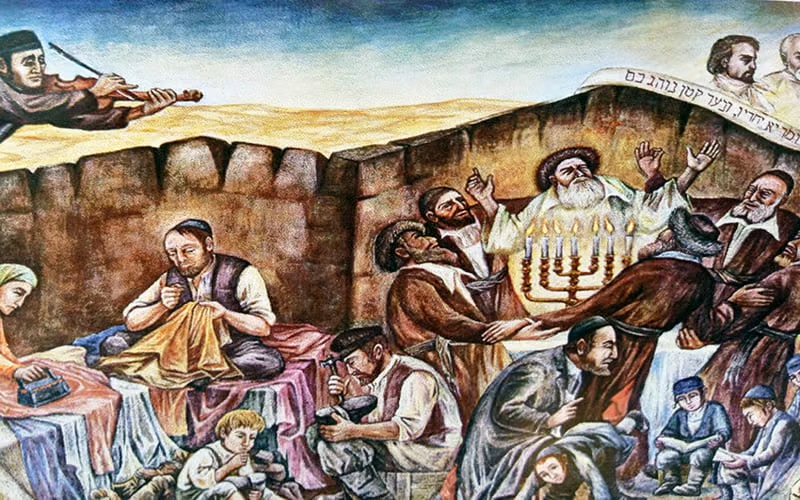


 _________________________________________


 __________________________________________________________


