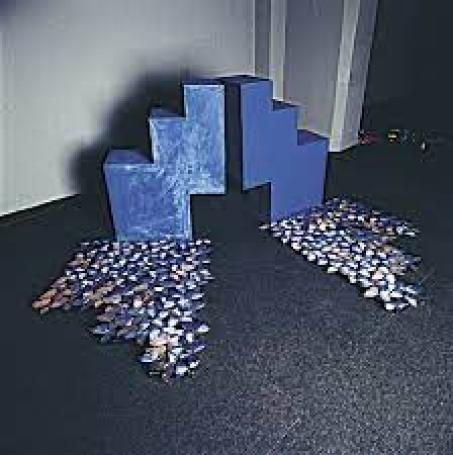
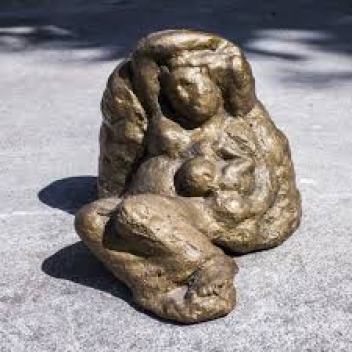
Tosia Malamud nació en 1923 en Vinnytsya, Ucrania, fue la menor de los dos hijos de Isaac Malamud y Liza Backal, quienes emigraron a México cuando ella tenía 4 años de edad. En el nuevo hogar, su padre estableció la primera imprenta en idish, donde se publicó el legendario libro: “Di Drai Vegn” (Los Tres Caminos) de los recordados poetas Itzjak Berliner, Yacov Glantz y Moishe Glikovsky.. En 1952 tuvo la oportunidad de tener su propio estudio formal que compartió con otro artista, así logró separar su vida familiar con la artística. El año de 1954 fue para Tosia muy importante, debido a que tuvo varias exposiciones, tanto en el Salón de Plástica Mexicana del INBA como en el Centro Deportivo Israelita. Ya se pueden advertir tendencias personales y de estilo que la distinguen de otros escultores de México. Lo que más destaca es la acción, el movimiento; es decir Tosia no toma la expresión escultórica como arte inerte, estática, sino que sus preferencias y su talento la llevan a animar un aliento vivo y sugerente al menor tema. Tosia participó en más de 40 exposiciones individuales y otras tantas colectivas, tanto en México, Estados Unidos, Europa e Israel. Su magistral obra, la mayor parte de ella elaboradas en bronce y piedra, de las cuales 38 de ellas están expuestas en instituciones y lugares públicos en la República Mexicana y 14 en el extranjero.
_______________________________________
Tosia Malamud was born in 1923 in Vinnytsya, Ukraine, the younger of two children of Isaac Malamud and Liza Backal, who emigrated to Mexico when she was four years old. In their new home, her father established the first Yiddish printing press, where the legendary book “Di Drai Vegn” (The Three Paths) by the renowned poets Itzjak Berliner, Yacov Glantz, and Moishe Glikovsky was published. In 1952, she had the opportunity to have her own formal studio, which she shared with another artist, thus allowing her to separate her family life from her artistic life. The year 1954 was very important for Tosia, as she had several exhibitions, both at the Salón de la Plástica Mexicana of the INBA (National Institute of Fine Arts) and at the Israeli Sports Center. Personal and stylistic tendencies that distinguish her from other Mexican sculptors were already evident. What stands out most is the sense of action and movement; that is, Tosia did not conceive of sculptural expression as an inert, static art form, but rather her preferences and talent led her to imbue even the simplest subject with a vibrant and evocative spirit. Tosia participated in more than 40 solo exhibitions and numerous group exhibitions in Mexico, the United States, Europe, and Israel. Her masterful works, most of them created in bronze and stone, include 38 pieces displayed in institutions and public spaces throughout Mexico and 14 abroad.
Olga Fisch (1901-1990) fue una artista, marchante de arte y promotora cultural extraordinaria. Nacida en Hungría, viajó por el mundo explorando las selvas de Sudamérica y viviendo en Marruecos, donde reunió su primera colección de artesanías. En 1932, se casó con su segundo esposo, Bela Fisch. La pareja emigró de Europa debido a las tensiones políticas en la Alemania nazi, particularmente peligrosas por su origen judío. En Ecuador, Fisch comenzó a enseñar en la Escuela de Bellas Artes y se involucró profundamente en el arte popular ecuatoriano. Para 1943, su colección de artefactos y obras de arte atrajo la atención internacional. Lincoln Kirstein, director del Museo de Arte Moderno de Nueva York (MoMA), visitó Ecuador para ver la colección. Este encuentro la catapultó a la fama y la llevó a tener a la ONU y al MoMA como sus primeros clientes. Durante la década de 1950, Fisch diseñó varias líneas de alfombras de gran éxito. En la década de 1960, su exclusivo negocio de alfombras, dirigido por mujeres y basado en encargos, era un éxito rotundo. También fundó un museo sin fines de lucro dedicado a la cultura ecuatoriana y una tienda de artesanías llamada “Folklore”, que aún hoy es un referente cultural en Quito. Incluso en sus últimos años, Fisch conservó un agudo sentido del estilo, combinando con maestría la inspiración arqueológica y los motivos precolombinos con influencias clásicas coloniales.
Olga Fisch (1901-1990) was an extraordinary artist, art dealer and cultural advocate. Born in Hungary, Olga Fisch traveled the world exploring the jungles of South America and living in Morocco where she assembled her first collection of cultural handicrafts. In 1932, Olga married her second husband Bela Fisch. The couple emigrated from Europe due to political tensions in Nazi Germany, particularly dangerous due to their Jewish heritage. In Ecuador, Fisch began teaching at the School of Fine Arts. Fisch became deeply involved in Ecuadorian folk art. By 1943, Fisch’s collection of cultural artifacts and art attracted international attention. Lincoln Kirstein, the director of New York’s Museum of Modern Art, visited Ecuador to view the collection. This meeting catapulted Fisch into the spotlight and resulted in the U.N. and MoMA becoming her first clients. During the 1950s, Fisch designed several successful area carpet lines. By the 1960’s, Fisch’s exclusive women-run commission-based carpet business was a resounding success. She also started a non-profit museum dedicated to Ecuadorian cultural and a handicraft shop called “Folklore” that is still a cultural landmark in Quito. Even in her older years, Fisch retained a keen sense of style that artfully combined archaeological inspiration and Pre-Colombian motifs with classical colonial influences.
_______________________________________
__________________________________________
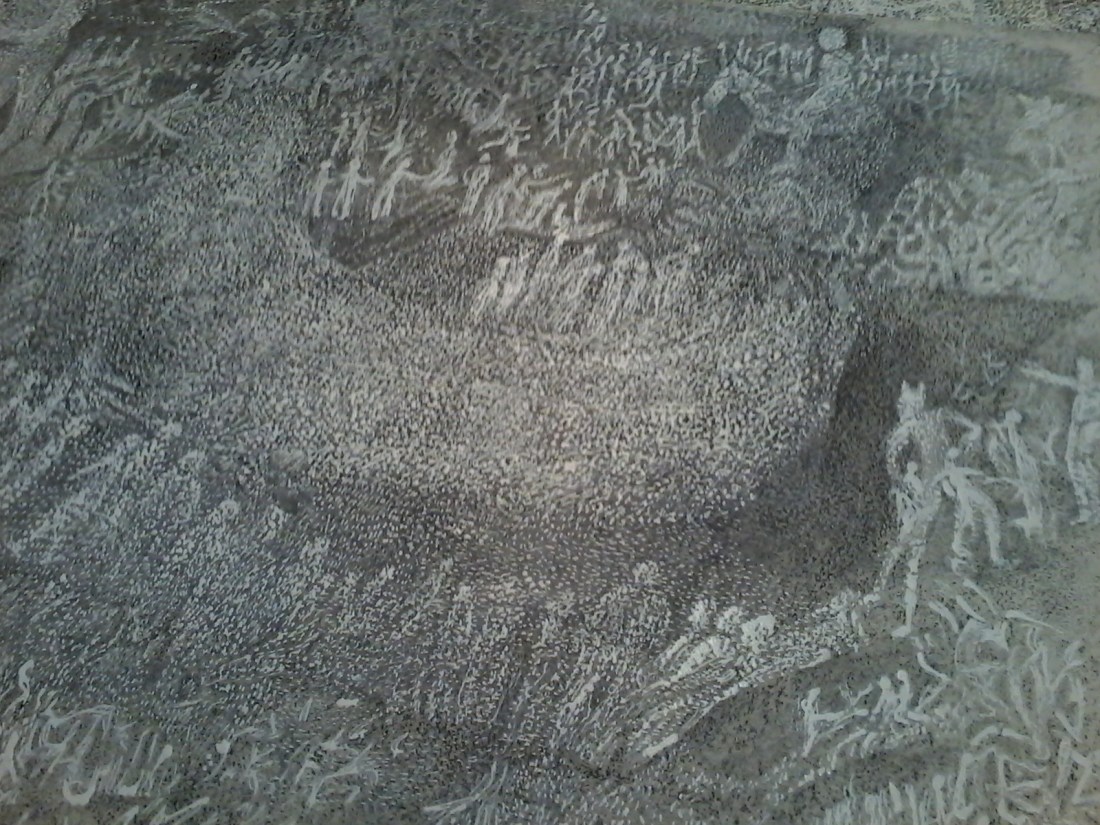
De la serie “Caverna”:/From the “Caverna” series
Diseños especiales/Special Designs
Gente del Ecuador, en la colonia y en la actualidad de la artista/Ecuadorian people in the Colonial period and time of the artist
Nascida na Argentina, filha de imigrantes judeus poloneses, em 1933, Anna Bella Geiger vive e trabalha no Rio de Janeiro. De 1950 a 1953, Geiger frequentou aulas gratuitas de desenho, pintura e gravura no Instituto Fayga Ostrower, onde seu trabalho tendeu à abstração. Viajou para Nova York para estudar história da arte e sociologia na Universidade de Nova York e no Metropolitan Museum of Art; Geiger retornou ao Rio de Janeiro em 1954. Ao longo da década de 1960, continuou a receber prêmios em exposições nacionais. Em 1964, Geiger se desencantou com a abstração informal. Seu trabalho começou a refletir as formas orgânicas do corpo. No final da década de 1960, sentiu a necessidade de responder ao clima sociopolítico de seu país. Participou de um boicote à 10ª Bienal de São Paulo (1969) e empregou colagem e assemblage para explorar a identidade brasileira e as noções de periferia. Cartografia e topografia logo se tornaram motivos importantes em sua obra. Na década de 1980, seu interesse pela pintura foi renovado, enquanto na década de 1990 ela retornou à escultura multimídia com formas cartográficas. Em 1987, em parceria com o artista, crítico e professor Fernando Cocchiarale, foi coautora de Abstração Geométrica e Informal: A Vanguarda Brasileira nos Anos 50. Geiger participou de bienais internacionais realizadas em São Paulo, Veneza (1980), Havana (1997) e Porto Alegre, Brasil (1997). Recebeu uma bolsa da Fundação Memorial John Simon Guggenheim (1982) e foi premiada diversas vezes, incluindo a Bolsa da Fundação Vitae, o Prêmio SESC Rio de Fomento à Cultura (2010) e o Prêmio Ibram de Arte Contemporânea (2011). — Courtney Smith
_________________________________________________
Born in Argentina to Polish Jewish immigrant parents in 1933, Anna Bella Geiger lives and works in Rio de Janeiro. From 1950 to 1953 Geiger attended free classes in drawing, painting, and engraving at Instituto Fayga Ostrower, where her work tended toward abstraction. She traveled to New York to study art history and sociology at New York University and the Metropolitan Museum of Art; Geiger returned to Rio de Janeiro in 1954, Through the 1960s she continued to receive awards at national exhibitions. By 1964 Geiger became disenchanted with informal abstraction. Her work began to reflect the body’s organic forms. By the late 1960s she felt the need to respond to the sociopolitical climate of her country. She participated in a boycott of the 10th Bienal de São Paulo (1969) and employed collage and assemblage to explore Brazilian identity and notions of the periphery. Cartography and topography soon became important motifs in her work. The 1980s saw her renewed interest in painting, while in the 1990s she returned to multimedia sculpture of cartographic forms. In 1987, with the artist, critic, and professor Fernando Cocchiarale, she coauthored Geometric and Informal Abstractionism: The Brazilian Avant-garde in the Fifties. Geiger participated in international biennials held in São Paulo Venice (1980), Havana (1997), and Porto Alegre, Brazil (1997). She received a John Simon Guggenheim Memorial Foundation Fellowship (1982) and won several awards, including the Bolsa da Fundação Vitae, Prêmio SESC Rio de Fomento à Cultura (2010), and Prêmio Ibram de Arte Contemporânea (2011). — Courtney Smith
Nacida como Olga Kostakowsky en Leipzig, Alemania, en 1913, Olga Costa llegó a México en 1925, cuando tenía apenas doce años. Su familia, de origen judío-ruso, buscaba un lugar para rehacer sus vidas. Fue en México donde realmente alcanzó la mayoría de edad, cambiando finalmente su nombre. Tomó clases de grabado con Emilio Amero, donde conoció a su futuro compañero de vida y artístico, José Chávez Morado. Se casaron en 1935, formando una unión que no solo fue emotiva sino también profundamente creativa. Olga Costa se dedicó a construir un cuerpo de trabajo marcado por una profunda originalidad. Sus pinturas son notables por su exaltación del color, síntesis formal y una mirada amorosa hacia la vida popular mexicana. Su universo eran flores, frutas, mujeres anónimas y altares domésticos. Su pintura más celebrada es La vendedora de frutas (1951), considerada un ícono del arte moderno mexicano. El máximo reconocimiento a su carrera llegó en 1990 cuando le fue otorgado el Premio Nacional de Artes y Ciencias en la categoría de Bellas Artes, uno de los máximos honores culturales de México. Falleció en Guanajuato en 1993.
____________________________
Born as Olga Kostakowsky in Leipzig, Germany, 1913, Olga Costa arrived in Mexico in 1925, when she was just twelve years old. Her family, of Jewish-Russian origin, was seeking a place to rebuild their lives, It was in Mexico where she truly came of age, eventually changing her name to She took printmaking classes with Emilio Amero, where she met her future life and artistic partner, José Chávez Morado. They married in 1935, forming a union that was not only emotional but also deeply creative. Olga Costa dedicated herself to building a body of work marked by profound originality. Her paintings are notable for their exaltation of color, formal synthesis, and a loving gaze toward Mexican popular life. Her universe was flowers, fruits, anonymous women, and domestic altars. Her most celebrated painting is La vendedora de frutas(1951), considered an icon of modern Mexican art, The highest recognition of her career came in 1990 when she was awarded the National Prize for Arts and Sciences in the Fine Arts category, one of Mexico’s highest cultural honors. She died in Guanajuato in 1993
_________________________________________________
FRUTAS
MUJERES Y MUCHACHAS MEXICANAS/MEXICAN WOMAN AND GIRLS
“Vlady” Vladimir Victorovich Kibalchich Rusakov fue un pintor judío-ruso-mexicano. “Vlady” Vladimir Victorovich Kibalchich Rusakov fue un pintor judio-ruso-mexicano, conocido simplemente como “Vlady” en México. Llegó a México como refugiado de Rusia con su padre, el escritor Victor Serge. Atraído por la pintura tras su experiencia en Europa, Vlady se integró rápidamente en la escena artística e intelectual mexicana, realizando su primera exposición individual en 1945, dos años después de su llegada al país. Vlady pasó la mayor parte de su carrera en México, con viajes de regreso a Europa, alcanzando la fama en la década de 1960. En la década de 1970, fue invitado a pintar murales en la Biblioteca Miguel Lerdo de Tejada, un edificio del siglo XVII en el centro histórico de la Ciudad de México. El resultado fue “Las Revoluciones y los Elementos”, dedicada a las diversas revoluciones modernas en el mundo, incluyendo la revolución sexual de mediados del siglo XX. La obra fue algo controvertida, pero dio lugar a otros murales en Nicaragua y Culiacán. Vlady recibió varios premios por su obra, incluyendo la Membresía Honoraria de la Academia Rusa de las Artes. Años antes de su fallecimiento en 2005, el artista donó 4600 obras de su propia colección, de las cuales aproximadamente 1000 se conservan en el Centro Vlady de la Universidad Autónoma de la Ciudad de México, dedicado a la investigación y difusión de judío-ruso-mexicano, conocido simplemente como “Vlady” en México. Llegó a México como refugiado de Rusia con su padre, el escritor Victor Serge. Atraído por la pintura tras su experiencia en Europa, Vlady se integró rápidamente en la escena artística e intelectual mexicana, realizando su primera exposición individual en 1945, dos años después de su llegada al país. Vlady pasó la mayor parte de su carrera en México, con viajes de regreso a Europa, alcanzando la fama en la década de 1960. En la década de 1970, fue invitado a pintar murales en la Biblioteca Miguel Lerdo de Tejada, un edificio del siglo XVII en el centro histórico de la Ciudad de México. El resultado fue “Las Revoluciones y los Elementos”, dedicada a las diversas revoluciones modernas en el mundo, incluyendo la revolución sexual de mediados del siglo XX. La obra fue algo controvertida, pero dio lugar a otros murales en Nicaragua y Culiacán. Vlady recibió varios premios por su obra, incluyendo la Membresía Honoraria de la Academia Rusa de las Artes. Años antes de su fallecimiento en 2005, el artista donó 4600 obras de su propia colección, de las cuales aproximadamente 1000 se conservan en el Centro Vlady de la Universidad Autónoma de la Ciudad de México, dedicado a la investigación y difusión de su obra.
_________________________________
“Vlady” Vladimir Victorovich Kibalchich Rusakov was a Russian-Jewish Mexican painter, known simply as “Vlady” in Mexico. He came to Mexico as a refugee from Russia together with his father, writer Victor Serge. Attracted to painting from his exposure in Europe, Vlady quickly became part of Mexico’s artistic and intellectual scene, with his first individual exhibition in 1945, two years after his arrival to the country. Vlady spent most of his career in Mexico with trips back to Europe, gaining fame in the 1960s. In the 1970s, he was invited to paint murals at the Miguel Lerdo de Tejada Library, a 17th-century building in the historic center of Mexico City. The result was “Las revoluciones y los elementos” dedicated to the various modern revolutions in the world including the sexual revolution of the mid 20th century. The work was somewhat controversial but it led to other mural work in Nicaragua and Culiacán. Vlady received a number of awards for his life’s work including honorary membership with the Russian Academy of Arts. A number of years before his death in 2005, the artist donated 4,600 artworks from his own collection, about a thousand of which are found at the Centro Vlady at the Universidad Autónoma de la Ciudad de México, which is dedicated to research and promotion of the artist’s work.
Fayga Ostrower foi nascida em 1920 na cidade de Lodz, Polônia. Gravadora, pintora, desenhista, ilustradora, teórica da arte e professora, Fayga Ostrower chegou ao Rio de Janeiro em 1934. Cursou Artes Gráficas na Fundação Getúlio Vargas Entre os anos de 1954 e 1970, desenvolveu atividades docentes na disciplina de Composição e Análise Crítica no Museu de Arte Moderna do Rio de Janeiro. No decorrer da década de 60, lecionou no Spellman College, em Atlanta, EUA; na Slade School da Universidade de Londres, Inglaterra, e, posteriormente, como professora de pós-graduação, em várias universidades brasileiras. Foi presidente da Associação Brasileira de Artes Plásticas entre 1963 e 1966. De 1978 a 1982, presidiu a comissão brasileira da International Society of Education through Art, INSEA, da Unesco. Fez parte do Conselho Estadual de Cultura do Rio de Janeiro de 1982 a 1988. Em 1972, foi agraciada com a condecoração Ordem do Rio Branco. Em 1998, foi condecorada com o Prêmio do Mérito Cultural pelo Presidente da República do Brasil. Em 1999, recebeu o Grande Prêmio de Artes Plásticas do Ministério da Cultura. Faleceu no Rio de Janeiro, em 2001.
______________________________________
Fayga Ostrower nació en 1920 en Lodz, Polonia. Grabadora, pintora, diseñadora, ilustradora, teórica del arte y profesora, llegó a Río de Janeiro en 1934. Estudió Artes Gráficas en la Fundación Getúlio Vargas. Entre 1954 y 1970, impartió clases de Composición y Análisis Crítico en el Museo de Arte Moderno de Río de Janeiro. Durante la década de 1960, impartió clases en el Spellman College de Atlanta, EE. UU.; en la Slade School de la Universidad de Londres, Inglaterra; y posteriormente, como profesora de posgrado en varias universidades brasileñas. Fue presidenta de la Asociación Brasileña de Artes Visuales de 1963 a 1966. De 1978 a 1982, presidió el comité brasileño de la Sociedad Internacional de Educación por el Arte (INSEA) de la UNESCO. Fue miembro del Consejo de Cultura del Estado de Río de Janeiro de 1982 a 1988. En 1972, recibió la Orden de Río Branco. En 1998, recibió el Premio al Mérito Cultural del Presidente de la República de Brasil. En 1999, recibió el Gran Premio de Artes Visuales del Ministerio de Cultura. Falleció en Río de Janeiro en 2001.
________________________________
Fayga Ostrower was born in 1920 in Lodz, Poland. Engraver, painter, designer, illustrator, art theorist and teacher, she arrived in Río de Janeiro in 1934. She studied Graphic Arts at the Fundación Getúlio Vargas. Between 1954 and 1970, she taught Composition and Critical Analysis at the Museum of Modern Art in Río de Janeiro. During the 1960s, she taught classes at Spellman College in Atlanta, EE. UU.; at the Slade School at the University of London, England; and later, as a postgraduate professor at several Brazilian universities. She was president of the Brazilian Association of Visual Arts from 1963 to 1966. From 1978 to 1982, she chaired the Brazilian committee of the International Society of Education for Art (INSEA) of UNESCO. She was a member of the Consejo de Cultura del Estado de Río de Janeiro from 1982 to 1988. In 1972, Ostrower received the Order of Río Branco. In 1998, she received the Cultural Merit Award from the President of the Republic of Brazil. In 1999, she received the Grand Prize for Visual Arts from the Ministry of Culture. She died in Río de Janeiro in 2001.
Las pinturas, dibujos y escritos teóricos del artista judío nacido en Austria, Wolfgang Paalen, fueron impulsados por una poderosa fascinación por la relación entre el arte, la ciencia y la magia. Después de unirse al grupo surrealista de París junto a su esposa, Alice Rahon, en 1935, Paalen quedó impresionado por las posibilidades creativas del automatismo, o la realización de acciones sin pensamiento consciente. Este principio se expresó más notablemente en su técnica fumage, en la que se utiliza humo de vela para hacer impresiones en un soporte preparado con pintura al óleo. Las formas ondulantes e impredecibles que resultaron de esta técnica hablaron de la inclinación de Paalen por aprovechar el potencial creativo del azar, evidente en su obra L’autophage (Fulgurites) (1938). En 1939, Paalen dejó París con Rahon y la fotógrafa Eva Sulzer para viajar por el noroeste del Pacífico antes de viajar a México. Tras el estallido de la Segunda Guerra Mundial, se establecieron juntos de forma permanente en la Ciudad de México, donde rápidamente se unieron a un grupo de innovadores artistas internacionales, entre ellos Diego Rivera, Manuel Álvarez Bravo y Leonora Carrington. En 1940, Paalen organizó la Exposición Internacional del Surrealismo en la Ciudad de México con André Breton, reuniendo las obras de arte y las ideas de sus colegas surrealistas entonces dispersos por la guerra. Sin embargo, en 1942 Paalen rompió con los surrealistas, publicando su mordaz manifiesto “Adiós al surrealismo” en el primer número de su ambiciosa revista interdisciplinaria Dyn (1942-1944). Con esta separación pública de los surrealistas, formó un nuevo grupo artístico experimental en el Área de la Bahía de San Francisco con los pintores Gordon Onslow Ford y Lee Mullican y la escritora Jacqueline Johnson. Llamándose a sí mismos Dynaton, estos artistas buscaron redefinir lo posible a través de una exploración de la mente inconsciente y las culturas pasadas.
__________________________________________
The paintings, drawings and theoretical writings of Austrian-born Jewish artist Wolfgang Paalen were driven by a powerful fascination with the relationship between art, science, and magic. After joining the Paris Surrealist group alongside his wife, Alice Rahon, in 1935, Paalen was struck by the creative possibilities of automatism, or performing actions without conscious thought. This principle was most notably expressed in his technique fumage, in which candle smoke is used to make impressions on an oil-paint-primed support. The billowing, unpredictable forms that resulted from this technique spoke to Paalen’s penchant for harnessing the creative potential for chance, evident in his work L’autophage (Fulgurites)(1938). In 1939, Paalen left Paris with Rahon and photographer Eva Sulzer to travel through the Pacific Northwest before journeying to Mexico. Following the outbreak of World War II, they settled together permanently in Mexico City where they quickly joined a group of innovative international artists, including Diego Rivera, Manuel Álvarez Bravo, and Leonora Carrington. In 1940, Paalen organized the International Exhibition of Surrealism in Mexico City with André Breton, bringing together the artwork and ideas of his Surrealist colleagues then scattered by the war. However, by 1942 Paalen broke with the Surrealists, publishing his biting manifesto “Farewell to Surrealism” in the first issue of his ambitious, interdisciplinary journal Dyn (1942–44). With this public separation from the Surrealists, he formed a new experimental artistic group in the San Francisco Bay Area with painters Gordon Onslow Ford and Lee Mullican and writer Jacqueline Johnson. Calling themselves Dynaton, these artists sought to redefine the possible through an exploration of the unconscious mind and past cultures.
_________________________________
Libros sobre Wolfgang Paalan/Books about Wolfgang Paalan
Mauricio Lasansky in his studio, Iowa City, IA ca. 1965
Biografía
Nacido en Buenos Aires, in 1914, Mauricio Lasansky es uno de los pocos artistas modernos que han limitado su obra casi exclusivamente a los medios gráficos. Gracias a sus tempranas contribuciones al desarrollo de las técnicas gráficas y a su dedicación al grabado, Lasansky es considerado un precursor en la evolución de las artes gráficas como forma de arte crítico y ha sido reconocido como uno de los “Padres del Grabado Americano del Siglo XX”.
En 1936, a los veintidós años, ya era director de la Escuela Libre de Bellas Artes de Villa María, Córdoba, Argentina. En 1943, Lasansky recibió la prestigiosa Beca Guggenheim, con la que viajó a Estados Unidos y estudió la colección de grabados del Museo Metropolitano de Arte. Esta oportunidad no solo le proporcionó un vasto conocimiento sobre grabados y grabadores, sino que también le brindó la oportunidad de conocer y trabajar con varios maestros europeos que habían huido a Estados Unidos durante la guerra. Para 1952, no solo había recibido numerosos reconocimientos, premios y galardones, y contaba con una impresionante colección de exposiciones, sino que también se había consolidado como ciudadano estadounidense.
Durante la década de 1940, el interés por el grabado como arte se revitalizó gracias a los talleres de artes gráficas de la Administración de Progreso de Obras (WPA), y muchos artistas continuaron explorando el método tras la suspensión de los proyectos de la WPA. El más importante de estos estudios fue el Atelier 17 de Nueva York, fundado por Stanley William Hayter. El suyo fue el primer taller estadounidense independiente creado para la experimentación exclusiva con el proceso de grabado calcográfico. Gracias a la labor de Hayter, el estudio captó la atención de artistas de todo el país. Muchos de estos artistas se conocen actualmente como la Escuela de Nueva York. Estos artistas adoptaron el expresionismo abstracto como medio de expresión estilística y su obra transformó radicalmente el curso del grabado calcográfico en Estados Unidos.
Muchos artistas, incluyendo a Lasansky, trabajaron extensamente en el Atelier 17 formulando nuevos métodos y creando nuevas técnicas tanto para sus temas como para sus grabados. Posteriormente, varios fueron invitados a establecer talleres de grabado en departamentos de arte universitarios de todo el país. Uno de los primeros artistas en aceptar este reto fue Mauricio Lasansky, quien fundó el importante taller de grabado en la Universidad de Iowa. Hasta el día de hoy, sirve de modelo para numerosos departamentos universitarios de grabado, dirigidos por muchos de sus antiguos alumnos.
La transmisión de técnicas e ideologías consolidadas sobre técnicas innovadoras de grabado, a través de generaciones de profesores y alumnos, marca el legado del Atelier 17. Y es Lasansky, una de las primeras generaciones de estos grabadores, quien ha influido en el desarrollo del grabado en Estados Unidos.
Conocido sobre todo por sus grabados a gran escala, en los que utiliza múltiples planchas y gamas cromáticas completas, Lasansky combina una amplia gama de técnicas gráficas, incluyendo el aguafuerte, la punta seca, el aguatinta y el grabado. A lo largo de su evolución estilística, ha creado elocuentes evocaciones figurativas, coloridas, frescas y espontáneas. Sus obras tempranas y tardías demuestran que su imaginería ha abordado constantemente elementos que han experimentado cambios y expansiones a lo largo de su creación. Por lo tanto, el tema de su arte es tan importante como el aspecto técnico de sus grabados.
Los retratos de Lasansky se presentan como ideales humanísticos en comparación con las figuras deshumanizadas que aparecen en sus otros grabados. Muchos de sus retratos comienzan en un formato individual, pero en muchas ocasiones la figura idealizada se degenera y se presenta en un espacio gráfico en lugar de pictórico. Tiene una especial consideración por el espectador, ya que retrata la imagen dentro de su espacio.
Lasansky se ha dedicado a explorar las posibilidades expresivas de las artes gráficas. Ha acumulado un conjunto de grabados considerados entre los más impactantes e impactantes del arte contemporáneo. Ha contribuido significativamente a consolidar el grabado como una forma de arte significativa y crucial del siglo XX. Y, como resultado, se ha convertido en uno de los primeros de una generación de importantes grabadores en enseñar a decenas de estudiantes, quienes a su vez enseñan a decenas de generaciones futuras en este país. Por todas estas razones, se le considera uno de los “Padres del Grabado Americano del Siglo XX”.
Lasansky ha recibido cinco Becas Guggenheim, seis Doctorados Honoris Causa en Artes y numerosos premios y distinciones especiales. Su obra está representada en más de cien colecciones públicas, incluyendo prácticamente todos los principales museos de Estados Unidos. Reconocido internacionalmente, ha expuesto en América del Norte y del Sur, Europa y Rusia. Ya jubilado de la Universidad de Iowa, sigue siendo una inspiración para los artistas por sus contribuciones, la riqueza e intensidad de sus superficies impresas y su estilo profundamente personal.
__________________________________ Biography
Born in Buenos Aires, in 1914, Mauricio Lasansky is one of the few modern artists who have limited their works almost exclusively to the graphic media. Due to his early contributions in the development of graphic techniques and his dedication to printmaking, Lasansky is considered to be a forerunner in the evolution of the graphic arts as a critical art form and has become recognized as one of the “Fathers of 20th Century American Printmaking.”
In 1936, at the age of twenty-two, he had already become the director of the Free Fine Arts School, in Villa Maria, Cordoba, Argentina. In 1943, Lasansky was offered the prestigious Guggenheim Fellowship in which he came to the United States and studied the print collection at the Metropolitan Museum of Art. This opportunity not only afforded him a wealth of knowledge about prints and printmakers but created an opportunity for him to be exposed to and work with a number of European masters who had fled to the United States during wartimes. By 1952, he had not only received a great deal of recognition, prizes and awards, and had an impressive line of exhibitions, but also had established himself as an American citizen.
During the 1940’s, the interest in printmaking as a fine art was revitalized by the Works Progress Administration graphic arts workshops and many artists continued to explore the method after the WPA projects were discontinued. The most important of these studios was the New York Atelier 17 established by Stanley William Hayter. His was the first independent American workshop developed for exclusive experimentation of the intaglio process of printmaking. Through Hayter’s efforts, the studio gained the attention of artists from around the country. Many of these artists are now referred to as the New York School. These artists adopted Abstract Expressionism as a means of stylistic expression and their work radically altered the course of intaglio printmaking in America.
Many artists, including Lasansky, worked extensively at the Atelier 17 formulating new methods and creating new techniques for their subjects as well as their prints. Several were later invited to develop print-shops in university art departments around the country. One of the first artists to accept this challenge was Mauricio Lasansky. He established the vital printmaking workshop at the University of Iowa. To this day, it serves as a model for numerous other university printmaking departments led by many of Lasansky’s former students.
It is the passing down of established techniques and ideologies about innovative printmaking techniques from generations of these teachers and students that marks the legacy of Atelier 17. And, it is Lasansky, one of the first generations of these printmakers, who has influenced the course of printmaking in the United States.
Best known for large scale prints in which he uses multiple plates and full ranges of color, Lasansky combines a spectrum of graphic techniques including etching, drypoint, aquatint and engraving. Throughout his stylistic evolution, he has created eloquent figural statements that are colorful, fresh and spontaneous. His early and late works show that his imagery has consistently dealt with elements which have undergone change and expansion as the work was created. Therefore, the subject of his art is as important as the technical aspect of his printmaking.
Lasansky’s portraits appear as humanistic ideals when compared to the dehumanized figures that appear in his other prints. Many of his portraits begin in an individual format, but many times the idealized figure degenerates and is presented in graphic rather than pictorial space. He has a special regard for the spectator, as he portrays the image within the viewer’s space.
Lasansky has devoted himself to exploring the expressive possibilities of graphic arts. He has amassed a body of prints considered to be some of the most powerful and impressive in contemporary art. He has contributed significantly in establishing printmaking as a meaningful and critical art form of the 20th century. And, as a result, he has become one of the first in a generation of important printmakers to teach scores of students, who in turn are teaching scores of future generations in this country. For all these reasons, he is considered to be one of the “Fathers of 20th Century American Printmaking.”
Lasansky has been the recipient of a total of five Guggenheim Fellowships, six honorary Doctorate of Arts degrees and numerous prizes and special honors. His work is represented in more than one hundred public collections including virtually every major museum in the United States. Internationally recognized, he has been exhibited throughout North and South America, Europe and Russia. Now retired from the University of Iowa, he continues to be an inspiration to artists for his contributions, his richly and intensely printed surfaces, and his highly personal style.
Abraham Palatnik é uma figura icônica nos movimentos de arte óptica e cinética do Brasil — um pioneiro em seu interesse de longa data por explorar as possibilidades criativas incorporadas em cruzamentos de arte e tecnologia. Tendo estudado engenharia, o artista se interessou em investigar usos mecânicos deluz e movimento. Em 1949, ele ganhou destaque com a criação de seu Dispositivo Cinecromático, reinventando efetivamente a ideia de uma pintura usando lâmpadas de diferentes voltagens movendo-se em diferentes velocidades e direções para criar imagens caleidoscópicas. A peça foi exibida na 1ª Bienal de São Paulo (1951) e recebeu uma Menção Honrosa do Júri Internacional por sua originalidade. Abraham Palatnik posteriormente iniciou seu trabalho com relevos, cunhados relevos progressivos, que ele fez de vários materiais (como madeira, papelão duplex e acrílico) usando processos manuais meticulosos para criar uma variedade de efeitos ópticos e cinéticos. Além da série W, que passou a incorporar o uso do corte a laser, Palatnik continuou a construir e a pintar cada peça à mão, tornando cada trabalho um símbolo de seu artesanato.
Nara Roesler
Para mais informações sobre a arte de Abraham Palatnik, veja a Galeria Nara Roesler:
Abraham Palatnik es una figura icónica de los movimientos de arte óptico y cinético. de Brasil, un pionero en su interés de larga data por explorar las posibilidades creativas Incorporado en las intersecciones del arte y la tecnología. Habiendo estudiado ingeniería, el artista se interesó en investigar los usos mecánicos de la luz y el movimiento. En 1949, saltó a la fama con la creación de su Dispositivo Cinecromático, reinventando efectivamente la idea de una pintura al utilizar bombillas de diferentes potencias que se movían a diferentes velocidades y direcciones para crear imágenes caleidoscópicas. La pieza fue expuesta en la 1ª Bienal de São Paulo (1951) y recibió una Mención Honorífica del Jurado Internacional por su originalidad. Abraham Palatnik comenzó más tarde su trabajo con relieves, llamados relieves progresivos, que realizó a partir de diversos materiales (como madera, cartón dúplex y acrílico) mediante meticulosos procesos manuales para crear una variedad de efectos ópticos y cinéticos. Además de la serie W, que comenzó a incorporar el uso del corte por láser, Palatnik continuó construyendo y pintando cada pieza a mano, haciendo de cada obra un símbolo de su artesanía.
Nara Roesler
Para obtener más información sobre el arte de Abraham Palatnik, visite la Galería Nara Roesler:
Abraham Palatnik is an iconic figure in the optical and kinetic art movements of Brazil—a pioneer in his long-standing interest for exploring the creative possibilities embedded in crossings of art and technology. Having studied engineering, the artist became interested in investigating mechanic uses of light and movement. In 1949, he rose to prominence with the creation of his first Kinechromatic Device effectively reinventing the idea of a painting by using different voltage bulbs moving at different speeds and directions to create kaleidoscopic images. The piece was shown at the 1st Bienal de São Paulo (1951) and received an Honorable Mention from the International Jury for its originality. Abraham Palatnik subsequently initiated his work with reliefs, coined Progressive reliefs, which he made out of various materials (such as wood, duplex cardboard and acrylic) using meticulous manual processes to create a variety of optical and kinetic effects. Apart from the series W, which has come to incorporate the use of laser-cutting, Palatnik continued to construct and paint every piece by hand, making each work a token of his craftsmanship. His main solo exhibitions include: Abraham Palatnik: Seismograph of Color, at Nara Roesler (2022), in New York, United States; Abraham Palatnik – A Reinvenção da Pintura [Abraham Palatnik – The Reinvention of Painting], was featured in several Brazilian institutions
Nara Roesler
For more information about and art of Abraham Palatnik, see Nara Roesler Gallery:
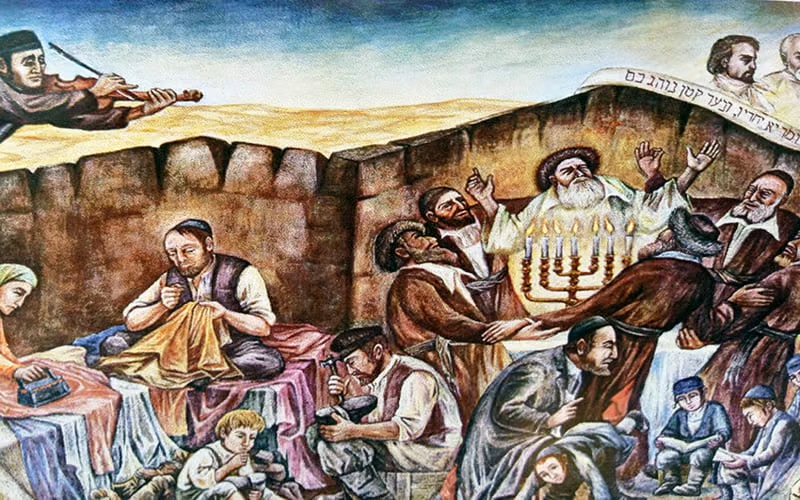
Fanny Rabel nació en 1922 en Polonia, en el seno de una familia judía que huyó a la Ciudad de México en 1937, cuando comenzó la Segunda Guerra Mundial. A los 17 años, comenzó su carrera artística, estudiando en la Escuela Nocturna para Trabajadores No. 1. Después de eso, fue contratada por David Alfaro Siqueiros para decorar los murales del Sindicato Mexicano de Electricistas y por Diego Rivera para trabajar en los murales del Palacio Nacional. Su primera exposición individual pública se realizó en 1941 en la Liga Popular Israelita en la Ciudad de México. Sus temas, composiciones y técnicas eran característicos de los conceptos del realismo social que la mayoría de los artistas de la época intentaban retratar. Realizó varios murales importantes con estos temas. En 1993, el Instituto Nacional de Bellas Artes reconoció sus 50 años de dedicación a las artes en el Palacio de Bellas Artes. Fanny Rabel, murió en 2008 a los 86 años en la Ciudad de México. Su cuerpo fue enterrado en el Panteón Israelita. Adaptado de la Galería Artspawn.
____________________________________________
Fanny Rabel was born in 1922 in Poland to a Jewish family that fled to Mexico City in 1937 when WWII began. At 17, she began her artistic career, studying at the Escuela Nocturna para Trabajadores No. 1. After that she was hired by David Alfaro Siqueiros to decorate the murals of the Mexican Syndicate of Electricians and by Diego Rivera to work on the murals at the Palacio Nacional. Her first public solo exhibit was held in 1941 at the Liga Popular Israelita in Mexico City. Her themes, compositions and the techniques were all characteristic of the concepts of social realism which most artists of the time tried to portray. She did several important murals with these themes. In 1993, the Instituto Nacional de Bellas Artes recognized her 50 years of dedication to the arts at the Palacio de Bellas Artes. Fanny Rabel, died on in 2008 at age 86 in Mexico City. Her body was buried at the Panteon Israelita. Adapted from Artspawn Gallery.
Mariana Yampolsky nació en Chicago de padres judíos. Como fotógrafa tomó fotografías de muchas personas y lugares mexicanos. A la edad de diecinueve años en 1944, se mudó sola a México y no hablaba nada de español. “Desde el principio le gustó mucho México y su gente. Diez años después tuvo que tomar una decisión difícil”. Mariana se nacionalizó mexicana en 1954. Oscar, su padre, le enseñó a seguir sus sueños donde quiera que fuera. “Él le dio un fuerte sentimiento de confianza en sí misma que conservó toda su vida”. (Entrevista con Arjen Van der Sluis, 2/12/05) Mariana era artista, pero utilizó su arte como herramienta para hacer de México un lugar mejor para los pobres. Ella usó su arte para mostrar la belleza de México. Tomó fotografías de México y de los mexicanos durante cincuenta años. Creó dieciséis libros de su fotografía. Aunque Mariana Yampolsky era famosa, se preocupaba por las personas que fotografiaba. Ella siempre preguntaba antes de tomar fotografías por respeto a su privacidad. “Cuando fotografía en el campo, Mariana Yampolsky se acerca a la gente de un pueblo como si llevara una bandera blanca en las manos”. dice Vander de Sluis. Era maestra y ayudó a muchos huérfanos a encontrar familias. Fue famosa en México y su arte se mostró en otros países: Italia, Inglaterra, Francia, Yugoslavia, Holanda, Ecuador, Islandia, Alemania, Cuba, Australia y España.
Mariana Yampolsky was born in Chicago of Jewish parents. As a photographer she took pictures of many Mexican people and places. At the age of nineteen in 1944, she moved to Mexico by herself and did not speak any Spanish. “Right from the beginning, she liked Mexico and its people very much. Ten years later she had to make a difficult decision.” Mariana became a Mexican citizen in 1954. Oscar, her father, taught her to follow her dreams wherever she went. “He gave her a strong feeling of self-confidence that she kept all her life.” (Interview with Arjen Van der Sluis, 12/2/05) Mariana was an artist, but she used her art as a tool to make Mexico better for the poor people. She used her art was to show Mexico’s beauty. She took pictures of Mexico and Mexican people for fifty years. She created sixteen books of her photography. Though Mariana Yampolsky was famous, she cared for the people she photographed. She always asked before taking pictures out of respect for their privacy. “When she photographs in the field, Mariana Yampolsky approaches the people in a village as if she’s carrying a white flag in her hands.” says Vander de Sluis. She was a teacher, and she helped many orphans find families. She was famous in Mexico, and her art was shown in other countries: Italy, England, France, Yugoslavia, Holland, Ecuador, Iceland, Germany, Cuba, Australia, and Spain.
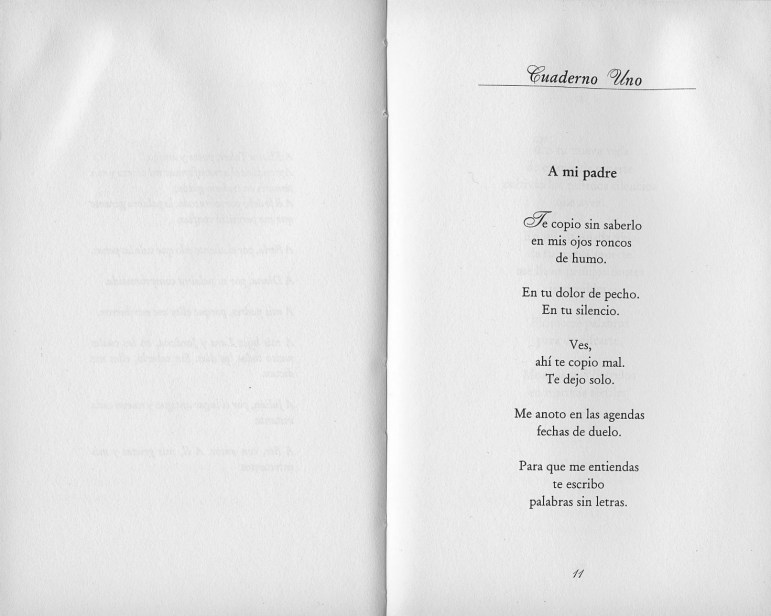
Myriam Moscona (1955) es poeta y periodista. Es autor de nueve libros, entre ellos Vísperas 1996), El que nada (México, 2006) y De par en par ( México, 2009). Su libro De frente y de perfil (DDF, México, 1996), presenta retratos literarios de 75 poetas mexicanos, con fotografías de Rogelio Cuéllar. Tela de sevoya (2012) y León de Lidia (2024) es una narración híbrida que entrelaza la memoria y la ficción; el telón de fondo del libro es el idioma familiar de Moscona, el ladino o el judeoespañol. Su secuencia de libro, Ivory Black (Negro marfil)”, traducido del español por Jen Hofer, recibió el Premio Harold Morton Landon 2012 de la Academia de Poetas Americanos. Moscona ha recibido numerosos premios, entre ellos el Premio de Poesía Aguascalientes y el Premio Nacional de Traducción de Poesía; Ella es beneficiaria del Sistema Nacional de Creadores de Arte, y recibió una beca de la Fundación Guggenheim. Selecciones de su trabajo también se han traducido al alemán, italiano, francés, hebreo, árabe, ruso, búlgaro, chino y sueco.
________________________________________________
Myriam Moscona (1955) is a poet and journalist. She is the author of nine books, including Vísperas (1996), El que nada (Mexico, 2006) and De par en par (Mexico, 2009). Her book De frente y de perfil ( Mexico, 1996), presents literary portraits of 75 Mexican poets, with photographs by Rogelio Cuéllar. Tela de sevoya (2012) and León de Lidia (2024) are hybrid narratives that intertwine memory and fiction; the book’s backdrop is Moscona’s familiar language, Ladino or Judeo-Spanish. Her book sequence, Ivory Black (Negro marfil),” translated from Spanish by Jen Hofer, received the 2012 Harold Morton Landon Award from the Academy of American Poets. Moscona has received numerous awards, including the Aguascalientes Poetry Prize and the National Poetry Translation Prize; she is a beneficiary of the National System of Art Creators, and received a Guggenheim Foundation Fellowship. Selections of her work have also been translated into German, Italian, French, Hebrew, Arabic, Russian, Bulgarian, Chinese, and Swedish.
*****************************
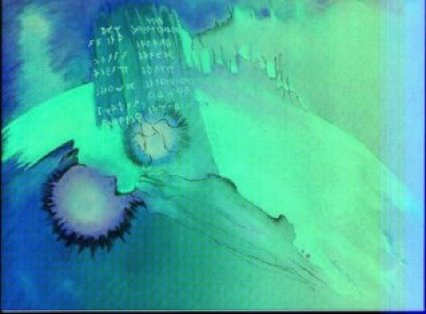
When conceiving Negro marfil, Moscona focused on the use of visual materials (inks, pastels, graphite, and acrylics), which led her to explore visual poetry. In this realm, she is the creator of a variety of art objects and artist books, some of which are part of the Special Collections and Archives at the University of California, Irvine.
********************************
Al concebir Negro marfil, Moscona se centró en el uso de materiales visuales (tintas, pasteles, grafito y acrílicos), lo que la llevó a explorar la poesía visual. En este ámbito, es creadora de una variedad de objetos de arte y libros de artista, algunos de los cuales forman parte de las Colecciones Especiales y Archivos de la Universidad de California, Irvine.
Yaco Nowens nació en Buenos Aires en 1938. Estudió en la Escuela Nacional de Bellas Artes Manuel Belgrano y en los talleres de José Maltz y Méndez Terrero hasta 1965. Trabajó como dibujante en Clarín. Teórico de arte y coeditor de la revista de artes plásticas Óleo y Mármol junto con Teresa Pociello. Sus primeras muestras fueron como dibujante, junto a Quino, Garaycochea y Landrú. En 1964 o 1965 lo empiezan a invitar y René Morón, su maestro y guía, lo obligó a exponer y así comenzó. Dictó conferencias nacionales e internacionales. Miembro de Société des Auteurs dans les Arts Graphiques et Plastiques de París. En 1972 invitado por la OEA viajó a Estados Unidos. Expuso en la Argentina, Estados Unidos, Israel, Corea, Venezuela, España, Ecuador, Francia y Cuba. “Su obra de los años 1960 era netamente confesional, desde el expresionismo, Más adelante, impresionado por los informalistas del Grupo del Paso de España, Pollock y Kooning, su obra se mantiene dentro de una abstracción lírica que nos permite adivinar el gesto de la pincelada manteniendo el todo dentro de composiciones de gran equilibrio geométrico y afín a las primeras etapas del cubismo. De colores restallantes, y de líneas que se entrecruzan a veces, para aludir a una marcada y cierta figuración paisajística”, (Rafael Squirru). También bajo la dirección del artista plástico Yaco Nowens, el periódico judío y militante Nueva Presencia se seguiría editando desde 1987 hasta 1993, año en que Di Presse quebró definitivamente.
____________________________________________
Yaco Nowens was born in Buenos Aires in 1938. He studied at the Manuel Belgrano National School of Fine Arts and in the workshops of José Maltz and Méndez Terrero until 1965. He worked as a draftsman for Clarín. He was an art theorist and co-editor of the visual arts magazine Óleo y Mármol together with Teresa Pociello. His first exhibitions were as a draftsman, alongside Quino, Garaycochea and Landrú. In 1964 or 1965 he began to receive invitations and René Morón, his teacher and guide, forced him to exhibit and that’s how he began. He gave national and international lectures. He is a member of the Société des Auteurs dans les Arts Graphiques et Plastiques in Paris. In 1972, invited by the OAS, he traveled to the United States. He exhibited in Argentina, the United States, Israel, Korea, Venezuela, Spain, Ecuador, France and Cuba. “His work from the 1960s was clearly confessional, from an expressionist perspective. Later, impressed by the informalists of the Grupo del Paso in Spain, Pollock and Kooning, his work remained within a lyrical abstraction that allows us to guess the gesture of the brushstroke, keeping the whole within compositions of great geometric balance and akin to the early stages of cubism. With bright colours and lines that sometimes intersect, to allude to a marked and certain landscape figuration”, (Rafael Squirru). Also, under the direction of the visual artist Yaco Nowens, the Jewish and militant newspaper Nueva Presencia continued to be published from 1987 to 1993, the year in which Di Presse went bankrupt definitively.
Retrato de Yaco Nowens por el gran artista judío-argentino Gyula Kosice/A Portrait of Yako Nowens by the great Argentine Jewish artist Gyula Kosice
Carlos Poveda nació en San José, Costa Rica, en 1940. Su obra artística comenzó a exponerse a principios de la década del 60 en el continente americano. En 1965 obtuvo la Mención Honorífica para Dibujo de la VIII Bienal de Arte de Sao Paulo, Brasil, y el Premio Nacional de Pintura de Costa Rica. En el 2004 recibe el Premio Nacional de Escultura de Costa Rica, y en el 2005 el Premio Unico Francisco Narváez de la VIII Bienal de Escultura Francisco Narváez en Venezuela. Luego de haber vivido 30 años en Venezuela, actualmente reside en Paris.
___________________________________________
Carlos Poveda was born in San José, Costa Rica, in 1940. His artistic work began to be exhibited in the early 1960s in the American continent. In 1965 he received the Honorable Mention for Drawing at the VIII Sao Paulo Art Biennial, Brazil, and the National Painting Award of Costa Rica. In 2004 he received the National Sculpture Award of Costa Rica, and in 2005 the Francisco Narváez Unique Award of the VIII Francisco Narváez Sculpture Biennial in Venezuela. After having lived in Venezuela for 30 years, he currently resides in Paris.
___________________________
Dibujos y otras técnicas /Drawings and other Techniques
Nessim Bassan nació en la ciudad de Panamá en 1950. Bassan comenzó a exponer desde muy temprano, en 1968, donde obtuvo un gran éxito. Su arte fue admirado y valorado por reconocidos críticos de arte y curadores como Thomas Messer del Museo Solomon R. Guggenheim de Nueva York y Lester Cooke de la Galería Nacional de Arte de Washington DC. En 1970, José Gómez-Sicre, lo invitó a exponer en la Organización de Estados Americanos en Washington DC, lo que posteriormente propició su participación en la Bienal de Sao Paulo de 1981. Después de este sorprendente comienzo en su carrera artística, se tomó un descanso del mundo del arte, dedicó su tiempo a su familia y comenzó a pintar por sí mismo. A finales de la década de 1990, comenzó a pintar todos los días y dedicó plenamente su tiempo a su arte. . Comenzó a explorar más a fondo el arte cinético, incorporando madera y pintura. Su visión de la cinética tiene una fuerte estética abstracta geométrica moderna, que da como resultado cientos de capas de pintura y texturas entrelazadas, que evocan fantasías conceptuales. Esta técnica refleja además una perfecta armonía entre mediciones matemáticas controladas, oscilando entre la gravedad y las ilusiones ópticas que son aparentemente simples pero intrincadas. El atractivo de las infinitas composiciones de Bassan es que son delicadas y elegantes ilusiones ópticas, con un impecable equilibrio y precisión visual. Nessim Bassan tuvo una importante exposición que inició en noviembre de 2022, en el Museo de Arte Contemporáneo de Panamá, y viajó al Museo Nacional de Identidad de Honduras, el Museo de Arte de El Salvador finalizó en el Museo de Arte Moderno Carlos Mérida en Guatemala. . El artista vive y trabaja en Panamá.
___________________________
Nessim Bassan was born in Panamá City in 1950. Bassan started exhibiting very early on, in 1968, where he found great success. His art was admired and valued by renowned art critics and curators such as Thomas Messer from the Solomon R. Guggenheim Museum in New York and Lester Cooke from the National Gallery of Art in Washington DC. In 1970, José Gómez-Sicre, invited him to exhibit at the Organization of American States in Washington DC, which later lead to his participation in the 1981 Sao Paulo Biennial. After this astonishing start to his artistic career, he took a break from the art world and dedicated his time to his family, and began painting for himself.During the late 1990s, he started painting every day, and fully dedicated his time to his art. He started to further explore kinetic art, incorporating wood and paint. His take on kinetics has a strong modern geometric abstract aesthetic, resulting in hundreds of layers of paint and interwoven textures, evoking conceptualfantasies. This technique further reflects a perfect harmony between controlled mathematical measurements, oscillating between gravity and optical illusions that are seemingly simple yet intricate. The allurement in Bassan’s infinite compositions is that they are delicate and elegant optical illusions, with an impeccable balance and visual precision. Nessim Bassan had a significant exhibition that began in November of 2022, at the Contemporary Art Museum in Panamá, and traveled\ to the National Identity Museum of Honduras, The Museum of Art of El Salvador ended at the Museum of Modern Art Carlos Mérida in Guatemala. The artist lives and works in Panamá.
Gerardo Goldwasser nace en Montevideo, Uruguay, en 1961. Artista, docente y diseñador gráfico, vive y trabaja en Montevideo. La sastrería, la violencia y el arte contemporáneo se conjugan en su trabajo. Realizó bachillerato de arquitectura, entre 1984 y 1988 estudió artes plásticas en el CEA Centro de Expresión Artística, dirigido por Nelson Ramos. En 1986 realiza un curso de grabado en metal con David Finkbeiner (Profesor del Manhattan graphics of New York, Pratt Institute of New York) en el Museo Nacional de Artes Visuales, Montevideo, Uruguay. En 1987 participó en el curso de elaboración de papel con Laurence Baker (director del Barcelona Helkshop en España) en el Museo Nacional de Artes Visuales, Montevideo, Uruguay. Desde 1985 ha participado en numerosas exhibiciones nacionales e internacionales, entre las que se destacan: En 2011 “Blanco Móvil” en el Centro Cultural Dodecá, en 2010 en el Museo Departamental Juan Manuel Blanes “Repeat me”, en 2008 Galería Dabbah Torrejón, Buenos Aires; ARTbo. En el 2001 recibió la Beca Fundación Pollock Krasner. En el 2004 recibe el Primer Premio en el 51º Salón Nacional de Artes Visuales, Ministerio de Educación y Cultura, Uruguay. En el 2002 Primer Premio 50º Salón Nacional de Artes Visuales, Ministerio de Educación y Cultura, Uruguay. En el 2000 recibe el Segundo Premio de grabado, en la II Bienal de grabado del Mercosur, Feria arte BA 2000, Fondo Nacional de las Artes, Buenos Aires, Argentina. En 1999 Premio adquisición Salón Municipal de Artes Plásticas, Montevideo. En 1996 Primer Premio, Paul Cezzane, Embajada de Francia-Montevideo Beca/residencia París, Nantes. Proyecto FRAC. Fondo Regional de Arte Contemporáneo, Nantes, Francia.
Gerardo Goldwasser was born in Montevideo, Uruguay, in 1961. Artist, teacher and graphic designer, he lives and works in Montevideo. Tailoring, violence and contemporary art come together in his work. He completed a bachelor’s degree in architecture, and between 1984 and 1988 he studied fine arts at the CEA Centro de Expresión Artística, directed by Nelson Ramos. In 1986 he took a metal engraving course with David Finkbeiner (Professor at Manhattan Graphics of New York, Pratt Institute of New York) at the Museo Nacional de Artes Visuales, Montevideo, Uruguay. In 1987 he participated in a papermaking course with Laurence Baker (director of the Barcelona Helkshop in Spain) at the Museo Nacional de Artes Visuales, Montevideo, Uruguay. Since 1985 he has participated in numerous national and international exhibitions, among which the following stand out: In 2011 “Blanco Móvil” at the Dodecá Cultural Center; in 2010 at the Juan Manuel Blanes Departmental Museum “Repeat me”, in 2008 Dabbah Torrejón Gallery, Buenos Aires; ARTbo. In 2001 he received the Pollock Krasner Foundation Scholarship. In 2004 he received First Prize at the 51st National Salon of Visual Arts, Ministry of Education and Culture, Uruguay. In 2002 First Prize 50th National Salon of Visual Arts, Ministry of Education and Culture, Uruguay. In 2000 he received Second Prize for engraving, at the II Mercosur Engraving Biennial, Feria arte BA 2000, National Fund for the Arts, Buenos Aires, Argentina. In 1999 Acquisition Award Municipal Salon of Plastic Arts, Montevideo. In 1996, First Prize, Paul Cezzane, French Embassy-Montevideo. Scholarship/residency Paris, Nantes. FRAC Project. Regional Fund for Contemporary Art, Nantes, France.
_______________________________________________
Abajo: Detalle, siluetas de moldes de uniformes superpuestas e impresas digitalmente en transparencias, intercaladas entre papeles de molde plegados.Museo Blanes, 2010.
__________________________________
Below: Detail, silhouettes of uniform molds superimposed and digitally printed on transparencies, interspersed between folded mold papers. Blanes Museum, 2010.
Poesía, reflexión y arte unidos para conmemorar el 7 de octubre de 2023
Liderado por la destacada escritora, periodista y poeta judío-venezolana Raquel Markus – Finckler, este proyecto busca convertirse en un esfuerzo intelectual significativo que permitirá recordar y honrar a las víctimas de los atentados, a sus familias, a todos los afectados directa o indirectamente por este pogromo. La publicación está dedicada al Estado de Israel, a sus habitantes y, en general, a todos los miembros del pueblo judío.
Por medio de la fusión de palabra, voz e imagen, No alcanzan las palabras busca transmitir el dolor, la tristeza y la desesperación que la Nación judía (en Israel y en el mundo) ha cargado desde aquel terrible día, y al mismo tiempo, es un reconocimiento a su unión, a la esperanza, fe y templanza que ha demostrado durante este tiempo. La obra es un reflejo de las sombras y luces de todos sus participantes que promete dejar una huella profunda en todos sus lectores y escuchas.
A propósito de este próximo lanzamiento, Raquel Markus – Finckler expresó: “Tenemos planificado realizar su difusión en todas las comunidades judías hispanoparlantes de América Latina, Estados Unidos, Europa e Israel. Gracias a la colaboración de muchas personas involucradas en este proyecto, incluyendo a todos los artistas que participan, queremos llegar tan lejos como sea posible. Nuestra voz debe ser escuchada por el mundo, el pueblo y el Estado de Israel tienen derecho a la vida y tienen derecho a defender sus vidas. Este libro es un necesaria reivindicación de nuestro honor y de nuestro nombre. Aquí estamos de pie y orgullosos respondiendo a la proclama de Am Israel Jai, el pueblo de Israel vive”.
Son muchos los artistas plásticos que aceptaron colaborar con este proyecto literario y artístico ad honorem y completamente comprometidos con su propósito. En orden de publicación, ellos son: Ricardo Benaim, Edith Shlesinger, Samantha Finckler, Irene Pressner, Monique Mendelovici, Susy Iglicki, Cecilia Hecht, Orlando Campos, Susan Hirschhaut, Lisette Waich, Luis Franco Gutiérrez, Lihie Talmor, Geula Zylberman, Vanessa Baumgartner, Dahlia Dreszer, Vanessa Katz, Leah Reategui Rotker, Pájaro, Maruja Herrera Benzecri, Paola Levy, Raquel Soffer, Simón Weitzman, Lucy Keme, Silvia Cohen, Karla Kantorovich. Todos ubicados entre Venezuela, Estados Unidos e Israel y unidos bajo la consigna de Am Israel Jai (el pueblo de Israel vive).
El prólogo de esta obra está a cargo del reconocido académico Stephen A, Sadow, profesor emérito de Literatura Latinoamericana en la Northeastern University de Boston, autor de varios libros que tratan sobre la literatura y el arte judíos latinoamericano, así como creador de la reconocida página web jewishlatinamerica.com. Sadow dice:
Confrontar directamente una catástrofe requiere gran coraje. Convertir las emociones confusas del momento en literatura y arte requiere gran talento y estabilidad emocional. En su No alcanzan las palabras, la poeta judeo-venezolana Raquel Markus-Finckler –junto a los artistas plásticos que en sus obras reaccionan a los poemas escritos por ella– tiene el coraje y talento requeridos. En este libro se crea una nueva forma de denuncia de una catástrofe judía. He aquí las interacciones entre la poética y el arte. Un grupo de gente talentosa se esfuerza para protestar en contra de los ataques del 7 de octubre sobre los kibutzim Kfar Aza, Be’eri, Ofakim, Sderot, Yad Mordejái, Yated, Kisufim y Urim, el festival musical Nova de Simjat Torá y por los numerosos soldados israelíes caídos, los rehenes tomados y el dolor sentido por el país y la Diáspora. Raquel Markus-Finckler extiende la tradición judía
“En fin, No alcanzan las palabras es una profunda e incisiva respuesta a los horrorosos eventos del 7 de octubre de 2023. Se puede considerar como una reacción de la kehilá de Venezuela a un momento de gran agitación en el país. No alcanzan las palabras está armado por los poemas de Raquel Markus-Finckler y por un conjunto de obras de distintos artistas plásticos. Ellos actúan como representantes de una comunidad judía relativamente pequeña de la Diáspora, la venezolana, que muestra su solidaridad hacia los rehenes y sus familias, y hacia los que murieron y sufrieron el ataque del 7 de octubre”.
En su contexto histórico, la analista internacional Beatriz W. de Rittigstein, expresa:
“Las atrocidades perpetradas por Hamás, la Yihad Islámica Palestina, otros grupúsculos terroristas y miles de civiles gazatíes en el territorio soberano de Israel aquel nefasto 7 de octubre, sin ninguna duda, constituye para el Estado y el pueblo judíos un parteaguas, una línea divisoria de un antes y un después, un suceso que marca que ya nada será igual a lo previo. Va más allá de una guerra de religiones; se trata de una confrontación de civilizaciones entre el islam radical y la cultural judeocristiana, entre el mal y el bien, y, por la ventura de la humanidad, la cultura de la luz deberá prevalecer”.
El epílogo de la obra, a cargo del reconocido periodista, escritor y poeta Néstor Garrido, expresa:
“Conocida es la prolífica pluma de Raquel a la hora de traducir en versos sus pensamientos y sentimientos, como también su habilidad de hallar las palabras sencillas y tropos acertados; lo que sí no sabía era de su capacidad de convencer a un grupo de instituciones, artistas e intelectuales para seguirla en esta meta, habida cuenta de que se trataba de un trabajo ad honórem y por la sola satisfacción de hace No alcanzan las palabras es una creación hecha yad beyad (mano con mano), a la que le sobraron conciencias para concretar una obra colectiva que se ejecutó desde el coraje y la temeridad. Su propósito principal es poder conmemorar, por medio de la poesía, la reflexión yel arte el primer aniversario desde aquel trágico 7 de octubre.
A partir de su lanzamiento oficial, el 6, “No alcanzan las palabras” estará disponible sin costo alguno en formato de ebook, como PDF para ser compartido por medio de correos y chats institucionales, y en veinte video poemas, publicados en la plataforma de YouTube en un canal que lleva por nombre: No alcanzan las palabras.
“Words Are Not Enough” by Raquel Markus – Finckler Poetry, reflection and art united to commemorate October 7, 2023
Led by the prominent Jewish-Venezuelan writer, journalist and poet Raquel Markus – Finckler, this project seeks to become a significant intellectual effort that will allow us to remember and honor the victims of the attacks, their families, all those directly or indirectly affected by this pogrom. The publication is dedicated to the State of Israel, its inhabitants and, in general, to all members of the Jewish people.
Through the fusion of word, voice and image, “Words Are Not Enough” seeks to convey the pain, sadness and despair that the Jewish Nation (in Israel and in the world) has carried since that terrible day, and at the same time, it is a recognition of its union, the hope, faith and temperance that it has shown during this time. The work is a reflection of the shadows and lights of all its participants that promises to leave a deep mark on all its readers and listeners.
Regarding this upcoming release, Raquel Markus-Finckler said: “We plan to distribute it in all Spanish-speaking Jewish communities in Latin America, the United States, Europe and Israel. Thanks to the collaboration of many people involved in this project, including all the participating artists, we want to reach as far as possible. Our voice must be heard by the world, the people and the State of Israel have the right to life and the right to defend their lives. This book is a necessary vindication of our honor and our name. Here we stand proudly responding to the proclamation of Am Israel Jai, the people of Israel live.”
There are many visual artists who agreed to collaborate with this literary and artistic project ad honorem and are completely committed to its purpose. In order of publication, they are: Ricardo Benaim, Edith Shlesinger, Samantha Finckler, Irene Pressner, Monique Mendelovici, Susy Iglicki, Cecilia Hecht, Orlando Campos, Susan Hirschhaut, Lisette Waich, Luis Franco Gutiérrez, Lihie Talmor, Geula Zylberman, Vanessa Baumgartner, Dahlia Dreszer, Vanessa Katz, Leah Reategui Rotker, Pájaro, Maruja Herrera Benzecri, Paola Levy, Raquel Soffer, Simón Weitzman, Lucy Keme, Silvia Cohen, Karla Kantorovich. All live in Venezuela, the United States and Israel and are united under the slogan Am Israel Jai (the people of Israel live).
The prologue to this work is by the renowned academic Stephen A. Sadow, professor emeritus of Latin American Literature at Northeastern University in Boston, author of several books dealing with Latin American Jewish literature and art, as well as creator of the renowned website jewishlatinamerica.com. Sadow says:
To confront a catastrophe directly requires great courage. To convert the confusing emotions of the moment into literature and art requires great talent and emotional stability. In her No alcanzan las palabras, the Jewish-Venezuelan poet Raquel Markus-Finckler –along with the visual artists who in their works react to the poems written by her– has the courage and talent required. In this book, a new form of denunciation of a Jewish catastrophe is created. Here are the interactions between poetics and art. A group of talented people is working hard to protest against the October 7 attacks on the kibbutzim Kfar Aza, Be’eri, Ofakim, Sderot, Yad Mordechai, Yated, Kisufim and Urim, the Nova Simchat Torah music festival and for the numerous fallen Israeli soldiers, the hostages taken and the pain felt by the country and the Diaspora. Raquel Markus-Finckler extends the Jewish tradition
“In short, Words Are Not Enough is a profound and incisive response to the horrific events of October 7, 2023. It can be considered as a reaction of the kehilá of Venezuela to a moment of great turmoil in the country. Words Are Not Enough is put together by the poems of Raquel Markus-Finckler and by a set of works by different visual artists. They act as representatives of a relatively small Jewish community in the Diaspora, the Venezuelan one, which shows its solidarity towards the hostages and their families, and towards those who died and suffered in the attack on October 7.”
In its historical context, the international analyst Beatriz W. de Rittigstein, expresses:
“The atrocities perpetrated by Hamas, the Palestinian Islamic Jihad, other terrorist groups and thousands of Gazan civilians in the sovereign territory of Israel on that fateful October 7, without a doubt, constitute for the Jewish State and people a watershed, a dividing line of a before and after, an event that marks that nothing will be the same as before. It goes beyond a war of religions; it is a confrontation of civilizations between radical Islam and Judeo-Christian culture, between evil and good, and, for the good of humanity, the culture of light must prevail.”
The epilogue of the work, by the renowned journalist, writer and poet Néstor Garrido, states:
“Raquel’s prolific pen is well-known when it comes to translating her thoughts and feelings into verse, as well as her ability to find simple words and successful tropes; what I did not know was her ability to convince a group of institutions, artists and intellectuals to follow her in this goal, given that it was an ad honorem work and for the sole satisfaction of doing it.
No alcanzan las palabras is a creation made yad beyad (hand in hand), which had more than enough conscience to realize a collective work that was executed from courage and recklessness. Its main purpose is to commemorate, through poetry, reflection and art, the first anniversary of that tragic October 7th.
From its official launch, “No alcanzan las palabras” will be available free of charge in ebook format, as a PDF, that can also to be shared through institutional emails and chats, and in twenty video poems, published on the YouTube platform in a channel called: No alcanzan las palabras.
Nací en Argentina en 1952 y emigré a Israel en 1972. Graduada en Literatura Española por la Universidad Hebrea de Jerusalén. Postgrado en Ciencias de la Información de la Universidad de Haifa. M.Ed. en Educación linguística en sociedades multiculturales, del Instituto Levinsky del Profesorado. Mi proyecto de investigacion trata sobre las relaciones entre el ejercito y la sociedad civil en Israel, desde el ciberdiscursoHe iniciado un camino espiritual a traves de una reflexion sobre el proceso creativo y recientemente he iniciado estudios formales de Budismo en el marco de un curso para formacion de maestros de Meditacion budista. Ejerzo como profesora de Lengua y Literatura Española, escritura creativa y arte.Poeta en español y hebreo y traductora. Artista plástica e ilustradora.Publicada, premiada, antologada y traducida al inglés, hebreo, francés, portugués, italiano, alemán , mixteca y sueco. Autora de catorce poemarios que publico en internet, para el acceso de todos los lectores en español: Anfibia, Cuerpo mediterráneo, Monólogo en la arena, Libro de las horas lejanas, Body Art, Revisión de los amores, El abrazo de la diosa , Rios y penumbras, Homenaje a la caligrafia efimera, Zona, Movilizacion, Secuencias, Pausa y Paradero. Asimismo soy autora de dos poemarios en hebreo, inéditos: Orillas y Antes del viaje.En mi escritura reflejo las voces de un mandala interior en busca de armonía y equilibrio como única supervivencia posible en este Medio Oriente excesivo, encandilante y luctuoso.Estudié Arte en la Academia de Bellas Artes de Florencia, Italia y en talleres de notables maestros en Israel como Iosef Hirsh, Dan Kriger y Aharon April. Ahora estoy aprendiendo caligrafia japonesa con el master zen japonés Ishii Katsuo.
_____________________________________________
I was born in Argentina in 1952 and emigrated to Israel in 1972. Graduated in Spanish Literature from the Hebrew University of Jerusalem. Postgraduate in Information Sciences from the University of Haifa. M.Ed. in Language Education in Multicultural Societies, from the Levinsky Teachers Institute. My research project is about the relations between the army and civil society in Israel, from cyberdiscourse. I have begun a spiritual path through a reflection on the creative process and I have recently begun formal studies of Buddhism within the framework of a training course. of Buddhist Meditation teachers. I work as a teacher of Spanish Language and Literature, creative writing and art. Poet in Spanish and Hebrew and translator. Visual artist and illustrator. Published, awarded, anthologized and translated into English, Hebrew, French, Portuguese, Italian, German, Mixtec and Swedish. Author of fourteen collections of poems that I publish on the internet, for access to all readers in Spanish: Anfibia, Cuerpo mediterráneo, Monólogo en la arena, Libro de las horas lejanas, Body Art, Revisión de loamores, El abrazo de la diosa , Rios y penumbras, Homenaje a la caligrafia efimera, Zona, Movilizacion, Secuencias, Pausa y Paradero. I am also the author of two unpublished collections of poems in Hebrew: Shores and Before the Journey. In my writing I reflect the voices of an inner mandala in search of harmony and balance as the only possible survival in this excessive, dazzling and mournful Middle East. I studied Art in the Academy of Fine Arts in Florence, Italy and in workshops of notable masters in Israel such as Iosef Hirsh, Dan Kriger and Aharon April. Now I am learning Japanese calligraphy with the Japanese Zen master Ishii Katsuo.
Aída Socolovsky nació en Montevideo. Estudió en la Escuela de Bellas Artes y le Taller Torres García. Se perfeccionó con Guillermo Fernández y Nelson Ramos. Realizó más de un centenar de exposiciones individuales y colectivas en su país y EE.UU. Obtuvo innumerables premios. Poseen su obra colecciones de los EE.UU., El Salvador y Río de Janeiro. Su obra integra los libros Al sur del sur de Susana Negri y 12 pintores uruguayos de Ernesto Heine.
_______________________________________________
Aída Socolovsky was born in Montevideo. She studied in the School of Fine Arts and the Torres García Studio. She completed her studies with Guillermo Fernández and Nelson Ramos. She has had more than a hundred individual and group exhibitions in Uruguay and the United States. She won innumerable prizes. Collections in the United States, El Salvador and Rio de Janeiro own her works. She is Included in the books Al sur del sur [To the South of the South] by Susana Negri and 12 pintores uruguayos [12 Uruguayan Painters] by Ernesto Heine.
José Lévy (1978-) es un artista dominicano de ascendencia judía sefardí que ha estado exponiendo la complejidad de la sociedad dominicana a través de su arte. El arte de Lévy cuenta la historia del Caribe y su gente, a menudo ignorada por los principales medios de comunicación. Busca crear una sociedad más inclusiva dando voz a quienes están marginados. Después de graduarse de la escuela secundaria, Lévy dedicó su talento a estudiar en profundidad la cultura dominicana y a conectarla con parte de su historia judía sefardí. Según Lévy, “podría ser fácil para mí explorar las diferentes formas de arte, especialmente las que recibimos de Europa o Estados Unidos. Sin embargo, mi experiencia como judío sefardí dominicano y el sentimiento de pérdida cultural debido al borrado de La historia sefardí nos recuerda que necesitamos crear artes que reflejen nuestra cultura para la generación futura”. Su arte fusiona la historia de los antepasados judíos de Lévy y la sociedad dominicana actual. Su trabajo ha sido exhibido en lugares de todo el Caribe, América Latina y Estados Unidos.
“A través de mis pinturas busco una catarsis como todo artista serio; reflejar cosas que entiendo están mal en la sociedad, como la corrupción, la violencia, el Estado cuasi podrido de la sociedad dominicana, entre otros tipos de cosas.” – El Caribe, 2018
____________________________________
José Lévy (1978- ) is a Dominican artist of Jewish Sephardic descent who has been exposing the complexity of Dominican society through his art. Lévy’s art tells the story of the Caribbean and its people, often overlooked by mainstream media. He seeks to create a more inclusive society by giving a voice to those who are marginalized. After graduating high school, Lévy dedicated his talents to studying Dominican culture in depth and connecting it to part of his Sephardi Jewish history. According to Lévy, “it could be easy for me to explore the different forms of arts, especially those we receive from Europe or the United States. However, my experience as a Dominican Sephardic Jew and the sense of cultural loss due to the erasure of the Sephardi history reminds us that we need to create arts that reflect our culture for the future generation.” His art merges the history of Lévy’s Jewish ancestors and the present Dominican society. His work has been exhibited in venues throughout the Caribbean, Latin America, and the United States.
“Through my paintings I look for catharsis like every serious artist; reflect things that I understand are bad in society, such as corruption, violence, the quasi-rotten state of Dominican society, among other types of things.” – El Caribe, 2018
La historia de los judíos en Venezuela es de larga data: comenzó muy probablemente a mediados del siglo xvi, cuando habrían llegado varios grupos de judeoconversos en la expedición del conquistador Pedro Malaver de Silva. Algunos creen que la primera sinagoga fue fundada en 1710 y, desde el siglo XIX, el país posee el cementerio judío más antiguo de América. El músico Reynaldo Hahn, la periodista y promotora del arte Sofía Ímber, el escritor Moisés Naím, la cineasta Margot Benacerraf, el dramaturgo Isaac Chocrón, la escritora Elisa Lerner o el médico Baruj Benacerraf, entre tantos otros, han contribuido a la fundamental presencia de la cultura judía en la sociedad venezolana, de la cual forma parte VascoSzinetar (Caracas, 1948), ampliamente conocido por sus ya célebres series fotográficas, CheektoCheek y Frente al espejo, en las que, desde los años ochenta del siglo pasado, se ha fotografiado a sí mismo con personajes de la talla de Jorge Luis Borges, Gabriel García Márquez and Mario Vargas Llosa ejecutando, sotto voce, uno de los pilares de su obra: reconstruir su vida y el mundo con imágenes significativas.
Adaptado de: Centro Sefarad Israel 2023
Esta tradición sigue hasta el presente por la obra de los escritores y artistas venezolanos judíos citados abajo. También, las sinagogas forman parte de la cultura del país. Para ver la obra de ellos, haz clic a sus entradas.
_______________________________
The history of the Jews in Venezuela is long-standing: it most likely began in the mid-16th century, when several groups of Jewish converts arrived on the expedition of the conquistador Pedro Malaver de Silva. Some believe that the first synagogue was founded in 1710 and, since the 19th century, the country has had the oldest Jewish cemetery in America.The musician Reynaldo Hahn, the journalist and art promoter Sofía Ímber, the writer Moisés Naím, the filmmaker Margot Benacerraf, the playwright Isaac Chocrón, the writer Elisa Lerner or the doctor Baruj Benacerraf, among many others, have contributed to the fundamental presence of Jewish culture in Venezuelan society, of which Vasco Szinetar (Caracas, 1948) is a part, widely known for his now famous photographic series, CheektoCheek and In Frente al espejo, in which, since the eighties of the last century, he has photographed himself with people of the stature of Jorge Luis Borges, Gabriel García Márquez and Mario Vargas Llosa, executing, sottovoce, one of the pillars of his work: reconstructing his life and the world with meaningful images.
Adapted from: Sefarad Israel Center 2023
This tradition continues to the present through the work of the Venezuelan Jewish writers and artists cited below. Also, synagogues are part of the country’s culture. Please click to their blog posts.
Susana Beibe, artista argentina, realizó su formación en pintura y escultura. Trabaja escultura en cemento, piedra, cerámica, metal y elementos no convencionales. Además realiza relieves con técnicas mixtas utilizando todos los derivados del papel.Estudió en la Escuela Nacional de Cerámica y su formación en escultura y dibujo la realizo con los maestros: Leo Tavella, Aurelio Macchi y Leo Vinci. Algunos de sus esculturas monumentales están emplazadas en el Centro Cultural San Martín, Plaza Seca, Buenos Aires, Parque Lenín, La Habana, Cuba. Museo Metropolitano, Buenos Aires. Invitada a dar seminarios sobre creatividad en España y Canada. Realizó el proyecto “Jugando en la Vereda” para la lX Bienal de La Habana, muestra colateral. Ganadora del proyecto del Monumento a la Humanidad por la Argentina a realizar por la Humanitad Foundation, United Kingdom. Susana Beibe integró numerosas exposiciones colectivas en salones nacionales y municipales y realizó muestras individuales en espacios públicos y privados, a nivel nacional e internacional. Sus obras se encuentran en colecciones institucionales y privadas de Argentina y el exterior.
___________________________________________
Serie Cabezas
____________________________________________
Susana Beibe, Argentine artist, completed her training in painting and sculpture. He works sculpture in cement, stone, ceramics, metal and unconventional elements. He also makes reliefs with mixed techniques using all derivatives of paper. He studied at the National School of Ceramics and his training in sculpture and drawing was done with the masters: Leo Tavella, Aurelio Macchi and Leo Vinci. Some of his monumental sculptures are located in the San Martín Cultural Center, Plaza Seca, Buenos Aires, Parque Lenín, Havana, Cuba. Metropolitan Museum, Buenos Aires. Invited to give seminars on creativity in Spain and Canada. He carried out the project “Jugando en la Vereda” for the 10th Havana Biennial, collateral exhibition. Winner of the Monument to Humanity for Argentina project to be carried out by the Humanitad Foundation, United Kingdom. Susana Beibe participated in numerous group exhibitions in national and municipal exhibitions and held individual exhibitions in public and private spaces, nationally and internationally. His works are found in institutional and private collections in Argentina and abroad.
___________________________________
Durante sus vasta trayectoria como artista plástica y pintora, el arte de Susana habla por su colorido y su aproximación al mercado, siendo a la vez conmovedor y aplicable a todo tipo de espacios.
__________________________________
Throughout her vast career as a visual artist and painter, Susana’s art speaks for its color and its approach to the market, being both moving and applicable to all types of spaces.
Periodista, historiadora, antropóloga, crítica de arte y escritora creativa, Anita Brenner fue una de las intérpretes más comprensivas y perspicaces de México. Nacida en una familia de inmigrantes judíos en México unos años antes de la Revolución Mexicana, maduró hasta convertirse en una liberal independiente que defendió a México, a los trabajadores y a todos aquellos que eran tratados injustamente, cualquiera que fuera su origen o nacionalidad. Sus extensos escritos, especialmente Your Mexican Holiday y The Wind that Swept Mexico, introdujeron a los lectores estadounidenses en la riqueza de la cultura y la historia mexicanas:.
_________________________________
Journalist, historian, anthropologist, art critic and creative writer, Anita Brenner was one of Mexico’s most sympathetic and discerning interpreters. Born to a Jewish immigrant family in Mexico a few years before the Mexican Revolution, she matured into an independent liberal who defended Mexico, workers and all those who were treated unfairly, whatever their origin or nationality. Her extensive writing, especially Your Mexican Holiday and The Wind that Swept Mexico introduced American readers to the wealth of Mexican culture and history.
Estos fragmentos vienen de: Susannah Joel Glusker. Anita Brenner: A Mind of her Own. Austin, TX: University of Texas Press, 1996. pp. 32-39, 150-4.
Los fragmentos incluidos aquí vienen de: Susannah Joel Glusker. Anita Brenner: A Mind of her Own. Austin, TX: University of Texas Press, 1996. pp. 32-39, 150-4.
_____________________________________
Aún bastante joven, Anita Brenner se convierte en una escritora:
EN EL VERANO DE 1923 Anita regresó a San Antonio y convenció a su padre para que la dejara ir a la escuela en la Ciudad de México. Isidore Brenner consultó al rabino Ephraim Frisch, quien le aseguró que estaría a salvo.
El Dr. J. L. Weinberger, quien dirigió la oficina de B’nai B’rith en México, se mantuvo en contacto y no informó ningún problema. La lucha armada de los dirigentes revolucionarios había terminado. Álvaro Obregón era presidente. otros (Carranza, Villa y Zapata) estaban muertos. La Universidad de México. estaba en sesión.
Anita llegó a la Ciudad de México en septiembre de 1923. Tenía dieciocho años. Pasaría los siguientes cuatro años asistiendo a la escuela, trabajando para mantenerse y comenzando una carrera. Su primer trabajo fue enseñar inglés en la Escuela Normal de San Ángel, una escuela misionera presbiteriana. Sus 2 años incluían alojamiento y comida. En ese momento se establecieron muchos patrones para el futuro. Su vida social cambió dramáticamente. Pasó de sentirse fuera de lugar a sentirse orgullosa de ser parte de un grupo excepcional de personas, algunas de las cuales luego serían consideradas los artistas e intelectuales más importantes de México.
Todo se juntó rápidamente. La carta de presentación del rabino Frisch a Weinberger le dio a Anita su entrada al mundo de los escritores, artistas e intelectuales como Paca o (Panchita), miembro del grupo de intelectuales. Visitar a Panchita fue muy divertido, en contraste con la vida solemne en la escuela misionera. Frances vivía en un apartamento con vistas a un patio compartido y sus vecinos eran amigos y colegas, incluidos Carleton Beals, Bertram y Ella Wolfe.
Frances llevó a Anita a tomar el té a la YMHA (Asociación Hebrea de Hombres Jóvenes). Carleton la llevó a bailar al Salón México y todos fueron a Sanborns (la Casa de los Azulejos), “el único lugar donde se podía tomar un café decente” y donde la gente iba a las citas. Anita rebosaba emoción en una larga carta dirigida a su amigo Jerry Aron en Austin.
Está bastante de moda, sobre todo a la hora del té. Pero en el desayuno es diferente. Usted descansa mientras come, y gente interesante que conoce (o debería conocer) se acerca y habla (oh, libros, política, teatro y chismes) mientras fuma y toma café. Está Goopta, un revolucionario hindú que enseña sánscrito en la universidad y también en las escuelas públicas, que es famoso, intrigante y encantador. Están los Wolfe, comunistas, lectores ávidos, satisfactorios y encantadores, sobre todo la dama. Hay muchos otros: todos los que tienen algún tipo de derecho al intelectualismo (?) están más o menos ligados a él. Artistas, escultores, escritores, socialistas, músicos, poetas intelectuales, pero no la imitación que tenemos nosotros, Jerry. No son nada sorprendentes. Que el amor es libre es una cuestión tan aceptada que a nadie se le ocurre molestarse en afirmarlo. Todos hablan el mismo idioma, es decir, todos se entienden, lo aprueben o no. Por supuesto que lo disfruto. Sin esnobismo, prejuicios de ningún tipo, raciales, monetarios, aparentes. En cuanto a la raza, no podría haberla. Hay demasiados tonos de piel y /1.ag representados. En cuanto a lo monetario, bueno, prácticamente todos tienen sus “nombramientos”, que significa una hora o dos de trabajo en las escuelas públicas, lo que significa mucha política y una posibilidad azarosa de recibir un pago. Todo el mundo siempre está pidiendo prestado a los demás, lo cual es bastante reconfortante como en casa, ¿sabes? Pero es tan real, tan fácil, tan libre y nada agitado, que tengo ganas de tener alas vivas, poner mi máquina de escribir bajo el brazo e ir al cielo o a algún lugar más tranquilo para realizar una obra maestra.
Anita se vio arrastrada a un mundo de personas e ideas. Renunció a su trabajo en la escuela de la misión para protestar por el despido de una maestra estadounidense por salir con un mexicano; Más tarde ficcionalizó el evento en un cuento. El trabajo que encontró a continuación, con Weinberger en B’nai B’rith, incluía recibir barcos que traían inmigrantes judíos a Veracruz; llevar registros del número, ocupaciones y necesidades de las personas que llegaron; redacción de informes; y ayudar a asentar a los inmigrantes en una nueva cultura.
Anita comenzó a escribir para su publicación. Los primeros artículos establecieron su patrón de vida: escribir positivamente sobre México. Su primer artículo, “El judío en México” en The Nation en 1924, fue una respuesta a las críticas estadounidenses a México como un lugar inadecuado para que se establecieran los judíos. Maurice Hexter, jefe del Comité Judío Estadounidense, consideraba que México no estaba seguro, incluso si el conflicto armado de la Revolución de 1910 hubiera terminado. Consideraba que México era demasiado diferente culturalmente de la cultura europea. Los judíos necesitaban abandonar Europa y Estados Unidos había cerrado sus puertas a una nueva inmigración. Anita sintió que México era apropiado. Escribió una serie de artículos para el Jewish Morning Journal, envió numerosos despachos a la Agencia Telegráfica Judía y ficción al Menorah Journal. En todos ellos presentó a México con entusiasmo, describiendo el estilo de vida de los judíos europeos y los acontecimientos sociales y culturales de la comunidad, así como las actividades económicas, contrarrestando eficazmente la mala prensa que había en los Estados Unidos. Anita se identificó como judía. No practicó su religión dentro de una tradición ortodoxa, ni se unió a ningún movimiento sionista, pero estaba comprometida, como periodista independiente, a ayudar a los judíos a escapar de los pogromos en Europa y defender a México.
La contradicción de que una joven contribuyera a la construcción de una nueva sociedad mientras su familia enfrentaba la posibilidad de perder su tierra no parecía preocupar a Anita. Muchos artistas y (como Diego Rivera, José Clemente, Orozco, Daniel Alfaro Siqueiros, Atonieta Rivas Mercado y las familias Marín y Asúnsulo) se encontraban en una situación similar. Ellos también pertenecían a la clase media y alta educada. Anita conocía los problemas de los ricos, pero eso no atenuó su entusiasmo por crear una nueva sociedad.
Diego Rivera
_____________________
Anoche vino Diego (Rivera) a mecanografiar un artículo: “El arte de la revolución” y de allí derivó una larga y emocionante discusión, en el curso de la cual me convertí activamente en un revolucionario, puesto que (ya que) estás a favor o en contra y la pasividad es negación… El valor de la conversación para mí es una razón para trabajar…
___________________________________________
En 1933, el problema era el antisemitismo en México… especialmente después de que la Ley Johnson restringiera la inmigración a los Estados Unidos en 1924. Algunos inmigrantes llegaron con la idea de cruzar la frontera hacia los Estados Unidos. El peligro era ser atrapado y deportado a Europa. Muchos judíos inmigrantes trabajaron como vendedores ambulantes en la Ciudad de México y otras ciudades importantes. También viajaron a pequeñas comunidades rurales en busca de clientes con planes de pago a plazos. A medida que aumentaron los ingresos, alquilaron puestos en los mercados públicos. El siguiente paso fue alquilar una tienda y luego establecer sus propias pequeñas plantas de fabricación. A los propietarios de grandes almacenes les molestaba la competencia, especialmente la pérdida de clientes, que preferían tratar con amables vendedores ambulantes en casa que enfrentarse a taciturnos empleados de la ciudad. Se sintieron más cómodos haciendo preguntas, realizando pagos y esperando futuras visitas. Los comerciantes europeos establecidos eligieron el momento para financiar una campaña xenófoba contra judíos y orientales. Apoyaron al congresista Ángel Ladrón de Guevara, quien organizó manifestaciones y lanzó una campaña de prensa. Logró expulsar a judíos y orientales del centro comercial Lagunilla de la Ciudad de México y estaba trabajando para expulsarlos de México.
Anita se puso a trabajar. Telegrafió a La Nación para documentar la necesidad de una entrevista con el presidente Abelardo Rodríguez y Ángel Ladrón de Guevara. La Nación respondió con telegramas presionando para obtener información. Anita publicó los hechos sobre la campaña antisemita y la declaración del presidente Rodríguez en las portadas de la prensa local. La Nación publicó entrevistas así como un comunicado del presidente para frenar efectivamente la campaña. Los judíos no serían expulsados de México. Su nacionalidad no sería revocada; estaban a salvo.
Anita había iniciado su carrera como periodista en los años veinte escribiendo sobre México. Su papel de defensa de la comunidad judía de México fue un puente entre su pasado y su futuro, escribiendo en defensa de las personas en problemas. Su identificación con el pueblo judío está estrechamente relacionada con sus luchas como radical independiente: ella era una judía independiente y una radical independiente.
The selections included here come from: Susannah Joel Glusker. Anita Brenner: A Mind of her Own. Austin, TX: University of Texas Press, 1996. pp. 32-39, 150-4.
IN THE SUMMER OF 1923 Anita returned to San Antonio and persuaded her father to let her go to school in Mexico City. Isidore Brenner consulted Rabbi Ephraim Frisch, who reassured him that she would be safe.
Dr. J. L. Weinberger, who headed the B’nai B’rith office in Mexico kept in touch and did not report any problems. The armed struggle n the revolutionary leaders was over. Alvaro Obregon was president. others-Carranza, Villa, and Zapata-were dead. The University of Mexico. was in session.
Anita arrived in Mexico City in September 1923. She was eighteen years She would spend the following four years going to school, working to support herself, and launching a career. Her first job was teaching English at the Escuela Normal de San Angel, a Presbyterian mission school. Her 2es included room and board. Many patterns for the future were set at time. Her social life shifted dramatically. She moved from feeling out of place to feeling proud to be part of an exceptional group of people, some of whom would later be considered Mexico’s most important artists and intellectuals.
It all came together quickly. Rabbi Frisch’s letter of introduction to Weinberger gave Anita her entree to the world of writers, artists, and intellectuals as Paca, or (Panchita), a member of the group of intellectuals. Visiting with Panchita was great fun, in contrast to thsolemn life at the mission school. Frances lived in an apartment overlooking a shared courtyard, and her neighbors were friends and colleagues, including Carleton Beals and Bertram and Ella Wolfe.
Frances took Anita to the YMHA (Young Men’s Hebrew Association) for tea. Carleton took her dancing to the Salon Mexico, and they all went to Sanborns (the House of Tiles), “the only place where one could get decent coffee” and where people went to rendezvous. Anita bubbled with excitement in a long letter to her friend Jerry Aron in Austin.
It is quite fashionable, particularly tea-time. But at breakfast it is different. You lounge through your meal, and interesting people whom you know-or ought to know, drop along and talk-oh, books and politics and the theatre and gossip-over the cigarettes and the coffee. There is Goopta, a Hindu revolutionist, who teaches Sanskrit in the University and also teaches in the public schools, who is famous and intriguing and delightful. There are the Wolfes, com munists, avid readers, satisfying and quite charming, particularly the lady. There are lots of others-everybody who has any sort of claim to intellectual-ism (?) is sort of loosely bound into it. Artists, sculptors, writers, socialists, musicians, poets-intelligentzia, but not the imitation of it that we have, Jerry. They are not a bit startling. That love is free is a matter so accepted that no one ever thinks to bother to state so. They all speak the same language, that is, all understand each other, whether they approve or not. Of course I bask in it No snobbishness, prejudice of any sort racial, monetary, apparent. As to racial, there couldn’t be. There are too many shades of skin and /1.ag represented. As to monetary-well, practically all of them have their “nombramientos” [contracts] which means an hour or two of work at the government schools, which means much politics and a haphazard chance of being paid. Everybody is always borrowing from everybody else which is quite comfortingly like home, you know. But it is so real, so easy, so unconstrained and not at all hectic, that I feel like living wings, putting my typewriter under my arm and going to heaven or to some quieter place to achieve a masterpiece.
Anita was swept up into a world of people and ideas. She resigned from her job at the mission school to protest the firing of an American teacher for dating a Mexican; she later fictionalized the event in a short story. The job she found next, with Weinberger at B’nai B’rith, included meeting boats bringing Jewish immigrants to Veracruz; keeping records on the number, occupations, and needs of people who arrived; writing reports; and helping to settle the immigrants into a new culture.
Anita began to write for publication. The earliest articles established her lifelong pattern: writing positively about Mexico. Her first article, “The Jew in Mexico” in The Nation in 1924, was a response to U.S. criticism of Mexico as an inappropriate place for Jews to settle. Maurice Hexter, head of the American Jewish Committee, felt that Mexico was not safe, even if the armed conflict of the 1910 Revolution was over. He considered Mexico too culturally dissimilar from European culture. Jews needed to leave Europe, and the United States had closed its doors to new immigration. Anita felt that Mexico was appropriate. She wrote a series of articles for the Jewish Morning Journal, sent numerous dispatches to the Jewish Telegraphic Agency, and sent fiction to the Menorah Journal. In them all, she presented Mexico enthusiastically, describing the life style of European Jews and the community’s social and cultural events as well as economic activities, effectively countering the bad press had in the states. Anita identified as a Jew. She did not practice her religion within an orthodox tradition, nor did she join a Zionist movement, but she was committed , as an independent journalist, to helping Jews excape pogroms in Europe and defending Mexico.
***********************
The contradiction of a young woman contributing to building a new society while her family faced the possibility of losing their land did not seem to concern Anita. Many artists and (such as Diego Rivera, José Clemente, Orozco, Daniel Alfaro Siqueiros, Atonieta Rivas Mercado, and the Marin and Asunsulo families) were in a similar situation. They too belonged to the educated upper- and middle-class. Anita knew of the problems of the wealthy., but that did not temper her enthusiasm for creating a new society.
_____________________
Diego Rivera
_____________________
Last night Diego (Rivera) came over to get an article typed– “Art of the Revolution” and derived therefrom a long and thrilling discussion, in the course of which I I became actively a revolutionist, puesto que (since) you are either for or against and passivity is negation… The value of the conversation for me a reason to work…
************************
In 1933, the issue was anti-Semitism in Mexico... especially after the Johnson Act restricted immigration to the United States in 1924. Some immigrants came with the idea of getting across the border into the United States. The danger was getting caught and being deported back to Europe. Many immigrant Jews worked as peddlers in Mexico City and other major cities. They also traveled to small rural communities in search of installment-plan clients.As revenues increased, they rented stalls in public markets. The next step was to rent a shop and then to establish their own small manufacturing plants.’ Large department-store owners resented the competition, especially the loss of clients, who preferred dealing with friendly peddlers at home to facing taciturn city clerks. They felt more comfortable asking questions, making payments, and looking forward to future visits. Established European merchants chose the moment to fund a xenophobic campaign against Jews and Orientals. They supported Congressman Angel Ladron de Guevara who organized demonstrations and launched a press campaign. He succeeded in getting Jews and Orientals expelled from the Lagunilla market center of Mexico City and was working on expelling them from Mexico.
Anita went to work. She cabled The Nation to document the need for an interview with President Abelardo Rodriguez and Angel Ladron de Guevara. The Nation responded with telegrams pressuring for information. Anita got the facts about the anti-Semitic campaign and President Rodriquez’s statement on the front pages of the local press. The Nation published interviews as well as a statement from the president to effectively stop the campaign. Jews would not be expelled from Mexico. Their nationality would not be revoked; they were safe.
Anita had initiated her career as a journalist in the twenties writing about Mexico. Her role defending the Jewish community of Mexico was a bridge from her past to her future, writing in defense of people in trouble. Her identification with the Jewish people is closely related to her struggles in independent radical-she was an independent Jew and an independent radical.
Jacques Sterenberg nació en 1959 en Lima, Perú. Como hijo de madre chilena, su nacimiento fue inscrito en el Consulado de Chile en Lima y a los tres años llegó a vivir a nuestro país. Es Licenciado en Artes Plásticas por la Universidad de Chile. Durante su formación fue invitado a participar en la muestra “Arte & Textos, Provincia Señalada”(1983) realizada Santiago, Chile. En 1994 se trasladó a Israel tras obtener una beca para artistas otorgada por el Jerusalem Post. En ese mismo país, en el cual se radicó, tomó cursos de impresión y pintura industrial, así como también de diseño gráfico computacional. Además, vivió y trabajó en Estados Unidos entre 1998 y 1999, posteriormente volvió a Tel Aviv. Su estadía en el extranjero permitió la internacionalización de su carrera, durante la cual ha exhibido sus obras en Israel, Estados Unidos, Alemania, Francia, Hungría, España y Holanda, destacándose sus exposiciones individuales “To the Moon and Back” (2015-2014) en Menashe Art Gallery, Israel, y “Los dos juntos y cada uno por separado” (2017) en Granot Factories, Israel; además fue parte de “Art Beyond Boundaries” (2016-2017) que transitó por diversas ciudades de Estados Unidos. No obstante, Sterenberg ha mantenido siempre contacto con Chile, esto se refleja en su participación en muestras colectivas de la Galería Artium, los años 2012 y 2015, y en la exposición “Eduardo Torres & Jacques Sterenberg”(2011) en Galería Trece, todas en Santiago. Entre los reconocimientos obtenidos en el desarrollo de su carrera, destaca el primer lugar en el concurso “Postal Card Inter Ministerial Committee For Outstanding Artists “(1996), en Tel Aviv, Israel.
__________________________________
Jacques Sterenberg was born in 1959 in Lima, Peru. As the son of a Chilean mother, his birth was registered at the Chilean Consulate in Lima and at the age of three he came to live in our country. He has a degree in Plastic Arts from the University of Chile. During his training he was invited to participate in the exhibition Arte & Textos, Provincia Indicada (1983) held in Santiago, Chile. In 1994 he moved to Israel after obtaining an artist scholarship from the Jerusalem Post. In that same country, where he settled, he took courses in industrial printing and painting, as well as computer graphic design. In addition, he lived and worked in the United States between 1998 and 1999, later returning to Tel Aviv. His stay abroad allowed the internationalization of his career, during which he has exhibited his works in Israel, the United States, Germany, France, Hungary, Spain and Holland, highlighting his individual exhibitions “To the Moon and Back”(2015-2014) in Menashe Art Gallery, Israel, and “Both Together and Each Separately” (2017) at Granot Factories, Israel; He was also part of “Art Beyond Boundaries” (2016-2017) that traveled through various cities in the United States. However, Sterenberg has always maintained contact with Chile, this is reflected in his participation in group exhibitions at the Artium Gallery, in 2012 and 2015, and in the exhibition “Eduardo Torres & Jacques Sterenberg” (2011) at Galería Trece, all in Santiago. Among the many recognitions achieved in his career, the first place in the “Postal Card Inter Ministerial Committee For Outstanding Artists” competition (1996) in Tel Aviv, Israel stands out.
______________________________________________
Sterenberg desarrolla sus pinturas utilizando una paleta cromática intensa, en la que predominan los colores primarios, los cuales contrasta entre sí y complementa con el uso de escalas de grises para desarrollar matices “antinaturales” en sus paisajes y retratos. Estos últimos se caracterizan por el minimalismo de los rasgos y expresiones hieráticas de los personajes que protagonizan las obras.
______________________________
Sterenberg develops his paintings using an intense color palette, in which primary colors predominate, which he contrasts with each other and complements with the use of gray scales to develop “unnatural” nuances in his landscapes and portraits. The latter are characterized by the minimalism of the hieratic features and expressions of the characters who star in the works.
Adaptado de “Museo de Bellas Artes de Chile“/Adapted from “Museum of Fine Arts of Chile”
Thea Segall (Rumania, 1929 – Caracas, 2009) fue fotógrafa y editora de libros. Se inicia en la práctica fotográfica a la edad de 19 años como reportera gráfica de la Agencia Internacional de Noticias AgerPres, en Bucarest (1949-1957). Llega a Venezuela en 1958, con una solida formación fotográfica que le permite abordar varios géneros fotográficos desde el Studio Thea: fotos carné, primeras comuniones, retratos, eventos familiares, ceremonias de la comunidad judía, fotografía científica en el Instituto Venezolano de Investigaciones Científicas (1964–1970), registros de temas corporativos, actividades mineras, petroquímicas e hidroeléctricas para las industrias básicas del Estado, al sur del territorio venezolano (1980-2007) y representaciones de contenido etnográfico que forma parte y definen su discurso autoral. Particularmente, Segall se detiene en procesos artesanales de elaboración de alimentos (arepa y casabe), medios de transporte (curiara y carpintería de ribera), instrumentos musicales (tambor), proceso de hilado, cestería, alfarería, en áreas rurales de los Andes y en Barlovento (afro-venezuela). Representa también la arquitectura y los trabajos manuales que realizan las mujeres en comunidades indígenas (yekuana, yanomami, piaroa y wayúu). Vertebra sus registros fotográficos en secuencia que poseen un inicio, se desarrollan y finalizan, apuntando a una representación temporal con cualidades de narración visual. Organiza cuerpos de trabajo afines al género fotolibro que denominó “fotosecuencias” en la trilogía: El casabe, La curiara y El tambor (1988). Como editora Segall publicó, además, veinte libros con diferentes tópicos. Sus fotografías ilustran textos antropológicos, entre ellos Religions et magies indiennes d’Amérique du Sud de Alfred Metreaux (Bibliotèque des Sciences Humaines, París, 1967) y Los warao de María Matilde Suérez (IVIC, 1968), entre otros. Bajo su propio sello editorial, “Imagen y Huella”, imprime compendios sobre la vida y obra de científicos y humanistas venezolanos (1981-1988). Su sólida trayectoria no sólo se refleja en temas etnográficos, sino también en una amplia documentación corporativa y en el registro de fotografías para pasaportes, retratos o conmemoraciones. Su vastísima obra está recopilada en el libro Luz de Venezuela (1978).
_________________________________
Thea Segall (Romania, 1929 – Caracas, 2009) was a photographer and book editor. She began her photography practice at the age of 19 as a photojournalist for the International News Agency AgerPres, in Bucharest (1949-1957). She arrived in Venezuela in 1958, with a solid photographic training that allowed him to approach various photographic genres from the Thea Studio: passport photos, first communions, portraits, family events, ceremonies of the Jewish community, scientific photography at the Venezuelan Institute of Scientific Research ( 1964–1970), records of corporate issues, mining, petrochemical and hydroelectric activities for the basic industries of the State, in the south of Venezuelan territory (1980-2007) and representations of ethnographic content that are part of and define his authorial discourse. Particularly, Segall focuses on artisanal processes of food preparation (arepa and casabe), means of transportation (curiara and riverside carpentry), musical instruments (drum), spinning process, basket weaving, pottery, in rural areas of the Andes and in Barlovento (Afro-venezuela). It also represents the architecture and manual work carried out by women in indigenous communities (Yekuana, Yanomami, Piaroa and Wayúu). She structures his photographic records in sequence that have a beginning, develop and end, pointing to a temporal representation with qualities of visual narration. He organizes bodies of work related to the photo book genre that he called “photosequences” in the trilogy: El casabe, La curiara and El tumba (1988). As editor, Segall also published twenty books with different topics. His photographs illustrate anthropological texts, including Religions et magies indiennes d’Amérique du Sud by Alfred Metreaux (Bibliotèque des Sciences Humaines, Paris, 1967) and Los warao by María Matilde Suérez (IVIC, 1968), among others. Under his own publishing imprint, “Imagen y Huella”, he prints compendiums on the life and work of Venezuelan scientists and humanists (1981-1988). His solid career is not only reflected in ethnographic themes, but also in extensive corporate documentation and in the registration of photographs for passports, portraits or commemorations. His vast work is compiled in the book Luz de Venezuela (1978).
____________________________________________
Exposición de fotos de las sinagogas de Venezuela/Exhibition of Photos of the Synagogues of Venezuela
Stephen A. Sadow es profesor emérito de literatura latinoamericana y estudios judíos en la Universidad Northeastern de Boston. Se especializa en literatura y arte judío-latinoamericano. Entre los libros de Sadow se encuentran King David’s Harp: Autobiographical Essays by Jewish Latin American Writers, ganador de un Premio Nacional del Libro Judío, y sus traducciones de Mestizo, A Novel by Ricardo Feierstein, Unbroken: From Auschwitz to Buenos Aires, la autobiografía del sobreviviente del Holocausto Charles Papiernik y Filosofía y otras fábulas, ensayos breves de Isaac Goldemberg. Con J. Kates, ha co-traducido la obra de 40 judíos latinoamericanos, entre ellos César Tiempo, Rosita Kalina, Angelina Muñiz-Huberman, Ricardo Feierstein, Isaac Goldmberg Sonia Chocrón y Jenny Asse Chayo. Su beca eciente aborda las obras místicas de Juan García Abás, José Luis Fariñas de Cuba, la poesía de Rosita Kalina de Costa Rica y la reacción literaria al atentado a la AMIA en Argentina. Stephen A. Sadow dirige el blog semanal https://jewishlatinamerica.com que presenta el trabajo de escritores, poetas, artistas y sinagogas de toda América Latina.
_________________________________
Stephen A. Sadow is Professor Emeritus of Latin American Literature and Jewish Studies at Northeastern University in Boston. He specializes in Latin American Jewish literature and art. Among Sadow’s books are King David’s Harp: Autobiographical Essays by Jewish Latin American Writers, winner of a National Jewish Book Award, and his translations of Mestizo, A Novel by Ricardo Feierstein, Unbroken: From Auschwitz to Buenos Aires, the autobiography of Holocaust survivor Charles Papiernik, and Philosophy and other Fables, short essays by Isaac Goldemberg. With J. Kates, he has co-translated the work of 40 Jewish Latin American, including César Tiempo, Rosita Kalina, Angelina Muñiz-Huberman, Ricardo Feierstein, Isaac Goldmberg Sonia Chocrón and Jenny Asse Chayo. His recent scholarship deals with the mystical works of Juan García Abás, José Luis Fariñas from Cuba, the poetry of Rosita Kalina, from Costa Rica and the literary reaction to the AMIA bombing in Argentina. Stephen A. Sadow directs the weekly blog https://jewishlatinamerica.com that features the work of writers, poets, artists, and the synagogues from of all of Latin America.
From I Am of the Tribe of Judah: Poems from Jewish Latin America,.
Rosita Kalina.
Rosita Kalina (1934-2004) was born in San José, Costa Rica. She graduated from the University of Costa Rica with a degree in English literature. She taught English at the high school level and helped to found the Santa Ana High School in San José. From 1965 to 1970, she lived in the United States. She returned to the University of Costa Rica, where she taught English. Kalina published much short fiction in the literary supplements of La Nación newspaper in San José, for which she also wrote social criticism. She often contributed to Herencia judía, a Jewish journal in Bogotá, Colombia. In 1988, she was awarded the National Poetry Prize for her Los signos y los tiempos. Though not an observant Jew, in her poetry, she frequently explored Jewish religious and existential themes in highly original in poetry collections such as Detrás de las palabras (1983), Cruce de niebla (1987), and Mi paz guerrero (1998).
___________________________________
“I Am of the Tribe of Judah”
I am of the tribe of Judah.
That of my grandparents and great-grandparents.
That of Solomon, of Jesus and Einstein.
Not to mention Freud
whose valuable Kabalistic secret
leaped to the therapist’s chair.
I don’t forgive the thousands of Holocausts
that in the name of false truths
were devised against my people,
against other extremely old peoples.
wiser than the law of the powerful.
I am horrified by the man who takes part in religious wars.
That we are one in the immense ship
Mother Earth, that transports to
unlimited dimensions.
That we all breathe a like destiny.
I am universal. Simply a woman
who dares to dream of a brotherhood
of souls and of wings.
Precisely because of my origin,
I well understand the sadness of others
brought down by color or angle of eyes.
Let the era of man come,
marvelous being who populates existence!
In him, I see as unique, unrepeatable,aress.
Loving even to ecstasy.
Translation from the Spanish by Stephen A. Sadow and J. Kates
Eduardo Cohen nació en la Ciudad de México, en 1939. Se formó en la Academia de San Carlos, en el México City College (hoy Universidad de las Américas) y los talleres de dibujo y pintura de los maestros Arnold Belkin, Silva Santamaría, Antonio Rodríguez Luna y Muñoz Medina… Su obra estuvo cargada de pasión, sensualidad, humor, mirada crítica y una reiterada perspectiva irónica que intentaba despojar a los objetos y a los seres de esa pomposa solemnidad tras la que a menudo se esconden otras “realidades” distintas que Cohen se empeñó en descubrir al tiempo que construir. De ahí su inclinación hacia el dibujo expresionista como vía que opta por mostrar la realidad, no tal cual aparece a nuestros sentidos sino como la percibe una mirada intensamente subjetiva que cambia, trastoca y altera nuestras acostumbradas convenciones para expresar una emoción profundamente personal. La búsqueda constante de Cohen dio pie a una insólita versatilidad. Sus referencias eran explícitas: consciente de su admiración a Francis Bacon, Grosz, Góngora, Schielle y Orozco, por citar algunos ejemplos, exploraba esos caminos compartidos con el resultado de que tales referencias eran rebasadas finalmente al imponerse en su obra su sello absolutamente personal.Hacia fines de los años ochenta el dibujo minucioso deja paso a un ímpetu informalista de trazos violentos y simplificados a partir de los cuales su virtuosismo se manifiesta en una nueva y más libre vertiente… El pastel va a ser usado por Cohen cada vez con más frecuencia y ello da pie a que el color ingrese en su mundo plástico como un elemento a la vez enriquecedor y desafiante… En esos mismos años es cuando Cohen recibe la misión de pintar un mural para una sinagoga y realizar poco después dos series de vitrales para bibliotecas de escuelas judías. Estos encargos, además de estimularlo a una ardua labor de investigación en referencia a los temas elegidos –el ritual festivo judío, los profetas bíblicos y la creación del mundo según una libérrima interpretación del texto bíblico– lo vuelcan hacia el descubrimiento de la sensualidad del trabajo en dimensiones espaciales mayores. A su muerte, acaecida el 15 de junio de 1995, guardaba en su estudio cerca de tres mil obras.
________________________________________
Eduardo Cohen was born in Mexico City, in 1939. He trained at the Academia de San Carlos, at the México City College (today the University of the Americas) and the drawing and painting workshops of the masters Arnold Belkin, Silva Santamaría, Antonio Rodríguez Luna and Muñoz Medina… His work was full of passion, sensuality, humor, a critical gaze and a repeated ironic perspective that attempted to strip objects and beings of that pompous solemnity behind which other different “realities” are often hidden that Cohen insisted on discovering. time to build. Hence his inclination towards expressionist drawing as a way that chooses to show reality, not as it appears to our senses but as it is perceived by an intensely subjective gaze that changes, disrupts and alters our usual conventions to express a deeply personal emotion. Cohen’s constant search gave rise to unusual versatility. His references were explicit: aware of his admiration for Francis Bacon, Grosz, Góngora, Schielle and Orozco, to name a few examples, he explored those shared paths with the result that such references were finally surpassed as his absolutely personal stamp was imposed on his work. Towards the end of the eighties, the meticulous drawing gave way to an informalist impetus of violent and simplified strokes from which his virtuosity manifested itself in a new and freer aspect… Pastel was going to be used by Cohen each time with more frequently and this gives rise to color entering his plastic world as an element that is both enriching and challenging… In those same years is when Cohen receives the mission of painting a mural for a synagogue and shortly after creating two series of stained glass for Jewish school libraries. These assignments, in addition to stimulating him to carry out arduous research work in reference to the chosen topics – the Jewish festive ritual, the biblical prophets and the creation of the world according to a very free interpretation of the biblical text – turned him towards the discovery of the sensuality of work. in larger spatial dimensions. At his death, on June 15, 1995, he kept nearly three thousand works in his studio.
Mónica Goldstein nació en 1953, Trabaja en Buenos Aires. Desde 1976 participa en muestras individuales y colectivas en Argentina y en el extranjero.
“De adolescente me conmovían las pinturas prehistóricas. Pensé que lo que llamamos arte debe ser esencial al ser humano, y decidí dedicarme a él. Me formé en el taller de Eva García. Por aquella época Max Ernst y Paul Klee eran los artistas que más admiraba. Investigué técnicas y materiales. Fuí encontrando aquellos con los que estaba en consonancia. Paralelamente estudié el pensamiento de India en la Universidad del Salvador. A mediados de los 80 comencé a practicar meditación budista y yoga; más adelante me formé como instructora. Me acerqué a los teóricos, artistas y filósofos del arte contemporáneo. Todo esto modificó tanto mi forma de producción como la obra. El uso de técnicas automáticas y la influencia del surrealismo fueron cediendo su lugar, surgió otra actitud. En mi taller entro en íntima relación conmigo misma, en un espacio silencioso, de tiempos pausados. Me interesan la posibilidad de evolución del ser humano, el Tiempo, la Libertad. Mi obra recorre distintas disciplinas: pintura, dibujo, monocopia, relieves, objetos, alguna instalación. Hacia finales de los 80 comencé a producir libros de artista. La mayoría de ellos son ejemplares únicos, si bien he hecho también pequeñas ediciones. Trabajé en diversos formatos: libro-objeto, rollos, libros intervenidos, entre otros”.
_________________________________
Mónica Goldstein was born 1953 and works in Buenos Aires. Since 1976, she has taken part in numerous solo and group exhibitions, both in Argentina and in the rest of the world.
“As a teenager I was touched by prehistoric paintings. I thought that which we call art had to be essential to humans, and so I decided to dedicate myself to it. I studied with the artist and art teacher Eva García. By that time, Max Ernst and Paul Klee were the artists I admired the most. I researched techniques and materials. I found those I was in tune with. At the same time, I studied Indian thought at Universidad del Salvador. In the mid-eighties, I started practicing Buddhist meditation and yoga, and later I trained as an instructor.I became closer to the theorists, artists and philosophers of contemporary art. All this changed both my way of production and the work itself. The use of automatic techniques and the influence of surrealism gradually lost ground and a different attitude emerged. In my atelier, I establish an intimate relationship with myself, in a quiet space with slower times. I am interested in the potential for evolution of the human being, Time, Freedom. My production runs across different disciplines: painting, drawing, monoprint, reliefs, objects, some installations. Towards the end of the 1980s, I also began to produce artists’ books. Most of my books are unique, but I have also published small editions. I have worked in a variety of formats —book art objects, scrolls, intervention in books, among others.”
________________________
El arte de Mónica Goldstein/Mónica Goldstein’s Art
___________________________________
Obras de varias técnicas: /Works in various techniques:
Pintura, óleo, fotografía, lápiz graso, monocopia sobre fiselina. Lápiz graso sobre acrílico, dibujo, tinta china/ Painting, oil, photography, grease pencil, monocopy on fiseline. Oily pencil on acrylic, drawing, Chinese ink
____________________________
Sonidos de Taa-Ga. 2003. Pintura, óleo y fotografía sobre MDF.1.50 m x 0.90 m.
____________________________
El Salar del Silencio, díptico. 2011. Oleo y lápiz graso sobre MDF. 200 cm x 100 cm.
_________________________
En medio del camino. Díptico. 2016. Pintura. Acrílico sobre MDF. 164 cm x 42 cm
___________________________
En el Salar. 2015. Dibujo. Lápiz graso sobre plancha de acrílico. 45 cm x 160,5 cm x 7 cm.
_____________________________________
Tiempo de quietud. 2013. Monocopia sobre fiselina. Lápiz graso sobre acrílico. 44 cm x 200 cm.
_____________________________
Como un Eco, díptico. 2018. Dibujo, acrílico y Dibujo.sobre MDF. 200 cm x 100 cm
_________________________________
Cordillera. 2018. Monocopia. 95 cm x 31 cm.
________________________________
Imperturbables II, díptico. 2019. Pintura, acrílico sobre MDF. 85 cm x 82 cm
_____________________________
Imperturbables III. Monocopia. Oleo y lápiz litográfico sobre papel. 118 x 48 cm.
___________________________
El Vigía. 2019. Dibujo. Tinta china, lápices y acrílico sobre MDF.
______________________________
Una vez un Lugar. 2022. Pintura, óleo sobre MDF.184 x 70 cm
________________________________
Marin County. 2022. Monocopia, óleo sobre papel 190 grs. 112 x 40 cm.
_________________________________
Libros de artista
“La dificultad de definir qué es un libro de artista me interesa. Cada vez que encuentro una definición al mismo tiempo surge una obra que la desborda. Hay una frase de un gran maestro de Budismo Tibetano, Lama Anagarika Govinda, que dice “La libertad no es indocilidad ni desenfreno, sino la expresión de la ley interior de uno’. Creo que cada libro de artista logrado tiene un orden, una ley interior que lo sostiene.”
Mónica Goldstein, 2014.
_________________________________
Artist’s Books
“The difficulty of defining what an artist’s book is interests me. Every time I find a definition, at the same time a work emerges that surpasses it. There is a phrase from a great teacher of Tibetan Buddhism, Lama Anagarika Govinda, who says ‘Freedom is not indocility or debauchery, but the expression of one’s inner law.’ I believe that every accomplished artist’s book has an order, an inner law that sustains it.
Mónica Goldstein, 2014.
________________________________
Shambala. 2008. Unico ejemplar. Libro modificado, técnica mixta, piedras, impresiones digitales, pintura. 27 cm x 33 cm x 9 cm/ Unique artist’s book. Modified book, mixed technique, stones, digital prints, painting. 27cm x 33cm x 9cm.
______________________________________
REINOS MITICOS. 2009. Único ejemplar. 7 páginas rígidas sobre una base de madera en la que se encastran en un eje central. Cada hoja está pintada de ambos lados y tiene un dibujo lineal que se continúa al desplegar las 7 páginas en orden para conformar un paisaje total en una cara y con 7 imágenes diferentes en la otra. 58 cm x 14 cm x 10 cm/
2009. Unique artist’s book. 7 rigid pages on a wooden base which they fit into a central axis. Each sheet is painted on both sides and has a linear drawing that continues when unfolding the 7 pages in order to form a total landscape on one side and with 7 different images on the other. 58cm x 14cm x 10cm/
______________________
Mi Principio mi Fin. Único ejemplar. Tinta en papel japonés Macau, Golden Panda, encuadernado en tela. 17,5 cm x 51,5 cm x 1 cm./ Unique artist’s book. Ink on Macau Japanese paper, Golden Panda, cloth bound. 17.5cm x 51.5cm x 1cm.
___________________________________
SERIE SENDEROS, obras números 3, 5 y 6
Técnicas: Dibujo e Ink jet print en papel ilustración mate 140 grs. Pastel tiza, lápices diversos, grafito, óleo pastel/ Drawing and ink jet print on 140 gr matte illustration paper. pastel chalk, various pencils, grafiti, pastel oil.
__________________________________
obra n°3. 2021. Dibujo e Ink jet print en papel ilustración mate 140 grs. Pastel tiza, lápices diversos, grafito, óleo pastel. 49,5 x 130 cm
obra n° 5. 2022. Dibujo e Ink jet print en papel ilustración mate 140 grs. Pastel tiza, lápices grasos. 49,5 x 130 cm
Shlomit Baytelman nació en Afula, Israel. Cuando tenía dos años, su familia se trasladó a Santiago, Chile. En pleno período de crisis política en el país y en momentos en que la producción local estaba en paupérrimas condiciones tras el golpe de estado, se convierte inesperadamente en el primer símbolo sexy del cine chileno. Su personaje de la prostituta adolescente de Julio comienza en julio (1984), que inicia sexualmente al joven protagonista, la instala en la imaginería erótica de los chilenos y hasta hoy se recuerdan sus escenas de desnudos, prácticamente inéditas en la his Antes de ese trabajo, su única experiencia cinematográfica era una breve participación en Estado de sitio, de Costa-Gavras (1973), rodada en Chile. En 1971 egresa de la Escuela de Teatro de la Universidad de Chile y hace sus primeras actuaciones en La remolienda y Tres tristes tigres, de Alejandro Sieveking, y El misántropo, de Moliere. Su carrera en la televisión local se ha mantenido por más de treinta años, participando como protagonista o como actriz invitada en diversos series de humor y teleseries; entre estas últimas, sus principales roles son los de Sol Tardío, El secreto de Isabel, Casagrande, La Gran Mentira y El Juego de la Vida. Uno de los trabajos destacados, fuera de las teleseries, es haber integrado el elenco de “La manivela”, prestigiado programa de humor. Como reconocimiento a su labor, en 1981 es elegida mejor actriz del año y en los años 1982 y 1983, es considerada la actriz más popular. A comienzo de los noventa participa activamente en la creación del Movimiento Universal Anti Censura (MUAC), a través del cual los trabajadores del cine chileno dan una batalla para eliminar uno de los residuos dictatoriales en la cultura: la censura previa en el cine, que permitía prohibir la exhibición de filmes nacionales y extranjeros en las salas locales. En 1992 y 1994 publica dos libros de poemas: Escritos para un amor inconcluso y Textos de anticipo.
_____________________________________
hlomit Baytelman was born in Afula, Israel. When he was 2 years old, her family moved to Santiago, Chile. In the midst of a political crisis in the country and at a time when local production was in very poor conditions after the coup d’état, she unexpectedly became the first sex symbol of Chilean cinema. Her character as the teenage prostitute Julio begins in July (1984), which sexually initiates the young protagonist, installs her in the erotic imagery of Chileans and to this day her nude scenes are remembered, practically unpublished in the country’s cinematographic history. In 1971 she graduated from the Theater School of the University of Chile and did performances in La remolienda and Tres tristes tigres, by Alejandro Sieveking, and El misántropo, by Moliere. Her career in local television has continued for more than thirty years, participating as a protagonist or as a guest actress in various comedy series and television series; Among the latter, her main roles are those of Tardío Sol, El secreto Isabel’. Casagrande, La gran mentira and El juego de la vida. One of the notable performances, other than soap operas, was joinin the cast of “La manivela”, a prestigious comedy program on Chilean television. In recognition of her work, in 1981 she was chosen best actress of the year and in 1982 and 1983, she was considered the most popular actress. At the beginning of the nineties, she actively participated in the creation of the Universal Anti-Censorship Movement (MUAC), through which Chilean film workers waged a battle to eliminate the dictatorial residues in culture: prior censorship in cinema, which would allow prohibiting the exhibition of national and foreign films in local theaters. In 1992 and 1994 she published two books of poems: Escritos para un amor inconcluso y Textos de anticipo.
________________________________________________
Me llamo Shlomit
Me llamo Shlomit. Nací en Afula, en la Galilea.
Me contaban que, en el mismo tiempo, en el mismo lugar
nació un niño arabe.
Viví en en Ramoth Meneshe, el kibutz donde mis padres
sacaban piedras todavía.
Me trajeron a la Amèrica del Sur, la tierra
donde ellos habían nacidos de padres extranjeros.
Así la historia vuelve y se va; gira hacia
uno y otro lado, nos lleva sobre aguas torrentosas.
Naufrago anclado en Buenos Aires, para tomar el
interminable tren transandino calado por el frío
del carro de 2a.
Y aquí encuentro en Santiago
explicando este nombre que tiene algo de Biblia y piedra
y calor del aire del desierto y una música.
____________________________________________
My Name is Shlomit
My name is Shlomit. I ws born in Afula, in the Galilee.
I am told that an Arab child
was born in the same time, at the same place.
I lived in Ramoth Menashe, the kibbutz where my parents
are still pulling stones from the ground.
They brought me to South America, the land
where they were born, of foreign parents.
So does history turn and come back, it winds around
one and another side, it carries us over rushing waters.
Shipwreck anchored in Buenos Aires, to catch the
interminable train across the Andes, chilled to the bone
in the second class, coach car.
And I find myself in Santiago
explaining the name that has a lot of the Bible and stone
and the heat of the desert air and music.
Translation by Elizabeth Horan
_________________________________________________
Las caras de Shlomit Baytelman/The Faces of Shlomit Baytelman
Gustavo Grisoski nació en Buenos Aires en 1963. Se graduó como Arquitecto de la Universidad de Buenos Aires. Realizó exposiciones en el Centro Cultural Recoleta y otras gallerias en Buenos Aires y el exterior. Fue seccionado para el Premio del Salón Nacional de Artes Visuales 2000 (Palais de Glace, Bs. As.)
_______________________________
Gustavo Grisoski was born in Buenos Aires in 1963. He is an Architect, having graduated from the University of Buenos Aires. He has had shows in the Recoleta Cultural Center and in other galleries and museums in Buenos Aires. Grisoski was awarded by the National Salon Prize for Visual Arts at the ‘Palais de Glace’ in Buenos Aires.
________________________________________
Gustavo Grisoski les pinta, con afección y algo de surrealismo, a los judíos devotos/ Gustavo Grisoski paints, with affection an a bit of surrealism, the devote Jews.
______________________________________________
Sin título/No title
Más allá de sí mismos/Beyond themselves
Más allá de sí mismos-2/Beyond themselves-2
Notas místicas/Mystical Notes
Se abre el camino/Opening the Way
Dónde estoy?/Where Am I?
No temas/Don’t fear
Duelo/Grief
Expansiones/Espansions
Between Heaven and Earth/Entre el cielo y la tierra
Paulina Pinsky nasceu em 1948, filha de sobreviventes do Holocausto cujas famílias – cônjuges e filhos, inclusive – foram assassinadas pelos nazistas. Teve uma infância itinerante, mudando-se da Alemanha para Israel, Itália e Bolívia, antes de finalmente se estabelecer no Brasil. Em 1967, Paulina passou um ano no Kibutz Brur Chayil e, após seu casamento (em São Paulo, em 1970) com Moises Pinsky, passou vários anos estudando e lecionando em Israel, antes de retornar ao Brasil, onde vive até hoje. . Em 1988, depois de ter passado muitos anos como professora de inglês e designer de interiores, Paulina voltou-se para a pintura em busca de realização emocional e espiritual. Sem formação, ela começou a pintar cenas simples de uma maneira refrescantemente inocente e infantil, entrando assim no mundo mágico da arte ingênua. Paulina Pinsky – uma artista indelevelmente influenciada por suas origens europeias e tradições judaicas – é a ingênua brasileira como nenhuma outra.
Dan Chill, October 2004, GINA Gallery of International Naïve Art
____________________________
Paulina Pinsky was born on 1948 to Holocaust survivors whose families – spouses and children, included – had been murdered by the Nazis. She had a peripatetic childhood, moving from Germany to Israel, Italy and Bolivia, before finally settling in Brazil. ln 1967, Paulina spent a year at Kibbutz Brur Chayil, and, after her marriage (in Sao Paulo in 1970) to Moises Pinsky, spent several years studying and teaching in Israel, before returning to Brazil, where she has been living to this day. In 1988, after having spent many years as an English teacher and an interior designer, Paulina turned to painting for emotional and spiritual fulfillment. Being without training, she began painting simple scenes in a refreshingly innocent, childlike manner, thereby entering the magical world of naïve art ln Paulina Pinsky – an artist indelibly influenced by her European origins and Jewish traditions – is the Brazilian naif like none other.
Dan Chill, October 2004, GINA Gallery of International Naïve Art
Carlos Kravetz (1953-) vivió en Israel y Alemania. Se formó en Avni Institute of Fine Arts, Tel Aviv, en talleres con Emilio Renart y M. Stempelsztejn, y en estudios con diversos teóricos del arte. También estudió Arquitectura en la FADU (UBA) y en el Technion, Haifa. Expone en Argentina desde 1979 y fuera del país desde 1991.
__________________________________
Carlos Kravetz (1953-) lived in Israel and Germany. He trained at Avni Institute of Fine Arts, Tel Aviv, in workshops with Emilio Renart and M. Stempelsztejn, and in studies with various art theorists. He also studied Architecture at FADU (UBA) and at the Technion, Haifa. He has exhibited in Argentina since 1979 and outside the country since 1991.
___________________________________
Carlos Kravetz comenta sobre su arte:
Me preocupa mostrar, aunque sea parcialmente, la realidad que me circunda, las cosas que me pasan a mí y a otros… Buenos Aires es un marco de fondo, pero que condiciona: la gente expresa de alguna manera la presión a que la somete la vida en nuestra ciudad. Eso se percibe en cada gesto si observamos con atención. Me preocupa también el paso del tiempo, modificándonos. У exagerando nuestros valores o defectos. Y me preocupan la locura y ese espacio sutil entre ella y aquello considerado normal. Quiero mostrar eso sin ‘lavar’ mi obra, expresando plásticamente toda la belleza contenida en la fealdad, la vejez o la locura, que no es justamente la belleza clásica. Me interesa mostrar una parte de la realidad: dar mi aporte para que el arte esté menos separado de la vida: no me interesa para nada un arte de especulación metafísica, sino de una reflexión sobre lo cotidiano que permita que nos reconozcamos en él; un arte que no se disocie devolviendo imágenes que no nos pertenecen. . .
____________________________________
Carlos Kravetz comments on his art:
I am concerned about showing, even partially, the reality that surrounds me, the things that happen to me and others… Buenos Aires is a background setting, but one that conditions: people express in some way the pressure to which they are subjected by life in our city. This can be perceived in each gesture if we look carefully. I am also concerned about the passage of time, changing us, exaggerating our values or defects. And I am concerned about madness and that subtle space between it and what is considered normal. I want to show that without ‘washing’ my work, plastically expressing all the beauty contained in ugliness, old age or madness, which is not exactly classical beauty. I am interested in showing a part of reality: giving my contribution so that art is less separated from life: I am not at all interested in an art of metaphysical speculation, but rather a reflection on the everyday that allows us to recognize ourselves in it; an art that does not dissociate itself by returning images that do not belong to us. . .
El carácter de Lilith ha evolucionado a lo largo de los años. Comenzó como un demonio femenino común en muchas culturas del Medio Oriente, apareciendo en el libro de Isaías, el Talmud de Babilonia y cuencos de encantamiento del antiguo Irak e Irán. Se la describe como una amenaza para los aspectos sexuales y reproductivos de la vida, especialmente el parto. Un texto judío medieval llamado Alfabeto de Ben Sira la describe como la primera esposa de Adán que lo desobedeció a él y a Dios y afirmó su igualdad con Adán, dando un origen legendario a su comportamiento demoníaco. Ella también aparece en la Cabalá como un reflejo maligno del aspecto femenino de Dios junto con Samael. Las feministas judías, aprovechando su afirmación de igualdad, han reclamado a Lilith como símbolo de autonomía, independencia y liberación sexual.
Jewish Women’s Encyclopedia
_________________________________
Lilith’s character has evolved throughout the years. She began as a female demon common to many Middle Eastern cultures, appearing in the book of Isaiah, Babylonian Talmud, and incantation bowls from ancient Iraq and Iran. She is described as threatening the sexual and reproductive aspects of life, especially childbirth. A medieval Jewish text called the Alphabet of Ben Sira describes her as Adam’s first wife who disobeyed him and God and asserted her equality to Adam, giving a legendary origin to her demonic behavior. She also appears in Kabbalah as an evil reflection of the feminine aspect of God along with Samael. Jewish feminists, seizing upon her assertion of equality, have reclaimed Lilith as a symbol of autonomy, independence, and sexual liberation.
Lilith brota cual serpiente, le brotaron alas de muerte en su afán de sellar con un beso de muerte los bostezos de los hijos de Eva, aún con restos de leche en los labios. No hay quien vuele como Lilith, amante de Samael, ángel caído. Nadie trenza su pelo bajo las estrellas, nadie contempla sus ojos al brillo de la luna, sin morir de espanto. Bruja de los cuentos chilla frente a los amuletos que llevan su nombre, su imagen rebelde. Espejo, espejito: ¿quién es la más poderosa? Espejo Espejito: ¿Quién huye de su propio rostro para no perderse en la nada, para no ver morir a los engendros de su vientre? Lilith, madrastra de Blanca Nieves, huye a los espejos: hablan más de la cuenta hay que silenciarlos con la huida o con la muerte.
____________________________________
Pandora’s Womb
VI
Lilith emerges as a serpent;
the wings of death emerge from her in her eagerness to seal
with a kiss of death
the yawns of the sons of Eve
with the leftovers of milk still on their lips.
There is no one who flies like Lilith,
lover of Samael, fallen angel
No one weaves her braids,
under the stars.
No one looks into her eyes,
by the light of the moon, without dying of terror.
Witch of the fairy tales
shrieks in the presence of the amulets that bear her name,
Her rebellious image.
Mirror, little mirror:
who is the most powerful?
Mirror, Little mirror:
Who flees her own face,
so as not lose herself in nothingness,
to not see die the spawn of her womb?
Lilith, stepmother of Snow White,
flees the mirrors:
they speak more than enough
it’s necessary silence them with fleeing or with death.
Translated by Stephen a Sadow
______________________________________
_____________________________________
Elina Wechsler – Argentina*
Lilith, primera compañera de Adán
Una suerte de fijeza al árbol genealógico, a los muertos, invita en ocasiones a perderse en la Boca de los Siglos. Como un sapo irreverente a la orilla del río, como el imán que me lleva a tu cuerpo y a tu oído. Si Eva no fue la primera qué desorden de la letra, qué traspié en el poder del jeroglífico. Una suerte de fijeza, Gioconda mirando al infinito. Una madre será por todas las madres, Eva robará las tentaciones de Lilith, las suyas, por un pequeño error bíblico.
_____________________________
Lilith, Adam’s First Partner
A kind of obsession with the family tree, to the dead, an invitation to spiral down the Mouth of the Centuries. Like a disdainful toad on the riverbank, like a magnet leading me to your body, your ear. If Eve wasn’t the first what confusion of the word, what a blunder in the power of the hieroglyph. A kind of fixation, Gioconda peering into infinity. A mother for all mothers, Eve will steal Lilith’s temptations, her own, because of a small biblical error.
Translated by Carlie Hoffman
________________________________
*Elina Wechsler es una poeta argentina. Nacida en Buenos Aires, es psicoanalista de profesión. Abandonó Argentina en 1977 como consecuencia de la dictadura militar que desató una extrema represión política y violencia y fijó su residencia en Madrid. Wechsler es autor de cuatro poemarios: El fantasma (1983), La larga marcha (1988), Mitomanías amorosas (1991) y Progresiones en un cierto mes de julio (1995)
_________________
*Elina Wechsler is an Argentinean poet. Born in Buenos Aires, she is a psychoanalyst by profession. She left Argentina in 1977 as a consequence of the military dictatorship that unleashed extreme political repression and violence and took up residence in Madrid. Wechsler is the author of four collections of poetry: El fantasma (1983), La larga marcha (1988), Mitomanías amorosas (1991), and Progresiones en un cierto mes de julio (1995).
Mi nombre es Fanny Haiat, soy una escultora y pintora mexicana nacida en 1940. Mi carrera artística comenzó en 1980, logrando una destacada exposición nacional e internacional. En 1988 ganó la prestigiosa Bienal de Florencia en Italia. Mis esculturas son un elemento importante para el paisaje urbano de la Ciudad de México; ubicados en áreas que, durante muchos años, han sido parte del núcleo de la ciudad. A nivel internacional y en conjunto con la embajada de México, tengo esculturas monumentales en Sofía, Bulgaria y en Roma, Italia. Un gran número de coleccionistas, museos y galerías tienen mis piezas especiales. Estuve en la exposición de Wynnewood de 2017 durante el festival internacional de las artes. Hasta el momento tengo 28 exposiciones individuales y 15 exposiciones colectivas en la Ciudad de México y otras partes del mundo. En mi opinión, el arte es la forma más pura de comunicación en la que el artista tiene una conexión franca con el espectador. De “UniqLuxury”.
____________________________
My name is Fanny Haiat. I am a Mexican sculptor and painter born in 1940. My artistic career began in 1980, achieving outstanding national and international exposure. In 1988 she won the prestigious Florence Biennale in Italy. My sculptures are an important element for the urban landscape of Mexico City; located in areas that, for many years, have been part of the core of the city. Internationally and in conjunction with the Mexican embassy, I have monumental sculptures in Sofia, Bulgaria and in Rome, Italy. A great number of collectors, museums and galleries have my special pieces. I was at the 2017 Wynnewood exhibition during the international arts festival. So far I have 28 solo exhibitions, and 15 group exhibitions in Mexico City and other parts of the world. In my opinion, art is the purest form of communication in which the artist has a frank connection with the viewer. From “UniqLuxury”
El artista judío nacido en Chile, Mauricio Avayu,(1968- ) dijo: “Al principio quería hacer toda la Torá, pero cuando comencé a estudiar para el proyecto me di cuenta de que sería imposible”, aunque comenzó el proyecto a fines de 2013 y solo completó la sección del mural para Génesis. Cada libro de la Torá se representará a través de ocho pinturas; incluirá 40 pinturas que representarán secuencialmente los eventos de la Torá. Avayu se refiere constantemente a la Torá antes de continuar con su trabajo. Su proceso consiste en leer la Torá , Midrash y Rashi varias veces; solo entonces las imágenes comienzan a venir a su cabeza, dice: “La parte difícil en comparación con lo que he hecho antes es que aquí no soy totalmente libre”, dice Avayu. “Con otros proyectos, tendría la inspiración y las herramientas y comenzaría a pintar. Con este proyecto, no puedo hacer eso. Tengo que comenzar a estudiar, y solo después de eso puedo comenzar mi trabajo”. Comenzó a asistir a la escuela judía en Ecuador a los 10 años y realizó dibujos de personajes y eventos de la Biblia para el anuario escolar. Hasta el momento, la obra solo se ha exhibido en Chile y EE. UU. Fue inaugurada la primera noche de Hanukkah en diciembre de 2013 en la casa del presidente de Chile.
Chilean-born Jewish artist Mauricio Avayu (1968- ) said, “At first I wanted to do the whole Torah, but when I started studying for the project I realized it would be impossible,” though he started the project in late 2013 and only completed the mural section for Genesis. Each book of the Torah will be represented through eight paintings; It will include 40 paintings that will sequentially represent the events of the Torah. Avayu constantly refers to the Torah before continuing his work. His process involves reading the Torah, Midrash, and Rashi multiple times; only then do the images start to come to her head, she says, “The hard part compared to what I’ve done before is that I’m not totally free here,” says Avayu. “With other projects, I would have the inspiration and the tools and start painting, “says Avayu. “With other projects, I would have the inspiration and the tools and start painting. With this project, I can’t do that. I have to start studying, and only after that can I start my work.” He began attending a Jewish school in Ecuador at the age of 10 and drew pictures of characters and events from the Bible for the school yearbook. So far, the work has only been exhibited in Chile and the United States. It was inaugurated on the first night of Hanukkah in December 2013 in the house of the President of Chile.
Pedro Friedeberg, aunque se nació en Italia, es un artista y diseñador mexicano conocido por su obra surrealista llena de líneas, colores y símbolos antiguos y religiosos. Su pieza más conocida es la “Hand-Chair”, una escultura/silla diseñada para que las personas se sienten en la palma de la mano, usando los dedos como respaldo y reposabrazos. Friedeberg comenzó a estudiar arquitectura pero no completó sus estudios ya que comenzó a dibujar diseños contra las formas convencionales de la década de 1950. Su trabajo llamó la atención del artista Mathias Goeritz, quien lo animó a continuar como artista. Friedeberg se convirtió en parte de un grupo de artistas surrealistas en México que incluía a Leonora Carrington y Alice Rahon, quienes produjeron obras de arte altamente provocativas, rechazando las formas de arte social y político que eran dominantes en ese momento. Desde sus primeras exposiciones individuales a fines de la década de 1950, Friedeberg se ha convertido en uno de los artistas más reconocidos de México, con sus obras de arte surrealistas que se encuentran en las colecciones de prestigiosas galerías y museos de todo el mundo. Frecuentemente conocido como el último gran excéntrico, Friedeberg crea obras absurdas e irreverentes que desafían las convenciones y superan los límites de lo imposible. Friedeberg ha tenido una reputación de por vida de ser excéntrico y afirma que “el arte está muerto porque no se produce nada nuevo”.
Adaptado from Todd Merrill Studio
_____________________________
Pedro Friedeberg, although born in Italy, is a Mexican artist and designer known for his surrealist work filled with lines colors and ancient and religious symbols. His best known piece is the “Hand-Chair” a sculpture/chair designed for people to sit on the palm, using the fingers as back and arm rests. Friedeberg began studying as an architect but did not complete his studies as he began to draw designs against the conventional forms of the 1950s. His work caught the attention of artist Mathias Goeritz, who encouraged him to continue as an artist. Friedeberg became part of a group of surrealist artists in Mexico which included Leonora Carrington and Alice Rahon, who produced highly provocative art works, rejecting the social and political art forms that were dominant at the time. Since his first solo exhibitions in the late 1950s, Friedeberg has become one of Mexico’s most recognized artists, with his surreal artworks found in the collections of prestigious galleries and museums around the world. Often referred to as the last great eccentric, Friedeberg creates absurd and irreverent works that challenge convention and push the limits of the impossible. Friedeberg has had a lifelong reputation for being eccentric, and states that “art is dead because nothing new is being produced.”
Ricardo Lapin es un artista plástico, escritor y conferencista radicado en Israel. Nació en Buenos Aires, Argentina, 1961. A los 16 años partió a Israel en tiempos de la Junta Militar. Comenzó a estudiar pintura al óleo a los 10 años, y esta disciplina se convirtió en una forma de vida: también creando y también enseñando. Estudió 4 años en el Taller “Río de la Plata” en Buenos Aires (de tendencia constructivista-JoaquínTorres-García) y en la Academia Bezalel de Jerusalén (B.F.A., 1988).
____________________________________________
Ricardo Lapin is an artist, writer and lecturer based in Israel. He was born in Buenos Aires, Argentina, 1961. At the age of 16, he left for Israel during the time of the Military Junta. He began studying oil painting at the age of 10, and this discipline became a way of life: also creating and also teaching. He studied for 4 years at the “Río de la Plata” Workshop in Buenos Aires (constructivist-Joaquín Torres-García) and at the Bezalel Academy in Jerusalem (B.F.A., 1988).
Creo que el artista debe reflejar el “Zeitgeist” del período en el que trabaja. Mis propias luchas y dilemas, la cultura y el entorno en el que vivo están presentes en cada obra. La pintura para mí es mi lugar más protegido y estable, como un refugio invaluable. Siempre presente, desde mi más tierna infancia, a pesar de las situaciones y realidades cambiantes. Un territorio que se puede construir y cambiar sin cesar, un lugar de encuentro de recuerdos, miedos, deseos. Dentro del proceso creativo todo tiene existencia, sin nombre ni definición; un lugar donde todo es posible y reparable. .. Junto a la expresión estética, mis obras buscan examinar los límites de la justicia y la libertad, el significado de la vida y la muerte en un período de pérdida espiritual, depresión y continua devaluación de la vida humana .. Las imágenes me vienen a mí. Como despertando de un sueño, los atrapo dibujándolos, dibujándolos antes de que se escapen; luego las articulo y encuentro nuevas imágenes relacionadas, en un proceso asociativo. Puedo percibir que muchas imágenes tienen un aroma a relatos orales, recuerdos, leyendas familiares, traumas secretos. A veces llegan del misterio y se quedan ahí, incluso cuando ya están pintadas. El trabajo final es a veces una especie de oración inconclusa, para ser completada por el público, de muchas maneras sorprendentes, a veces muy lejos de mis asociaciones e ideas durante el proceso creativo. Siempre es mágico y veraz para mí darme cuenta de las múltiples formas de leer mi obra.
I believe that the artist should reflect the “Zeitgeist” of the period in which he works. My own struggles and dilemmas, the culture and the environment in which I live are present in each work. Painting for me is my most protected and stable place, like an invaluable refuge. Always present, from my earliest childhood, despite changing situations and realities. A territory that can be built and changed endlessly, a meeting place for memories, fears, desires. Within the creative process everything has existence, without name or definition; a place where everything is possible and fixable. .. Along with aesthetic expression, my works seek to examine the limits of justice and freedom, the meaning of life and death in a period of spiritual loss, depression and continuous devaluation of human life .. The images come to me me. As if waking up from a dream, I catch them drawing them, drawing them before they escape; then I articulate them and find new related images, in an associative process. I can perceive that many images have an aroma of oral stories, memories, family legends, secret traumas. Sometimes they come from the mystery and stay there, even when they are already painted. The final work is sometimes a kind of unfinished sentence, to be completed by the public, in many surprising ways, sometimes far removed from my associations and ideas during the creative process. It is always magical and truthful for me to realize the multiple ways of reading my work.
The Amphoraex22s Dream II, 2009, oil on canvas, 1 X 1,20 m
______________________________________________
Amplificación de la entrada por la guerra en Gaza/Enlargement of the blogpost because of the War in Gaza
__________________________________________
Fabriano 2023
___________________________________________
De: Ricardo Lapin, 16 de octubre 2023
Colgando de clavos ardientes
No me olvido, como podría/ El viernes segunda fiesta de Sucot, yendo a almorzar a lo de mi hijo mayor, se cumplió medio siglo/ Seis de octubre, a las 14 horas, volvieron las grabaciones de la catástrofe/ como un presagio maligno, “Sir basar, Sir basar” (olla de carne)-“Jamsim kaved, jamsim kaved” (Siroco pesado), los códigos para unidades de combate, presentarse de inmediato/ Fiesta, viernes, encuentro ameno y rica comida/ Por la noche el encuentro de los primos Lapines en Modiin, el tradicional encuentro de pizzas en la Sucá/ con hijos y nietos, ya unas 20 personas/ alguien me recordó que yo fui el primero en llegar de los 5 primos, y Lara con pasaje para venir en 2 semanas, luego de recibirse de arquitecta/ Brindamos por otra prima entre nosotros, en el país/ Y me fui temprano porque quedamos con amigos para el sábado en casa: empanadas caseras, chorizos y un buen vino tinto./ El sábado llegó con sirenas por la mañana/ correr a las escaleras, la vecina rusa cerrando su batón mientras trata de controlar el stress que las sirenas le producen. Charla coloquial, que carajos es esto de despertarnos en sábado de Simjá Torá/ Buscar información en noticieros, mucho caos, mucho pánico: ataque en el sur por la franja de Gaza/ Cientos de terroristas entraron-¿cómo mierda?-atacan los kibutzim, las ciudades de Sderot, de Ofaquim/ No puede ser, es una pesadilla, ¿dónde está la fuerza aérea, los tanques, las divisiones de infantería?/Llamar a mi suegra Mati en el kibutz Najal Oz: pidieron que se encierren en los cuartos blindados, todo en orden/ Adrián desde Mefalsim nos escribe que están encerrados sin electricidad, y que terroristas entraron en su kibutz, se oyen tiros, bombazos y gritos/ ¡Qué es esta pesadilla maldita, que se termine de una vez!/ Creemos que es una segunda guerra de Yom Kippur, quedamos aferrados al televisor, pero a medida que llegan informaciones y noticias, esto toma olor distinto: nos están conquistando aldeas y ciudades/ El ánimo baja a cero del mazazo, llegan informaciones confusas, todas catastróficas: jóvenes de un festival masacrados, capturan rehenes, degüellan familias maniatadas, bebés y niños, torturados, vejados y ejecutados/ No, no es 1973, yo reconozco ese tufillo infame: es el Holocausto, es mi madre huyendo de niña en la nieve, perseguida por perros y Waffen SS, por cazas Messerschmitt ametrallando caravanas de refugiados y fugitivos, escondida en sótanos o con mi abuela acostada sobre ella y su hermana Zlate, en medio de un bombardeo aéreo/ es ella adulta confesando en el filo de la demencia, que pasó abuso sexual/ Comienzan a circular fotos y vídeos de los secuestros, de las vejaciones y torturas, de los rehenes abusados/ ¡Fuimos traicionados…fueron traicionados y abandonados! / Mati sigue encerrada y bien; varias horas después, combatientes reservistas con armas en sus casas se organizan en grupos de camaradas y bajan al sur a combatir, a ayudar, a salvar civiles, ya que la nación no existe, ciega, sorda y muda/ Angustia atroz, paralizante, como un veneno que avanza por el cuerpo espeso e implacable/ que deja paso al odio feroz, a un enojo volcánico, y horas después ya comienzan las iniciativas personales y civiles frente a un gobierno inoperante: somos nación nacida a la sombra del Holocausto, somos un ADN de traumas y postraumas constantes, hilvanados como una red de cicatrices/ Operativo tras operativo, guerra tras guerra, atentado tras atentado/ muertos civiles y militares/ y allí lejos, como humo que el viento esfuma, unos intentos de paz, de convivencia, de ingenuidad/ Faivush el lituano me lo dijo “Ricardo, no se puede hacer una guerra con estos enemigos pensando que estamos luchando contra escandinavos”/ No me olvido de Subji del campamento de refugiados de Jabalya y de su compadre Rafik del campamento de Shati en Gaza, que vivían durante la semana en el kibutz, y volvían a sus casas cada weekend/ no olvido que nos construían las casas y eran casi miembros: preparaban falafel para todo el kibutz, recibían donaciones de los miembros cuando sus casas eran afectadas por el conflicto/ Recuerdo comprar mi primer mueble ya liberado del servicio en la ciudad de Gaza, unas estanterías de bambú y mimbre en la avenida Al-Nasser/ y no olvido los lupines en agua salada de Beit Lahía, o el mejor ful medames de toda Gaza a la vuelta del edificio de la Gobernación militar/ y no olvido esas playas bellísimas, de blanca arena y pescadores remendando sus redes/ y no olvido que volvimos con 5 muertos del servicio de reservas en plenas tratativas de paz en 1994 en Netzarim/ o aquel yihadista que nos comenzó a charlar en español a Caniche y a mí, confesandonos que habría atentados proximamente en España por sus desfachatez de haber convertido mezquitas en iglesias hace 500 años, en pleno zoco de Jabalya/ y mataron a Rabin y el sueño comenzó a morir con él.
Mis hijos recibieron llamados de emergencia, el siempre temido Tzav 8. También yo lo recibíen el kibutz, en 1982/ Entonces fue el Líbano, ahora Gaza, maldito lugar / Luego de una semana de comer vidrios molidos y aferrarnos a clavos ardientes, se tiene una dimensión del desastre/ el gobierno, sarta de impotentes e inoperantes, brilla por su ausencia. Mi suegra fue recatada tras 20 horas de encierro y mucha suerte / Una heroína en sus 83 años, quien lo hubiera pensado. Vecinas y vecinos de sus edades similares no tuvieron su suerte / Viajamos al sur a pedido de Michael, que anuncia que están a punto de tomar posiciones alrededor de la Franja, llevando ropa limpia, torta y alfajores, y algunas herramientas que en toda guerra hacen las cosas más llevaderas y seguras / la ruta 6 es un hervidero de camiones y semi-trailers con tanques y semiorugas, de camionetas con equipo y gente furiosa con deseos de entrar a Gaza/ En Beit Qamá la estación de servicio es un hervidero de gentes: uniformados, civiles / religiosos que ofrecen tefilim y fotos del Rebe de Lubavich / Llegamos al fin a la base que es un ordenado caos de gente, soldados, familiares y novias, reservistas, autos con banderas drusas, israelíes, de Jabad, perros y gente que reparte agua, gaseosas, shakshuka / Encontramos a Michael que recibe un par de horas para charlar y despedirse. Su primera guerra, carajo. Hace dos meses se liberó de servicio. / Te deseo lo mejor, la protección, la suerte, la supervivencia/ Recuerdo en 1982 que cada uno se aferraba, en la diabólica incertidumbre, a algún amuleto, a rezar salmos, a escribir el nombre de la novia en un brazo, a poner una foto querida en el bolsillo izquierdo de la camisa, junto al corazón/ Participé con mi suegra en su Birkat Hagomel pero no pido cosas a Dios, es como pedirlas al gobierno/ Confío en ti y en tus compañeros: vayan en paz y regresen sanos y salvos. / Es la hora del heroísmo y los milagros.
____________________________________
Follow me!!!
_____________________________________
BY: Ricardo Lapin, October 16, 2023
Hanging on burning nails
I don’t forget, as I might have/ On Friday the second holiday of Sukkot, going to lunch at my eldest son’s, half a century before/ October 6, at 2 p.m., the sounds of the catastrophe returned/ like an evil omen, “Sir basar, Sir basar” (meat pot)-“Jamsim kaved, jamsim kaved” (Heavy Sirocco), the codes for combat units, report immediately/ Party, Friday, pleasant meeting and delicious food/ At night the meeting of the Lapines cousins in Modiin, the traditional pizza meeting in the Sukkah/ with children and grandchildren, and about 20 people/ someone reminded me that I was the first to arrive of the 5 cousins, and Lara with a ticket to come in 2 weeks, after graduating as an architect/ We toasted another cousin among us, in the country/ And I left early because we were meeting friends for Saturday at home: homemade empanadas, chorizos and a good red wine./ Saturday arrived with sirens during the morning/running to the stairs, the Russian neighbor closing her dressing gown while trying to control the stress that the sirens cause her. Colloquial talk, what the hell is this about waking up on the Sabbath of Simcha Torah/ Search for information in , a lot of chaos, a lot of panic: attack in the south through the Gaza Strip / Hundreds of terrorists entered – how the hell? – they attack the kibbutzim, the cities of Sderot, Ofaquim / It can’t be, it’s a nightmare, where is the air force, the tanks, the infantry divisions? / Call my mother-in-law Mati at the Najal Oz kibbutz: they asked to lock themselves in the armored rooms, everything in order / Adrián from Mefalsim writes to us that they are locked up without electricity, and that terrorists entered their kibbutz, shots, bombs and screams are heard/ What is this cursed nightmare, let it end once and for all!/ We believe it is a second Yom Kippur war, we remain clinging to the television, but as information arrives and news, this takes on a different smell: they are conquering our villages and cities/ The spirit drops to zero from the sledgehammer, confusing information arrives, all catastrophic: young people from a festival massacred, hostages captured, tied families, babies and children, tortured, humiliated, slaughtered and executed/ No, it is not 1973, I recognize that infamous whiff: it is the Holocaust, it is my mother fleeing as a child in the snow, pursued by dogs and Waffen SS, by Messerschmitt fighters machine-gunning caravans of refugees and fugitives, hidden in basements or with my grandmother lying on top of her and her sister Zlate, in the middle of an aerial bombardment/ she is an adult confessing, on the verge of dementia, that she suffered sexual abuse/ Photos and videos of the kidnappings, humiliation and torture begin to circulate, of the abused hostages/ We were betrayed…they were betrayed and abandoned! / Mati is still locked up and doing well; several hours and good so far. Several hours later, reservist combatants with weapons in their homes organize themselves into groups of comrades and go down to the south to fight, to help, to save civilians, since the nation does not exist, blind, deaf and mute/ Atrocious, paralyzing anguish, as a poison that advances through the thick and implacable body / that gives way to fierce hatred, to volcanic anger, and hours later personal and civil initiatives begin in the face of an inoperative government: we are a nation born in the shadow of the Holocaust, we are a DNA of constant traumas and post-traumas, woven together like a network of scars/ Operation after operation, war after war, attack after attack/ civilian and military deaths/ and there far away, like smoke that the wind dissipates, some attempts at peace, at coexistence, of naivety/ Faivush, the Lithuanian told me “Ricardo, you cannot wage war with these enemies thinking that we are fighting against Scandinavians”/ I have not forgotten Subji from the Jabalya refugee camp and his compadre Rafik from the Shati camp in Gaza, who lived during the week in the kibbutz, and returned to their homes every weekend/ I do not forget that they built our houses and were almost members: they prepared falafel for the entire kibbutz, they received donations from the members when their houses were affected by the conflict/ I remember buying my first piece of furniture already released from service in Gaza City, some bamboo and wicker shelves on Al-Nasser Avenue/ and I do not forget the lupines in salt water from Beit Lahia, or the best ful medames in all of Gaza the return of the military Government building/ and I do not forget those beautiful beaches, with white sand and fishermen mending their nets/ and I do not forget that we returned with 5 dead from the reserve service in the middle of peace negotiations in 1994 in Netzarim/ or that jihadist who began to chat in Spanish to Caniche and me, confessing that there would be attacks soon in Spain for his audacity of having converted mosques into churches 500 years ago, in the middle of the Jabalya souk/ and they killed Rabin and the dream began to die with him .
_____________________
My children received emergency calls, the always feared Tzav 8. I also received it in the kibbutz, in 1982/ Then it was Lebanon, now Gaza, damned place/ After a week of eating ground glass and clinging to burning nails, it was It has a dimension of disaster/ the government, packed with impotent and ineffective people, is conspicuous by its absence. My mother-in-law was modest after 20 hours of confinement and a lot of luck / A heroine in her 83 years, who would have thought it. Neighbors of similar ages did not have their luck / We travel south at the request of Michael, who announces that they are about to take positions around the Strip, carrying clean clothes, cake and alfajores, and some tools that in every war they make the most bearable and safe things / Route 6 is a hive of trucks and semi-trailers with tanks and half-tracks, of vans with equipment and angry people wanting to enter Gaza / In Beit Qamá the service station is a hive of people : uniformed, civilians / religious offering tefilim and photos of the Lubavich Rebbe / We finally arrive at the base which is an orderly chaos of people, soldiers, family members and girlfriends, reservists, cars with Druze, Israeli, Chabad flags, dogs and people handing out water, soda, shakshuka / We find Michael who gets a couple of hours to chat and say goodbye. His first war, damn it. Two months ago he was released from service. / I wish you the best, protection, luck, survival / I remember in 1982 that each one clung, in diabolical uncertainty, to some amulet, to pray psalms, to write the name of the bride on one’s arm, to put a beloved photo in the left pocket of the shirt, next to the heart/ I participated with my mother-in-law in her Birkat Hagomel but I don’t ask for things from God, it’s like asking the government/ I trust in you and your companions: go in peace and return healthy and saved. / It is the hour of heroism and miracles.
_________________________________
PENTAEX Image
Eine kleine Nachtpatrol
Balada para la novia viuda/Ballad for the Bride-Widow
Para Alicia Segal, La fotografía ha sido uno de sus intereses fundamentales. La cámera ha sido su compañera permanente. Fue miembro de foto-clubes. Su necesidad de aprender la acercó a Horacio Coppola y Grete Stern, de quien fue discípula, asistente y curadora. Trabajó por medios de Argentina y del exterior y para instituciones comunitarias. Ha ejercido la docencia de fotografía. Realizó muchas exhibiciones en Buenos Aires, Jerusalén, Nueva York, Boston y París.
For Alicia Segal, photography has been one of her fundamental interests. The camera has been her permanent companion. She was a member of photo-clubs. Her need to learn brought her closer to Horacio Coppola and Grete Stern, of whom she was a disciple, assistant, and curator. He worked for media in Argentina and abroad and for community institutions.She taught. She has had many exhibitions in Buenos Aires, Jerusalem, New York, Boston, and Paris.
La pintora, grabadora y educadora influyente Olga Blinder nació en 1921 en Asunción, Paraguay en el seno de una familia judía. Recibió su educación formal en ingeniería y luego en educación (en la Universidad Nacional de Asunción). Su formación artística provino de la instrucción privada en Argentina y Brasil con Lívio Abramo (1902-1992), Ofelia Echagüe (1904-1987) y João Rossi. (1923–1999.) En 1954, Blinder co-fundó el grupo Arte Nuevo con Plá, Lilí del Mónico (n. 1910) y José Laterza Parodi (1915–1981), juntos organizaron la Primera Semana de Arte Moderna, que tenía como objetivo desafiar los paradigmas artísticos existentes.
The painter, printmaker, and influential educator Olga Blinder was born in 1921 in Asunción, Paraguay to a Jewish family. She received her formal education in engineering and later in education (at the Universidad Nacional de Asunción. Her art training came from private instruction in Argentina and Brazil with Lívio Abramo (1902–1992), Ofelia Echagüe (1904–1987), and João Rossi (1923–1999.) In 1954, Blinder cofounded the group Arte Nuevo with Plá, Lilí del Mónico (b. 1910), and José Laterza Parodi (1915–1981). Together they organized Primera Semana de Arte Moderna, which aimed to challenge existing artistic paradigms. Blinder’s work was groundbreaking, and her impact on the artistic milieu of her country was fundamental.
Saúl Kaminer nace en la Ciudad de México en 1952. Entre 1970-75 estudia en la Escuela Nacional de Arquitectura de la UNAM. Obtiene su titulo de Arquitecto con una tesis sobre la fundación de las ciudades prehispánicas Teotihuacán, Tula y Tenochtitlán. En 1976 se instala en Paris, donde permanece durante 22 años guardando un fuerte contacto con México. Realiza estudios de doctorado en el Instituto de Urbanismo de Paris. Actualmente comparte su tiempo entre Francia y México.Ubicado en Paris, en 1982 se hizo miembro fundador del grupo MAGIA-IMAGEN integrado por ocho artistas latinoamericanos, el cual fue disuelto en 1992, este grupo tuvo una intensa relación con el pintor Roberto Matta. Desde 1973 ha realizado 70 exposiciones individuales desde 1978 al 2020, ha participado en más de 170 exposiciones colectivas en galerías y museos de México y Paises como Francia, E. U., Nicaragua, Italia, España, Inglaterra, Argentina, Chile, Alemania, República Dominicana, Suiza, Perú, Puerto Rico y Cuba.
_____________________________________
Saúl Kaminer was born in Mexico City in 1952. Between 1970-75 he studied at the National School of Architecture at UNAM. He obtained his title of Architect with a thesis on the foundation of the pre-Hispanic cities Teotihuacán, Tula and Tenochtitlán. In 1976 he settled in Paris, where he stayed for 22 years keeping a strong contact with Mexico. He is doing doctoral studies at the Institute of Urbanism in Paris. He currently shares his time between France and Mexico. Located in Paris, in 1982 he became a founding member of the MAGIA-IMAGEN group made up of eight Latin American artists, which was dissolved in 1992. This group had an intense relationship with the painter Roberto Matta. Since 1973 he has had 70 individual exhibitions; From 1978 to 2020, he has participated in more than 170 collective exhibitions in galleries and museums in Mexico and countries such as France, the United States, Nicaragua, Italy, Spain, England, Argentina, Chile, Germany, the Dominican Republic, Switzerland, Peru, Puerto Rico and Cuba.
___________________________________________
Variaciones en el arte de Saúl Kaminer/Variations in the Art of Saúl Kaminer
Ein Sof 1963 imprint on styrene on stone and wood baseSize:62.5 x 26 x 23 cm. (24.6 x 10.2 x 9.1 in.)
Lugar del desierto
Amor lejano, Signed and dated París 94, Lithograph 37/ 150, 63 x 47 cm / 24.8 x 18.5 inches.
Las voces del cielo (The Voices in the Sky), 2018. Oil on canvas. 47 1⁄4 in. (120 cm) diameter.
The Mountain and the Seed, 2015. Glass, Wood and steel. 22 x 15 x 2 in. (56 x 38 x 5 cm.).
The Photographer
Portrait de l’Oiseau-Qui-N’Existe-Pas, 2005. Mixed media on paper laid down on canvas, 38 x 28 cm.
Le Souffle de la Terre, Oil on canvas, diameter 120 cm. 2015
La Peluquera (The Hairdresser), Oil on Canvas 65 × 45 1/2 in | 165.1 × 115.6 cm 2019
Ancêtre, Oil on canvas, 15 2/5 × 11 2/5 in | 39 × 29 cm, 2019
Tour, Metal and ceramic 10 × 9 1/10 × 7 9/10 in | 25.5 × 23 × 20 cm, 2020
Coeur du Nord, Oil on canvas, 17 7/10 × 13 4/5 in | 45 × 35 cm, 2021
Géo-écriture, Oil on wood16 1/10 × 10 3/5 in | 41 × 27 cm, 2019
“Oestrus”, óleo sobre tela, 195 x 260 cm, 2016
La boda. Engraving 30 x 27 cm 2004
Verticalité, commencement et semence, Arches cardboard 640 gr on paper, 13 1/5 × 9 3/10 in | 33.5 × 23.5 cm, 2021
Patricia Israel (1939-2011) nació en Temuco, Chile, y realizó sus primeros estudios en la Academia de Escultura de Tótila Albert para luego cursar pintura y grabado en la Escuela de Bellas Artes de la Universidad de Chile. Vivió en Argentina y Venezuela. fue pintora y grabadora de origen judío adscrita a la corriente del Neo-expresionismo. Entre los ejes temáticos de su trabajo están las diversas situaciones que simbolizan la relación del humano con el mundo, desarrollando temas específicos, como el del holocausto judío, pero que traspasado al ámbito del arte, representa dolores y horrores universales. Esa unión se presenta siempre bajo un pulcro tratamiento formal que permite vislumbrar al dibujo como soporte de su imaginario, utilizando tanto el color como la tela misma, como soporte de la composición. Ese modus operandi, que ha sido la punta de lanza de su producción desde el inicio, le permitió en sus trabajos más recientes abordar con más fuerza temas americanistas. Partiendo su investigación en textos literarios, rescataba imágenes iconográficas como el conquistador y los dominados, representando la aún utópica liberación sudamericana.Israel fue la primera mujer en ganar la Bienal Internacional de Arte de Valparaíso (1991) algo muy significativo para ella, ya que desde muy el comienzo de su carrera asumió y defendió su postura como mujer, chilena y latina en defensa de la injusticia de género como analogía del sufrimiento de los oprimidos. De ahí que su pintura “Mujer” del mismo año sea un homenaje a esta lucha.Su obra ha sido exhibida internacionalmente destacando su participación en la Bienal de Venecia en 1974 y el Premio Altazor a las Artes Nacionales recibido el año después de su muerte, en 2012.
_____________________________________
Patricia Israel (1939-2011) was born in Temuco, Chile and studied at the Tótila Albert Sculpture Academy, before studying at the School of Fine Arts of the University of Chile. She lived in Argentina and Venezuela. She was a painter and engraver of Jewish origin attached to Neo-expressionism. Among the thematic axes of her work are the various situations that symbolize the human relationship with the world, developing specific themes, such as the Jewish Holocaust, but which, transferred to the field of art, represents universal pain and horror. This union is always presented under a neat formal treatment that allows us to glimpse the drawing as a support for his imaginary, using both color and the fabric itself, as a support for the composition.That modus operandi, which has been the spearhead of his production from the beginning, allowed her to address Americanist themes more forcefully in his most recent works. Starting her research in literary texts, she rescued iconographic images such as the conqueror and the dominated, representing the still utopian South American liberation. Israel was the first woman to win the Valparaíso International Art Biennial (1991), something very significant for her, since from the very beginning of her career she assumed and defended her position as a woman, Chilean and Latina in defense of gender injustice, as an analogy for the suffering of the oppressed. Hence, his painting “Woman” from the same year is a tribute to this fight. Her work has been exhibited internationally, highlighting his participation in the Venice Biennale in 1974 and the Altazor Award for National Arts received the year after her death in 2012.
Silvio Fischbein, 1949, artista visual y director de cine, vive y trabaja en Buenos Aires. Recibió los títulos de Arquitecto, año 1974 y Urbanista, año 1980, de la Universidad de Buenos Aires. Es Profesor Consultor de la Universidad de Buenos Aires. Participó en la creación y dirigió las Escuelas Audiovisuales de ORT, Facultad de Arquitectura, Diseño y Urbanismo de la Universidad de Buenos Aires, Facultad de Arte de la Universidad Nacional del Centro. Como guionista y director, realizó 30 cortometrajes, 5 largometrajes y 2 videoarte. Obtuvo el Premio George Meliès del Gobierno de Francia en 1984. Desde 1965, en las artes visuales, ha realizado 40 exposiciones individuales en el país y en el exterior, y ha participado en salones y exposiciones colectivas. Fue becado en varias ocasiones por los Gobiernos de Canadá y Francia. Entre otras distinciones, obtuvo la Beca Pollock – Krasner Foundation, 2015 y 2018. En 2021 obtuvo el 1er. Premio en la 26 Bienal de Arte Textil, Argentina. Presidió en repetidas ocasiones la Asociación Iberoamericana de Escuelas Audiovisuales y perteneció al comité ejecutivo de la Asociación Internacional de Escuelas de Cine y TV, CILECT. Actualmente preside AAVRA, Asociación de Artistas Visuales de la República Argentina.
Silvio Fischbein, 1949, visual artist and film director, lives and works in Buenos Aires. He received the titles of Architect, year 1974 and Urban Planner, year 1980, from the University of Buenos Aires. He is Consulting Professor at the University of Buenos Aires. He participated in the creation and directed the Audiovisual Schools of ORT, Faculty of Architecture, Design and Urbanism of the University of Buenos Aires, Faculty of Art of the National University of the Center. As a screenwriter and director, he made 30 short films, 5 feature films and 2 video art. He obtained the George Meliès Prize from the Government of France in 1984. Since 1965, in the visual arts, he has held 40 individual exhibitions in the country and abroad, and has participated in salons and collective exhibitions. He was awarded scholarships on several occasions by the Governments of Canada and France. Among other distinctions, he obtained the Pollock – Krasner Foundation Scholarship, 2015 and 2018. In 2021 he obtained the 1st. Award at the 26th Biennial of Textile Art, Argentina. He repeatedly presided over the Ibero-American Association of Audiovisual Schools and belonged to the executive committee of the International Association of Film and TV Schools, CILECT. He currently chairs AAVRA, Association of Visual Artists of the Argentine Republic.
Baruj Salinas (La Habana, 1935) pintor, escultor, grabador y ceramistacubano de origen judío, nació en La Habana, Cuba en 1935. La carrera de Salinas se inició en el campo de la arquitectura. Se graduó de la Universidad de Ohio con un título de arquitecto y emigró de Cuba a Miamia, Fla. de forma permanente en 1959. Salinas estableció en Miami y más tarde se trasladó a Barcelona, donde estudió junto a artistas Joan Miró y Antoni Tàpies. Aunque la arquitectura informó a sus primeros trabajos, poco a poco se trasladó hacia una expresión puramente abstracta. Su obra se asemeja a cuadros de espacio, donde el color es más importante que la forma y la misma se convierte en un tema principal. Hay rastros, también, de las tradiciones judías, pero haber nacido en Cuba ha hecho su impacto. Para él, Cuba es el trópico y la caña de azúcar, también es el sol y la luz. Él nunca dejará de ser cubano. Las pinturas de Salina se puede ver en las colecciones importantes de todo el mundo, como la Fundación Joan Miró, de Barcelona, el Museo Nacional de Catalunya, Barcelona, el Instituto Nacional de Bellas Artes, México DF, el Uri Museo Beit, Israel, el Museo de Fort Lauderdale de las Artes, Florida, el Museo de Bellas Artes, Budapest, el Instituto de Arte de Chicago y el Museo de Arte de Phoenix, Arizona.
Baruj Salinas (Havana, 1935) Cuban painter, sculptor, engraver and ceramicist of Jewish origin, was born in Havana, Cuba in 1935. Salinas’s career began in the field of architecture. He graduated from Ohio University with an architecture degree and immigrated from Cuba to Miami, Fla. permanently in 1959. Salinas settled in Miami and later moved to Barcelona, where he studied alongside artists Joan Miró and Antoni Tàpies. Although architecture informed his early work, he gradually moved towards a purely abstract expression. His work resembles paintings of space, where color is more important than form and form becomes a main theme. There are traces, too, of Jewish traditions, but being born in Cuba has made its impact. For him, Cuba is the tropics and the sugar cane, it is also the sun and the light. He will never stop being Cuban. Salina’s paintings can be seen in important collections around the world, such as the Joan Miró Foundation, Barcelona, the National Museum of Catalonia, Barcelona, the National Institute of Fine Arts, Mexico City, the Uri Beit Museum, Israel, the Fort Lauderdale Museum of the Arts, Florida, the Museum of Fine Arts, Budapest, the Art Institute of Chicago, and the Phoenix Art Museum, Arizona.
____________________________
El proyecto de la Torah/The Torah Project
El Proyecto Torá Humash contiene los cinco libros de Moisés en hebreo, which is the original language. The Hebrew text is accompanied by commentaries, from recognized personalities in the arts and biblical studies, written in four languages. English, Spanish, Italian and German.There are 27 unique paintings from the Jewish Cuban artist – Master Baruj Salinas, which were beautifully reproduced in the technique of litho-seriagraphy from the original paintings by the printing house Santa Chiara in the City of Urbino, Italy. This special Torah Project Humash has been printed on 100% cotton paper in 160 gr. which was supplied by the Magnani House, an Italian paper mill in Pescia, Italy. There are 126 editions of the Torah Project Humash and each one has a wooden cover (called the Jerusalem Book Cover), made by La Casa Gentili, in the small town of Fossombrone, Italy. All the books are numbered from 1 to 126 and signed by the artist Baruj Salinas and the publishing house ACC Arte Scritta, this aims to identify each book as authentic
____________________________________________
The Torah Project Humash has 372 pages and it contains all of the five books of Moses in Hebrew, which is the original language.The Hebrew text is accompanied by commentaries, from recognized personalities in the arts and biblical studies, written in four languages. English, Spanish, Italian and German.There are 27 unique paintings from the Jewish Cuban artist – Master Baruj Salinas, which were beautifully reproduced in the technique of litho-seriagraphy from the original paintings by the printing house Santa Chiara in the City of Urbino, Italy. This special Torah Project Humash has been printed on 100% cotton paper in 160 gr. which was supplied by the Magnani House, an Italian paper mill in Pescia, Italy.There are 126 editions of the Torah Project Humash and each one has a wooden cover (called the Jerusalem Book Cover), made by La Casa Gentili, in the small town of Fossombrone, Italy.All the books are numbered from 1 to 126 and signed by the artist Baruj Salinas and the publishing house ACC Arte Scritta, this aims to identify each book as authentic.
Roberto Burle Marx fue paisagista, arquiteto, desenhista, pintor, gravador, litógrafo, escultor,tapeceiro, ceramista, designer de jóias, decorador. Durante a infância vive no Rio de Janeiro. Vai com a família para a Alemanha, em 1928. Em Berlim, estuda canto e se integra à vida cultural da cidade, freqüenta teatros, óperas, museus e galerias de arte. Entra em contato com as obras de Vincent van Gogh (1853-1890), Pablo Picasso (1881-1973) e Paul Klee (1879-1940). Em 1929, freqüenta o ateliê de pintura de Degner Klemn. Nos jardins e museus botânicos de Dahlen, em Berlim, entusiasma-se ao encontrar exemplares da flora brasileira. De volta ao Brasil, faz curso de pintura e arquitetura na Escola Nacional de Belas Artes de Rio de Janeiro, entre 1930 e 1934.onde é aluno. Em 1932, realiza seu primeiro projeto de jardim para a residência da família Schwartz, no Rio de Janeiro. Entre 1934 e 1937, ocupa o cargo de diretor de parques e jardins do Recife, Pernambuco, onde passa a residir. Nesse período, vai com freqüência ao Rio de Janeiro e tem aulas com Candido Portinari (1903-1962) e com o escritor Mário de Andrade (1893-1945), no Instituto de Arte da Universidade do Distrito Federal. Em 1937, retorna ao Rio de Janeiro. O final da década de 1930 arca a integração de sua obra paisagística à arquitetura moderna, época em que o artista experimenta formas orgânicas e sinuosas na elaboração de seus projetos. Sua paixão por plantas remonta à juventude, quando se interessa por botânica e jardinagem, mas é em 1949 que Roberto Burle Marx organiza uma grande coleção, quando adquire um sítio de 800.000 m², em Campo Grande, Rio de Janeiro. Em companhia de botânicos, realiza inúmeras viagens por diversas regiões do país, para coletar e catalogar exemplares de plantas, reproduzindo em sua obra a diversidade fitogeográfica brasileira. Adaptado de https://www.guiadasartes.com.br/roberto-burle-marx/biografia
_____________________________________________
Roberto Burle Marx was a Landscaper, architect, draughtsman, painter, engraver, lithographer, sculptor, upholsterer, potter, jewelry designer, decorator. During his childhood he lived in Rio de Janeiro. He went with his family to Germany in 1928. In Berlin, he studied singing and became part of the city’s cultural life, frequenting theaters, operas, museums and art galleries. He came into contact with the works of Vincent van Gogh (1853-1890), Pablo Picasso (1881-1973) and Paul Klee (1879-1940). In 1929, he attended the painting studio of Degner Klemn. In the gardens and botanical museums of Dahlen, in Berlin, he is excited to find specimens of Brazilian flora. Back in Brazil, he studied painting and architecture at the Escola Nacional de Belas Artes (Enba), Rio de Janeiro, between 1930 and 1934. In 1932, he carried out his first garden project for the Schwartz family’s residence in Rio de Janeiro. Between 1934 and 1937, he held the position of director of parks and gardens in Recife, Pernambuco, where he took up residence. During this period, he went frequently to Rio de Janeiro and took classes with Candido Portinari (1903-1962) and with the writer Mário de Andrade (1893-1945), at the Art Institute of the University of the Federal District. In 1937, he returned to Rio de Janeiro. The end of the 1930s saw the integration of his landscape work into modern architecture, a time when the artist experimented with organic and sinuous forms in the elaboration of his projects. His passion for plants dates back to his youth, when he became interested in botany and gardening, but it was in 1949 that Roberto Burle Marx organized a large collection, when he acquired an 800,000 m² site in Campo Grande, Rio de Janeiro. In the company of botanists, he made numerous trips to different regions of the country to collect and catalog plant specimens, reproducing the Brazilian phytogeographic diversity in his work. Adapted from: https://www.guiadasartes.com.br/roberto-burle-marx/biografia
Feliza Bursztyn, la escultora colombiana, nació en Bogotá en 1933 de inmigrantes judíos polacos. Bursztyn estudió, primero en Bogotá, luego en la Art Students League de Nueva York y finalmente en la Académie de la Grande Chaumière de París. Tomó una decisión temprana de trabajar con chatarra y otras piezas de material desechado. Cuando Bursztyn presentó la primera de once chatarras (esculturas hechas con chatarra) en 1961, recibió duras críticas. En 1964, con motivo de su segunda exposición individual, los críticos de arte habían reconsiderado las posibilidades de la chatarra como medio artístico. en 1967, un nuevo cuerpo de obra, realizado en acero inoxidable y con un componente cinético, se titula Las histéricas. Estas esculturas motorizadas se presentaban ocasionalmente en entornos inmersivos que incluían no solo un fuerte sonido mecánico, sino también un cortometraje titulado Hoy Feliza. Las camas, 1974 y El baile mecánica, 1979— abrazaron por completo las posibilidades del arte cinético en un entorno multimedia. Creó figuras que “bailaban” al ritmo de la música con una iluminación dramática para completar la presentación escénica. Algunos vieron estos trabajos como comentarios políticos contra el estado y la iglesia. En 1981, luego de dos viajes a Cuba, fue detenida e interrogada por militares. Pidió asilo político en México y luego se instaló en París, donde en 1982 murió de un infarto a la edad de cuarenta y nueve años. Su obra ha sido coleccionada de forma privada y también por instituciones públicas, como el Museo de Arte Moderno, el Museo Nacional de Colombia y el Banco de la República, todos en Bogotá, y la Tate Modern, Londres.
Adaptada de Marcela Guerrera, Hammer Galleries
_________________________________________________
Feliza Bursztyn, the Colombian sculptor, was born in Bogotá in 1933 to Polish Jewish immigrants. Bursztyn study, first in Bogotá, then at the Art Students League in New York, and lastly at the Académie de la Grande Chaumière in Paris. She made an early decision to work with scrap metal and other pieces of discarded material.. When Bursztyn presented her first of eleven chatarras (sculptures made from scrap) in 1961, she received a harsh reviews. By 1964, on the occasion of her second solo show, art critics had reconsidered the possibilities of junk as an art medium. in 1967, a new body of work, made of stainless steel and with a kinetic component, was entitled Las histéricas (The hysterical ones). These motorized sculptures were occasionally presented in immersive environments that included not only a loud mechanical sound but also a short film titled Hoy Feliza (Today Feliza.) Las camas (The beds, 1974) and La baila mecánica (The mechanical dance, 1979)—fully embraced the possibilities of kinetic art in a multimedia setting. She created figures that would “dance” to music with dramatic lighting to complete the stagelike presentation. Some saw these works as political commentaries against the state and the church. In 1981, after two trips to Cuba, she was detained and questioned by the military. She sought political asylum in Mexico and then settled in Paris, where in 1982 she died of a heart attack at the age of forty-nine. Her work has been collected privately and also by public institutions, such as the Museo de Arte Moderno, Museo Nacional de Colombia, and Banco de la República, all in Bogotá, and Tate Modern, London.
adapted from de Marcela Guerrero, Hammer Galleries
Costa Rica es el hogar de aproximadamente 4000 judíos, la mayoría de ellos descendientes de los más de 300 inmigrantes de Zelechow, Polonia, que llegaron a principios de la década de 1930 en busca de oportunidades económicas y huyendo de las primeras señales de advertencia del gobierno nazi. El Museo de la Comunidad Judía de Costa Rica de San José presenta la historia de esa inmigración, así como los primeros años de los hombres como vendedores de puerta en puerta, cuando se ganaron el apodo yiddish de “clappers” por el sonido que hacían tocando puertas—se desarrolla a través de una serie de fotografías de archivo, paneles informativos y artefactos rituales. Valiosos shofars, tallits e instrumentos de brit milah atestiguan la adhesión de los primeros pobladores a la vida religiosa. El museo es parte del Centro Israelita Sionista de Costa Rica, un extenso campus inaugurado en 2004. Con 2.500 miembros, esta es la dirección principal ortodoxo para gran parte de lo judío en el país: servicios de adoración diarios, certificación de kashrut, mikvehs, educación escolar diurna, programas para personas mayores y sociedad funeraria. Hay una sinagoga reformista. Los judíos ocupan un lugar elevado y enrarecido en la sociedad costarricense. Operadores turísticos usan misma palabra: “elegante”, utilizada con reverencia en lugar de como un insulto—cuando lucha en inglés para describir a los judíos locales, muchos de los cuales son dueños de importantes concesionarios de automóviles, franquicias de comida rápida y otros negocios exitosos.
_______________________________________
Costa Rica is home to approximately 4,000 Jews, most of them descendants of the 300-plus immigrants from Zelechow, Poland, who arrived in the early 1930s looking for economic opportunity and fleeing the early warning signs of Nazi rule. In San José’s Museo de la Comunidad Judía de Costa Rica, the story of that immigration as well as the men’s early years as door-to-door salesmen—when they earned the Yiddish sobriquet “klappers” for the sound they made knocking on doors—unfolds through a series of archival photographs, informational panels and ritual artifacts. Treasured shofars, tallits and brit milah instruments testify to the earliest settlers’ adherence to religious life. The museum is housed in the Centro Israelita Sionista de Costa Rica, a sprawling multi-acre campus opened in 2004. With 2,500 members, this is the main address for most things Jewish in the country—daily Orthodox worship services, kashrut certification, mikvehs, day school education, senior programs and burial society. There is one Reform congregation. Jews inhabit a lofty, rarified place in Costa Rican society. Tour leaders use the word “fancy,” with reverence rather than as a slur—when struggling in English to describe local Jews, many of whom own prominent car dealerships, fast-food franchises and other successful businesses.
“Paz y amor” celebra no solamente la sobrevivencia de Sarita y su familia, sino la recepción que recibieron de los judío costarricenses y la solidaridad de esa comunidad. Trata de la adaptación de Sarita a su vida nueva en Costa Rica. También, es una historia de amor entre Samuel Rovinski que llegará a ser un escritor importante y su querida Sarita.
___________________________________________
“The Mountain of Saw Dust”
“Peace and Love’”celebrates not only the survival of Sarita and her family, but also the reception they received by the Costa Rican Jews and the solidarity of that community. It deals with Sarita’s adaptation to her new life en Costa Rica. Also, it is adolescent love story between Samuel Rovinski, who would become an important writer, and his beloved Sarita.
Parque de la Vida – en honor de los 190 sobrevivientes del Holocausto que hicieron sus vida en Costa Rica/ Life Park – in honor of the 190 Holocaust survivors who made their lives in Costa Rica — Velma Faingerziedt, directora
Noé Katz nació en la Ciudad de México en 1953 de padres judíos. Se inició como diseñador gráfico luego de estudiar en la escuela del INBA, en la Ciudadela, y continuó su formación en la academia de Bellas Artes de Florencia, con una beca de la embajada de Italia en México y de la Secretaría de Relaciones Exteriores.Ha incursionado en el dibujo, la pintura, la escultura y la obra mural, además de dedicarse al diseño editorial. Su obra forma parte de las colecciones del museo de arte moderno de México y otros museos del extranjero.Entre sus premios se puede mencionar el premio en el Museo Carillo Gil con el tema “Sobre el humor”. El premio de la Cámara Nacional de las Artes Gráficas en México, el premio de la revista Escala de Aeroméxico a la mejor portada con motivo del Mundial Francia ’98, el premio de la Cámara de Artes Gráficas de Brasil por su obra “El Ángel”, y quizá uno de los más representativos: El premio por su timbre postal conmemorativo a los 100 años de presencia judía en México. Adaptado de Enlace Judío de México
_________________________________________
Noé Katz was born in Mexico City in 1953 to Jewish parents. He began as a graphic designer after studying at the INBA school, in the Ciudadela, and continued his training at the Academy of Fine Arts in Florence, with a scholarship from the Italian embassy. in Mexico and the Ministry of Foreign Affairs. He has ventured into drawing, painting, sculpture and mural work, in addition to dedicating himself to editorial design. His work is part of the collections of the Museum of Modern Art in Mexico and other museums abroad. Among his awards we can mention the award at the Carillo Gil Museum with the theme “On humor”. The award from the National Chamber of Graphic Arts in Mexico, the award from Aeroméxico’s Escala magazine for the best cover on the occasion of the France ’98 World Cup, the award from the Brazilian Chamber of Graphic Arts for his work “El Ángel” , and perhaps one of the most representative: The award for its commemorative postage stamp for 100 years of Jewish presence in Mexico. Adapted from Enlace Judío de México
“My imagination leads me to design three-dimensional ideas. Sometimes I create on a smaller scale, imagining them being built in a much larger scale such as public spaces. Besides sculpture, I’m a full time painter who loves to let my imagination flow and I take pride in my technique as well. I enjoy the use of colors and smooth surfaces. I think that a person who wants to feel alive has to read, travel, love, and let himself be loved.” Noé Katz
_______________________
“Mi imaginación me lleva a diseñar ideas tridimensionales. A veces creo en una escala más pequeña, imaginando que se construyen en una escala mucho mayor, como los espacios públicos. Además de la escultura, soy un pintor a tiempo completo al que le encanta dejar fluir mi imaginación y también me enorgullezco de mi técnica. Disfruto el uso de colores y superficies lisas. Creo que una persona que quiere sentirse viva tiene que leer, viajar, amar y dejarse amar”. Noé Katz
____________________________________
El premio por su timbre postal conmemorativo a los cien años de presencia judía en México/The prize for its commemorative postage stamp for one hundred years of Jewish presence in México
Kurt Levy nació en Alemania en 1911, pero pasó la mayor parte de su carrera pictórica en Colombia. Es célebre por sus paisajes en acuarela del campo colombiano. “Encontré la luz del Caribe como una ocasión espléndida para la gran aventura de la pintura”, dijo Levy en una exposición en Bogotá en 1959. El pintor judío huyó de Europa en 1935 y se estableció en Colombia, donde apoyó sus actividades artísticas trabajando como litógrafo. La carrera pictórica de Levy despegó en 1947 con su primera exposición individual en la Biblioteca Nacional de Bogotá. Aceptó un puesto para trabajar como profesor de dibujo y acuarela en la Universidad de Barranquilla, en el norte de Colombia, en 1956. El artista también vivió en Medellín durante varios años, trabajando como instructor de pintura y dibujo en el Centro Colombo Americano. Los paisajes colombianos de Levy, que describió como concisos y nada sentimentales, se han exhibido en todo el país.
_____________________________________
Kurt Levy was born in Germany in 1911, but spent most of his painting career in Colombia. He is celebrated for his watercolor landscapes of the Colombian countryside.“I found the light of the Caribbean a splendid occasion for the great adventure of painting,” Levy said at an exhibition in Bogotá in 1959. The Jewish painter fled Europe in 1935 and settled in Colombia, where he supported his artistic pursuits by working as a lithographer. Levy’s painting career took off in 1947 with his first solo exhibition at the Biblioteca Nacional de Bogotá. He accepted a position to work as a professor of drawing and watercolor painting at the University of Barranquilla, in northern Colombia, in 1956. The artist also lived in Medellin for several years, working as a painting and drawing instructor at Centro Colombo Americano. Levy’s Colombian landscapes, which he described as concise and unsentimental, have been exhibited all over the country.
Su obra ha sido un intento por encontrar su lugar en el mundo. Si bien Esther Vainstein nació en Lima en 1947, sus orígenes están en Polonia y Rumania, de donde vinieron sus padres antes de estallar la Segunda Guerra Mundial. Eso los salvó del exterminio nazi. Sin embargo, la mayoría de su familia judía en Europa pereció en loscampos de concentración. Actualmente, ella tiene una hermana y dos hijas que viven desde hace buen tiempo en Estados Unidos. Por eso, dice: “Soy la primera y la última generación de mi familia en el Perú”.Esto la llevó a buscar sus raíces a través de sus proyectos artísticos, y decidió adoptar el desierto costeño como su patria. “Yo no conozco Polonia ni Rumania y tampoco tengo ganas de ir porque no quiero visitar los campos de concentración. Esto es como una búsqueda de raíces en un país que no es el mío, como tampoco lo son Polonia ni Rumania. Yo estudié cine y trabajé nueve años en la BBC de Londres haciendo documentales sobre el Perú, viajé mucho y descubrí el desierto que para mí resulta fantástico. Es un tema recurrente en mi obra desde hace 40 años”, dice.Y el desierto costeño está conectado con lo precolombino, con culturas como Chancay, Paracas y Nazca, temas que Esther Vainstein ha desarrollado en pinturas e instalaciones como la realizada en 2007, en el ICPNA, titulada Ofrendas de Barro y Viento / Cadencia y variaciones, una exposición antológica de su obra, donde construyó una huaca enorme en la sala miraflorina. “Ese año ocurrió el terremoto en Pisco —cuenta— y se derrumbó una casa hecha de adobes en Chorrillos. Uno de los obreros que estaba trabajando conmigo me avisó del hecho y esa noche mandamos un camión a recoger esos adobes y con ellos construí la instalación de la huaca. La hice con arena negra como símbolo de la muerte causada por el terremoto. . . Fue toda una experiencia”.Lo que a ella le interesa contar es eso que se esconde y revela en la aparente inercia del desierto. “El desierto está vivo —dice— las arenas se mueven constantemente, tapan y destapan las cosas. En Paracas, en Nazca, en Palpa, por ejemplo, los vientos cambian mucho, y existen cosas que recién se han ido descubriendo, como las líneas Paracas, porque antes estaban ocultas”. Se queda en silencio y segundos después, agrega: “Hace más de 40 años, vivo frente al mar y creo que este es equivalente al desierto. Las mareas cambian, nunca nada es igual, todos los días el mar es distinto, lo mismo sucede con el desierto, por eso cada persona tiene una visión distinta de él”.
El Comercio, Lima
.__________________________________________
His work has been an attempt to find his place in the world. Although Esther Vainstein was born in Lima in 1947, her origins are in Poland and Romania, where her parents came from before the outbreak of World War II. That saved them from Nazi extermination. However, most of his Jewish family in Europe perished in the concentration camps. Currently, she has a sister and two daughters who have long lived in the United States. For this reason, she says: “I am the first and the last generation of my family in Peru.” This led her to seek her roots through her artistic projects, and she decided to adopt the coastal desert as her homeland. “I don’t know Poland or Romania and I don’t feel like going because I don’t want to visit the concentration camps. This is like a search for roots in a country that is not mine, and neither are Poland or Romania. I studied film and worked for the BBC in London for nine years making documentaries about Peru, I traveled a lot and discovered the desert, which for me is fantastic. It has been a recurring theme in my work for 40 years ”, he says. And the coastal desert is connected with the pre-Columbian, with cultures such as Chancay, Paracas and Nazca, themes that Esther Vainstein has developed in paintings and installations such as the one carried out in 2007, at the ICPNA, entitled Offerings of Clay and Wind / Cadence and Variations, an anthological exhibition of her work, where she built a Huge huaca in the Miraflorina room. “That year the earthquake occurred in Pisco,” he says, “and a house made of adobes collapsed in Chorrillos. One of the workers who was working with me told me of the fact and that night we sent a truck to collect those adobes and with them I built the installation of the huaca. I made it with black sand as a symbol of death caused by the earthquake. . . It was quite an experience. ”What she is interested in telling is what is hidden and revealed in the apparent inertia of the desert. “The desert is alive,” he says, “the sands are constantly moving, covering and uncovering things. In Paracas, in Nazca, in Palpa, for example, the winds change a lot, and there are things that have only recently been discovered, such as the Paracas lines, because before they were hidden ”. He remains silent and seconds later, he adds: “For more than 40 years, I have lived in front of the sea and I think it is equivalent to the desert. The tides change, nothing is ever the same, every day the sea is different, the same happens with the desert, that is why each person has a different vision of it ”.
Gertrud Herta Sojková Baum nació en 1909 en Berlín de padres judíos checos. Su padre, Rudolf Sojka, era ingeniero y tenía tratos comerciales con el presidente ecuatoriano Eloy Alfaro relacionados con el sistema ferroviario ecuatoriano. Pronto la familia se mudó a Praga, Checoslovaquia. Se matriculó en la Academia de las Artes de Prusia en Berlín. Su talento como pintora la llevó a exponer en Berlín; Con el ascenso al poder de Hitler y la invasión de Checoslovaquia por el Tercer Reich, la familia judía de Sojka se vio amenazada. En 1938, Sojka se casó con Dezider Schwartz. En 1942, la pareja fue transportada al campo de concentración de Majdanek, luego al campo de trabajo de Sered y luego, en 1944, al campo de concentración de Auschwitz. Trude es trasladado al campo de concentración de Gross-Rosen, liberado por los rusos. Nunca volvería a encontrar a Dezider Schwartz. Pero encontró en la Cruz Roja un periódico de su hermano mayor, Waltre, que buscaba a su familia. Vivía en Ecuador desde 1938. Waltre había sido invitado a Ecuador para dar conferencias de química en la Universidad Central del Ecuador y, decidió quedarse allí. Trude decidió unirse a ellos. “Cuando llegué al puerto de Guayaquil , mi hermano me esperaba con los brazos abiertos.” “Solo que cuando salí del barco, fui corriendo directo a abrazar un racimo de plátanos”, solía bromear Sojka. Sojka estaba fascinado por la cultura, los pueblos indígenas y el paisaje. Ella descubre es el arte autóctono y aborigen , que comienza a estudiar cuanto antes: una fuente de inspiración para sus propias obras. Sojka comienza a trabajar para su hermano y su esposa, tanto en su fábrica como en su tienda de artesanías, llamada AKIOS, (Sojka escrito al revés), en el Centro Histórico de Quito. Cuando Sojka llegó a Guayaquil, conoció a un buen amigo de su hermano Hans Steinitz, también sobreviviente del Holocausto, quien logró huir del campo de concentración de Sachsenhausen. Se casaron. Luego, la artista se dedica casi por completo a su arte. Por estos tiempos conoce a grandes artistas ecuatorianos como Gilberto Almeida, Víctor Mideros, Manuel Rendón o, durante los 90, o Pilar Bustos. Incluso llega a enseñar escultura a Oswaldo Guayasamín. Sus primeras pinturas en Ecuador, creadas en 1950, representan sus experiencias en Auschwitz. También trabajó mucho en torno al significado de su apellido: Sojka, un pájaro que deambula por los bosques del este de Europa. Posteriormente, volvió a estudiar, pero esta vez profundamente, el arte precolombino, especialmente el arte indígena tradicional ecuatoriano y sus diferentes divinidades. Por eso, introdujo a muchas de sus figuras en su forma de pintar expresionista europea, que es única. Mientras tanto, sus pinturas se volvieron más alegres: la naturaleza, el universo, las oraciones, los recuerdos nostálgicos de su amada Checoslovaquia se convirtieron en sus temas principales. A finales del siglo XX pintó muchas más figuras tiernas. Las obras de Trude Sojka también se consideran muy especiales debido a su técnica. La artista utilizó cemento, un material muy duro y de secado rápido, para realizar sus pinturas, al igual que haría sus esculturas, dando una segunda dimensión a la superficie generalmente plana. Se le ocurrió la idea porque le encantaba trabajar con arcilla, pero el cemento era más barato y desafiante. Para fijar el cemento a la superficie de madera o cartón, utilizó un pegamento que su hermano Walter Sojka, un químico, inventó solo para ella. Además, fue pionera en Ecuador, y probablemente también en América Latina, en utilizar materiales reciclados dentro de sus obras de arte, como vidrios rotos, piezas de metal, estructuras de ruedas, tejas, tapas de cubos de basura. Con motivo del 90 cumpleaños de Sojka, la Casa de la Cultura Ecuatoriana ” Benjamín Carrión ” le rindió homenaje, nombrándola “Artista emérita” y se realizó una exposición retrospectiva de sus obras. En 2001, Sojka sufrió un derrame cerebral. Logró superarlo con un mínimo de pérdida de memoria. Continuó haciendo pinturas y esculturas pesadas con cemento y materiales reciclados hasta los noventa y cinco años. Cuando sus manos se volvieron demasiado frágiles, dejó de trabajar con cemento. Sin embargo, nunca dejó de pintar y dibujar. Se murió en 2007.
Gertrud Herta Sojková Baum was born in 1909 in Berlin to Czech Jewish parents. His father, Rudolf Sojka, was an engineer and had business dealings with Ecuadorian President Eloy Alfaro related to the Ecuadorian rail system. Soon the family moved to Prague, Czechoslovakia. He enrolled at the Prussian Academy of Arts in Berlin. Her talent as a painter led her to exhibit in Berlin; With Hitler’s rise to power and the Third Reich’s invasion of Czechoslovakia, Sojka’s Jewish family was threatened. In 1938, Sojka married Dezider Schwartz. In 1942, the couple were transported to the Majdanek concentration camp, then to the Sered labor camp, and then, in 1944, to the Auschwitz concentration camp. Trude is transferred to the Gross-Rosen concentration camp, liberated by the Russians. She would never see Dezider Schwartz again. But he found in the Red Cross a newspaper of his older brother, Waltre, who was looking for his family. He had lived in Ecuador since 1938. Walter had been invited to Ecuador to give chemistry lectures at the Central University of Ecuador and decided to stay there. Trude decided to join them. “When I arrived at the port of Guayaquil, my brother was waiting for me with open arms.” “Only when I got off the boat, I ran straight to hug a bunch of bananas,” Sojka used to joke. Sojka was fascinated by culture, indigenous peoples and the landscape. She discovers indigenous and aboriginal art, which she begins to study as soon as possible: a source of inspiration for his own works. Sojka begins to work for his brother and his wife, both in their factory and in their handicraft store, called AKIOS, (Sojka written backwards), in the Historic Center of Quito When Sojka arrived in Guayaquil, she met a good friend of her brother Hans Steinitz, also a Holocaust survivor, who managed to escape from the Sachsenhausen concentration camp. They married. Later, the artist devotes herself almost entirely to her art. During these times he met great Ecuadorian artists such as Gilberto Almeida, Víctor Mideros, Manuel Rendón or, during the 90s, or Pilar Bustos. He even taught sculpture to Oswaldo Guayasamín. His first paintings in Ecuador, created in 1950, depict his experiences at Auschwitz. He also worked hard around the meaning of his last name: Sojka, a bird that roams the forests of eastern Europe. Later, he returned to study, but this time deeply, pre-Columbian art, especially Ecuadorian traditional indigenous art and its different divinities. For this reason, he introduced many of his figures in his European Expressionist way of painting, which is unique. Meanwhile, his paintings became more joyful: nature, the universe, prayers, nostalgic memories of his beloved Czechoslovakia became his main themes. At the end of the 20th century he painted many more cute figures. Trude Sojka’s works are also considered very special due to their technique. The artist used cement, a very hard and fast drying material, to make her paintings, as she would her sculptures, giving a second dimension to the generally flat surface. She came up with the idea because he loved working with clay, but cement was cheaper and more challenging. To fix the cement to the wooden or cardboard surface, she used a glue that her brother Walter Sojka, a chemist, invented just for her. In addition, it was a pioneer in Ecuador, and probably also in Latin America, in using recycled materials within its works of art, such as broken glass, metal pieces, wheel frames, roof tiles, and garbage can lids. On the occasion of Sojka’s 90th birthday, the Ecuadorian House of Culture “Benjamín Carrión” paid tribute to her, naming her “Emeritus Artist” and a retrospective exhibition of her works was held. In 2001, Sojka suffered a stroke. She managed to get through it with minimal memory loss. She continued to make heavy paintings and sculptures with cement and recycled materials until he was ninety-five years old. When his hands became too fragile, she stopped working with cement. However, he never stopped painting and drawing. He died in 2007.
Fotos de Lene Schneider-Keiner como actriz, pintora,fotógrafa y viajera/ Photos of Lene Schneider-Keiner as a actrice, painter, photographer and traveler
Lene Schneider-Keiner nació en 1885, en Viena, Austria, en una familia judía. Estudió pintura en Viena y en Munich. La suya es la historia de una mujer judía creativa, independiente y rompedora de fronteras que se adelantó a su tiempo. Lene Schneider-Keiner fue una pintora y diseñadora de moda en Berlín en la década de 1920 que navegó por el escándalo, se vistió de hombre para dedicarse a su arte, se divorció de su marido y viajó por partes poco visitadas de Asia y Oriente Medio en el camino de Marco Polo. De 1926 a 1928, participó en una expedición a Asia, que la llevó a ella y al autor Bernhard Kellermann a Irán, Ladakh (Klein-Tibet), India, Tailandia y China. Luego se trasladó a Berlín, donde fue apoyada por la Academia de Bellas Artes de Prusia y la Villa Másimo en Roma. Tras una estancia en España en la década de 1930, se instaló en Nueva York y más tarde en Berlín. Ella escapó y se mantuvo unos pasos por delante de los nazis, y finalmente se dirigió a la ciudad de Nueva York, luego a Cochabamba, Bolivia, donde en 1954 se había mudado para encontrarse con familiares que se establecieron allí después de huir de los nazis. En Cochabamba, Bolivia, donde se hizo conocida como Elena Eleska, murió en 1971. ___________________________________________________
Lene Schneider-Keiner was born in 1885, in Vienna, Austria, to a Jewish family. She studied painting in Vienna and Munich. Her’s is the story of a creative, independent and border-breaking Jewish woman who was ahead of her time. Lene Schneider-Kainer was a painter and fashion designer in Berlin in the 1920s who navigated scandal, dressed as a man to pursue her art, divorced her husband, and traveled through little-visited parts of Asia and the Middle East. on the road to Marco Polo. From 1926 to 1928, she participated in an expedition to Asia, which took her and author Bernhard Kellermann to Iran, Ladakh (Klein-Tibet), India, Thailand, and China. She then moved to Berlin, where she was supported by the Prussian Academy of Fine Arts and the Villa Másimo in Rome. After a stay in Spain in the 1930s, she settled in New York and later in Berlin. She escaped and stayed a few steps ahead of the Nazis, eventually making her way to New York City, then Cochabamba, Bolivia, where in 1954, she moved to meet relatives who settled there after fleeing the Nazis. In Cochabamba, Bolivia, where she became known as Elena Eleska, she died in 1971.
Pinturas de sus viajes inmensos sobre la ruta de Marco Polo y más visitas del mundo/Paintings from her enormous journeys following the Route of Marco Polo and other visits around the world
Una mujer ladok de la Himalayas/A Laddock woman from the Himalayas
Un lama de las Himalayas/A lama from the Himalayas
Mujer china con bebé/Chinese Woman with Baby
Una mujer del Golfo de Persia/A Woman of the Persian Gulf
Attork
Bailarina de Siam/Siamese Dancing Girl
Una madre jóven de Persia/A Young Mother from Persia
Una mendiga en Persio/A Woman Beggar in Persia
Dos hombres de la India con frutas/Two men from India with fruit __________________________
El mercado de Peking/The Pekin market
Pueblo en las montañas Altas de Moroco/A Village in the Atlas Mountains of Morocco
Franz Weissman (1911-2005) Escultor, desenhista, pintor e professor. Veio para o Brasil em 1921. No Rio de Janeiro, entre 1939 e 1941, frequenta cursos de arquitetura, escultura, pintura e desenho na Escola Nacional de Belas Artes (Enba). De 1942 a 1944, estudou desenho, escultura, modelagem e fundição com August Zamoyski (1893-1970). Em 1945, muda-se para Belo Horizonte, onde dá aulas particulares de desenho e escultura. Três anos depois, Guignard (1896-1962) o convida a lecionar escultura na Escola do Parque, que mais tarde recebe o nome de Escola Guignard. Inicialmente, desenvolve um trabalho baseado no figurativismo. A partir da década de 1950, vai elaborando gradativamente uma obra de cunho construtivista, valorizando as formas geométricas, submetendo-as a cortes e dobras, utilizando chapas de ferro, fios de aço, alumínio em dintel ou chapa. Ingressou no Grupo Frente, em 1955. No ano seguinte, voltou ao Rio de Janeiro e participou da Mostra Nacional de Arte Concreta, em 1957. Foi um dos fundadores do Grupo Neoconcreto, em 1959. Nesse ano, viajou para a Europa e Extremo Oriente, retornando ao Brasil em 1965. Na década de 1960, expôs a série Amassados, feita na Europa com chapas de zinco ou alumínio trabalhadas com martelo, clava e instrumentos de ponta, aliando-se temporariamente ao informalismo. Depois, volta aos aspectos construtivos. Na década de 1970, recebeu o prêmio de melhor escultor pela Associação Paulista de Críticos de Arte (APCA), participou da Bienal Internacional de Escultura ao Ar Livre, em Antuérpia, na Bélgica, e da Bienal de Veneza. Realiza esculturas monumentais para espaços públicos de várias cidades brasileiras, como a Praça da Sé, em São Paulo, o Parque da Catacumba, no Rio de Janeiro e o Palácio das Artes, em Belo Horizonte.
____________________________________
Franz Weissmann (1911-2005) Escultor, dibujante, pintor y maestro, llegó a Brasil en 1921. En Río de Janeiro, entre 1939 y 1941, asistió a cursos de arquitectura, escultura, pintura y dibujo en la Escuela Nacional de Bellas Artes ( En BA). De 1942 a 1944 estudió dibujo, escultura, modelado y fundición con August Zamoyski (1893-1970). En 1945 se trasladó a Belo Horizonte, donde impartió clases particulares de dibujo y escultura. Tres años más tarde, Guignard (1896-1962) lo invitó a enseñar escultura en la Escola do Parque, que más tarde recibió el nombre de Escola Guignard. Inicialmente he desarrollado un trabajo basado en el figurativismo. A partir de la década de 1950, poco a poco elaboró una obra de carácter constructivista, valorando las formas geométricas sometiéndolas a cortes y pliegues, utilizando planchas de hierro, alambres de acero, aluminio en dintel o chapa. Ingresó al Grupo Frente, en 1955. Al año siguiente, regresó a Río de Janeiro y participó en la Exposición Nacional de Arte Concreto, en 1957. Fue uno de los fundadores del Grupo Neoconcreto, en 1959. En ese año, viajó a Europa y Extremo Oriente, regresando a Brasil en 1965. En la década de 1960 expone la serie Amassados, realizada en Europa con láminas de zinc o aluminio trabajadas con martillo, maza e instrumentos afilados, alineándose temporalmente con el informalismo. Más tarde, volví al estilo constructivo. En la década de 1970, recibí el premio por mejor escultor de la Asociación de Críticos de Arte de São Paulo (APCA), participó en la Bienal Internacional de Escultura al Aire Libre, en Amberes, Bélgica, y la Bienal de Venecia. Creó esculturas monumentales para espacios públicos en varias ciudades brasileñas, como Praça da Sé, en São Paulo, Parque da Catacumba, en Río de Janeiro y Palácio das Artes, en Belo Horizonte.
__________________________________
Franz Weissmann (1911-2005) Sculptor, draughtsman, painter and teacher, came to Brazil in 1921. In Rio de Janeiro, between 1939 and 1941, he attended courses in architecture, sculpture, painting and drawing at the National School of Fine Arts (Enba). From 1942 to 1944, he studied drawing, sculpture, modeling and casting with August Zamoyski (1893-1970). In 1945, he moved to Belo Horizonte, where he taught private lessons in drawing and sculpture. Three years later, Guignard (1896-1962) invited him to teach sculpture at Escola do Parque, which later received the name Escola Guignard. Initially, he developed work based on figurativism. From the 1950s onwards, he gradually elaborated a work of a constructivist nature, valuing geometric shapes, submitting them to cuts and folds, using iron plates, steel wires, aluminum in lintel or sheet. He joined Grupo Frente, in 1955. The following year, he returned to Rio de Janeiro and participated in the National Exhibition of Concrete Art, in 1957. He was one of the founders of Grupo Neoconcreto, in 1959. In that year, he traveled to Europe and the Far East, returning to Brazil in 1965. In the 1960s, he exhibited the Amassados series, made in Europe with zinc or aluminum sheets worked with a hammer, club and sharp instruments, temporarily aligning himself with informalism. Later, he came back to the constructive style. In the 1970s, he received the award for best sculptor from the São Paulo Association of Art Critics (APCA), participated in the International Biennial of Outdoor Sculpture, in Antwerp, Belgium, and the Venice Biennale. He created monumental sculptures for public spaces in several Brazilian cities, such as Praça da Sé, in São Paulo, Parque da Catacumba, in Rio de Janeiro and Palácio das Artes, in Belo Horizonte.
“O vazio sempre foi uma grande obsessão minha, o vazio ativo e não o vazio morto. O vazio está activo em relação ao conjunto de elementos de que dispõe [ao conjunto de elementos que ele tem]. Sempre tive a obsessão de não fechar portas, de abrir as janelas para ver, através delas, o mundo. Mesmo nas minhas figuras já trabalhei com o vazio, perfurei as figuras em argila e papel.”
_____________
“El vacío fue siempre una gran obsesión mía, el vacío activo y no el vacío muerto. El vacío es activo en relación con el conjunto de elementos que tiene [ao conjunto de elementos que ele tem]. Siempre tuve la obsesión de no cerrar puertas, de abrir las ventanas para ver, a través de ellas, el mundo. Incluso en mis figuras ya trabajé con el vacío, perforé las figuras en arcilla y papel.“
______________
“The void was always a great obsession of mine, the active void and not the dead void. The void is active in relation to the set of elements that it has [ao conjunto de elementos que ele tem]. I always had the obsession of not closing doors, of opening the windows to see, through them, the world. Even in my figures I already worked with the void, I pierced the figures in clay and paper.”
Franz Weismann
Renato Rodrigues da Silva (2021) The (neo)concrete sculptures of Franz Weissmann: between heaven and earth, World Art, 11:1, 41-70, DOI: 10.1080/21500894.2020.1737213
_________________________________
Escultura exterior/Escultura de afuera/Outdoors Sculpture
Harry Abend. Arquitecto, escultor y orfebre judío-polaco-venezolano. Su obra, se expuso en Caracas, Valencia, Brasil, Londres y Nueva York. Y en ella usó bronce, madera, cemento y otros.Nacido en Yaroslau, Polonia en 1937, llegó a Venezuela a los 11 años de edad. Comenzó a trabajar como escultor a partir de 1958, cuando estudiaba en la Facultad de Arquitectura y Urbanismo de la Universidad Central de Venezuela. Abend inició su actividad expositiva en 1961 y, en 1963, obtuvo el Premio Nacional de Escultura con la obra “Forma”. Un año después trabajó en Caracas junto con el escultor inglés Kenneth Armitage y artistas jóvenes venezolanos. En 1967 egresó de la Facultad de Arquitectura y Urbanismo de la UCV. A finales de esta década realizó relieves que fueron integrados a la arquitectura de varios edificios caraqueños, entre ellos la Sinagoga de la Unión Israelita (1969) y el Hotel Caracas Hilton, hoy Hotel Alba Caracas (1969). También la Sala Plenaria de Parque Central (1974) y la Sinagoga de la Asociación Beth-El (1974-1975). Pero fundamentalmente destacado su trabajo en el Teatro Teresa Carreño (1980-1982). Luego, en 1976, el artista se mudó a Londres donde continuó desarrollando sus trabajos en madera y metal. Allí expuso en galerías como la Roundhouse Gallery y la Hayward Gallery. Pero en la capital británica vivió hasta 1982, cuando volvió a Venezuela. En los últimos años Harry Abend continuó trabajando y exponiendo. En 2019, como parte de la exhibición “Harry Abend: lo inesperado”, de la Sala Mendoza, lanzó un libro retrospectivo de su obra .
Harry Abend. Polish Venezuelan Jewish architect, sculptor and goldsmith. His work was exhibited in Caracas, Valencia, Brazil, London and New York. And in it he used bronze, wood, cement and others.Born in Yaroslau, Poland in 1937, he came to Venezuela at the age of 11. He began working as a sculptor in 1958, when he was studying at the Faculty of Architecture and Urbanism of the Central University of Venezuela. Abend began his exhibition activity in 1961 and, in 1963, he won the National Sculpture Prize with his work”Forma.” A year later he worked in Caracas together with the English sculptor Kenneth Armitage and young Venezuelan artists. In 1967 he graduated from the UCV Faculty of Architecture and Urbanism. At the end of this decade he made reliefs that were integrated into the architecture of several Caracas buildings, among them the Synagogue of the Israelite Union (1969) and the Hotel Caracas Hilton, today Hotel Alba Caracas (1969). Also the Central Park Plenary Hall (1974) and the Beth-El Association Synagogue (1974-1975). But his work at the Teresa Carreño Theater (1980-1982) was outstanding. Then, in 1976, the artist moved to London where he continued to develop his works in wood and metal. There he exhibited in galleries such as the Roundhouse Gallery and the Hayward Gallery. But he lived in the British capital until 1982. In recent years, Harry Abend continued working and exhibiting. In 2019, as part of the exhibition “Harry Abend: the unexpected” by Sala Mendoza, he launched a retrospective book of his work.
,Livio Abramo foi um desenhista, gravador e aquarelista paraguaio nascido no Brasil. Abramo nasceu em Araraquara, Brasil, filho de pais ítalo-judeus de origem sefardita. Ele descreveu seu pai como um liberal e seu avô paterno como um anarquista. Apesar de ter nascido no Brasil, adotou o Paraguai como nação e foi neste país que produziu grande parte de suas obras. Ele é considerado “um jogador-chave no desenvolvimento da arte moderna paraguaia”. Em seu livro Estágios de um itinerário: grabados, dibujos, acuarelas de Livio Abramo Abramo, Abramo afirmava que suas habilidades artísticas eram totalmente autodidáticas e que muitas de suas criações eram inspiradas em suas visões políticas. Os estudiosos consideram-no influenciado por Oswaldo Goeldi e por expressionistas alemães como Käthe Kollwitz.
____________________________
Livio Abramo fue un grabador y acuarelista paraguayo, nacido en Brasil. Abramo nació en Araraquara, Brasil, hijo de judíos italiano de origen sefardí. Describió a su padre como liberal y a su abuelo paterno como anarquista. A pesar de haber nacido no Brasil, adoptó a Paraguay, como nación y en este país produjo gran parte de sus obras. Es considerado “un jugador clave en el desarrollo del arte moderno paraguayo”. En su libro Etapas de un itinerario: grabados, dibujos, acuarelas de Livio Abramo, él afirmó que sus dotes artísticas fueron completamente autodidactas y que muchas de sus creaciones se inspiraron en sus opiniones políticas. Los estudiosos consideran que fue influenciado por Oswaldo Goeldi y por expresionistas alemanes como Käthe Kollwitz.
______________________________
Livio Abramo was a Brazilian-born Paraguayan sketcher, engraver, and aquarellist. Abramo was born in, 1903, in Araraquara, Brazil to Italian-Jewish parents of Sephardic background. He described his father as a liberal and his paternal grandfather as an anarchist. Although born in Brazil, he adopted Paraguay as his nation and it was in this country that he produced much of his work. He is considered to be “a key player in this development of Paraguayan modern art.” In his bookEtapas de un itinerario: grabados, dibujos, acuarelas de Livio Abramo ,Abramo claimed that his artistic skills were entirely autodidactic, and that many of his creations were inspired by his political views. Scholars consider him to be influenced by Oswaldo Goeldi and by German expressionists such as Käthe Kollwitz.
Stella Sidinació en Sofía, Bulgaria, junto a sus padres iniciaron un éxodo por la persecución nazi, un largo viaje hasta Buenos Aires. Argentina, donde tenían parientes.
Allí se establecieron. Através de un cuaderno, bitácora de viaje de su mamá se generó una gran muestra sobre la epopeya familiar, en Argentina y en Bulgaria, auspiciada por la Vice-presidente de su país de nacimiento (2016/2019)
Estudió en las Escuelas Nacionales de Bellas ARTES obteniendo el título de profesora. Completó sus estudios con diferentes seminarios. Coordina su estudio de enseñanza artística desde el año 1983. Participó en numerosas Ferias Nacionales e Internacionales. Concursó en gran cantidad de Salones Nacionales e Internacionales, también por Internet. Integró muchas muestras colectivas en el país y el exterior. Obtuvo 20 Premios. Columnista de Artes Plásticas desde 1995. A partir de 1999 dirige y produce su propio programa dedicado a las Artes Visuales. Actualmente en www.conexionabierta.com.ar, sábados de 4 a 5 pm hora argentina.
Stella Sidi was born in Sofia, Bulgaria, together with her family, made an exodus from Nazi persecution and a long voyage to Buenos Aires. Argentina, where they had relatives.
They settled there. Through a notebook, the travel diary of her mother, a great exhibition was created about the family epic, in Argentina and in Bulgaria, sponsored by the vice president of his country of birth (2016/2019)
She studied at the National Schools of Fine Arts obtaining the title of teacher. She completed her studies with different seminars. Since 1983, She has coordinated her workshop for art study since 1983. She participated in numerous National and International Art Fairs. She participated in a large number of National and International Salons and also online.She joined many group exhibitions in the country and abroad. She obtained 20 Awards.Stella Sidi has been an Arts Columnist since 1995. Since 1999 he directs and produces her own program dedicated to the Visual Arts. Currently at www.conexionabierta.com.ar , Saturdays from 4 to 5 pm Argentine time.
Con motivo del 90 aniversario del establecimiento de relaciones diplomáticas entre Bulgaria y Argentina por invitación del Instituto Estatal de Cultura al Ministro de Relaciones Exteriores Fondo Nacional de Endowion “13 Siglos Bulgaria” presenta la exposición “Tour del Mundo por 270 Días” de Stella Sidi en el Ministerio de Relaciones Exteriores. La exposición forma parte de la colección de NDF “13 Siglos Bulgaria”. Se presenta por primera vez en 2019 bajo el patrocinio de la Sra. Iliana Yotova, Vicepresidenta de la República de Bulgaria, en el Salón “Prof. Dr.Sc.(Econ.) Vasil Gerov” del Fondo.
_____________________
On the occasion of the 90th anniversary of the establishment of diplomatic relations between Bulgaria and Argentina at the invitation of the State Institute of Culture to the Minister of Foreign Affairs National Endowion Fund “13 Centuries Bulgaria” presents the exhibition “World Tour for 270 Days” by Stella Sidi in the Ministry of Foreign Relations. The exhibition is part of the NDF collection “13 Centuries Bulgaria”. It is presented for the first time in 2019 under the patronage of Ms Iliana Yotova, Vice President of the Republic of Bulgaria, in the “Prof. Dr.Sc. (Econ.) Vasil Gerov” Hall of the Fund.
La vuelta al mundo en 270 días/Around the World in 270 Days — Libro de artista/Artist’s Book
_____________________________________
Proyecto de valorización de la memoria vivida y recreada con el presente en forma cinematográfica, mixturando soportes,técnicas, hechos y palabras no lineales. Un cuaderno, bitácora de viaje escrito en francés, del viaje de 9 meses de Sofía (Bulgaria) a Buenos Aires que realicé junto a mis padres en época de crisis causada por la guerra mundial, es el disparador. bordamos países como Turquía, Irán, Irak, India, China Japón, Hawaii, Estados Unidos. Atravesamos desiertos, mares, en barcos colmados de soldados, transcurriendo días en distintos puertos hasta conseguir nuevos destinos, sin pasajes definitivos. El viaje fué concebido a través del océano Pacífico y no del Atlántico. . . Una aventura emprendida con ansias de arribar a un destino seguro y esperanzador. Un reconocimiento al país cobijador,Argentina, y sobre todo revalorizar una epopeya moderna desde un objetivo simple como vivir en paz.
______________________________________________
A project of that valued the lived and recreated memory and with the present in cinematographic form, mixing supports, techniques, words and words in linear format. A notebook, a travel booklet written in French, of a 9-month trip from Sofia, Bulgaria to Buenos Aires, held together by my parents during the crisis caused by the World War, is the trigger. We touch on countries like Turkey, Iran, Irak, India, China Japan, Hawaii, United States. We cross deserts, seas, in the thatched boats of soldiers, spending days in different ports until we reach new destinations, without definitive passages. The journey was conceived across the Pacific Ocean, and not in the Atlantic. . . An adventure undertaken with the desire to arrive at a safe and hopeful destiny. A recognition of the coveted country, Argentina, and above all, giving new value to a modern epic from a simple objective like living in peace.
GRACIELA SHVARTZMAN (TOVA) es Licenciada en Sociología por la Universidad de Buenos Aires y Licenciada en Historia Judía por el Instituto de Ciencias Judías de Buenos Aires. Ha sido profesora universitaria en Psicoanálisis en la Universidad de Buenos Aires, y otras Universidades, Ha ocupado cargos de dirección en la comunidad judía en Argentina, así como en programas nacionales y de Naciones Unidas (PNUD). Ha colaborado activamente en el tratamiento de las víctimas del atentado a la Embajada de Israel en Argentina, y de las víctimas del atentado de Amia en Buenos Aires y ha formado parte de la Comisión de Investigación de la DAIA sobre los judíos desaparecidos durante la dictadura. Ha impartido conferencias en Madrid, Jerusalén, Tel Aviv, etc. y ha escrito artículos sobre cultura y mitos judíos. Ha publicado “De Grietas y Entretantos” (libro de poesía). Ha realizado libros de artista (“En cualquier aquí”, “Evanescencia”) y aún investiga este campo. Ha sido parte de LABA BA desde el principio, enseñando fuentes judías.
GRACIELA SHVARTZMAN (TOVA) has a degree in Sociology from the University of Buenos Aires, and a degree in Jewish History from the Institute of Jewish Sciences of Buenos Aires. She has been a university teacher in Psychoanalysis in the University of Buenos Aires, and others Universities, She has held positions of direction in the Jewish community in Argentina, as well as in national programs and the United Nations (UNDP). She has actively collaborated in the treatment of the victims of the attack on the Israeli Embassy in Argentina, and of the victims of the Amia attack in Buenos Aires and has been part of the DAIA Commission of Investigation on the disappeared Jews during the dictatorship. She has given conferences in Madrid, Jerusalem, Tel Aviv, etc. and has written articles on Jewish culture and myths. She has published “De Grietas y Entretantos” (poetry book). She has made artist´s books (“En cualquier aquí”, “Evanescencia”) and still investigates this field. She has been part of LABA BA from the beginning, teaching Jewish sources.
Perla Bajder es licenciada en las artes visuales y es especialista en la administración cultural. Estudió en la Escuela Nacional de Bellas Artes y la Universidad de Barcelona. Exhibió su obra y dio clases en Córdoba, Mendoza, Río Negro (Argentina), Barcelona, Biesko Biala, Krackow and Torun (Polonia), Boston, Washington, D.C. (USA), Cappadocia (Turquía), Edinborough, Essex (Reino Unido), Florencia, Urbino (Itaia), Kazakhstan México D.F., La Havana, Quito, Santiago Transylvania (Romania), Y Vilnius (Lituania). Museos en muchos es esos lugares guardan sus obras. En 2018 fue invitada para dar seminario con producción en el instituto de Bellas Artes y una exhibición en la galería Meiki Meghara de Tetuán y presentar mi libro Un país de maravillas en la Universidad de Tetuán en el marco del XIII Encuentro Internacional de escritoras homenaje a Fatima Mernisi. Ese libro fue presentado en el mismo año en el Museo del Libro y de la Lengua por las escritoras Susana Cella Silvia Martinez de Delucchi y el académico Dr Emilio José Burucua.2019 invitada a exhibir “The Other, The Same” en el Museo Grebocin de la ciudad Medieval de Torun, Polonia,Estaba programada la muestra en la galería de la Universidad de Poznan.En 2020 fue seleccionada mi serie “Familia de Bacterias Eróticas Americanas para participar de la exhibición art week organizada por la Universidad de POZNAN y la Universidad de GRANADA. En 2021 envié pequeños trabajos sobre Diversity; y el Small Graphic Bienal para Interart Foundation, Aiud, Rumania. Participaré con ellos en el programa artista en residence August 2021.
_____________________________________
Perla Bajder earned a degree in visual arts and is a specialist in cultural administration. She studied at the National Schools of Fine Arts and at theUniversity of Barcelona. She exhibited her work and gave classes in Córdoba, Mendoza, Río Negro (Argentina), Barcelona, Biesko Biala, Krackow and Torun (Poland), Boston, Washington, D.C. (USA), Cappadocia (Turkey), Edinborough, Essex (United Kingdom), Florencia, Urbino (Italy), Kazakhstan México City., Havana, Quito, Santiago (Chile), Transylvania (Romania), Y Vilnius (Lithuania). Museums in many of these places show her Works .In2018 she was invited to give a seminar with production at the Institute of Fine Arts and an exhibition at the Meiki Meghara Gallery in Tetuan and present my book A country of wonders at the University of Tetuan in the framework of the XIII International Meeting of Writers homage to Fatima Mernisi. That book was presented in the same year at the Museum of the Book and Language by the writers Susana Cella Silvia Martinez de Delucchi and the academic Dr Emilio José Burucua. 2019 invited to exhibit “The Other, The Same” at the Grebocin Museum of the Medieval city of Torun, Poland, The exhibition was scheduled in the gallery of the University of Poznan. In 2020 my series “Family of American Erotic Bacteria was selected to participate in the art week exhibition organized by the University of POZNAN and the University of GRANADA.In 2021 I sent small papers on Diversity; and the Small Graphic Biennial for Interart Foundation, Aiud, Romania. I will participate with them in the artist program in residence August 2021.
La Torá dice: El hombre es un árbol del campo. Como el árbol arraigado a la tierra, son las emociones las que expresan nuestra profundidad . Asegurar al igual que los árboles nuestro arraigo en el sustento espiritual depende de nuestra conexión profunda con nuestra esencia. Al igual que el árbol, tenemos raíces, tronco y frutos. Las raices no son visibles y están profundamente enterradas, son las que dan vida al arbol.
Tenemos una parte invisible: la fe, es la que nos sostiene y le da sustento a nuestra vida. El tronco y las ramas son visibles, asi como los frutos que contienen la semillas a través de las cuales el árbol se propaga. El tronco es el intelecto y las emociones y los frutos el producto de nuesra existencia que se propaga después de nuestra desaparición física. Las ramas son ideas y raíces en acción. El que tiene mas sabiduría que acción es como un árbol frondoso que tiene pocas raíces, cualquier viento lo voltea. El que tiene acciones mas que sabiduría es capaz de resistir todos los vientos- Rabino Shemtov Shoftim
El tiempo suspendido, en que la incertidumbre y la ansiedad nos envuelven, los valores del espíritu son los que pueden darme respuesta. Mi cuerpo pierde material en la comunicación virtual y me alejo del corazón de las cosas simples . Se me están cerrando los sentidos . Me siento como un golem ciego a las huellas, como las piedritas que dejaban Hansel y Gretel con la esperanza de ser rescatados en el bosque.
Aunque parezca que miro de lejos el sentimiento de orfandad que sintieron Hansel y Gretel me recuerda el tiempo de las noches de verano, cuando la luna iluminaba los fragmentos de mi memoria confundidos al sonido del follaje que respiraban las hojas, los olores frescos , la manzana que caía para unirse al suelo, entonces escuchaba la voz de mi madre …no lejos cae lamanzana del árbol. Ahora en la necesidad de volver a conectarme con lo que he dejado allí fabrico paisajes de mar de tinta para poder estar. En esa necesidad de encontrar las huellas mi relación con el árbol se vueve emocional Contemplarlo, buscar cobija,inundarme de su esencia para descubrir seres y cosas y volver a las huellas.
Prof. Perla Bajder/ Lic. en Artes Visuales/ Universidad Nacional de las Artes/ Buenos Aires/Argentina
The Torah says: Man is a tree of the field. Like the tree rooted in the ground, it is our emotions that express our depth. Ensuring like trees our roots in spiritual sustenance depends on our deep connection with our essence. Like the tree, we have roots, trunk and fruits. The roots. They are not visible and are deeply buried, they are what give life to the tree.
We have an invisible part: faith, It is what sustains us and gives sustenance to our life. The trunk and branches are visible, as well as the fruits that contain the seeds through which the tree propagates. The trunk is the intellect and the emotions and the fruits the product of our existence that spreads after our physical disappearance. Branches are ideas and roots in action. He who has more wisdom than action is like a leafy tree that has few roots, any wind will turn it over. He who has actions more than wisdom is able to resist all winds- Rabbi Shemtov Shoftim
The suspended time, in which uncertainty and anxiety surround us, the values of the spirit are the ones who can give me answer. My body loses material in virtual communication and I get away from the heart of the simple things. My senses are closing. I feel like a golem blind to footprints, like the pebbles left by Hansel and Gretel hoping to be rescued in the forest.Although it seems that I look from afar the feeling of orphan that Hansel and Gretel felt reminds me of the time of summer nights, when the moon illuminated the fragments of my memory confused by the sound of the foliage that the leaves breathed, the fresh smells, the apple fell to join the ground, then listened the voice of mother … not far falls theapple from the tree. Now in need; to reconnect with what I have left there, I make landscapes of sea of ink to be able to be. In that need to find the traces, my relationship with the tree becomes emotional Contemplating it, seek shelter, flood myself with its essence to discover beings and things and go back to the tracks.
Prof. Perla Bajder / Graduate in Visual Arts / National University of the Arts / Buenos Aires / Argentina
DIBUJOS DE TINTA SOBRE PAPEL/ PEN AND INK DRAWINGS
Y mañana serán árboles/And Tomorrow They Will Be Trees
La imagen de mis padres casándose y navegando en un pequeño bote hacia la Argentina/The picture of my parents getting married and travelling in a small boat toward Argentina
____________________________________
La rebelión de los árboles/The Rebellion of the Trees
Leonor Coifman, ha cursado estudios en las Escuelas Nacionales de Arte Manuel Belgrano y Prilidiano Pueyrredón, estudió Historia del Arte con Córdova Iturburu, Crítica Plástica con Moraña y perfeccionamiento plástico con Juan Muñeza, habiendo realizado labor docente en escuelas de la Municipalidad de la Ciudad de Buenos Aires y en su taller de Libre Expresión para niños.
Ha realizado numerosas exposiciones colectivas e individuales en conocidas instituciones tales como el Fondo Nacional de las Artes, el salón Isidoro Steimberg, Universidad de Belgrano, Ateneo Popular de la Boca, Sociedad de artistas Plásticos, Círculo Hebreo Argentino, Teatro Municipal General San Martín, Manzana de las Luces, Planetario Galileo Galilei, etc.Ha expuesto en las ciudades más importantes del Perú, en la Ciudad española de Vigo, en México (Primera Bienal Iberoamericana de Pintura).
Leonor Coifman, has studied at the Manuel Belgrano and Prilidiano Pueyrredón National Art Schools, studied Art History with Córdova Iturburu, Art Criticism with Moraña and advanced art with Juan Muñeza, having done teaching work in schools of the Municipality of the City of Buenos Aires and in its Free Expression workshop for children.
He has made numerous collective and individual exhibitions in well-known institutions such as the National Arts Fund, the Isidoro Steimberg room, the University of Belgrano, Ateneo Popular de la Boca, the Society of Plastic Artists, the Argentine Hebrew Circle, the General San Martín Municipal Theater, Manzana. de las Luces, Planetarium Galileo Galilei, etc. He has exhibited in the most important cities of Peru, in the Spanish City of Vigo, in Mexico (First Ibero-American Biennial of Painting.)
Libro Artista: Tema de Luz/ Artist’s Book: Theme of Light
The candle burns in my window/I, Leonor Coifman, about to turn/eighty-one follow it’s dance, hoping that it with/ it’s light dissipate my shadows and illuminate my world/ and the whole world. /And while the story comes to my memory of the Rabbi and his teaching in “While the Candle Burns” life/ there is still time to repair, to reinvent one’s self, to begin again, to return to make mistakes again and/ to get up again, despite the/shadows that accompany us,/While a candle burns in my window, the light shines, I have life. — Leonor CoifmanOn Shabbat, Genie lights the additional/candles, in honor of the many grandmothers, that she found to be Jewish/but had never/been able to light the Sabbath candles./On lighting these candles/Genie imagines them/standing at her side/sharing that/sacred moment. — After centuries,/her Jewish condition. — GenieWhat appears to be an act of faith/to light the candles to welcome Shabbat/ to thank life, is a gift to the soul./while two doves wait to take off,/ carrying a message of light. — Martha WolffWhat signs are there in the sky,/I can’t decipher from them/what mystery is hidden in my being/that I can’t decipher (find.) I walk in my soul/move blindly looking for signs./figuring out day by day/what I live (or what I dream)/Knowing that the first road/ is for the inside and that later/I will be able fly off through the world. — Leonor CoifmanA candle, lit, chalice of fire,/between the sky that says goodbye to the day,/its clarity dying in order to give itself/ to the penumbra of the night. small among the immensity that surrounds it/is for Shabbat, the little universe./that prays thanking the Divine Light. — Martha WolffBits of Time Lived — Life is not delivered with/an expiration date, and when that date/approaches us, with serenity and fear,/ we look at ita course and like a puzzle, we begin to put together the times live/with pressure and with love. — Leonor CoifmanQuestions and Answers — November 19, 2014,/at nightfall, whenever we have the courage/to ask our being what it needs,/dawn will break and on our pillow/will be the answer./Our life cannon be lived by others, life has to be lived with a passion/so intense, that it hurts./To know that it was fought for/cried over, laughed over and that/is the only way that I know about, to know/that I am here, doing it. Deserving of being Alive.Two candles brighten, two doves/ pairing with the believer and with the Creator/ creating an invisible union of love/ and celebration. — Martha WolffBuilding Dreams — History speaks of our wisdom/ among the nations and it is necessary ro remind then/ again. Everyone of us, will be a/ bastion with a common front against/ discrimination, hatred and ignorance./ Let us be the dignified transmitters of our legacy/ for future generations, so the Miracle of Light is not lost. – Leonor CoifmanI am fertile earth, which has been seeded/ since a time without history, Seeds of Faith./ My soul conserves deep roots from/ immemorial time, of epopeyas/of vast passages which tenuous threads unite/ with infinite skies, whirlwinds of light and darkness,/that populate the spiralled trip/ in lapsus of life and death. — Leonor Coifman
Identidad y diversidad: Libro de Artista , cada uno de los catorce artistas visuales judíos latinoamericanos reacciona a través del arte a un poema de cada uno de los catorce poemas de un poeta judío latinoamericano. Ninguno de los artistas simplemente ilustró el poema, sino que utilizó pintura, dibujo, grabado y fotografía para expresar su comprensión de la poesía. Por lo tanto, la poesía y el arte, conectados, crean una sinergia que expande enormemente el poder de ambos. Luego se agregaron las traducciones de los poemas al inglés para que una audiencia más amplia pudiera apreciar el efecto acumulativo de la interacción de la poesía y el arte. Como la de los poetas, la obra de los artistas incorpora los valores judíos con la cultura de su país de nacimiento de adopción: Argentina, Uruguay, México, Brasil, Costa Rica, Cuba, Perú, Bolivia y Venezuela: dos de Argentina se habían asentado en Israel. Los catorce poemas tratan temas centrales de la experiencia judía latinoamericana: la identidad judía, el Holocausto, el sentido de ser o no ser igual a otros ciudadanos en una República latinoamericana, el bombardeo del centro comunitario AMIA en Buenos. Aires en 1994, Israel, Sefarad (España medieval antes de la Expulsión), la Biblia y la Cabalá.
Al crear cada uno de los libros de artista separados, de 17 ”de alto por 11” de ancho, el poema, el arte original y el poema en inglés y las biografías breves de los poetas y las artes se encuadernaron en un gran trozo de cartón pesado doblado; cada combinación, entonces, se convirtió en un libro de artista individual. Los catorce llevan el mismo diseño de portada que unifica al grupo. Este artículo de “América Latina judía” y el que le sigue son entradas del catálogo de una exposición que se exhibió en el Museo Judío de Buenos Aires, la Librería El Péndulo-Polanco de la Ciudad de México y, en Estados Unidos, en el Consulado Argentino en Nueva York, Northeastern University, University of Texas-Austin, University of Denver, Arizona State University, University of Wisconsin-Milwaukee y Emmanuel College en Boston. Permanecen en exhibición permanente en el Centro Schusterman de Estudios Judíos de la Universidad de Texas-Austin.
Los creadores del proyectos son Perla Bajder, Irene Jaievsky y Stephen A. Sadow
In this collection Identity and Diversity: Artist Book, each of fourteen Latin American Jewish visual artists react through art to one poem by each of fourteen poems by a Latin American Jewish poet. None of the artists simply illustrated the poem, but rather uses painting, drawing, engraving and photography to express their understanding of the poetry. Hence, poetry and art, connected, create a synergy that greatly expands the power of both. The translations of the poems into English were then added so that a broader audience could appreciate the cumulative effect of the interaction of poetry and art. Like that of the poets, the work of the artists incorporates Jewish values with the culture of their country of birth of adoption: Argentina, Uruguay, Mexico, Brazil, Costa Rica, Cuba, Peru, Bolivia and Venezuela: two from Argentina had settled in Israel. The fourteen poems deal with central issues of the Latin American Jewish experience: Jewish identity, The Holocaust, the sense of being or not being an equal to other citizens in a Latin American Republic , the bombing of the AMIA community center in Buenos Aires in 1994, Israel, Sepharad (medieval Spain before the Expulsion,) the Bible and Kabbalah.
In creating each of the separate artist books, 17” high by 11” wide, the poem, the original art and the poem in English and short biographies of the poets and arts were bound into a large folded piece of heavy cardboard; each combination, then, became an individual artist’s book. All fourteen bear the same cover design which unifies the group. This post in “Jewish Latin America” and the one that follows it entries from the catalogue of an exhibit that was shown in the Jewish Museum of Buenos Aires, the El Péndulo-Polanco Bookstore in Mexico City, and, in the United States, at the Argentine Consulate in New York, Northeastern University, the University of Texas-Austin, The University of Denver, Arizona State University, the University of Wisconsin-Milwaukee and Emmanuel College in Boston. They remain on permanent exhibition at the Schusterman Center for Jewish Studies at the University of Texas-Austin.
The projects creators are Perla Bajder, Irene Jaievsky y Stephen A. Sadow
En esta colección Identidad y Diversidad: Libro de Artista, cada uno de los catorce artistas visuales judíos latinoamericanos reacciona a través del arte a un poema de cada uno de los catorce poemas de un poeta judío latinoamericano. Ninguno de los artistas simplemente ilustró el poema, sino que utilizó pintura, dibujo, grabado y fotografía para expresar su comprensión de la poesía. Por lo tanto, la poesía y el arte, conectados, crean una sinergia que expande enormemente el poder de ambos. Luego se agregaron las traducciones de los poemas al inglés para que una audiencia más amplia pudiera apreciar el efecto acumulativo de la interacción de la poesía y el arte. Como la de los poetas, la obra de los artistas incorpora los valores judíos con la cultura de su país de nacimiento de adopción: Argentina, Uruguay, México, Brasil, Costa Rica, Cuba, Perú, Bolivia y Venezuela: dos de Argentina se habían asentado en Israel. Los catorce poemas tratan temas centrales de la experiencia judía latinoamericana: la identidad judía, el Holocausto, el sentido de ser o no ser igual a otros ciudadanos en una República latinoamericana, el bombardeo del centro comunitario AMIA en Buenos. Aires en 1994, Israel, Sefarad (España medieval antes de la Expulsión), la Biblia y la Cabalá.
Al crear cada uno de los libros de artista separados, de 17 ”de alto por 11” de ancho, el poema, el arte original y el poema en inglés y las biografías breves de los poetas y las artes se encuadernaron en un gran trozo de cartón pesado doblado; cada combinación, entonces, se convirtió en un libro de artista individual. Los catorce llevan el mismo diseño de portada que unifica al grupo. Este artículo de “América Latina judía” y el que le sigue son entradas del catálogo de una exposición que se exhibió en el Museo Judío de Buenos Aires, la Librería El Péndulo-Polanco de la Ciudad de México y, en Estados Unidos, en el Consulado Argentino en Nueva York, Northeastern University, University of Texas-Austin, University of Denver, Arizona State University, University of Wisconsin-Milwaukee y Emmanuel College en Boston. Permanecen en exhibición permanente en el Centro Schusterman de Estudios Judíos de la Universidad de Texas-Austin.
Los creadores del proyecto son Perla Bajder, Irene Jaievsky y Stephen A. Sadow
In this collection Identity and Diversity: Artist Book, each of fourteen Latin American Jewish visual artists react through art to one poem by each of fourteen poems by a Latin American Jewish poet. None of the artists simply illustrated the poem, but rather uses painting, drawing, engraving and photography to express their understanding of the poetry. Hence, poetry and art, connected, create a synergy that greatly expands the power of both. The translations of the poems into English were then added so that a broader audience could appreciate the cumulative effect of the interaction of poetry and art. Like that of the poets, the work of the artists incorporates Jewish values with the culture of their country of birth of adoption: Argentina, Uruguay, Mexico, Brazil, Costa Rica, Cuba, Peru, Bolivia and Venezuela: two from Argentina had settled in Israel. The fourteen poems deal with central issues of the Latin American Jewish experience: Jewish identity, The Holocaust, the sense of being or not being an equal to other citizens in a Latin American Republic , the bombing of the AMIA community center in Buenos Aires in 1994, Israel, Sepharad (medieval Spain before the Expulsion,) the Bible and Kabbalah.
In creating each of the separate artist books, 17” high by 11” wide, the poem, the original art and the poem in English and short biographies of the poets and arts were bound into a large folded piece of heavy cardboard; each combination, then, became an individual artist’s book. All fourteen bear the same cover design which unifies the group. This post in “Jewish Latin America” and the one that follows it entries from the catalogue of an exhibit that was shown in the Jewish Museum of Buenos Aires, the El Péndulo-Polanco Bookstore in Mexico City, and, in the United States, at the Argentine Consulate in New York, Northeastern University, the University of Texas-Austin, The University of Denver, Arizona State University, the University of Wisconsin-Milwaukee and Emmanuel College in Boston. They remain on permanent exhibition at the Schusterman Center for Jewish Studies at the University of Texas-Austin.
The projects creators are Perla Bajder, Irene Jaievsky y Stephen A. Sadow